Showing posts with label breakfast cereal. Show all posts

Friday, 8 March 2019

Fresh From Battle Creek


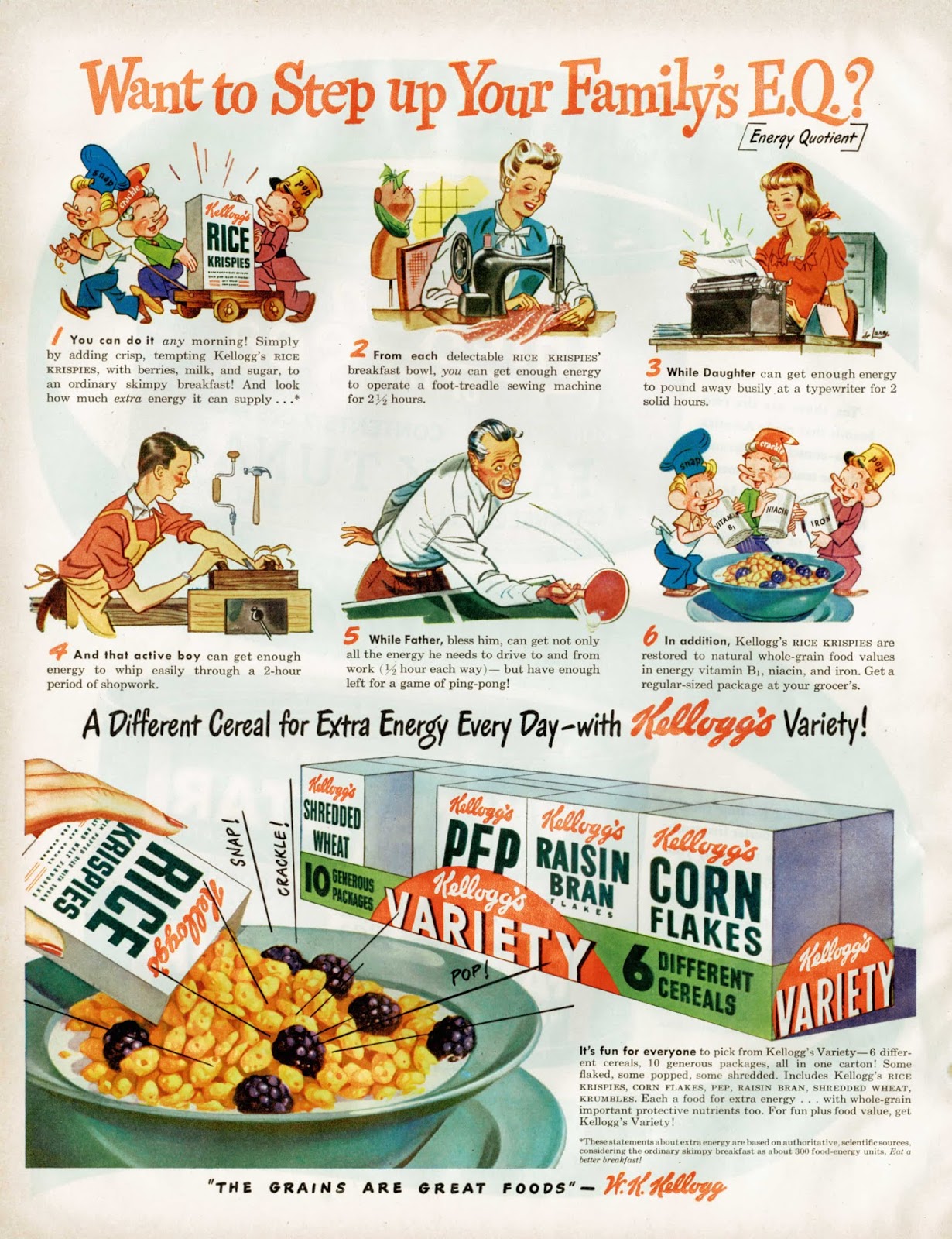
We begin with a postcard from 1958 on which an impressed visitor from South Africa writes home with an account of a visit to the Kellogg’s factory in Battle Creek, Michigan. Unlike many of its competitors, the Kellogg Company has retained its independence and still resides in Battle Creek, where it was founded in 1898. As the postcard illustrates, it has a global presence and there are very few countries where its products are not on sale. It operates in an ultra-competitive market and pioneered the inclusion of free collectable figures and toys in its packages. Offering modest books of pictures and stories for children in return for a nominal sum was another successful strategy in popularising the product with children. Brand characters played their part from Snap! Crackle! and Pop! (Rice Krispies) to Tony the Tiger (Frosties) while established cartoon characters such as Yogi Bear were drafted in on an as-required basis, all to embed themselves in the affections of juvenile consumers. Their efforts were probably more effective on television than they were in print. The logo has been regularly and subtly remodelled but remains recognisable as the signature-based original from 1900. And there’s a Kellogg’s Sans font to support the corporate identity. Movie tie-ins are the staple of today’s promotional activity.


Kellogg’s print advertising is unspectacular but persistent. Sometimes directed exclusively to the junior end of the market – at other times focused on the needs and anxieties of adults. The message to adults is often designed to exploit fears about physical health with a special emphasis on regular bowel movements. Mothers are frequently reminded of their parental responsibilities for child welfare with an implication that a child without Kellogg’s in her diet is a victim of neglect. The use of slogans and taglines is functional but not especially imaginative – few, if any, have passed into popular culture. This survey is concentrated on the period 1930 to 1960 and the only slogan with any staying power seems to be The best to you each morning. Efforts such as The Grains are Great Foods or Mother Knows (Kellogg’s) Best are justly forgotten. The invention of the Variety pack – 5 types of cereal, 10 small servings, all wrapped in cellophane was a masterstroke. Smaller quantities and increased packaging boosted margins while the direct appeal to children made life difficult for parents in the supermarket.




Tuesday, 5 March 2019

Sunny Side of Life


Written as a hymn by prolific Christian song writer, Ada J Blenkhorn, it was made famous by the Carter Family in their 1928 recording, issued on the Victor label as Keep on the Sunny Side. An uplifting sentiment with a strong undertow of foreboding – perfect for the imminent financial crash and subsequent Depression. The phrase sets the tone for this promotional brochure from 1934, published by Kellogg’s in 1934. On the cover a hyperactive family, supercharged by solar energy (and a generous intake of Kellogg’s products), orbit a sundial. Inside, we are quickly introduced to a world of anxiety about constipation – the enemy of happy family life. The man of the household waves his hat as he sets out on the Road to Regularity. Then comes the undertow of foreboding – the passage of food through the body is described and illustrated, leading to a graphic timeline of the alimentary journey. Medication is dismissed in favour of a healthy diet with plenty of “bulk”. Happily there is a natural remedy in the form of Kellogg’s range of breakfast cereals. And so it goes on, and on, revealing a touching faith in the power of the written word. It serves as a reminder that the business we know today, infamous for the quantities of sugar and salt loaded into their cereals, had its origins in the wilder margins of dietary obsessives and the congregation of the Seventh-day Adventist Church.


Thursday, 13 August 2009

Today’s Recipe No. 2


It’s easy to take Shredded Wheat for granted without reflecting on what a bizarre substance it is. Very much a product of 19th. century food technology, it seems to be formed from multiple extrusions of wheat paste filaments stacked up and modelled into pillow shaped structures and baked to a brittle finish.

This small book, The Vital Question, was published by The Cereal Machine Co., Worcester, Mass. in 1899 and contains 148 pages of recipes devised by Mrs. Harriett Higbee, every one of which depends on the inclusion of Shredded Wheat. It comes complete with a passionate testimonial from its inventor, Henry D Perky,

“From the most abject physical wreck I have succeeded, by the use of naturally organized food, in reorganizing my body into perfectly healthy conditions.”

The miraculous powers of Shredded Wheat that achieved this transformation are now available to all in combination with an extraordinary variety of foodstuffs including oysters, goose and woodcock. There exists no meal or dish that cannot be enhanced by the judicious addition of Shredded Wheat. Members of the Tatnuck Farmer’s Club were given the opportunity to discover this for themselves on January 20th. 1899 when they sat down to a dinner of:

Celery Soup with Shredded Wheat Croutons
Fricassée of Chicken on Shredded Wheat Toast
Creamed Spinach on Shredded Wheat Toast
Jellied Apple Sandwich. Cheese with Shredded Wheat Toast.
Wheat Shred Drink. Fruit. Nuts.