Showing posts with label chocolate. Show all posts

Saturday, 2 July 2022

Noisiel Revisited in Postcards

Twelve years ago I visited Noisiel to see the unique Chocolat Menier factory complex designed by Jules Saulnier on the banks of the River Marne, east of Paris.  The factory was in production from 1871 to 1993 and in 1997 was remodelled to serve as the headquarters of Nestlé France. Le Moulin Saulnier is the landmark building - behind the chromatic brilliance of its ceramic cladding lies an interior in which iron box girders and arched roof trusses create uninterrupted floor space for machinery.  Since 2010 I’ve acquired some vintage postcards of Noisiel that can be seen below, what they confirm is how well everything appears to have been conserved. A recent acquisition is this corporate prospectus of the Noisiel factory published by Menier in the 1930s to mark more than a century of progress. On the cover is a familiar school girl figure in use in Menier publicity since 1892, as airbrushed and updated 50 years later for the 1930s. There’s a double page spread of photos illustrating the major buildings and the manufacturing process at the Usine de Noisiel.  Alongside a chance to win a Peugeot 302 “luxe”, more photos can be seen on the back, including views of the internal railway that ran through the premises.  
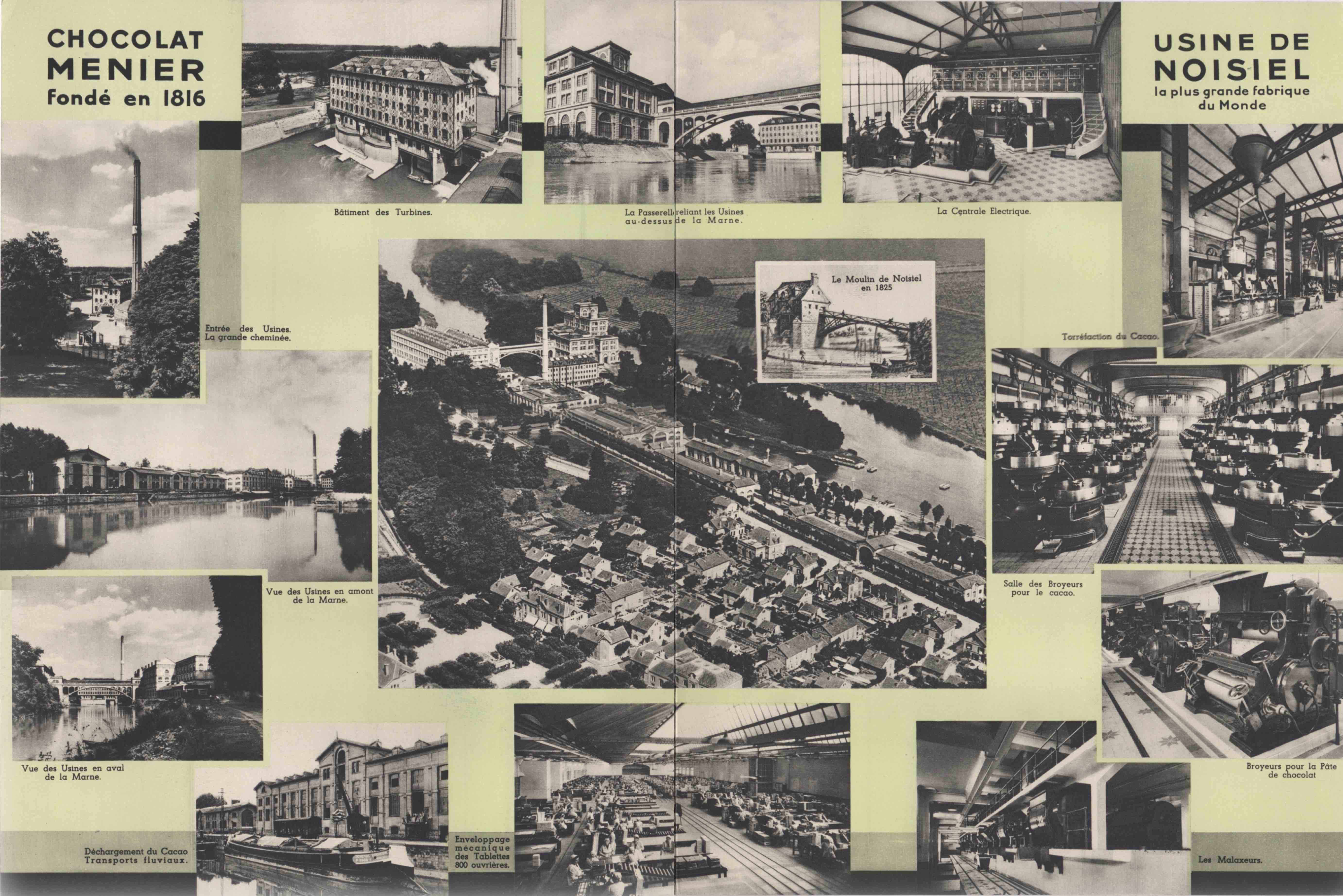
In 2020 Nestlé France moved out of Noisiel to new premises in Issy-les-Moulineaux and disposed of the entire site to a developer, leaving the buildings to face an uncertain future.  Much wrangling is now going on between developers, local authorities and nearby residents - developers want to maximise the residential potential while locals are looking for community and cultural facilities.  The buildings have some protection as National Monuments but many spectacular interiors could be lost whichever way the argument is settled. Some reports say that the developers intend to permit a number of community enterprises to operate within the site on a temporary basis until 2024, the date set for launching the redevelopment.  This is unlikely to offer any public access to the site. More Chocolat Menier posts can be seen here and here.


Wednesday, 2 June 2021

Delectaland and the Havindens

There was a time when every town of a certain size would have its own brewery, lemonade factory, biscuit maker and confectionery producer.  Watford was large enough to have most of these businesses - confectionery was represented by Delectaland.  Judging by its publicity it was a business with its roots firmly planted in Fairyland in the belief that repeated exposure to diaphanous flutterings would develop a growing market for their exotically packaged sugary offerings.  This ad is from 1919, less than 12 months after the end of the Great War during which the factory served the nation by turning out thousands of explosive shells.  Eliminating the flavour of cordite from the Delecta range would have been a formidable task.  The Chairman of the company was Gustavus Havinden, who, inspired by the example of Lord Leverhulme’s paternalistic philanthropy, made plans to build housing and welfare facilities for his workforce.  Details of this scheme are hard to come by and it can be safely assumed that it didn’t amount to much. There are indications online that worker housing was built in Neston Road, North Watford but there’s nothing to confirm it.

Another reason for taking an interest in Mr. Havinden is his son Ashley, born in 1903 who would become one of the most versatile and influential designers in Britain.  The family link also explains why the young Havinden spent 18 months absorbing the technical side of the printing industry while employed in various print works in Watford.  This detailed understanding of the principles of typesetting, layout, photogravure and block making led to his first job at the newly established W S Crawford advertising agency where he would remain for his entire working life.  The lack of an art college background was no deterrent and may have been an advantage in allowing his natural instinct to range far and wide in search of visual ideas while rejecting the narrow categorisations of the ‘trained specialist’.  Crawford gave him the chance to live and work in Germany where he came to appreciate the superior power of German graphic design and illustration under the influence of Modernism and the infant Bauhaus. 

Having swerved the perils of art education where ‘commercial art’ was regarded as a second class activity, Ashley had no inhibitions about exploring any aspect of the visual arts that engaged his interests and he happily tried his hand at textile and rug design, interior design, and abstract painting.  Henry Moore, Ben Nicholson and John Piper were in his friendship group and he developed a keen interest in contemporary architecture to the extent that he moved his family into an apartment at Highpoint II, designed by Lubetkin in 1938.  This placed him at the heart of the North London friends of European Modernism where he continued his tireless promotion of Modernist values, working with European emigrés such as Herbert Bayer, Laszlo Moholy-Nagy, and Walter Gropius and instrumental in organising Mondrian’s stay in London.  All of which was accomplished in a deeply conservative visual culture in which the prevailing advertising setting was dominated by a blend of Merrie England and  Imperial Victoriana with a dash of Regency Dandies plus Francis Drake and Walter Raleigh.

The illustrations are, in descending order: an ad for Delectaland from Colour magazine, 1919 - a self-portrait included as a plate in Ashley Havinden’s Line Drawing for Reproduction (published in 1933) - Ashley’s best known design for Eno’s Fruit Salt from 1927 - a post-war ad for Martini (1953), typical of Ashley’s mid-century phase - an illustrated magazine insert promoting the Delecta range for Christmas 1928 (by which time the business was less than 2 years away from closure in 1930) and the book cover for Line Drawing for Reproduction.  The key text is Ashley Havinden, Advertising & the Artist, Michael Havinden et al, Edinburgh 2003.


Wednesday, 27 June 2018

Cadbury Century


When this commemorative brochure was published in 1931, chocolate manufacturers, Cadbury, had a very different relationship with their consumers than exists today. Successive generations of the Cadbury family had presided over the rapidly expanding business, exercising paternalistic control over an army of employees. As Victorians and Quakers they felt a sense of responsibility for the welfare of their workforce for whom they built homes and leisure facilities whilst encouraging a culture of sobriety and self-improvement. The second century was rather different and the family incrementally lost control and eventually, ownership of the business. Global capital took over and the connections with its Quaker origins evaporated.


Not sure how these prestigious brochures were distributed or whether copies went to members of the public or if they were confined to retailers or wholesalers but no expense was spared in the production values. Full colour illustrations throughout, many of them specially commissioned illustrations, and a textured card cover with embossing. The aim was very much to emphasise the continuity of the business and celebrate past achievements – with the onset of the Great Depression, there was little of substance about future plans. The power of our collective serotonin addiction ensures that the industry remains profitable. Cadbury battled for market share and absorbed several of its competitors to the point where further expansion became dependent on moving into other activities. From 1969 to 2008 it traded as Cadbury Schweppes before falling into the clutches of Mondelez in 2010. For Mondelez, Cadbury is just one of a vast portfolio of brands and as long as its performance targets are met, it will survive. If it loses its grip on the market, Mondelez has plenty of ammunition to fall back on – from its corporate HQ in the suburbs of Chicago it controls Toblerone, Suchard, Côte d’Or and Marabou, as well as Fry’s and Terry’s.


The brochure provides a fascinating review of the evolution of graphic styles in packaging and publicity – confectionery manufacturers competed for public attention with eye-catching wrappers and sustained campaigns across a wide range of media. This was the period when railway stations, football stadiums, public houses and High Street shops displayed an enormous gallery of enamel signs. This was followed by the rise of the poster – in the interwar years purpose built poster sites proliferated in town and city centres and suburbs along bus, tram and train routes. Chocolate makers made full use of these opportunities to get their message across. Some idyllic, fanciful views of the factory premises are included – a little steam engine, smartly turned out in company colours, puffs past with a trainload of company wagons on a perfect summer day. It’s the largest cocoa factory in the world, we are assured. The workers themselves are largely absent save for a picture of some white-coated female employees relaxing in a conspicuously sober and responsible fashion.


Thursday, 20 July 2017

Paris with Chocolat-Menier


A postcard trip around Paris with Chocolat-Menier, France’s best known chocolate brand. There’s a Menier-related feature smuggled into every example of these promotional items. It might be a poster, a delivery vehicle, an illuminated sign or a Morris column. The views are usually conventional tourist hotspots with an occasional diversion to lesser attractions such as the cattle market at La Villette or Place Daumesnil. They are hand-painted in a casual brushy style with a taste for dramatic weather effects and night skies. Over a hundred were issued in the series which expanded to include les Environs de Paris. For a description of a visit to the Usine Menier at Noisiel, please follow this link.