Showing posts with label florida. Show all posts

Tuesday, 18 March 2025

Rails over the Ocean

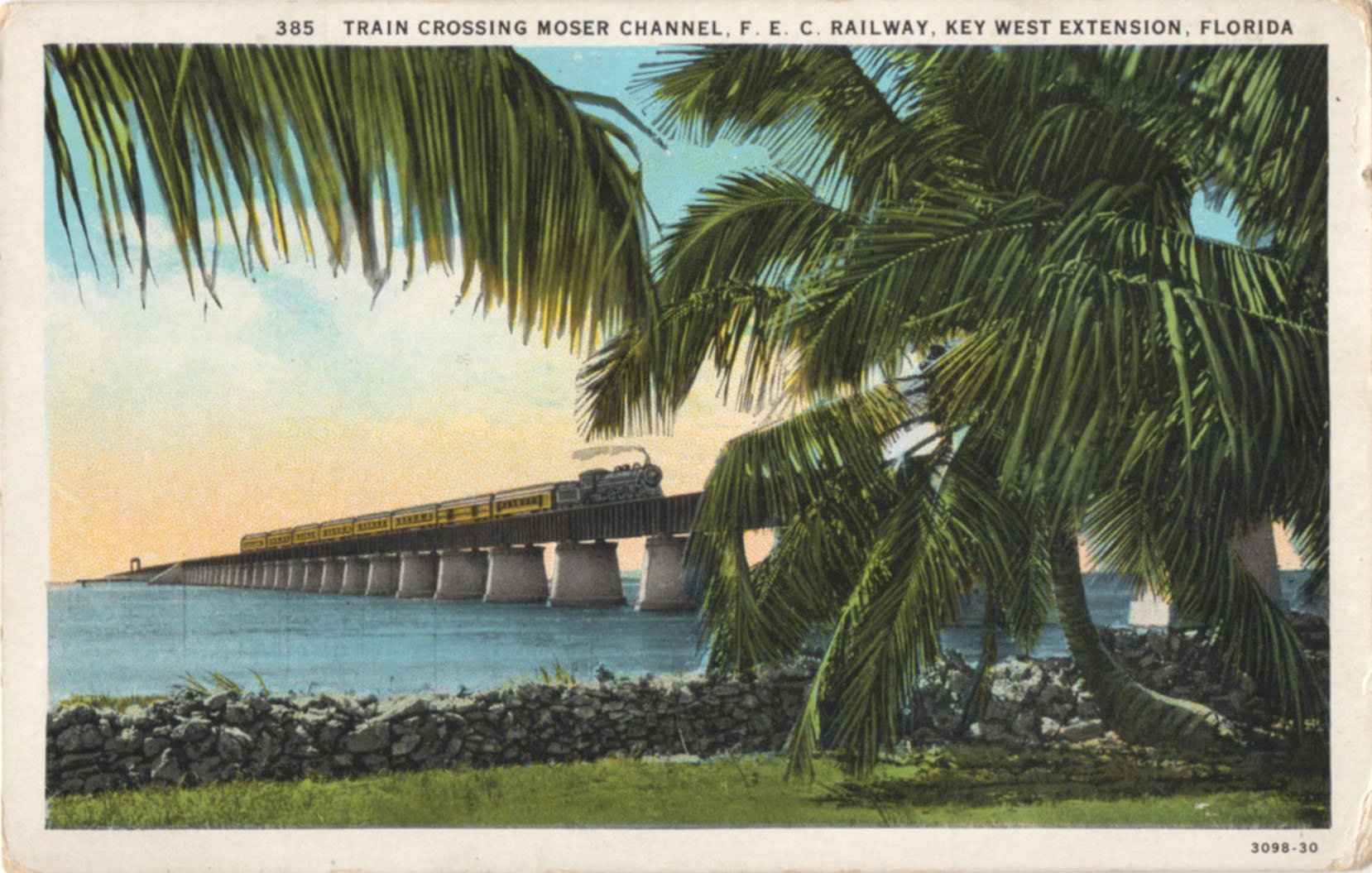
It took 4,000 labourers 7 years to build a 120 mile railroad connecting mainland Florida with the city of Key West. The project was financed by Henry Flagler, fabulously wealthy founder of Standard Oil and cost more than $50 million.  Flagler was a master of manipulating markets and freezing out competitors and until the advent of Anti-Trust legislation, he and Rockefeller were well on the way to establishing undisputed control of the entire American market for oil and gas. On the plus side he was an attentive husband and in middle age accompanied his ailing spouse to Florida in search of a cure in warmer climes. At which point his interest in fossil fuels declined in favour of a new passion for developing resort hotels and transport infrastructure to expand the market for Florida tourism.  The system of “convict leasing” enabled local prisons to supply him with a regular source of (literally) captive labour for his projects.  In a weird parody of the Manifest Destiny, Flagler’s army of contractors relentlessly drove south, clearing wilderness, draining swamps, dredging channels, building roads and luxury hotels on a steady advance via St. Augustine and Palm Beach that ended in Miami.

The connection to Key West was planned to move freight that had travelled via the new Panama Canal northwards to customers across America but the anticipated traffic never materialised. The postcard view above shows a vast but relatively passive crowd gathered at Key West in January 1912 to greet the arrival of the first regular service on the new extension to the Florida East Coast Railway. In the 1920s there was a daily train from New York to Key West timed to connect with a ferry to Havana. Key West to Miami was a 4½ hour trip thanks to a 15 mph limit on all the oversea sections.  Maintenance was a constant drain on resources and the railroad was on the verge of insolvency when fate intervened in the form of the Labor Day Hurricane of 1935 that overwhelmed the railroad beyond repair. In a final indignity, surviving sections of the infrastructure were commandeered to support a new Overseas Highway that survives to the present day. It had lasted for 23 years. Flagler died in 1913, just over a year after the railroad was inaugurated. If Flagler had not declined the honour of renaming Key Biscayne, there would be no city of Miami today - only Flagler and Flagler Beach, Flagler Dolphins, Flagler Vice, Flagler Art Deco …



Tuesday, 23 April 2019

To Key West in Postcards


The Florida town of Key West is at the southernmost point in the continental United States at the end of a chain of small islands linked by a causeway. It is closer to Havana (106 miles) than it is to Miami (127 miles). Other than an association with Ernest Hemingway (who had a home there from 1931-39), its distinction is its location. Visitors to places situated at extremities are frequently moved to send postcards home and the industry was quick to supply them in copious amounts.


There was a time when it was connected to the mainland by rail. The Overseas Railroad to Key West operated from 1912 to 1935 when it was destroyed in the Labor Day Hurricane – forty miles of track was washed away on September 2nd. With no funds to rebuild, it was abandoned by its owner, the Florida East Coast Railway. There being no compelling economic case for the railroad, most of the track-bed was converted to road use and designated US Route 1 – the Overseas Highway.


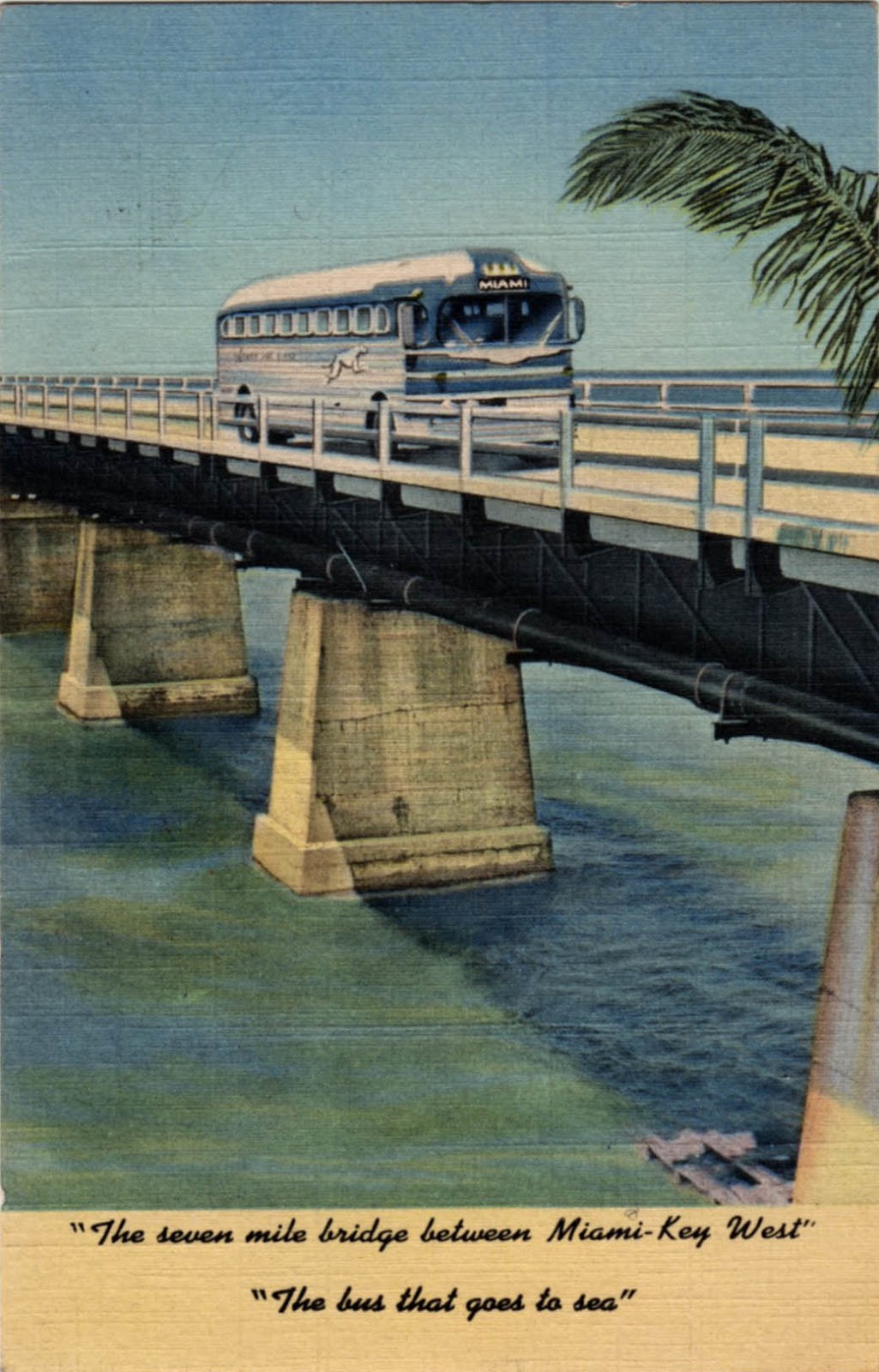
The Overseas Highway made a frequent postcard subject in the inter-war era of the linen card. The endless perspectives, big skies, gaudy sunsets and expanses of tropical blue seas lent themselves to the saturated colour of the linen postcard. For those without a motor vehicle, the Greyhound bus (the bus that goes to sea) was the only way to travel and they too turn up on postcards. One view of Pigeon Quay shows a queue of traffic driving off to sea with no seasickness as the caption has it. Amazingly it includes a pair of nonchalant pedestrians – difficult to believe they’re walking the entire 127 miles.


Tuesday, 13 January 2015

Marineland Oceanarium


Florida – Perpetual State of Wonders - Alligator Farms, Rattlesnake Ranches, Mystery Houses, Ringling Brothers Circus, the Green Benches, Fountain of Youth and the Singing Tower. Marineland opened in 1938 as the world’s first Oceanarium – a visitor attraction featuring sea dwelling mammals. Giant Turtles, Sharks, Whales and Porpoises drew in the tourists and the project borrowed a little literary respectability, having among its founders, Ilya Tolstoy (grandson of the great Leo and pioneer of underwater photography). Linen postcards offer the perfect medium for recording these sub-aquatic theatricals in which a changing cast of sea creatures swim around in the company of clumsy Marineland employees encased in diving suits constructed in an age of heavy engineering. I like these cards for their slow motion compositions and persistent air of absurdity – one or two of them could easily be taken for pieces of Performance Art. Follow this link to see what Florida offers today’s visitor – it’s an impressive range of implausible curiosities from which it’s difficult to select the most compelling but I wouldn’t want to miss the Atheist Monument, the Lowest State High Point in the US and the Garbage Truck Museum. 


Tuesday, 16 December 2014

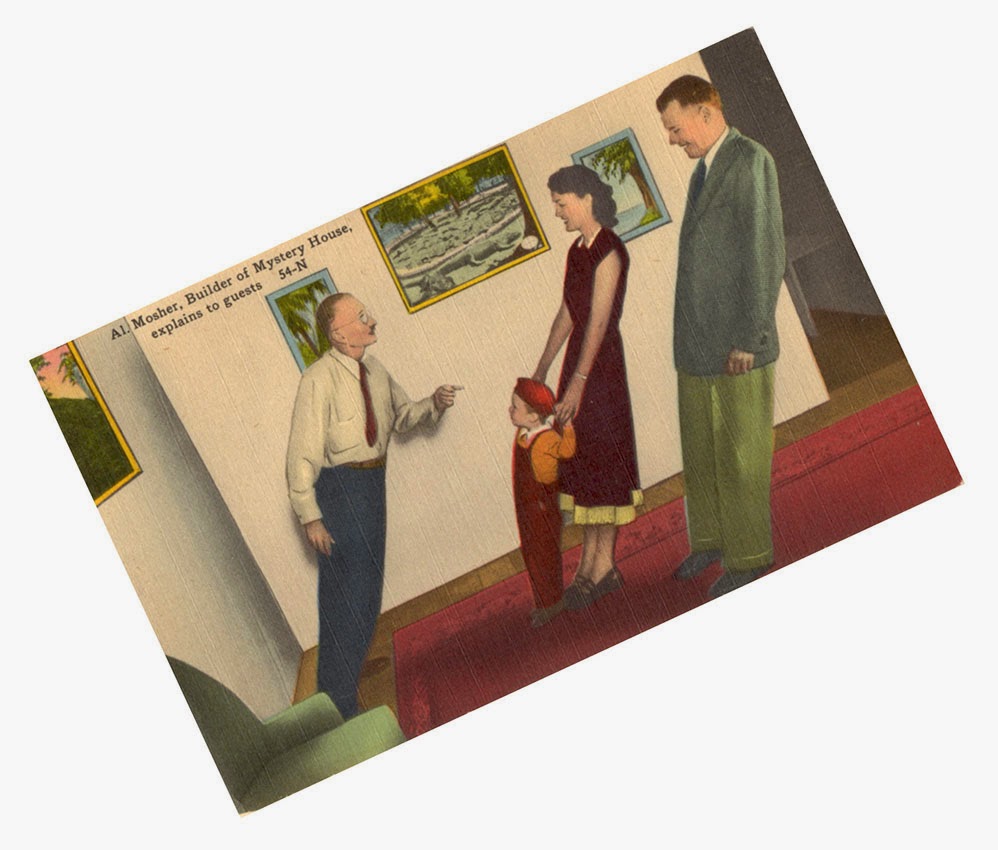
Postcard of the Day No. 71 – Al Mosher’s Mystery House


Eye-witnesses report that it wasn’t unknown for visitors to this unusual Florida attraction to be overcome with disequilibrium-induced nausea and exit the house vomiting copiously, although this wasn’t mentioned in the publicity. As it says on the reverse – cross the Bridge of Lions, just opposite the St. Augustine Alligator Farm on Route A1A – and you’re there. It takes a leap of the imagination to come up with an idea like this and a justly proud Al has the air of a born teacher as he explains his creation to Mr and Mrs Average and Junior. There should be one of these in every town if only for the pleasure of submitting a Planning Application and hearing what Building Regs. have to say about it. With Mr Pickles still in charge of national planning policy and prioritising economic potential, there really should be no obstacles. 


Friday, 30 May 2014

Postcard of the Day No. 67, Tex the Trainer


Meet Tex the Trainer, resplendent in shiny lace-up boots, necktie and suspenders. Tex makes light of his celebrity status as he demonstrates his technique for suppressing the natural instincts of these fearsome carnivores. These reptiles were placed on earth 37 million years ago to add to the sum of human happiness by making themselves available for inspection by paying customers on purpose-built reservations, often called ranches or farms. And when their performing days are over they generously donate their skins to be made up into shoes for pimps or handbags for whores. Repellent, scaly and reptilian, with a formidable reputation for unprovoked savagery – they made ideal material for the producers of postcards. Similar businesses can be found today at ranches or farms across the southern USA although, in tune with the times, they are keen to emphasise the conservation value of their activities. 


Sunday, 23 March 2014

Industrial Grime in the Sunshine State


The British consumer is a compliant creature, always ready to pay up for the latest techno-gadgetry or dutifully embark on long-haul holiday flights to exotic destinations. Florida is one such popular choice - about one million UK citizens visit the state every year of whom two-thirds arrive in Orlando, the theme park capital of the world. For most the purpose of the trip is to haul the family around Walt Disney World, SeaWorld Orlando, Universal Studios Florida, the Orlando Odditorium – Ripley’s Believe It or Not followed by a shopping spree at the Florida Mall and a day at the beach if time permits. The visit will pass in a blur of hyper-consumption and fast food outlets. The rationale is to protect the family from any stigma that might attach to the less advantaged for whom such a trip would be unaffordable. An average visitor will discover nothing about Florida’s social or physical topography unless they have the misfortune to be a victim of crime or to fall foul of the law. 


This would not be my choice but if I was compelled by circumstances (such as a lucky raffle win with no cash alternative) to travel to Florida I would explore the industrial Florida to be seen in these postcards. Other than agribusiness the principal industries are electronics, food processing and chemicals. I’m confident I could quickly locate the least salubrious industrial suburbs and if I can’t be found there I shall be in Polk Street in Tampa observing the mile-long freight trains that nose their way through the traffic in the downtown district, as seen on YouTube. At the end of Polk Street it’s a left turn for the Tampa Museum of Art but I might just go to Clearwater for more of the same. The day’s soundtrack will be Ry Cooder’s Going to Tampa from the Election Special album. 


Thursday, 27 October 2011

Postcard of the Day No. 51, Palm Beach Chariot


Two people have their images forever imprisoned in this postcard, condemned to an eternity of circulation through the broad boulevards of mid-century Palm Beach. On the left is a man whose face bears some resemblance to that of the great Chicago bluesman, Howlin’ Wolf. Impassive and dignified with just a flash of the defiance that was ever present in the voice of Howlin’ Wolf. On the right is a female face that gives away virtually nothing – the eyes squint against the sunlight, the lips slightly parted in an unreadable smile. The story is that when the oilman and railroad tycoon, Henry Flagler, developed Palm Beach as a resort, he autocratically banned the use of horse-drawn or motor vehicles, giving rise to these cycle-mounted wicker chairs that were propelled by employees of the local hotels. In another cultural context this might look like a colourful image of a novel method of transport devised for the entertainment of tourists and as a source of income for the locals. But in the context of the United States in the pre-Civil Rights era it expresses some deeply insensitive attitudes to race and ethnicity. It may be less abhorrent than the postcard genre of demeaning and patronising ‘picaninny’ imagery but it remains a distinctly unsettling picture even after the passage of more than 50 years.