Showing posts with label confectionery. Show all posts

Tuesday, 4 April 2017

Easter – a time for fury


Easter is a season with little in the way of comedy to mark its passing although the confectionery industry has always done its best to trivialise the occasion. The Passion and Resurrection may express an alternation of extreme darkness and light – a place for awe and wonder and redemption, but none for humour. So we should all be grateful to our Prime Minister for supplying some inadvertent light relief with her thoughts on the importance of the word “Easter”. Especially amusing in the context of her declared highest priority – bringing the nation together. For someone with no discernible sense of humour, Mrs. May has made a promising start as an entertainer, if nothing else.


On the very day that many were expressing their anger at the harsh and vindictive cuts in benefits for bereaved families the Mother of the Nation was herself roused to fury by the news that the National Trust has omitted the word “Easter” from what is now to be known, unforgivably, as a mere “Egg Hunt”. Earlier in the day she had rejected criticism of the bereavement benefit cuts, defending it as a ‘fair deal for taxpayers’. Nobody has asked her to provide examples of taxpayer grievance at the level of bereavement benefits. Where were the campaigns calling for lower benefits for the victims of bereavement? Who demanded deliverance from the outrageous financial burden imposed on us all by a selfish minority of our fellow citizens who insist on dying prematurely from incurable diseases? Back to the eggs – Mrs. May felt uniquely qualified to pass judgement on this vitally important issue as the offspring of a vicar and a member of the National Trust. Now is the time to take a stand against the tyranny of political correctness and its endless assault on our national religion. Mrs. May was visiting the Middle East to ‘bang the drum for Britain’ and sell even more consignments of lethal weaponry for the purpose of killing and maiming anyone incurring the displeasure of the purchaser. It would be interesting to hear Mrs. May explain what part of the Church’s Easter Message endorses this traffic in human slaughter.


Friday, 30 January 2015

Neuralgia and Nostalgia


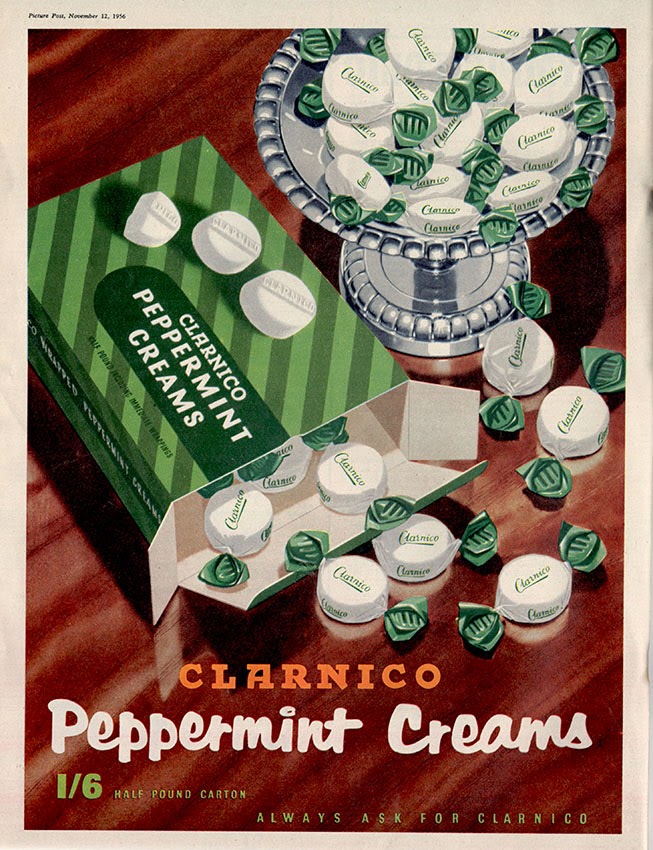
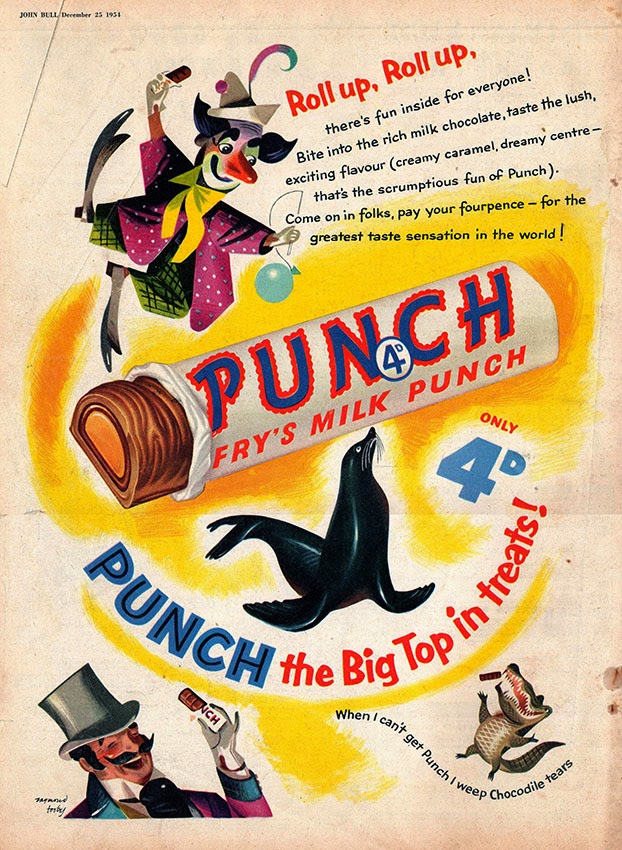
For a warm dose of comforting nostalgia there are few better triggers than childhood recollections of confectionery treats. Online protestations of undying affection for long forgotten sweets and chocolate are easily found. The attendant miseries and insecurities of childhood are erased by the power of pleasures recalled – unwrapping and consuming sugary, candied and chocolate-coated concoctions. For the immediate post-war generation these memories carry extra weight due to the imposition of sweet rationing which lasted until February 1953. The resulting expansion in demand is reflected in these full colour, full page magazine ads as manufacturers fought for market share in a new climate of plenty. An armada of temptation was mobilised to get Britain munching and chomping its way to the top of the international league tables of consumption. The dark clouds of rampant tooth decay and childhood obesity lay just over the horizon. A Conservative opposition fought, and almost won the 1950 general election on the issue of ending rationing while the Labour incumbents campaigned for indefinite retention. This began the process of stigmatising egalitarianism as a joyless and pointless aspiration, a denial of consumer choice and a symbol of the horrors of a planned economy, echoes of which persist to the present day. It was an early example of Labour politicians committing to unpopular policies – another tradition that survives. 


Tuesday, 31 December 2013

T for Toblerone


The distinctive triangular-shaped Toblerone chocolate would be instantly recognised by all but the most resolute of hermits. A unique blend of ultra-sweet milk chocolate and fine gravel (plus honey and nougat) has made it a firm favourite with the nation’s great supermarkets who mark all seasonal holidays by constructing towering piles of the stuff as if in homage to its Alpine origins. Brand-stretchers have devised a bewildering legion of variants from the original jaw-breaking pentahedron format in combination with many unlikely additives and a range of sizes from jumbo to nano. I suspect its popularity rests more on the packaging and typography rather than the pleasure to be obtained from extracting wedges of compacted chocolate slurry from inter-dental cavities. It was launched on the market in 1908 and this selection of fuzzily reproduced posters must come from the early days. The images appear to have been issued on perforated sheets and may have been intended to grace items of mail and bear the good tidings about Tobler products to all points near and far. All production is concentrated in the city of Bern in its Swiss homeland although the ownership of the business is now in the hands of Mondelēz International, formerly known as American food giant, Kraft Foods. 


Sunday, 24 March 2013

Flavor-Town


One of the most prized directives in the corporate witch-doctor’s bag of tricks is the need to identify your mighty enterprise with a small town or rural location. Plant the idea in the public mind that yours is a business just like the reader’s – you struggle along against all the obstacles that government puts in your path making just enough profit to keep going. At the end of the day you are just plain folks, nothing fancy or pretentious to unsettle the customer. The makers of Beech-Nut Gum made the most of their small town origin in the Mohawk Valley town of Canajoharie employing the service of a bucolic Adonis complete with pitchfork to bring the news to the visitor from the city. Just a bunch of local boys who got together to process wholesome smoked country hams and invented the vacuum jar – everything from ketchup to jam, from peanut butter to marmalade went into those jars until chewing gum was added to the product lines. To overcome the problem of pronouncing Canajoharie it was renamed Flavor-Town. 


Now for a Declaration of Bias – I have the undiluted petit-bourgeois aversion to the habit of chewing slabs of synthetically flavoured latex. The mechanical rhythms of the rotating jaw and associated vacuous facial distortions are self-inflicted and everyone has a right to look stupid, but the practice of transferring discarded gum to the clothing and footwear of strangers via the agency of table undersides and public seating is genuinely objectionable. So shed no tears for the demise of Beech-Nut. The company was swallowed up and spat out by a succession of competitors including Life Savers, Squibb, Nabisco, Nestlé, Ralston Purina, Madison Dearborn and the Hero Group. Somewhere in this marathon the gum expired and all that remains today is baby food. In 2011 the very last production facility in Flavor-Town moved elsewhere. 


Tuesday, 18 May 2010

Long Lasting Flavour


These budget-priced sweets could have been designed to inflict maximum damage on young teeth. They have the consistency of vulcanized rubber and demand an inordinate amount of chewing, leaving every crevice and cavity compacted with sugary tarry substance primed to corrode tooth enamel and dissolve dentine. And thus a legend was born – the hapless Limey victims of socialistic medicine, their cakeholes disfigured by ravaged, rotting teeth and cack-handed dentistry. What a contrast with transatlantic orifices where a sublime radiance of dental health illuminates serried ranks of armour-plated turbo teeth and weapons grade incisors, all perfectly formed and equal to the task of reducing mountains of donuts, waffles and pancakes to a viscid emulsion.


Rowntree’s Fruit Gums have been in production since 1893 - one of the few Nestlé products to retain Rowntree branding. The height of their popularity seems to coincide with the post-war era of sweet rationing and they were intensively advertised in magazines of the period to children and adults alike. In a decade when prose frequently dominated images these bright and clear messages with their flat colours and simple imagery were certain to stand out. Unsurprisingly, dental devastation went unremarked, in favour of invocations of a sunnier world of fresh fruit and outdoor pleasures. In the monochrome Age of Austerity this was a very shrewd strategy.


Monday, 26 April 2010

Noisiel Insolite

Only 40 minutes from central Paris on RER A brings us to the small town of Noisiel. The station is positioned at the centre of a new (post-1970) community of apartment blocks and shopping centres. The streets and apartments have been named after notable philosophers and a mischievous municipal bureaucrat has arranged for the Catholic church to be blessed with an address in Allée Jean-Paul Sartre. It’s a 20 minute walk via the Parc de Noisiel to the bank of the River Marne and the assorted buildings of the Usine Menier dedicated to the manufacture of what was once France’s leading brand, Chocolat Menier.

In the 19th. century a channel was diverted from the river to supply the factory with water power and a turbine mill designed by the company architect, Jules Saulnier (1817-1881) was constructed in 1871. It was the first significant building to be supported by a steel box girder construction with an external skin of brick and ceramic infill. Three large turbines were powered by the river and supplied electricity to the entire site. It’s a magnificent building to be treasured for its audacious engineering and the polychrome splendour of the surface treatment. Manufacturing ended in 1993 and in 1997 the Menier site was renovated and converted into office accommodation as the corporate HQ of Nestlé France. The restoration work on the Saulnier building was especially detailed due to its status as a Monument Historique.


Another building of interest is located between the channel and the riverbank. This reinforced concrete structure dates from 1906-1908 and was known as la Cathédrale. The intention was to create a public showcase for the chocolate manufacturing process in the double height internal spaces. The project engineer was Armand Considere. There is a covered bridge to connect the building with its neighbour across the water.


There is no public access to the site and the only way to get a closer look is to join one of the guided tours that are offered every few months. A public footpath follows the perimeter fencing but views across the site have been obscured, deliberately or otherwise, by planting. The photo below of the Saulnier mill from the riverside was taken by my son and guide whose height and agility is greatly superior to mine. The interpretation boards seem a little redundant in the absence of decent sightlines.


The association of chocolate and philanthropy crosses national boundaries and the Menier family built a small community opposite the factory between 1874 and 1911 to house the workforce known as the Citè Menier. Some 300 dwellings were provided together with public buildings. All have survived in good condition and remain occupied.