Showing posts with label magazine illustration. Show all posts

Thursday, 7 November 2024

Leslie Carr on the cover of “Morris Owner”

Images of motoring subjects made up the greater part of Leslie Carr’s output and he had a close relationship with Morris Motors, one of Britain’s most successful volume car manufacturers of the first half of the 20th. century. Morris Owner magazine was launched in 1924 to appeal to existing and prospective customers and in March 1925 Leslie Carr made his first appearance on the front cover.  Many more would follow (as many as 10 in 1926-27) and my selection of 5 is a very small part of his output. Sales were expanding rapidly in the post-war boom as more affordable vehicles attracted the middle class aspiring motorist. The 1920s was the decade of the open air motorist enjoying the freedom of the road in the pre-congestion era. Advertisers were beginning to learn the dark arts of selling dreams and the magazine covers served up a diet of bracing seaside picnics, following the local hunt down empty winding country roads, pitching a tent in deserted beauty spots, bluebell gathering in the woods - all the joys of the new found freedom that car ownership brings.  Carr was a remarkably versatile illustrator with the ability to adapt his style to suit any occasion, always with the support of outstanding drawing skills. A speciality was night scenes where the drama and excitement of contrasting pools of deep velvety darkness and incandescent flashes of artificial light are evoked to perfection. Picture editors recognised this and would routinely assign him to produce a cover for the prestigious Motor Show issues as seen here in 1928 and 1929. If I had to choose one it would be November 1929 where the composition is boldly divided by the angular form of the aircraft wing while the tightly drawn subject matter is confined to the lower third.


Thursday, 11 May 2023

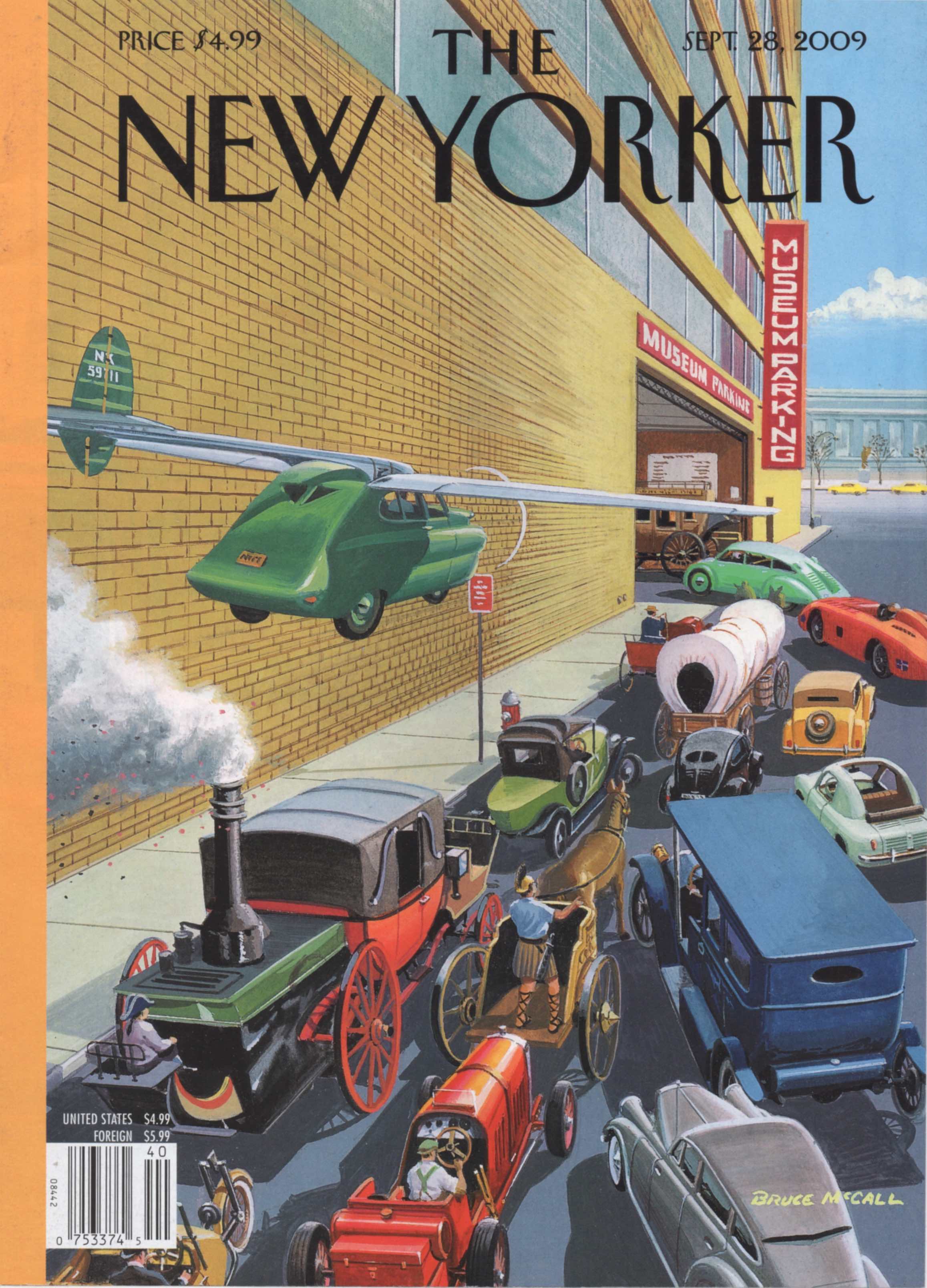
Bruce McCall (1935-2023)

I’ve been a fan of Bruce McCall’s illustrations since I first saw his parodies of Streamline Moderne in the pages of National Lampoon (see above). When he became a regular cover artist at the New Yorker I collected his covers as well as his books (Zany Afternoons, All Meat Looks Like South America).  In the past I’ve read some snide criticism of his work - stylistically conservative, unadventurous and boring, but that ignores the ingenuity and asperity with which he undermined the conceits and social pretensions of self-conscious modernity. His experiments with the visually incongruous could rival those of Magritte, an artist whose work was greatly enhanced by conservative techniques of representation. By the time of his death he had drawn 83 New Yorker covers (almost 18 months worth) and though he kept returning to the same themes (human vanity, bears, ocean liners, aviation, motor vehicles, advertising) he always found something fresh to say in his familiar deadpan fashion. With decades of experience toiling in the advertising industry he knew whereof he spake. He died last Friday at the age of 87, by way of tribute this is a selection of my favourites of his streetscene covers for the New Yorker taken from my scrapbooks.


 Plus two examples kindly provided by Robin Benson.


Monday, 10 May 2021

Mid-century Romance and Misadventure

Bernard D’Andrea, Saturday Evening Post, November 1957.

Romantic fiction was a staple offer in the pages of Saturday Evening Post and a legion of highly proficient illustrators were on hand to give visual form to tragic and comic stories of love and betrayal. Some of the visual interpretations reveal a psychological complexity in a single image, every bit as effectively as a narrative spread over 8 or 10 pages of text.  These illustrators were masters of gesture and expression, expert in capturing minute variations in body language to convey emotional subtleties.  This was an age in which prosperity and anxiety seemed to advance in step - the Cold War undermined the sense of national security along with a growing unease that over-consumption and the breakdown in community values as millions moved to the suburbs was corroding the American soul.  The fear of crime couldn’t be washed away by alcohol and barbiturates.  Communism was an ever present, if ill-defined threat to the American way of life and efforts to eradicate its influence fed the climate of political paranoia.  Casual violence toward women and children was broadly condoned while adultery and coercive sex were only condemned if they came to public attention.  Maintaining an appearance of moral rectitude was imperative - any fall from grace would be ruthlessly punished by community pressure as much as legal proceedings. Women were often unwelcome and underpaid in the workplace and protection from harassment and exploitation was minimal. All these threads could be found in popular fiction and may explain why so many of these images contain unsettling and ambiguous gestures, glances and facial tensions. Carefree relationships and romantic bliss are in short supply.  Surrender to passion is more common, perhaps because it paves the way to the high drama of disillusion, treachery, desertion and cruelty.  This selection of images are mostly from Saturday Evening Post - artists are identified and dates of publication supplied where known.  Some examples are better than others. The subjects all include a couple - among them are several examples of what illustrators referred to as “the clinch” plus a few from other fiction genres such as crime and adventure.


Unknown illustrator, Saturday Evening Post.

Alex Ross in Ladies Home Journal, December 1948.


Saturday Evening Post, illustrator and date unknown.


Joe Bowler, Saturday Evening Post, date unknown.


An expedition to a lingerie store illustrated by Joe De Mers for Saturday Evening Post.


Jon Whitcomb for the readers of Ladies Home Journal, July 1948.


Coby Whitmore for Saturday Evening Post, date unknown.


Saturday Evening Post, date unknown.


A frantic couple under siege - illustrated by Bernard D’Andrea, Saturday Evening Post, "The Hounds Of Youth" (1961).


Thornton Utz illustration for Saturday Evening Post.


Saturday Evening Post, illustrated by Edwin Georgi (1896-1964).


Saturday Evening Post, illustrator and date unknown.


James Bingham, Saturday Evening Post, December 1955.


Alex Ross in Ladies Home Journal, October 1948. 


Saturday Evening Post, illustrator and date unknown.


Coby Whitmore for Saturday Evening Post, date unknown.


Peter Stevens (1920-2001) for Saturday Evening Post, September 29, 1956.


Steamy mid-century romance illustrated by Jon Whitcomb for Ladies Home Journal, September 1948.


Coby Whitmore for Saturday Evening Post, 1953.


Saturday Evening Post, illustrator and date unknown.


Lionel Gilbert (1912-2005) for Collier’s Magazine, January 1952. 


Saturday Evening Post, illustrator and date unknown.


Peter Stevens (1920-2001) for Saturday Evening Post, date unknown.


Saturday Evening Post, illustrator and date unknown.


Tuesday, 2 January 2018

Mid-century American Illustration – a selection of double pages


To start 2018 we present some double page spreads from US magazines, mostly Saturday Evening Post with a few from Ladies Home Journal. In some we see the illustrator doing no more than take advantage of a broader space to add impact but in the best the illustrator has found fresh and innovative ways to integrate image and text to dynamic effect. The very best are those where the artist has exploited facial close-ups, dramatic lighting and tonal modelling to spring the image off the page and into our eyes – Jon Whitcomb and Alex Ross being masters of this technique. Artists include George Hughes, Melbourne Brindle, Robert Patterson, Halleck Finley, Peter Stevens and Walter Baumhofer. Baumhofer’s contribution (This time it’s Goodbye) artfully frames the text extract while maintaining a powerful spatial tension between the foreground figure and the distant couple she observes from behind the curtain.