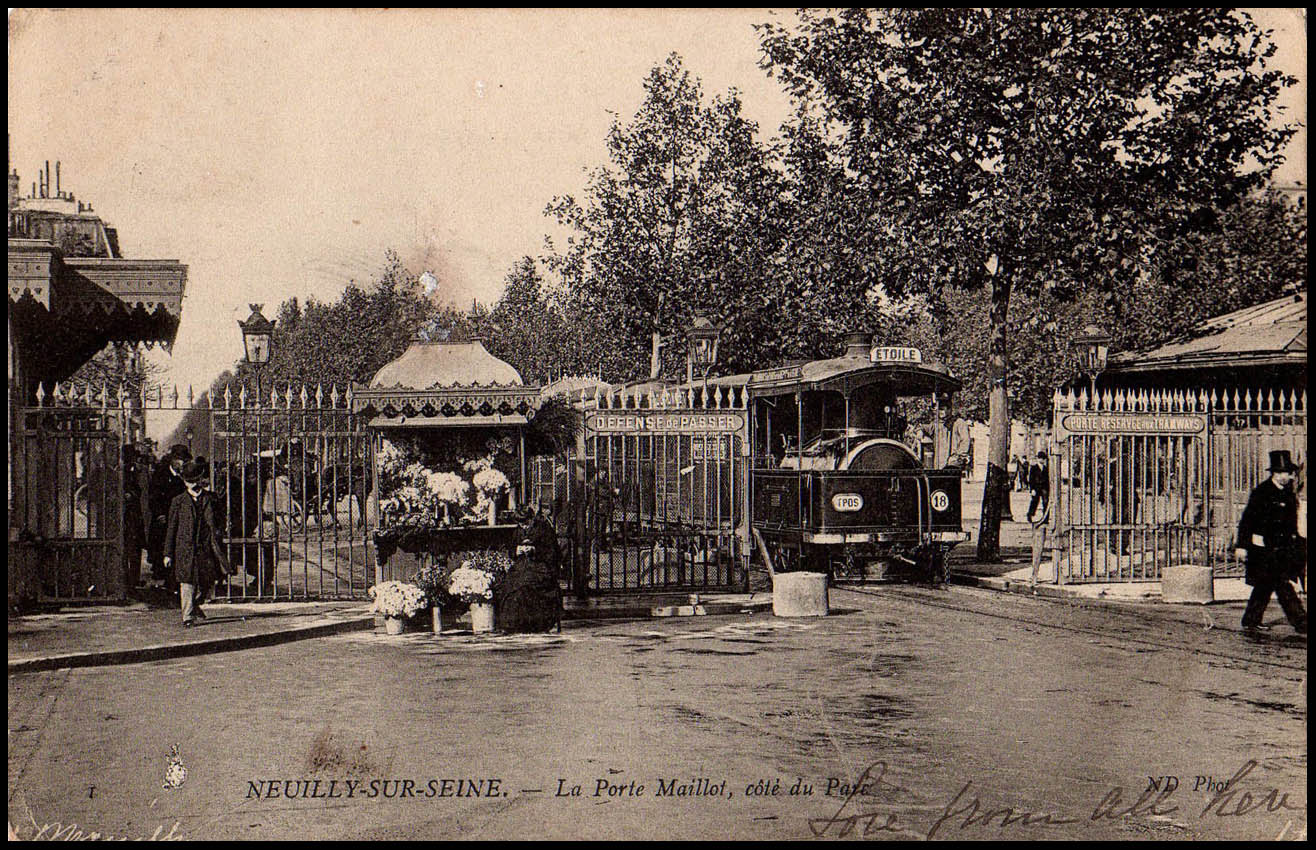
Paris had its very own Luna Park with a wide range of bizarre attractions for more than twenty years until its demise in 1931. It was to be found at Porte Maillot on the voie triomphale between l’Étoile and the Pont de Neuilly. In Raymond Queneau’s novel, Loin de Reuil (1944) the hero exits the Métro at Porte Maillot and bumps into an ex-girlfriend outside Luna Park before dashing off to catch a tram to Reuil. Queneau’s fiction is often deliberately vague about timing and this suggests that Loin de Reuil was set in an era more than a decade before it appeared in print. The card below shows a steam tram at Porte Maillot of the type that might have transported Queneau’s character to Reuil. Porte Maillot today would be an unrewarding destination for anyone in search of distraction. Angry streams of vehicles scream up the exit ramps from the Périphérique and do mortal combat with the traffic on the voie triomphale in the shadow of the massive and depressing Palais des Congrès and a towering hotel behind it.
Two postcards that feature communities divided by state lines. Above is a classic main street view with a difference. In the city of Bristol the line between Virginia and Tennessee runs down the middle of the main shopping street creating two Bristols that coexist side by side in their separate domains. A symbolic elevated sign spans the street in the distance and celebrates the anomaly. It was on this very street in 1927 that Ralph Peer rented rooms and made pioneering recordings featuring little known Appalachian performers (including the Carter Family and Jimmie Rodgers) that would catapult country music into the commercial mainstream. A 5 disc box set of the entire Bristol Sessions will be available soon in a luxurious Bear Family package at a very serious price. Texarkana (below) is likewise divided into twin cities but if you want to stay in Texas, you’ll have to take your chances at the Hotel Grim. R.E.M. recorded a song titled Texarkana on their 1991 album, Out of Time – any connection between the lyrics and the city of the same name remains a mystery. In the imagination of science-fiction writer, Walter M Miller, Texarkana was elevated in status to one of the two most important centres of population on planet Earth in the third millennium – sadly, in a blow to local pride, Miller later arranged for the city to be obliterated in a fictional nuclear attack (A Canticle for Leibowitz, 1960).
Today’s postcard exploration of lines drawn on maps looks at the United States and its neighbours to north and south. The first postcard is a view from the Mexican side in the era of Prohibition and has been helpfully annotated by the sender to indicate the availability of alcohol. In 1940s film noir, the Mexican border was the first destination of many an anti-hero looking to keep one step ahead of the law. An image of a fugitive Robert Mitchum springs to mind, hat tipped down over his eyes, hands gripping the steering wheel, scattering flocks of sheep on the dirt roads leading south to yet another seedy hotel room and a femme fatale with an exotic Latin flavour. Two further cards show border crossings between El Paso, Texas and Juarez as they appeared in less contentious times, decades before Juarez would acquire the infamy that inspired Roberto Bolaño’s fictional re-creation in the dark and dreadful pages of 2666.
The last card is a masterpiece of vagueness and anonymity. The US – Canada border runs for 5525 miles making it the longest in the world. There are 122 controlled border crossings of which this card shows just one. The image is an epic of passivity and given the generic and featureless quality of both landscape and buildings there seems little possibility of identification. In the universe of linen postcards where reality is never less than two steps removed, it all makes perfect sense.
Eric Rohmer’s films sharply divide critical opinion. Those with a taste for leisurely exposition, extended dialogues and philosophical complexity find much to commend. Others find them to be without equal when it comes to pretentious tedium. I can see both sides of this but the visual quality is the one I most appreciate - the sense of place and the curious intensity of observation in the way the camera is directed to record and scrutinise the surface of reality.
When filming La femme de l’aviateur in 1982, Rohmer selected the Parc des Buttes-Chaumont as the scene for the central encounter between the naive and emotionally confused twenty-something François and the precociously self-assured, articulate and animated fifteen year-old Lucie. François follows the aviator (with whom he suspects his girlfriend is deceiving him) and his female companion from Gare de l’Est to rue La Fayette where the three of them board an eastbound 26 bus. Unnoticed by François, Lucie also got on the bus and in order to keep the aviator under observation he moves to a seat opposite her. All four leave the bus at the Botzaris entrance to the park where Lucie and François collide with one another and strike up a conversation. What follows is a comedy of errors in which François, desperate not to disclose the secret object of his pursuit, tells his new companion an elaborate sequence of contradictory untruths.
The orbital meandering pathways in the park mirror the convoluted dialogue that results from François’s obfuscations. As his subterfuges unravel under Lucie’s spirited cross-examination she becomes his accomplice and takes the lead after they exit the park on to the rue Armand-Carrel and follow their target to the nearby office of a lawyer. Lucie weaves a web of deceit that in terms of invention easily surpasses the modest efforts of François. They sit at a café table in an attempt to maintain observation on their target where Lucie continues to baffle and befuddle the increasingly exhausted François to the point where he simply falls asleep. The film concludes with an interminable exchange between François and his neurotic girlfriend, Anne, that feels like the very worst of Rohmer and comes as a serious disappointment.
Rohmer’s fascination with Buttes-Chaumont began in 1964 when he made a short film of 13 minutes, Nadja à Paris in which the camera of Nestor Almendros follows a young overseas student across Paris as she exchanges the superficial pretensions of Saint-Germain des Près for the dependable working-class values of Belleville and the peace of the Parc des Buttes-Chaumont. The brief scene in the park is soon after the start of the second section of the film. There’s a melancholy epilogue of tragedy and unfulfilled promise to La femme de l’aviateur. Of the two young actors at the centre of the drama, Philippe Marlaud (François) would be killed in a campsite fire less than 6 months after the premiere and Anne-Laure Meury (Lucie) would go on to appear in no more than handful of movies (including another for Rohmer) before virtually disappearing from view in 1989.
Finally, my thanks go to Chris Mullen who brought this to my attention.
Despite the genteel air of the haute bourgeoisie that hovers over the sunlit lawns, the dark shadow of hidden history falls across the Parc Monceau, one of many Parisian open spaces drenched in the blood of slaughtered Communards when the dream of a workers’ republic disintegrated in la semaine sanglante in late May 1871. For Claude Monet it was a short walk north along boulevard Malesherbes from Gare Saint-Lazare in search of a new subject. Monet would paint about 5 canvases in Parc Monceau between 1876 and 1878 at a time when he was relocating from the suburban tranquility of Argenteuil to the Quartier de l’Europe. The verdant acres of Monceau made a pastoral counterpoint to the smoke and steam that preoccupied the artist at nearby Gare Saint-Lazare.
The main entrance to Parc Monceau is on boulevard Courcelles and notable for the classical rotunda designed by Claude Nicolas Ledoux (1736-1806). Originally built around 1785 as the Rotonde de Chartres for the collection of taxes, it formed part of the infamous and much resented Wall of the Farmers-General constructed between 1784 and 1791. The Wall was the brainchild of Louis XIV and encircled Paris to enable taxes to be collected on goods and produce as they entered the city. Prior to the Revolution the park had been the plaything of Philippe d’Orleans (Duc de Chartres) for whom it was constructed in an informal English-style complete with a Masonic pyramid and ruined Corinthian pillars.
In the aftermath of the Revolution the park passed into public ownership in 1793 but was only incorporated into the City of Paris in 1860 at the instigation of Haussmann. Half of the park was sold off for redevelopment and the remainder was remodelled by Jean-Charles Alphand (1817-91) in 1860-61 before opening to the public. The surrounding streets have a quiet aura of privilege and there remains a touch of grace and favour – six private residences bordering on the park retain their own access.
For all this the park is a fascinating place to explore with its gilded gates, sculptures of Chopin, de Musset, Gounod and de Maupassant, and Corinthian colonnade artfully distressed and reflected in the waters of the Naumachie pool. This item began with an episode of political violence and concludes with an episode of cinematic violence. The climactic rendezvous in the 2006 French film, Ne le dis à personne (Tell no one) was filmed in Parc Monceau in accordance with the Hitchcock doctrine that nothing increases dramatic tension as much as an unremarkable and unthreatening setting. The camera pans back and forth across a scene of unexceptional normality as the hapless hero prepares to meet the wife he has believed to be dead for ten years. The film clip happily ends before the violence turns truly nasty.
It was a long walk up boulevard Raspail from Montparnasse in search of this rather anonymous street corner. With few landmarks to go by, it was located more by good fortune than skill. The balconies and cornices confirm where we are – the intersection with rue de Grenelle. The shop premises of D Coute have been replaced by a Renault boutique car showroom and over the years the street level building has been homogenised by the elimination of architectural details. Several trees appear to have survived since the card was posted in 1926.
This postcard view has been taken from the southern heights of the Parc des Buttes-Chaumont. Today these slopes are densely wooded and this view is unobtainable. The railway is the Petite Ceinture, the long defunct Parisian orbital railway that runs through the eastern flank of the park enabling us to unite two obsessions in a single posting. The photographer is standing on top of the Tunnel de Belleville from which the tracks run north and leave the park at the point where the road bridge carrying the rue de Crimée travels overhead. The eastern boundary fence in the park has been breached and offers one of the easiest access points on to the trackbed of the Petite Ceinture. This writer is routinely mocked by friends and family for an aversion to any activity that might be construed, however remotely, as unauthorised so this was a major step in more ways than one. Which is how these photographs came to be taken.
La promenade est interdite sur la Petite Ceinture, comme pour toute voie ferrée appartenant au réseau national. L’alinéa 5 de l’article 73 du décret n° 730 du 22 mars 1942, modifié par le décret n° 69-601 du 10 juin 1969, portant règlement d’administration publique sur la police la sûreté et l’exploitation des voies ferrées d’intérêt général et d’intérêt local (J.O du 23 août 1942) stipule qu’ "il est défendu à toute personne de pénétrer, circuler ou stationner, sans autorisation régulière, dans les parties de la voie ferrée, ou de ses dépendances qui ne sont pas affectées à la circulation publique, d’y introduire des animaux ou d’y laisser introduire ceux dont elle est responsable, d’y faire circuler ou stationner aucun véhicule étranger au service, d’y jeter ou déposer des matériaux ou objets quelconques, d’entrer dans l’enceinte du chemin de fer ou d’en sortir par d’autres issues que celles affectées à cet usage.
Down on the hallowed ground of the Petite Ceinture, having transgressed line 5 of article 73 of decree 730 of March 22nd 1942, modified by decree 69-601 of June 10th 1969, it all looks very well cared for. The ballast has been renewed and is free of weeds while the tracks themselves show little evidence of rust formation. The railway emerges from the tunnel to the south into a cutting, the west side of which is buttressed by a brick built wall with alcoves adapted by rough sleepers using outsize plastic groundsheets to provide shelter and privacy. To the north where the tracks run underneath rue de Crimée, a branch that formerly served the abattoirs at La Villette diverges to the right. Some hardcore urban explorers were already present at the mouth of the tunnel engaged on a project of their own. Ignoring them in time-honoured fashion I walked north for a few hundred yards taking photographs before a deep seated fear of authority warned me the time to retreat was at hand.