Friday, 20 January 2012

Hotel Excelsior, Berlin


This is a follow-up to a post from last March on the subject of the Anhalter Bahnhof and the Hotel Excelsior, Berlin bei Nacht. Europe’s largest station and Europe’s largest hotel were connected by a pedestrian tunnel that ran underneath Askanischer Platz. Today we have some artist’s impressions of the underground connection found in a publicity brochure from the Hotel Excelsior. The tunnel opened in 1929 and sealed the Excelsior’s reputation as the most modern hotel in Berlin. The convenience of a seamless transition from train to hotel transformed the fortunes of what had been an ailing facility. The illustrations present an exciting subterranean world in which the great and the good could insulate themselves from the great unwashed, untroubled by the need to queue for a ticket having made use of the rail ticket desk in the hotel foyer. The end came in April 1945 when Allied bombs destroyed the Excelsior – it never re-opened and was finally demolished in 1954. The fate of the tunnel is unknown – perhaps it remains intact, awaiting rediscovery at some point in the future.


Tuesday, 17 January 2012

Van Gogh the Salesman


Separating the work of Van Gogh from the acres of verbiage devoted to the tragic legend of unappreciated genius is no easy task. Critics, journalists and film-makers have created a romanticised and mostly invented picture of a solitary artist mentally wrestling with demons through which all Van Gogh’s drawings and paintings are filtered. This crude characterisation leaves little room for consideration of Van Gogh’s many artistic subtleties and exposes the work to popular exploitation. Advertisers have noted that Van Gogh has just about the highest level of public recognition of any artist with two key facts, the saga of the missing ear and the suicide in the fields. This trio of examples is not especially tasteless despite an attempt to comment on the artist’s self-inflicted lack of stereo hearing. Gentle parody is as far as it goes but equally, none are especially inventive in their use of the artist’s image. There’s a school of thought that any use of Fine Art imagery in advertising is a desecration but that seems excessively narrow minded given the free use that artists have made of advertising imagery over the past half-century.


Monday, 9 January 2012

Modern Wonderland with L Ashwell Wood


Today we revisit the pages of Modern Wonder magazine in 1938-39 and focus on the work of Leslie Ashwell Wood. The editors of Modern Wonder had a team of highly skilled illustrators at their disposal but nobody brought such a stunning exactitude to the cutaway drawing as the man who signed himself L Ashwell Wood. The brilliance of his graphic eviscerations made him the first choice as cover artist in 1938-39 as this selection shows. When he delved beneath the surface of everyday reality, as in the petrol station drawing the results were every bit as fascinating as his responses to the great engineering wonders of the age. A sure and certain indicator of a mid-century middle class childhood was a subscription to the high-minded Eagle comic. This was the respectable face of comics but one of its greatest features was the weekly cutaway drawing from L Ashwell Wood that formed a double spread across the centre pages. Like many of my peers I was absorbed in these infinitely detailed images while elsewhere in the town others of my contemporaries sharpened their invective skills via the scurrilous humour to be found in the pages of The Topper, Beezer, Dandy or Beano. Many of the Eagle drawings have been anthologised and republished in recent decades but the Modern Wonder drawings, the very best he ever produced, remain unpublished as yet.


Tuesday, 3 January 2012

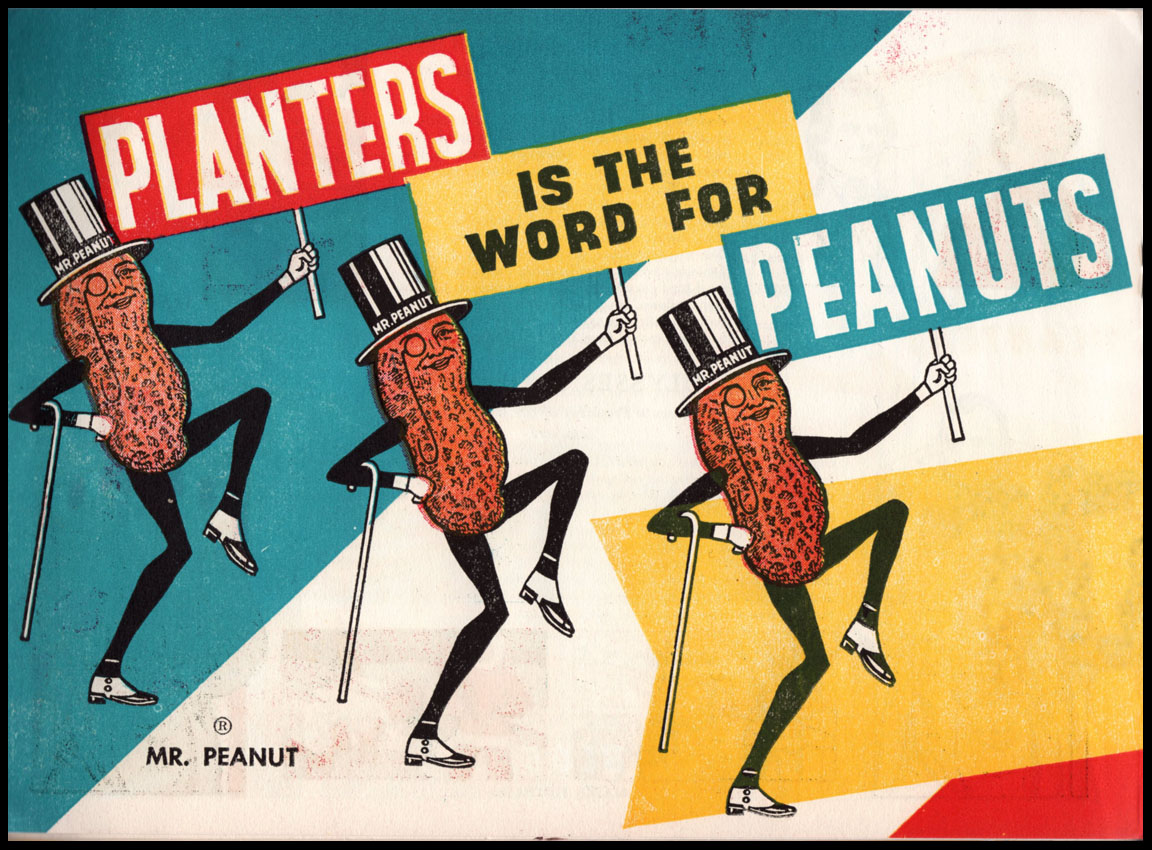
Mr. Peanut in Postcards


Mr. Peanut took the fight for market share to the very heart of New York City with a dedicated store and gigantic neon sign on Broadway near Times Square. A twenty-foot likeness in neon lights greatly enhanced his powers of persuasion with the sophisticates of Manhattan’s theater district. He even caught the eye of quintessentially Parisian photographer, Brassaï, on a visit to New York in 1957. The consumer on vacation was not forgotten and easy access was offered to the delights of Mr. Peanut’s portfolio of products in another Planters emporium in Atlantic City. A conscientious brand-character never rests and Mr. P conducted himself with exemplary dignity and decorum in all his assignments as product ambassador. With his cheery disposition and raffish air he won a special place in the affections of the American public that seems to endure to the present. He has yet to become the subject of a Broadway musical or have his spindly form carved into the slopes of Mount Rushmore but it may be only a matter of time. For now, follow his progress in the upcoming Republican Primaries – he has the makings of a fine President.


Wednesday, 28 December 2011

Mr Peanut presents........ Dead Presidents


The young American in 1953 with a thirst for knowledge, after consuming fifteen peanut-related products from Planters, could exchange the fifteen outer wrappers for this scholarly collection of words and images, free of charge. Each president is honoured with a portrait, a brief biography and an illustration to record the most dramatic feature of their term in office. This is usually a foreign war or the acquisition of more territory – in the case of Truman, it’s a nuclear explosion, in the case of Eisenhower, it’s a forest of placards proclaiming their undying affection for the dear leader. Some of the less distinguished occupants of the White House need no more than half a page to record their achievements – it’s comforting to note that Harding and Coolidge come into this category.


Mr Peanut, the noble impresario of all things peanut has preached the gospel of healthy and nutritious snacking since 1916 when the foppish accessories of monocle, top hat and cane were first attached to his peanut incarnation. With this publication he steps up to the task of improving young minds without entirely giving up on influencing their choice of snack in favour of his patron, Planters Nut and Chocolate Company.


Saturday, 24 December 2011

Christmas 1941


Seventy years ago Christmas was a grim wartime affair occurring just 3 weeks after the attack on Pearl Harbor. The comforting, sugary pleasures of Bird’s Custard were in short supply and the three birds are marching off to war with a jaunty but resolute air, wearing their service caps with pride. The three birds were first conscripted by Bird’s Custard in 1929 and in times of peace were tireless in serenading the product as shown below. To this day their chubby well-fed likenesses can be seen, gracing the pack in any supermarket – the McKnight Kauffer-like angularity of their early years has long since departed.

Thursday, 22 December 2011

Johnny-one-note


Today’s seasonal offering comes from the Wurlitzer Company, the only manufacturer of jukeboxes to advertise directly to the American public in mass-circulation magazines. Someone had the bright idea of employing the services of illustrator, Albert Dorne, the poet of the Frigidaire. Dorne transformed the jukebox into the high altar of the American Dream at the centre of a manic throng in advanced stages of rapture. Joy was unconfined yet all was clean and wholesome, although out in the real America, the jukebox was rapidly acquiring a darker reputation as an emblem of the emerging counter-culture in the form of the Beat Generation. The model featured here was the 1015 and by virtue of its styling excellence and ubiquity it would become the most fondly remembered of all jukeboxes. Robin Benson has posted a fine selection of Dorne’s Wurlitzer ads on his blog, Past Print. As for Johnny-one-note, he enjoyed a long life as the Wurlitzer brand character, promising musical excitement and sociability to the post-war pleasure-seeker.