Showing posts with label new york. Show all posts

Tuesday, 27 January 2026

Fire over America


It’s a dangerous occupation so firefighters are heroes everywhere (other than those who start their own fires) and nowhere more so than in the US.  Serving as the guardians of their community and emblems of selfless devotion to duty, they pose on these postcards inside their vehicles or standing to attention outside their fire stations. The men of the Salvage Corps in Newark exhibit an air of grim resolve as they prepare for their next assignment.  Edward Croker was appointed Chief Fire Officer for the city of New York in 1899 at the age of only 35. He led by example and attended every major fire in the city, often first on the scene thanks to his automobile outrunning the teams of horses that carried his comrades. After leaving the Fire Department he became an advocate and promoter of fire prevention.


Equipped with water pumps and access beneath the hull to an unlimited water supply, construction of special purpose Fire Boats began in the early 1900s. Equally effective at extinguishing waterfront fires as those onboard ship. In Seattle the Duwamish went into service in 1909 - after retirement in 1985 the vessel was preserved as a National Monument. Opportunistic postcard businesses appear to have used the same images, with extensive but clumsy retouching on the pairs of cards from New York. Postcards of burning buildings in San Francisco and Chicago (where extreme cold is freezing the water jets on contact) follow. The final item is a memorial in Hoboken where the local community honours the fire crew who perished in the line of duty.


Friday, 16 December 2022

New York City Landmarks No. 4 - USS Recruit

This was a New York landmark that came and went within the space of 30 months but in its brief existence it made a major statement. Constructed from timber by the US Navy, it was a full size replica of a Dreadnought Battleship located in Union Square on the boundary between Lower and Midtown Manhattan.  Commissioned into the Navy in September 1917 with a captain and 30 crew members its function was to serve as a central recruiting station for the entire city. On board was crew accommodation, officers’ quarters and a suite of offices.  Fully armed with a complement of wooden replica guns, the ship stood ready to bombard the neighbouring real estate.  Visitors were dwarfed by its great mass but turned up in great numbers, attracted by an ever changing programme of patriotic and social events, including concerts and dances.  Over the next 2 years, more than 25,000 volunteers were recruited for service in the Great War.  When the end finally arrived in March 1920, the ship was dismantled with the intention of moving it to Coney Island - a plan that was abandoned when it was calculated that the cost of reassembly greatly exceeded the value of the salvaged materials.

The postcard view includes two prominent buildings that are now landmarks in their own right - in the centre is the Germania Life Insurance building (now a hotel) and to the left, the Everett Building of 1908. The headquarters of the US Communist Party was elsewhere in the square and it was a popular place for organised labour demonstrations.  Frank Dobias wrote a few helpful facts on the reverse and posted it (presumably inside an envelope) to an address in New Zealand, suggesting that it might have been an example of postcard exchange, a popular pastime in the early decades of the last century. This was a part of the general mania for postcards (that died away after the Great War) and involved collectors making contact with total strangers in far off countries in the hope that their collections could be mutually enhanced by swapping examples from their respective home towns. Something like it still happens, even into the digital age.  The post concludes with postcard images of real battleships and an overview of Union Square without a wooden ship.


Wednesday, 12 October 2022

Steel Globe Tower, Coney Island

Property development is an occupation that attracts more than its fair share of swindlers and confidence tricksters.  A favoured strategy is to conceive a super-scaled and outrageously ambitious building to dazzle the unwary investor with its novelty value and the prospect of a share in stupendous profits.  In May 1906 in New York, Samuel Friede announced his scheme for the construction of a vast 11 storey globe resting on a 150 ft. cast-iron pedestal to tower over the Coney Island resort at Steeplechase Park.  Friede’s inspiration may have been the proposal for a monumental globe in honour of Christopher Columbus published in Scientific American in 1890.  The designer was Alberto Palacio of Bilbao and the location was to be the Chicago World’s Fair of 1893.  At  1300 ft. it would have been almost twice the height of the Steel Globe. Friede’s plan  would be the world’s largest building with space for four circus rings, a theatre and skating rink plus a hotel, restaurants and an Aerial Palm Garden.  A subterranean transport hub of trains and streetcars would connect with every neighbourhood in the city. Up to 50,000 visitors could be accommodated at any one time and the building would be open around the clock.  World class entertainment and a plethora of gambling facilities would keep the dollars rolling in on a grand scale. Postcards of the attraction were rushed into  print as if it was already in existence.  

The volume of publicity and celebratory functions greatly exceeded any activity on the ground. Investor concern turned into panic as it became apparent that Friede’s site held only 30 of the 800 foundation piles despite all the band concerts and firework displays laid on by the developer.  By 1908 the scheme had fallen apart and the ultimate owner of the site (and much else of Coney Island), George Tilyou had to remove the concrete piles at his own expense. For the Dutch architect, Rem Koolhaas, Coney Island was a laboratory for American architectural extremes of which the Steel Globe was the most inspirational. Steeplechase Park was acquired by Fred Trump in 1964. The entire site was then demolished to make way for apartment blocks.  In the early 1950s Fred Trump was Woody Guthrie’s landlord.  Trump’s blatantly racist letting policies became the subject of Guthrie’s 1954 lyric Old Man Trump.


Wednesday, 30 December 2020

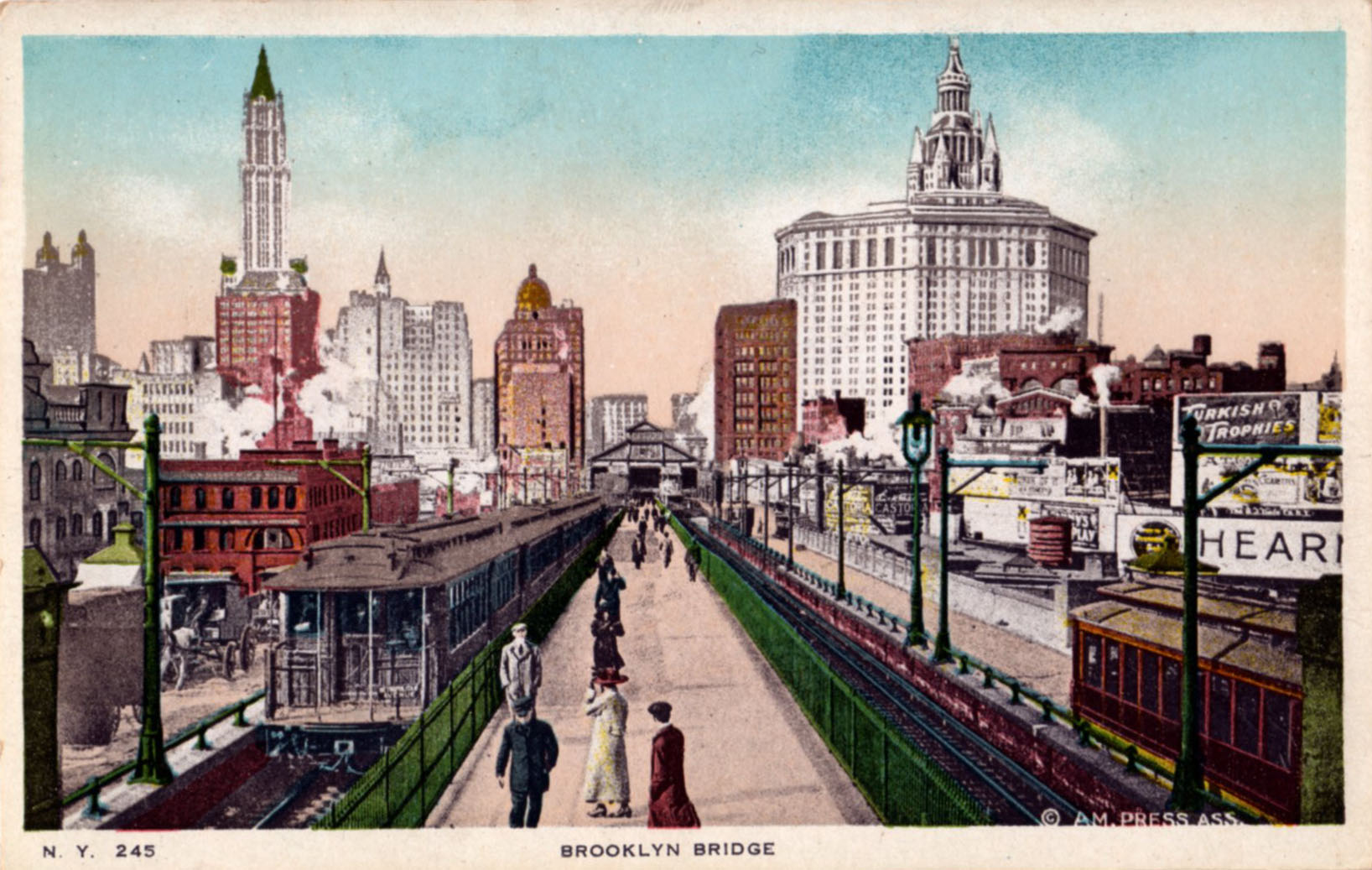
New York City Landmarks No. 3 - Brooklyn Bridge

When it opened in 1883, the Brooklyn Bridge was the longest suspension bridge in the world - a distinction it would hold for 20 years.  It spans the East River and links Manhattan with the borough of Brooklyn.  Design and construction was a family affair - John Roebling was the designer, his son, Washington was the project manager and his wife, Emily Warren Roebling, supplied additional design work.  The granite and limestone towers, each with twin gothic arch piercings went up first, followed by the cable work - constant technical details prolonged the construction to a total of 13 years.  Lengthy approach viaducts were needed to raise the roadway to the deck level, itself elevated to allow for the free passage of ocean going shipping.

Visually striking for the grandeur of scale and for the contrast between the delicate cable stays and the massive presence of the two towers, the bridge rapidly became a source of fascination to graphic artists and painters. Artists from all over the US and beyond felt the need to record their impressions of this stupendous structure. Georgia O’Keefe, Joseph Stella, John Marin, Richard Estes, Albert Gleizes, and C R W Nevinson. For the editors of the New Yorker, the bridge is one of the most powerful and emblematic symbols of the city to go by the frequency with which it appears on the front cover 


Monday, 30 March 2020

New York City Landmarks No. 2 – Met Life Building


At the time (1909 -1913) of these postcards this was the world’s tallest building. It has a complicated history of building, rebuilding, partial demolition and consolidation but it retains the appearance of a pioneering skyscraper. The Metropolitan Life Insurance Company (Met Life) occupied the premises from inception in 1909 up to 2005. In its current form it operates as a hotel plus office accommodation for Credit Suisse. Met Life (No. 43 on the Fortune 500) still have their board room and some executive offices in the building. Company activities are proudly presented here with the emphasis on the sheer scale of operations. Kafkaesque interiors in which faceless clerks toil away, checking and collating, in the shadow of towering cabinets stuffed with bulging customer files. Deep in the basement, massive turbines generate power for heating, lighting and the elevators while visitors enter and leave the building via the intimidating grandeur of the vast Marble Court and Grand Stairway. Advertising examples illustrate the extent to which the insurance industry insinuates itself into the necessities of modern life from education to dentistry, from housing to health - there’s always money to be made from fear and insecurity. 


Monday, 23 March 2020

Railroads on Parade 1939-40


This card covered publication was published to accompany Railroads on Parade, a musical pageant celebrating the early days of American railroads at the New York World’s Fair of 1939-40. The Railroad Building was the largest in area at the entire Fair. On the wraparound cover illustration we are shown how the power of steam left the ponies and oxen far behind - at the top an exotic streamliner represents the peak of contemporary technology. Famous mural painter, William A Mackay was the cover artist - it was his misfortune to die of a heart attack on a New York subway train in July 1939, less than 3 months after the Fair opened its doors on April 30th. It sets the tone for the anachronistic folksiness of the theatrical presentation. Kurt Weill was commissioned to compose the music. Since arriving in America in 1933, Weill had immersed himself in the American Songbook and mastered the idioms of the Broadway musical and popular song - this was his first opportunity to compose for a mass audience. Tickets were sold for only 25 cents and the auditorium could seat 4,000 spectators at up to 4 shows a day. The fair was a massive corporate jamboree designed to dazzle the American consumer with visions of future plenty. Major firms competed to offer the most architecturally extravagant pavilions in which to present the technology of the future. The railroad industry looked to the past and devised a historical pageant that catered to the public appetite for nostalgia as well as displaying the latest in locomotive development to build the market for future travellers. Please follow the links below for past posts on the World’s Fair.

World of Tomorrow
Meet the Middletons