Showing posts with label france. Show all posts

Thursday, 26 June 2025

Postcard of the Day No. 115, Saintes, Passarelle du Passage à Niveau

Saintes is a small town in Charente-Maritime on the railway linking La Rochelle with Bordeaux. A local postcard photographer has succumbed to the charms of robust displays of structural steel near the town station and, on a gloomy winter day, aimed a camera at the footbridge and level crossing that both join and separate the two halves of the town. For some this would have been seen as a modern intrusion into a traditional townscape, for others it was a minor wonder of the age. A trio of curious youngsters, with wheelbarrow and a passing facteur, with bicycle, have paused to witness what happens. In a drowsy town, any break with routine is welcomed. Especially if there's a chance of seeing their likenesses in print. The original photographic plate would have recorded much more detailed visual information than the limitations of the printed card would permit, but the enlarged details with all their imperfections have a charm of their own.


Saturday, 2 July 2022

Noisiel Revisited in Postcards

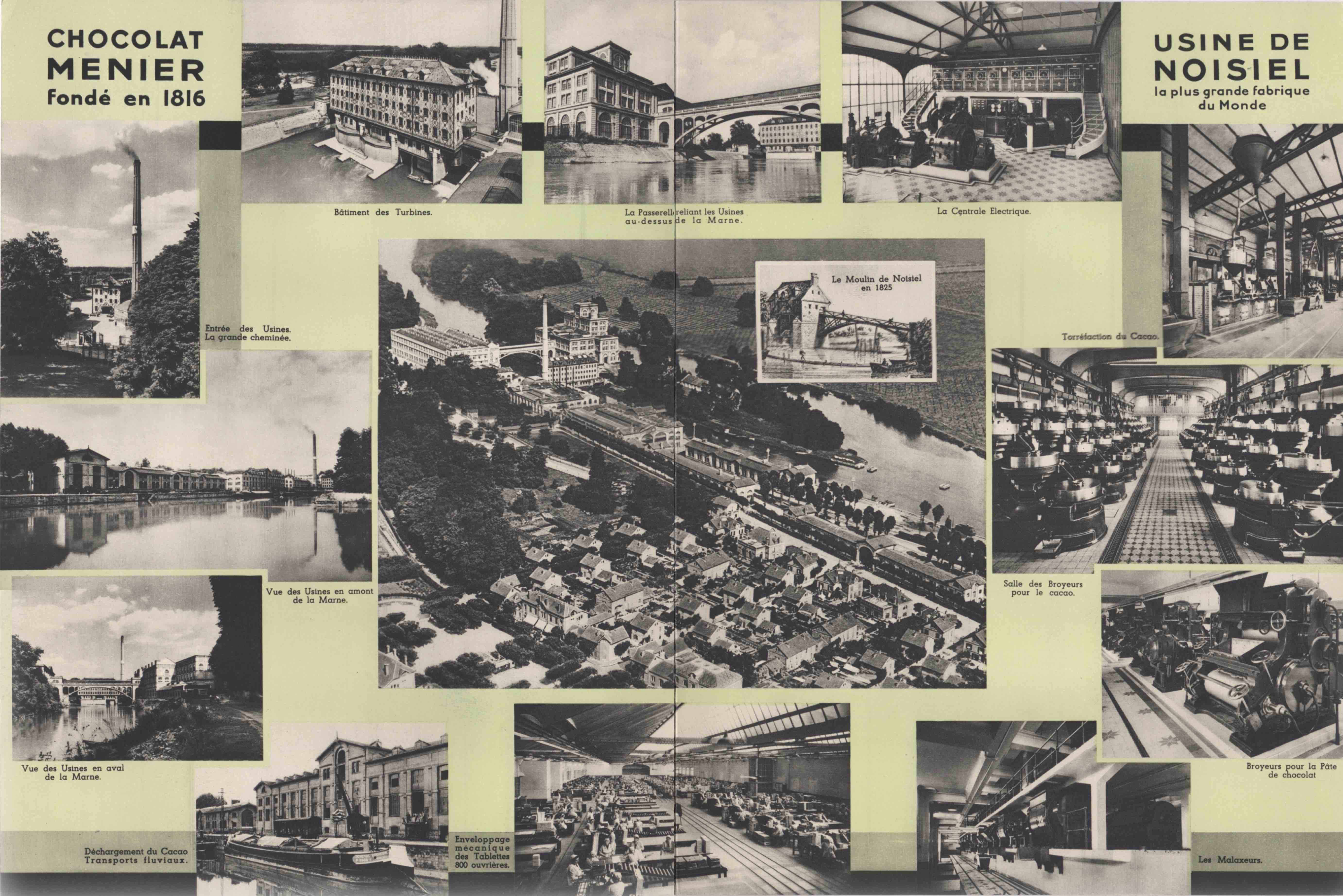
Twelve years ago I visited Noisiel to see the unique Chocolat Menier factory complex designed by Jules Saulnier on the banks of the River Marne, east of Paris.  The factory was in production from 1871 to 1993 and in 1997 was remodelled to serve as the headquarters of Nestlé France. Le Moulin Saulnier is the landmark building - behind the chromatic brilliance of its ceramic cladding lies an interior in which iron box girders and arched roof trusses create uninterrupted floor space for machinery.  Since 2010 I’ve acquired some vintage postcards of Noisiel that can be seen below, what they confirm is how well everything appears to have been conserved. A recent acquisition is this corporate prospectus of the Noisiel factory published by Menier in the 1930s to mark more than a century of progress. On the cover is a familiar school girl figure in use in Menier publicity since 1892, as airbrushed and updated 50 years later for the 1930s. There’s a double page spread of photos illustrating the major buildings and the manufacturing process at the Usine de Noisiel.  Alongside a chance to win a Peugeot 302 “luxe”, more photos can be seen on the back, including views of the internal railway that ran through the premises.  

In 2020 Nestlé France moved out of Noisiel to new premises in Issy-les-Moulineaux and disposed of the entire site to a developer, leaving the buildings to face an uncertain future.  Much wrangling is now going on between developers, local authorities and nearby residents - developers want to maximise the residential potential while locals are looking for community and cultural facilities.  The buildings have some protection as National Monuments but many spectacular interiors could be lost whichever way the argument is settled. Some reports say that the developers intend to permit a number of community enterprises to operate within the site on a temporary basis until 2024, the date set for launching the redevelopment.  This is unlikely to offer any public access to the site. More Chocolat Menier posts can be seen here and here.


Sunday, 18 April 2021

Postcard of the Day No. 103 Morlaix

A busy scene in the Breton market town of Morlaix where a narrow-gauge train operated by Chemins de Fer Armoricain, a metre-gauge network of lines built to connect small towns and neighbouring coastal settlements along the north coast of Finistère.  The Morlaix section opened in 1912 which may well be the year of the postcard. A group of women in Breton headdress are making their way into town, passing the modest but decoratively detailed station building, complete with édicule.  Above the train, the massive piers of a railway viaduct can be seen on its march across the steep sided valley in which the town is located.  What we see here is just the first level of the structure which has 9 arches - the upper level is more than 60 metres in height and has 14 arches.  Its presence is inescapable - it dominates the view from all districts of the town and must have been a hugely resented intrusion when it was under construction in 1861-63.  The lower level incorporated a pedestrian walkway but last time I was in Morlaix (more than 10 years ago) I discovered it locked and barred in a way that suggested it was unlikely to ever reopen.

After several years of construction the viaduct was fully opened in 1865 as a vital link in the main line from Paris to Brest operated by Chemins de Fer de l’Ouest. Today, up to 7 TGV services from Paris-Montparnasse cross overhead each day and the viaduct is protected as a national monument. These postcards are a reminder of how private commercial interests could transform a townscape that had evolved over many centuries by promising connectivity and future prosperity. At the same time public perception changes from outright hostility via gradual acceptance to popular veneration as a monument to engineering achievement.  The narrow-gauge railway was barely viable from the start and never generated enough traffic to pay its way - the convenience of delivering passengers to the heart of the town was offset by the lack of potential business in the sparsely populated hinterland. It closed for good in 1934 after only 22 years of service. Despite several visits to Morlaix over the years, I had no idea of its existence until I saw this postcard.


Tuesday, 26 January 2021

Postcard of the Day No.102 Mazamet, le Kiosque des Journaux


This is the sort of postcard I’m always looking out for - a modest building fully stocked with newspapers and magazines in a melancholy square in a small town in south west France.  It’s a midwinter scene and the only sign of life is a young girl, hands clasped, wearing a beret and an air of resignation that suggests she may be the photographer’s daughter pressed into accompanying her father on a weekend expedition.  In the distance there’s a flat-bed delivery lorry but everything else points to a bitterly cold Sunday afternoon.

To my astonishment, when I took a dive into Streetview, there it was. Almost unchanged after nearly a century - the finials and decorative ironwork fringe still in place in September 2019 when the Google car passed by.  Paris Match has replaced Le Petit Parisien and l’Illustration and the Franc has given way to the Euro but, despite the temporary nature of kiosks, there it stands - a triumphant survivor, still selling the printed word and image in the digital age.


Wednesday, 20 May 2020

By Coach to France 1938


This is from a holiday scrapbook recording a coach trip to France and Switzerland in May 1938. Luggage labels mark the route taken. The happy travellers can be seen, lined up for a photograph en route - the group leader is in the centre - he is described as a professor of English from the Sorbonne, a fluent linguist and “possessed of a first class knowledge of the history of France”. Missing is the photographer and chronicler of the trip. He’s an articulate observer of rural life and the natural world. When recording his impressions of human behaviour, he favours a sardonic tone that shades into pomposity and, on occasion, downright misanthropy, nowhere more so than when commenting on the physical imperfections of the ageing dowagers of Aix les Bains at their leisure in the casino. Orléans is a source of irritation - constant reminders of England’s defeat at the hands of Jeanne d’Arc overshadow the pleasure of a superb lunch at the Grand Hotel d’Aignan. Despite being a “port city”, Bordeaux meets with approval. Half the hotels in Biarritz are closed due the Spanish Civil War. At the Hotel de France in Pau they were served with the “finest lunch in all France”. The scale and mass of the fortified city of Carcassonne “impressed itself in detail more permanently upon our recollection than any other place we visited”. Nightingale song is heard in Avignon but Provence is too hot for comfort. In Geneva there was “a tablet to the memory of Woodrow Wilson, the man who fashioned the boat of peace and wouldn’t row”. Swiss pluralism is commended thus, “Happy is the state which has the genius to keep the demon of racial intolerance at arm’s length”. There’s an opportunity to do some snowballing in the heights of the Jura but all too soon the coach is back at Calais after overnight stops in Vittel and Amiens. A three hour crossing to Dover in storm force winds followed by a traffic jam in Kent concluded the trip and the participants went their separate ways with scarcely a mumbled farewell.


Wednesday, 22 April 2020

Usines Renault


For many decades, two of France’s major car manufacturers operated factories in the west of Paris. Citroën built a factory at Javel on the left bank of the Seine near Pont Mirabeau. Founder, André Citroën was an early visitor to Ford in Detroit and enthusiastically adopted Ford production methods. New cars rolled off the assembly lines from 1915 to 1975. No trace of the factory remains and the site is now occupied by the Parc André Citroën. Just over 3 miles further west was the Renault Billancourt factory, situated on the Île Seguin, an island in the river Seine. Louis Renault bought the island in 1919 and after raising the ground level by 6 metres a massive 5-storey assembly plant was constructed between 1929 and 1934, by which time the factory was the island rather than on the island. The facility shown in these postcards is what it replaced. Photographs show the new building appearing to float in the Seine like a clumsily formed passenger liner. At its peak almost 10,000 workers were employed and production ended in 1992 by which time the green field Renault factory at Flins (25 miles north west of Paris), established in 1952, was large enough to absorb the additional volume of production.


Louis Renault was a partial convert to Fordism. Like Ford he diversified production to include commercial vehicles, luxury cars, aero engines and railway equipment. Like Ford he built his own coal-fired power station in the interests of self-sufficiency and was obsessed with controlling every aspect of production. Unlike Ford, he constructed a wide range of vehicles in the same factory and dedicated assembly lines were only introduced in 1950 when the factory at Flins was opened. During the Occupation, production was commandeered by the German war machine and the factory’s conspicuous position in the river Seine made it an easy target for the RAF in 1942. Louis Renault was an abrasive, domineering character and an implacable enemy of trade unions. He had an audience with Hitler in 1938 and was heard to denounce his rival, André Citroën in grossly Anti-Semitic language. Renault cooperated fully with the Vichy regime and his factories supplied the Wehrmacht with copious volumes of vehicles and weaponry - after the Liberation he was arrested and charged with collaboration. Still awaiting trial, he died ignominiously in Fresnes prison in autumn 1944.


Aspiring professional photographer, Robert Doisneau was employed at Billancourt at the age of 22, from 1934 to 1939 as an in-house advertising and publicity photographer - a gallery of his images can be seen here. Some of his photos were choreographed for advertising purposes but most are highly accomplished exercises in the documentary tradition. They cover the whole range of activities from the forge to the foundry, from the factory floor via the staff canteen to the sanatorium. By Doisneau’s own account (Renault in the Thirties, Dirk Nishen, 1990) this was not the sinecure I fondly imagined. One of three “strolling photographers” on the payroll, he had to lug around 20 kilos of kit, including an 18 by 24 plate camera. Snapshots were not an option and most assignments involved considerable planning. A major lesson learned was never to photograph the workforce when they were on a snack break. Another lesson was to stay on good terms with the fork truck drivers whose assistance was invaluable in pursuit of elevated vantage points. Doisneau was not the only unexpected employee at Billancourt. From late 1934 to summer 1935 the young French philosopher, Simone Weil worked there incognito to experience proletarian labour at first hand. She worked in the drilling department and quickly discovered the tyranny of piece work. It was a punishing way for someone so notoriously frail as Weil to identify with working class life. By way of relaxation her next adventure was to sign up for the Spanish Civil War and enlist with the anarchist Durutti Column.


Since the factory closure in 1992 the island has seen various development schemes come and go. Demolition of the factory was rapid and left behind an island scraped raw on which nothing stood or grew. Thus far the only completed building is a concert venue, Cité Musicale which opened in 2017. Jean Nouvel and Rem Koolhaas have presented masterplans but little else seems to have happened. For almost a century the Île Seguin was an industrial citadel and the departure of the factory represented an immense opportunity to develop it as a social community asset. Unfortunately the investment priorities of late capitalism don’t favour the kind of imaginative approach that might have led to a permanent enhancement in the lives of all local residents. Inflated land values are the ultimate determinant and the future looks to be one of piecemeal commercial development as and when the figures can be shown to produce an acceptable return.