Constance Talmadge (1898-1973) was a star of the silent screen who made her mark in 1918 when she appeared in D W Griffith’s “Intolerance” but her days in front of the camera would be relatively brief. With the advent of sound in 1928 she retired in favour of making money from real estate. A handful of crew plus an umbrella and some auxiliary lighting seems to be enough. The movie is identifiable as “East is West”, made in 1922 with Constance playing the part of Ming Toy. Ming escaped from the notorious Love Boat in Shanghai only to find herself pursued by Charlie Yong (“Fifty-fifty Chinaman”) in San Francisco's Chinatown where she was again threatened with white-slavery. Straight arrow Billy Benson saved her from a fate worse than death for the second time. History doesn’t record much about the audience response but the movie had been judiciously calculated to feed into contemporary fears of all things oriental as represented by the Yellow Peril and it would be a disappointment if all their worst efforts had been in vain. It turned out to be one of Hollywood’s more forgettable movies but the director, Sidney Franklin went on to enjoy a long and prolific career including directing “The Barretts of Wimpole Street” twice (1934 and 1957) employing the same script, word for word, on both films. According to Imperial Tobacco (see below), Constance was noted in Hollywood for her inexhaustible supply of “pep”.
Showing posts with label california. Show all posts
Tuesday, 12 October 2021
Wednesday, 29 November 2017
Postcard of the Night No. 12 – Barbary Coast by Night, San Francisco
Barbary Coast was the red light district of San Francisco. It sprang into existence in 1849 with the California Gold Rush and for 60 years or more its nightclubs and brothels, bars and gambling dens catered to the needs of an itinerant population of workingmen in search of distraction. Our postcard from the first decade of the 20th. century shows a pilgrimage of lost souls, their haunted faces turned toward the camera – an unwanted intrusion into the pursuit of pleasure. Some furtive, some remorseful and some defiant, they shuffle through the gloom to be separated from their hard-earned dollar bills in return for copious quantities of intoxicants and sexual favours. The agencies of law and order had minimal traction in the district and organised criminal gangs threatened the security of the entire city. Conflict raged with regular arson assaults on the city leading to vigilante justice and public lynchings. It couldn’t last forever – the 1906 earthquake provided the opportunity to rebuild and gentrify the district. The guardians of public morals kept up the pressure on the civic authorities and a few years later a new hostility emerged with a ban on dancing and illuminated signs, restrictions on the sale of alcohol and the expulsion of brothels.
Thursday, 11 May 2017
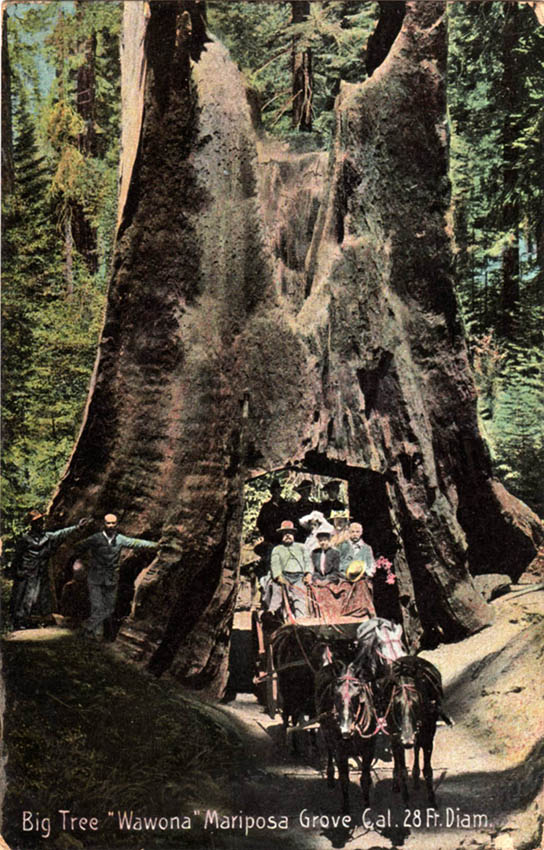
Wawona Tunnel Tree, Yosemite
This ancient Giant Sequoia tree was estimated (in the 1920s) to be 4846 years old, a suspiciously precise number. Whatever the true figure it lasted only another 40 years or so. It’s home address was Mariposa Grove, Yosemite National Park and in 1881 it suffered the indignity of having a tunnel hacked through its base by the Yosemite Stage and Turnpike Company to enhance its value as a tourist attraction. It certainly made for some eye-catching postcards as vehicles and celebrities passed through the aperture. The end came in February 1969 after heavy snowfall settled on the crown causing it to tilt. Felled in the interests of safety, it can still be seen lying in a horizontal position.
Labels:
americana,
california,
giant sequoia,
postcards,
yosemite
Friday, 10 March 2017
Pacific Electric in Los Angeles
In April last year the Guardian retold the story of the Great American Streetcar Scandal. It’s a depressing tale of unregulated capitalism triumphing over the interests of the consumer and the public realm. A syndicate involving Detroit motor manufacturers, major oil companies and the makers of auto tires assumed ownership of urban streetcar systems across the USA in the immediate post-war years and began the business of eliminating the electric powered streetcar in favour of bus lines with diesel engines running on rubber tyres. By the early 1960s all but a handful of streetcar mass transit systems had been converted to buses much to the satisfaction of the auto industry. This accelerated the trend towards individual vehicle ownership leading to massive congestion on urban roads and rapid deterioration in air quality. Local taxpayers had to fork out for grandiose freeway projects while federal taxes funded a new interstate highway network that had the effect of killing off the last vestiges of long distance rail travel. It remains a textbook case of corporate expansion funded largely by the public purse. The social costs – health impact of atmospheric pollution, limited mobility on the part of low-paid workers, the financial cost of chronic traffic congestion – all passed on to third parties.
The postcard history of Pacific Electric shows the downtown ten storey office block and streetcar terminal that served as the hub of the system and survived to the very end in 1961. The Pacific Electric Building was opened in 1905 to a design by Thornton Fitzhugh. Among the first tenants was the architectural practice Greene and Greene, noted Arts and Crafts designers responsible for the famous Gamble House in Pasadena. Until its closure in 1914, Arcade Depot was the principle station for Los Angeles – Pacific Electric streetcars wait in front. Santa Monica was just under 17 miles from the Pacific Electric Building at the end of what became known as the Santa Monica Air Line. The last two cards are real estate promotional cards issued by Pacific Electric to encourage homebuyers to settle along their routes in the verdant surroundings of Brentwood Park and Beverley Hills. These images offer a distinctly bleak prospect to a potential customer but that didn’t stop them becoming some of the most affluent neighbourhoods in Los Angeles. Beverly Hills had the dubious distinction of being planned as a white-only development, a situation that remained unchallenged until the 1940s when a group of black screen actors mounted a successful legal action.
It would be misleading to leave the impression that Pacific Electric was a philanthropic enterprise. The leading promoter was Henry E Huntington, a businessman of impeccably capitalist instincts. For him, the transport networks were entirely subordinate to his interests in the real estate developments they existed to serve. Profitability declined in the 1930s as the supply of development opportunities dried up. In the absence of any public sector transport authority, the unregulated network was fully exposed to a predatory assault from the auto industry. Indeed the switch from electric traction to diesel engined buses began in the Pacific Electric era. For light relief, watch Harold Lloyd’s efforts to control a Pacific Electric streetcar in the 1924 movie, Girl Shy.
Labels:
california,
interurbans,
los angeles,
pacific electric,
postcards,
streetcars,
transport
Friday, 21 October 2016
Postcard of the Day No. 85 – Hauling Rocks, San Pedro CA
It’s a great day when a card like this turns up. All our expectations of postcard imagery are overturned. A steam powered freight train hauling rock armour may be a thrilling sight to some (myself included) but that’s very much a minority view. More curious is the presence of a trio of ladies of leisure dressed for a stroll through the shady avenues in the garden of a luxury hotel, scrambling down an embankment to the railroad tracks. There’s a possibility the figures were added by a picture editor in the hope that a feminine touch would enhance the appeal of the image. Or perhaps there’s a pedestrian right-of-way across the tracks – given the extent of the tracks and the lack of an obvious destination that seems unlikely. San Pedro was, and remains the port for Los Angeles and the breakwater was constructed between 1899 and 1911. Below are some other examples of railroad freight on postcards.
Labels:
american railroads,
california,
freight trains,
los angeles,
postcards
Wednesday, 5 October 2016
Road of a Thousand Wonders
This extravagantly produced book dates from around 1910 and promotes the scenic value of a train journey through the High Sierras from San Francisco to Salt Lake City on the Southern Pacific railroad. Generously illustrated with more than twenty tipped-in photochroms of highlights along the permanent way, it made a fine souvenir of a memorable trip. This copy comes with terse annotations from its original owner who signed herself as Nellie when she inscribed it. The selected images make a pleasing mixture of the sublime and banal, alternating views of soaring mountain peaks and shimmering lakes with dairy farms, hydraulic mining and pulp mills.
Friday, 30 May 2014
Postcard of the Day No. 67, Tex the Trainer
Meet Tex the Trainer, resplendent in shiny lace-up boots, necktie and suspenders. Tex makes light of his celebrity status as he demonstrates his technique for suppressing the natural instincts of these fearsome carnivores. These reptiles were placed on earth 37 million years ago to add to the sum of human happiness by making themselves available for inspection by paying customers on purpose-built reservations, often called ranches or farms. And when their performing days are over they generously donate their skins to be made up into shoes for pimps or handbags for whores. Repellent, scaly and reptilian, with a formidable reputation for unprovoked savagery – they made ideal material for the producers of postcards. Similar businesses can be found today at ranches or farms across the southern USA although, in tune with the times, they are keen to emphasise the conservation value of their activities.
Labels:
alligators,
americana,
california,
florida,
postcards
Subscribe to:
Posts (Atom)