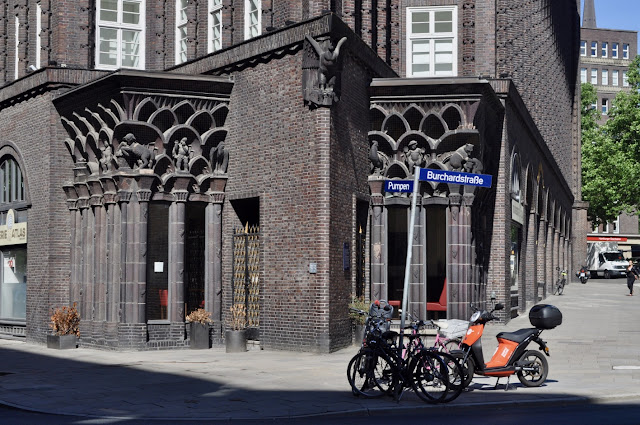
There’s a longstanding building tradition in the Netherlands and North Germany of ingeniously exploiting the potential plasticity of brickwork to escape the monotony of undifferentiated surfaces. Architects and builders devised ever more inventive ways to introduce visual interest by twisting, upending, projecting and re-aligning individual bricks and by combining brick types (especially clinker bricks) of different colour and texture. This practice became an essential component of the early 20th. century style, largely developed in Hamburg and Amsterdam, that became known as Brick Expressionism. Hamburg’s close trading links with New York meant that North American architectural styles quickly found an appreciative audience on the part of architects and developers. German business came to see the value of large scale statement buildings as an expression of corporate confidence in the days of the Weimar Republic.


Hamburg’s Kontorhausviertel is a business district where the prevailing style is Brick Expressionism of which the Chilehaus is the most notable. Other examples include the Burkhardhof and the Sprinkenhof. The awkward, asymmetric dimensions of the Chilehaus building plot lent themselves to the maritime theme adopted by the architect, Fritz Höger. Shipping and international trade were at the heart of the Hamburg story – the references to marine architecture found ready acceptance. Höger’s design included three upper floors with wrap-around balconies to resemble the tiered decks of an ocean going vessel. At the eastern extremity, two flanks of the building meet at an acute angle to create a dramatic image of the prow of a ship. There are three internal courtyards, accessible to the public via generously wide arches allowing a sense of easy circulation between open and constrained spaces. Höger’s client was Henry Sloman, a recently returned German businessman from Chile, where he had made his fortune exporting nitrates to his homeland. Construction began in 1922 and was completed in 1924 – it was a difficult build requiring deep piling to cope with the instability of a site so close to the river Elbe.

Fritz Höger (1877-1949) began his working life as a carpenter and technical draughtsman. Despite a lack of formal training as an architect he developed a successful practice designing substantial dwellings in the wealthy suburbs of Hamburg before going on to design many commercial buildings elsewhere in Berlin and Hannover. Office blocks and factory premises for the most part. Höger joined the staff of the Volkischer Beobachter (Nazi party newspaper) in 1927 and took up party membership in 1932, but his efforts to ingratiate himself with the regime came to nothing. Brick Expressionism was no more acceptable to the authorities than Bauhaus Modernism - despised as impure thus denying him the prestigious public building projects he coveted. His advocacy of Hanseatic clinker brick had a nationalist tinge – he held that its earthy quality corresponded to the enduring nature of the Germanic people.

In 2015 the Kontorhausviertel and adjacent Speicherstadt were awarded Unesco World Heritage status. In the written submission it was clear that the Chilehaus is the landmark building and the focus for all the elements that make the district so special. These photos come from a visit in June 2018 and attempt to show something of what makes this building so arresting. Unlike most maritime inspired buildings that follow a streamlined template, the Chilehaus is angular and aggressive in form. It has the quality of a massive cliff face – an intimidating force of nature, which is balanced by the spatial flow that exists at ground level between enclosed and open spaces. Owen Hatherley has pointed out there was a brief and unsuccessful revolution in Hamburg in October 1923 at the time the Chilehaus was under construction. KPD militants stormed police stations, seizing weapons and building barricades – yet within 24 hours the authorities regained complete control by which time 100 lives had been lost. In the aftermath the German left was fatally divided, to the advantage of the Freikorps and the insurgent NSDAP. Meanwhile construction of capitalist citadels in the Kontorhausviertel continued unabated.