Showing posts with label manufacturing. Show all posts

Friday, 20 March 2020

The Factory in Postcards


When I grew up in the 1950s factories were everywhere. Large and small, in city centres and outer suburbs, alongside railways and arterial roads, mostly of vintage construction, they were impossible to avoid in the North East England of childhood. The industrial presence was greatly amplified by legions of coal mines, coking works, steel mills, chemical processing plants, shipyards and breweries. There were factories making toffees and boiled sweets, glassware and pottery, lemonade and potato crisps, turbines and tyres, and clothing and furniture. Clouds of sooty vapours streamed into the upper atmosphere from thousands of pipes, valves and chimneys. Beaches were black with coal waste dumped at sea and promptly washed back to shore. Through the eyes of a child, this was just the way things were and the entire spectacle could be transcended at nightfall when the serial radiance of a chain of blast furnaces was observed from a passing train or a blazing “Fighting Temeraire” sunset colourised the multiple emission plumes. These intense visions of the industrial sublime left an after-image that still resonates after all this time. 


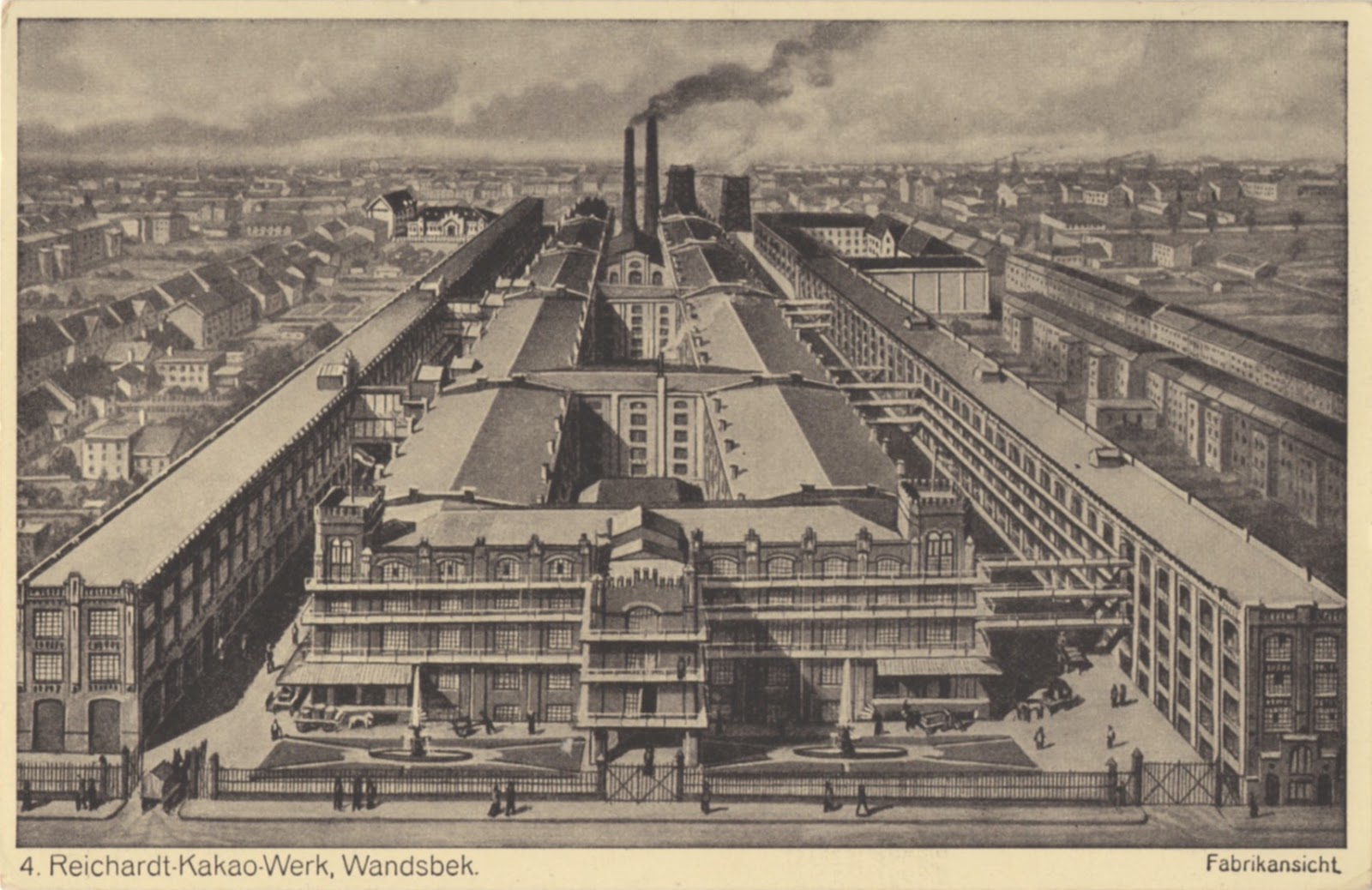
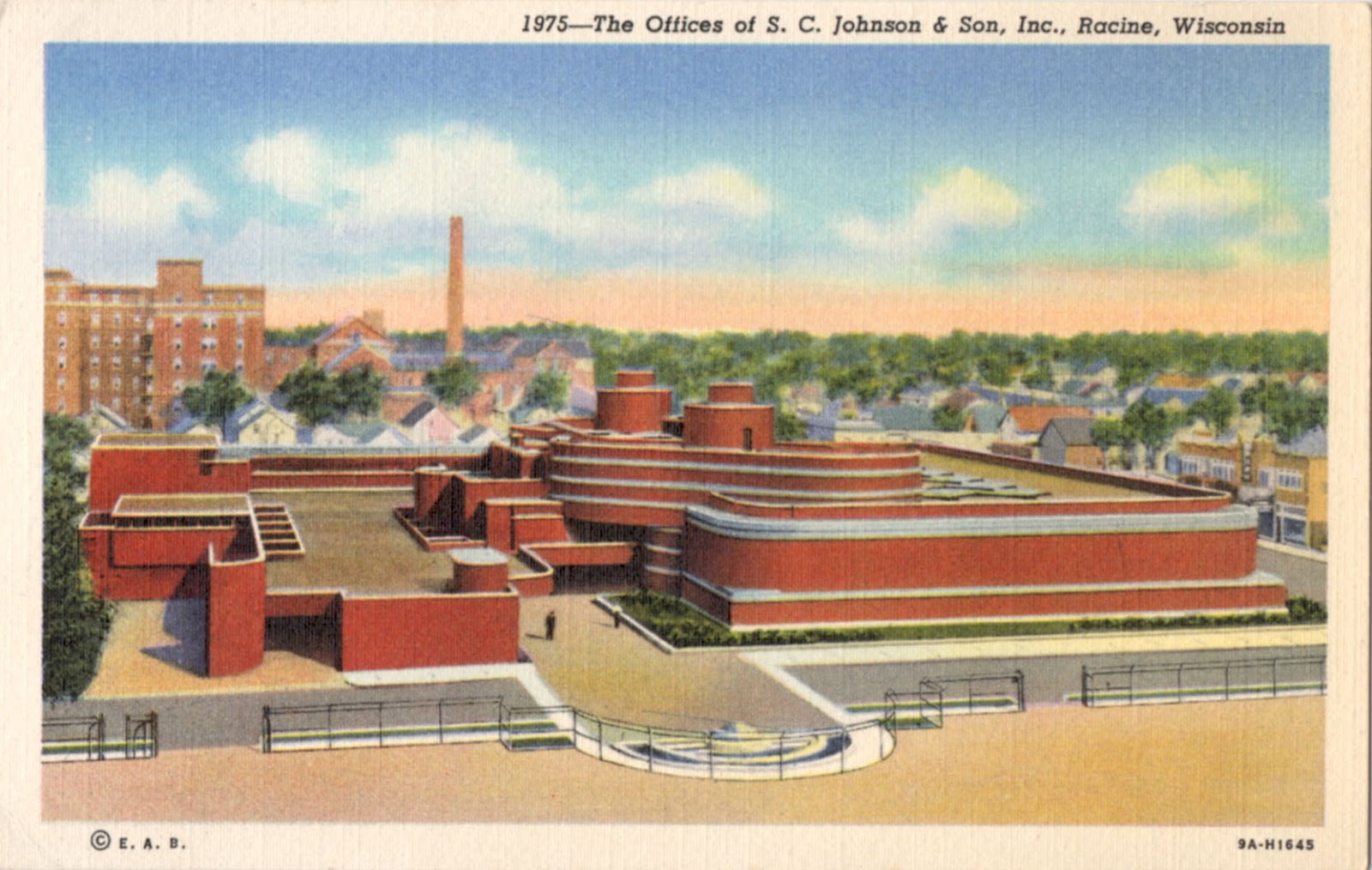
Many of these postcards feature what rapidly became the favoured aerial view of factory premises extending to the far horizon that would be endlessly reproduced on company letter headings and advertising. Every smoking chimney was proudly delineated in all its pomp while vast railway networks brought raw materials in and finished products out. Designed to impress by virtue of scale, this approach to the visual representation of industry persisted for many decades. It took the post-war emergence of new technologies, early automation and data processing, together with the trend for green field garden factories to change this stereotype. Factory buildings became standardised designs and modular structures - efforts to develop their potential as architectural forms were rare. Honourable exceptions to this include the idiosyncratic Johnson Wax Buildings in Racine, Wisconsin, designed by Frank Lloyd Wright in opposition to the auto industry buildings of Albert Kahn in Detroit, whose mastery of reinforced concrete, large floor spaces uninterrupted by structural supports and installations of vast areas of glazing achieved their grandeur by repetition of form. The theme of this post is to illustrate how the postcard became a valuable instrument for publicising industrial activity to a wide audience. Detailed consideration of factory architecture can be left to another time. 


Sunday, 15 March 2020

The Factory


For more than two centuries, the image of the factory has stood as an emblem of manufacturing and mass production. Carefully planned or simply improvised and extended as required, factories were an essential element in the iconography of industry and economic activity. Social historians divide them into two categories - basically pre-Ford and post-Ford. In a pre-Ford factory a single product was processed from raw materials. A post-Ford factory brought together a large number of components, many of which were made off-site, and combined them into something much greater by means of an assembly line where every intervention and activity was calculated to maximise efficiency and boost profitability. In the years of neo-liberal ascendancy, the post-Ford bargain with organised labour that ensured the workforce was sufficiently remunerated to afford to purchase the goods they produced has gradually withered away. Two powerful forces have emerged over the last 30 years to transform the modern factory - the first being automation and the second, the business of global outsourcing to secure the cheapest supply of labour. The image of the sprawling factory, often visualised from above, has completely lost the sense of awe and wonder that it once inspired. And very few remain embedded in urban areas where their presence once served as beacons in the local community as well as product advertising. It’s far more common to see images of the demolition of factory premises than to see the inauguration of new factories with the promise of employment and prosperity. To recapture any sense of that lost wonder we have to look to Asia where mega-factories such as Foxconn in China have borrowed the Victorian idea of the industrial settlement or company town and expanded it on a stupendous city-wide scale. 


Today’s employers rarely concern themselves with the welfare of their workforce - their responsibilities being confined to the simple transaction of remuneration for labour. Coercive control is the preferred model for improving productivity and the favoured tools are intrusive surveillance and real-time monitoring of performance against ever more demanding targets. Victorian paternalists had a sense of their duty to contribute to the health and education of their employees by establishing schools, colleges, libraries and clinics and paying their taxes. Little of that impulse has survived into the present where a reductivist view of human relationships dictates that business must be unimpeded by social concerns. The costs of ensuring a continuity of healthy and educated workers are for the taxpayer while business exercises its moral duty to pay as little tax as possible. Taken to its extreme this requires workers to accept terms that reduce them to anonymised units of labour with unending responsibilities and no rights. Not even assets, they are mere utilities, like water or electricity to be turned on and off as required. 


The story of the rise and fall of the factory, and the battle between capital and organised labour is told in Joshua B Freeman’s book, Behemoth - a detailed account of the birth and development of modern industry that presents a wealth of fascinating material. It was a surprise to discover that when American business began to construct textile mills on the British model they first had to evade the restrictions that Britain imposed on the emigration of skilled workers in an attempt to defend its technical advantages. New England mill owners relied on child labour and payment in vouchers redeemable at company-owned stores, just as in England. Labour shortages followed as the mills expanded in size and located to less populated areas. This lead to the large-scale recruitment of female workers and the provision of hostel accommodation with leisure and educational amenities attached. Perhaps a response to the example set by Robert Owen at New Lanark. In the absence of economically viable supplies of coal for steam power, New England operations continued to depend on water power with the result that the smoke darkened skies and atmospheric pollution of industrial England were several decades late in arriving. The result was that the early American industrialisation was a much more humane and utopian operation than its English counterpart. I had lazily assumed that the ultra-aggressive turbo-capitalism that erupted in the Reagan-Thatcher era was an all-American construction but it seems that its roots lie much closer to home. 


The images of factories displayed here are mostly taken from mid-century American advertising post-1945. This was an atypical period when organised labour briefly held the upper hand as the US economy shifted rapidly to a peacetime footing and chronic labour shortages placed unprecedented power in the hands of unionised workers. The pushback was not long in coming as employers campaigned to equate trade union activities with the new universal enemy - Soviet communism - throughout the Cold War 1950s. 


Wednesday, 23 January 2019

Transparent Factory, Dresden


Dresden's Transparent Factory (Die Gläserne Manufaktur) was built in 2002 for Volkswagen to a design by Gunter Henn, just less than a mile from the city centre in a corner of the Großer Garten at Straßburger Platz. Not strictly a factory, more of an assembly plant. No foundry, no metal bashing, no casting or forging. All the heavy work takes place 80 miles away in the city of Zwickau where VW inherited the former Trabant factory after the demise of the DDR. Vehicle components and chassis are shipped to a logistics centre in Dresden and onwards by a 150 ton CarGoTram that runs on the city’s tram network.


The principle assembly building extends along Stübelallee where a handful of workers, clad in white lab-coats, can be observed supervising the automated production line. For several years the VW Phaeton was “hand-built” on the premises but since 2017 production has moved to the e-Golf, VW’s first all electric vehicle. Rather than being conceived to take advantage of economies of scale, this factory seems like a vanity project, intended to generate publicity through high visibility and to function as a statement of faith in the commercial potential of the old DDR territory. A Visitor Centre and a Restaurant are provided to attract the curious to step inside. The great glass rotunda where finished vehicles are temporarily stacked certainly succeeds as a spectacle and the operation offers a brightly lit window into the workings of the motor industry. But the extent to which it’s profitable is for others to calculate.


Monday, 26 April 2010

Noisiel Insolite

Only 40 minutes from central Paris on RER A brings us to the small town of Noisiel. The station is positioned at the centre of a new (post-1970) community of apartment blocks and shopping centres. The streets and apartments have been named after notable philosophers and a mischievous municipal bureaucrat has arranged for the Catholic church to be blessed with an address in Allée Jean-Paul Sartre. It’s a 20 minute walk via the Parc de Noisiel to the bank of the River Marne and the assorted buildings of the Usine Menier dedicated to the manufacture of what was once France’s leading brand, Chocolat Menier.

In the 19th. century a channel was diverted from the river to supply the factory with water power and a turbine mill designed by the company architect, Jules Saulnier (1817-1881) was constructed in 1871. It was the first significant building to be supported by a steel box girder construction with an external skin of brick and ceramic infill. Three large turbines were powered by the river and supplied electricity to the entire site. It’s a magnificent building to be treasured for its audacious engineering and the polychrome splendour of the surface treatment. Manufacturing ended in 1993 and in 1997 the Menier site was renovated and converted into office accommodation as the corporate HQ of Nestlé France. The restoration work on the Saulnier building was especially detailed due to its status as a Monument Historique.


Another building of interest is located between the channel and the riverbank. This reinforced concrete structure dates from 1906-1908 and was known as la Cathédrale. The intention was to create a public showcase for the chocolate manufacturing process in the double height internal spaces. The project engineer was Armand Considere. There is a covered bridge to connect the building with its neighbour across the water.


There is no public access to the site and the only way to get a closer look is to join one of the guided tours that are offered every few months. A public footpath follows the perimeter fencing but views across the site have been obscured, deliberately or otherwise, by planting. The photo below of the Saulnier mill from the riverside was taken by my son and guide whose height and agility is greatly superior to mine. The interpretation boards seem a little redundant in the absence of decent sightlines.


The association of chocolate and philanthropy crosses national boundaries and the Menier family built a small community opposite the factory between 1874 and 1911 to house the workforce known as the Citè Menier. Some 300 dwellings were provided together with public buildings. All have survived in good condition and remain occupied.