Showing posts with label americana. Show all posts

Tuesday, 8 April 2025

Never Closed

“Hey Magda, show us a smile”, they called through their stained and broken teeth, their hungry eyes followed her contours as she navigated the room.


She never did - too much on her mind.


Bridie and Petra gave smiles away by the yard but got little in return. They resented Magda for the way she wormed her way into Hank’s affections.


The diner was Hank’s and it was his idea to place Magda out front when the photographer guy turned up to take a picture for a postcard.


“Great for publicity”, Hank was assured, “Give em away for free, they get mailed all round the world.” “But most of my customers work right here in the railroad yard or the tannery.”


Magda hated the idea but knew better than to complain. Never liked the way she looked. And she could recall all the photos for visas, passports, immigration permits, police line-ups - each of which took something away that never returned.


Hank refused to pay extra to have the address of the Lunch Room overprinted on the card. Photography guy fussed and grumbled. Magda found a pose she was happy with, the shutter clicked and she went back to work.


 

Wednesday, 23 March 2022

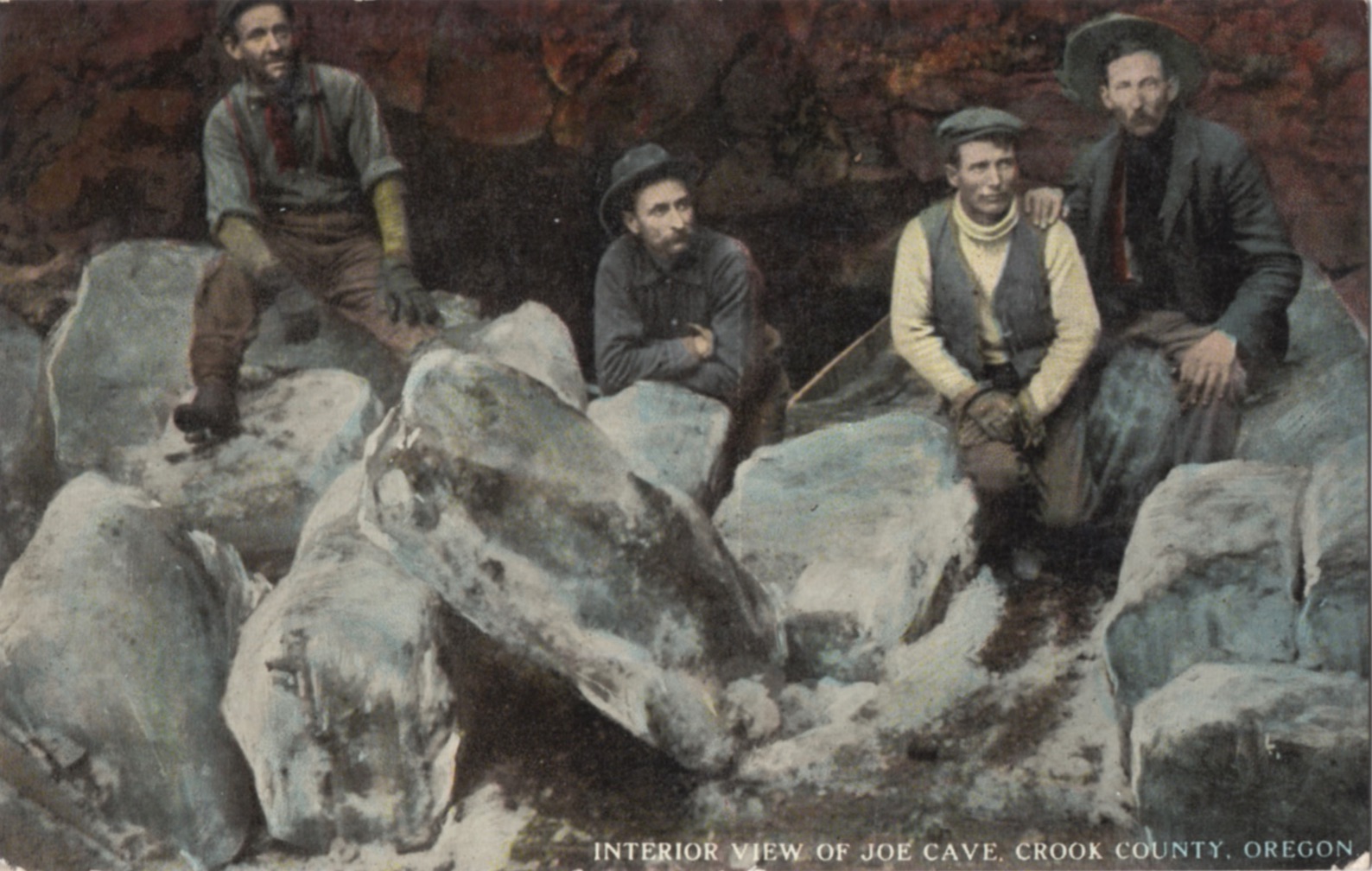
Postcard of the Day No. 108, Ice Men of Oregon

These are the four Ice Men of Crook County, Oregon who had the task of supplying the locals with  slabs of ice extracted from a hillside cave and hauled up a chute for onward transport to the nearby town of Bend. There was no shortage of ice in the winter months but in summer it commanded a premium price. This activity ended in 1920 when electricity became locally available. Up to then, the ice had been delivered to the local saloon-keeper who sold it on to the townspeople at a profit for refrigeration. Between them these two postcards tell the story of the ice gatherers and it’s pleasing that their gaunt and weary faces have been recorded and preserved for posterity. A local museum has a more detailed account here.


Saturday, 25 May 2019

Greyhound Scenicruiser


The great American highway belongs to the private motorist and the truck haulage industry – the humble bus, last resort of the indigent traveller, comes a poor third. Greyhound management was well aware that their core market was of low status and made great efforts to attract a better class of customer. Competition from plane and train was fierce and the long distance bus ride could never compete in terms of travel time. Unlike the airline business, bus and train passengers could be delivered to city centre locations but this was a slender advantage. The introduction of the Scenicruiser in 1954 marked a major effort by Greyhound to upgrade its offer and expand its market share. Passenger visibility was greatly enhanced by raising the height of the rear two-thirds of seats and a generous provision of panoramic windows. The styling could be described as restrained streamline and the stainless steel finish was inspired by the two level passenger coaches that the railroads had been operating for over a decade.


Marketing material made the most of the glorious views that passengers would enjoy as America the Beautiful spooled by. Air conditioning and a modern washroom completed the package. Raymond Loewy Associates were employed for their expertise on internal finishes and upholstery. A thousand examples were built by General Motors and despite being beset by technical and structural problems they remained in service for 20 years – the last of them being withdrawn in 1975. The illustrations in the brochure exclusively feature the clientele Greyhound were desperate to attract – high earning, clean shaven professionals in Arrow shirts with suits from Hart, Schaffner & Marx, accompanied by wholesome spouses and obedient offspring. The reality could hardly be more different – low income families, migrant workers, servicemen on leave, fugitives, drifters and vagrants. You might have found yourself sitting next to John Lee Hooker or Townes Van Zandt but you would never share a seat with Aaron Copland or John Updike.


Two Scenicruisers at a rest stop at Speck’s Café in Northern California between Redding and Sacramento. Somewhat motley clientele – a queue for the payphone and at least one naval uniform.

Sunday, 5 May 2019

Coney Island After Dark


When the sun sets over New York’s peninsular playground the lights come on and the fairground rides and attractions are transformed by spectacular displays of luminescence. Darkness conceals the blistered and faded paintwork while the patrons adapt to life in the shadows. Fairground folk, carnival freaks, counterfeiters, pickpockets and cardsharps take full advantage of the nocturnal opportunities for mischief and mayhem as the crowds stream into Luna Park, the Palace of Joy and Dreamland. Postcard photographers recorded the scene by day and employed retouching artists to add all the elements to turn day into night. Thousands of pulsating light-bulbs following the contours of the Cyclone and other amusement rides, painstakingly added by hand. There’s a steady traffic flow along Surf Avenue, streetcars like glow-worms, taxi-cabs and jalopies jostling for space and sidewalks packed with punters in search of excitement.


Tuesday, 23 April 2019

To Key West in Postcards


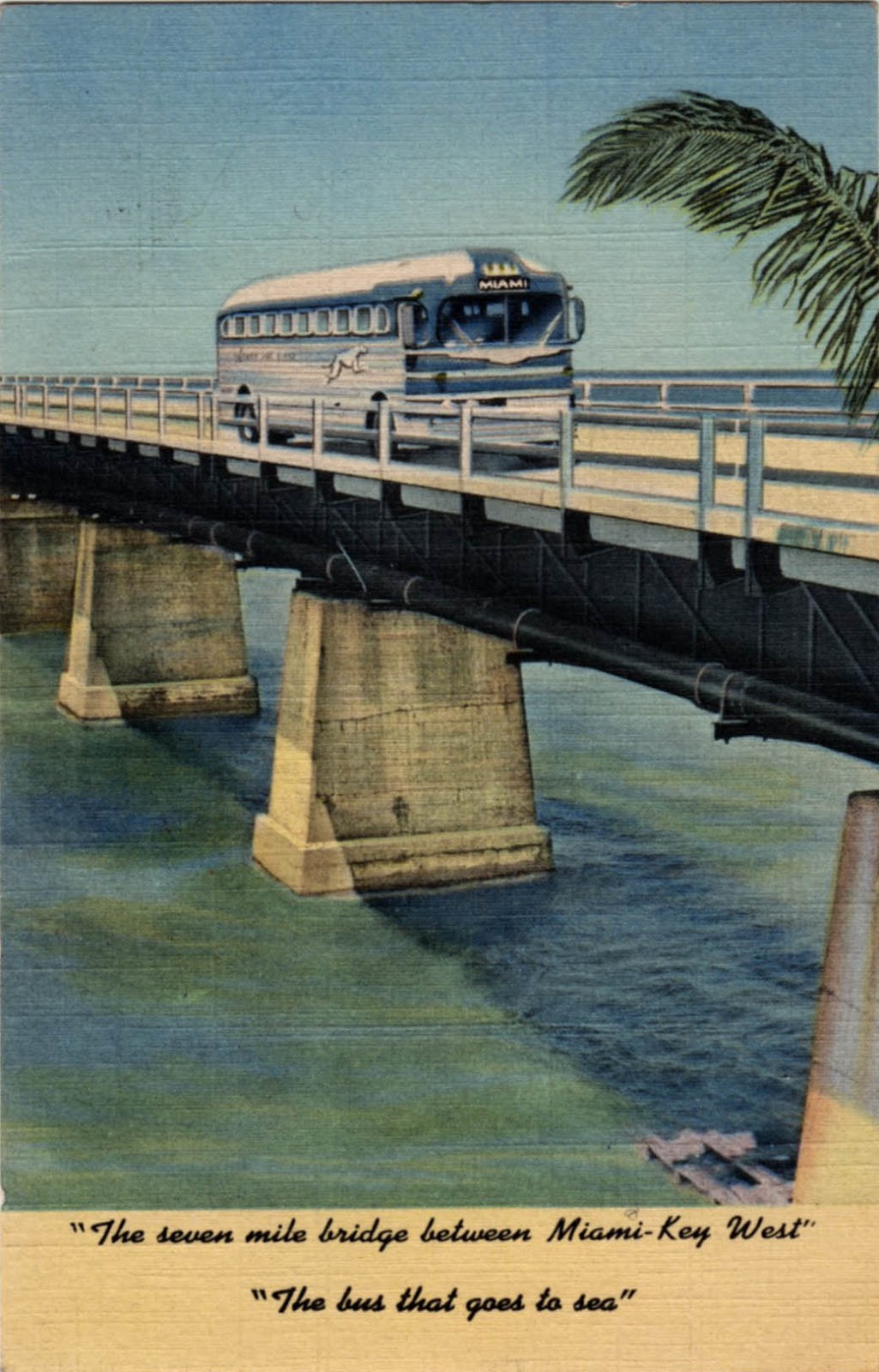
The Florida town of Key West is at the southernmost point in the continental United States at the end of a chain of small islands linked by a causeway. It is closer to Havana (106 miles) than it is to Miami (127 miles). Other than an association with Ernest Hemingway (who had a home there from 1931-39), its distinction is its location. Visitors to places situated at extremities are frequently moved to send postcards home and the industry was quick to supply them in copious amounts.


There was a time when it was connected to the mainland by rail. The Overseas Railroad to Key West operated from 1912 to 1935 when it was destroyed in the Labor Day Hurricane – forty miles of track was washed away on September 2nd. With no funds to rebuild, it was abandoned by its owner, the Florida East Coast Railway. There being no compelling economic case for the railroad, most of the track-bed was converted to road use and designated US Route 1 – the Overseas Highway.


The Overseas Highway made a frequent postcard subject in the inter-war era of the linen card. The endless perspectives, big skies, gaudy sunsets and expanses of tropical blue seas lent themselves to the saturated colour of the linen postcard. For those without a motor vehicle, the Greyhound bus (the bus that goes to sea) was the only way to travel and they too turn up on postcards. One view of Pigeon Quay shows a queue of traffic driving off to sea with no seasickness as the caption has it. Amazingly it includes a pair of nonchalant pedestrians – difficult to believe they’re walking the entire 127 miles.


Wednesday, 21 November 2018

Cotton Cultivation on Postcards


In the history of the linen postcard (Postcard America), Jeffrey L Meikle notes that postcard images of cotton fields were reused from year to year and decade to decade – the format might change but the content stayed the same. As he says, this gave the impression that the conditions of slavery remained unchanged and the servitude of African Americans was no more than the natural order. In the post-Civil War Reconstruction era, conditions for former slaves gradually improved but violent resistance from white supremacists gradually restored the pre-war status quo. Emancipated slaves were disenfranchised, subjugated and stripped of their civil rights across the former Confederacy. Organised labour and black landowners under the banner of the Colored Farmers’ National Alliance continued to resist the reassertion of white supremacy but the cause was lost by the early 1890s. By the time these postcards went on sale in the early 20th. century it would be more than half a century before the campaign for Civil Rights was revived.


These are the fields that gave rise to the Great Migration in the interwar years when millions of Southern blacks moved north to rebuild their lives in the industrial centres of the Midwest and Northeast states. Out in these fields, some stand up to be photographed, some even gather for a group portrait, and others stoically carry on with their backbreaking labour. Just part of the scenery you can expect to enjoy on your excursion to Dixieland – the ideal postcard for the folk back home. A mounted enforcer is the only reminder of the apparatus of coercion. Stamina and fortitude are the order of the day. Tattered and scruffy clothing is worn with a subtle swagger. The images are generic – locations are rarely disclosed. Somewhere in the Deep South or the Sunny South or the Heart of Dixie is all we are told. Behind the images is the unseen Southern White Gentleman, slave and plantation owner, renowned for his old world courtesy and softly spoken words of kindness for all. A great Southern stereotype to be placed alongside the equally specious stereotype of the cheerfully submissive black labourer, respectful but workshy, always ready with a watermelon smile.


We follow the industrial process as the compressed product is transported for onward shipment. The only white presence is when the crop is weighed, priced, valued and tallied. Acres of bales at the ports require additional intensive labour in terms of portering and loading on to ships. To the casual eye, this was all reassuring and gave no reason to suspect that this was anything other than a free and fair exchange of labour and remuneration. Indeed, there was a sub-genre of postcard that portrayed a life of carefree indolence, suggesting that African Americans, far from being exploited, were really a privileged group supported by the generosity of spirit of their white superiors.