Showing posts with label promotion. Show all posts

Tuesday, 11 February 2025

Guinness Scrapbook 1937

We like to think of embarrassment as a uniquely British thing but the concept is present in every known language. It’s especially prevalent among the English thanks to the local tradition of invented codes of behaviour, vocabulary, idioms, pronunciations - all designed to divide outsiders from insiders and perpetuate class distinctions.  Cartoonist H M Bateman arrived in England from South Africa with a readymade chip resting on his shoulder, a grumpy disposition and a casual fluency in drawing social tableaus. Ideally qualified to explore the English world of embarrassment and unwitting social transgression, he took pleasure in distorting the human features to convey all the nuances of social terror and personal humiliation - hair that quivers as it uplifts from the scalp, eyes on the verge of exploding from their sockets, lips that tremble and splutter, bodies that vibrate with shame.  A new genre was created in which the discomfort of disgraced victims was mercilessly exposed for the entertainment of all. When he wasn’t working much of his time was spent in protracted and ultimately unsuccessful disputation with tax authorities having conceived an obsessive aversion to all forms of taxation.

The Guinness offer to the nation’s doctors for 1937 was a collection of literary and visual tributes to the virtues of the famous stout presented the reader as if pasted into a scrapbook with a cover design by Antony Groves-Raines, many if not all of them were extracted from previous advertising campaigns. The page sequence was broken up with full page colour cartoons drawn by Bateman, themed around the worlds of golf, cricket and performance, relatively gentle in tone. Several of these had already featured in press and magazine ads. The choice of subjects reveals an assumption that the medical profession of the day was exclusively male - not really unsafe for 1937. For another selection of Bateman’s work for Guinness, please follow this link.  As for the product, Guinness has never been more popular with a new generation falling for its distinctive charms to the point where the brewers were declaring a shortage late last year which had the desired effect of boosting sales even further as consumers rushed to stockpile.  Diageo (corporate owners of the brand) responded to their good fortune, not as you might expect by expanding production but by considering selling the company to take advantage of its increase in value.  Must be what they teach in business school. 


Thursday, 7 November 2024

Leslie Carr on the cover of “Morris Owner”

Images of motoring subjects made up the greater part of Leslie Carr’s output and he had a close relationship with Morris Motors, one of Britain’s most successful volume car manufacturers of the first half of the 20th. century. Morris Owner magazine was launched in 1924 to appeal to existing and prospective customers and in March 1925 Leslie Carr made his first appearance on the front cover.  Many more would follow (as many as 10 in 1926-27) and my selection of 5 is a very small part of his output. Sales were expanding rapidly in the post-war boom as more affordable vehicles attracted the middle class aspiring motorist. The 1920s was the decade of the open air motorist enjoying the freedom of the road in the pre-congestion era. Advertisers were beginning to learn the dark arts of selling dreams and the magazine covers served up a diet of bracing seaside picnics, following the local hunt down empty winding country roads, pitching a tent in deserted beauty spots, bluebell gathering in the woods - all the joys of the new found freedom that car ownership brings.  Carr was a remarkably versatile illustrator with the ability to adapt his style to suit any occasion, always with the support of outstanding drawing skills. A speciality was night scenes where the drama and excitement of contrasting pools of deep velvety darkness and incandescent flashes of artificial light are evoked to perfection. Picture editors recognised this and would routinely assign him to produce a cover for the prestigious Motor Show issues as seen here in 1928 and 1929. If I had to choose one it would be November 1929 where the composition is boldly divided by the angular form of the aircraft wing while the tightly drawn subject matter is confined to the lower third.


Sunday, 3 April 2022

Johnny on the Spot

Twenty three year old Johnny Roventini was employed as a bellboy in the lobby of the New Yorker Hotel in 1933 when his potential for bringing a living presence to Philip Morris’s bellboy brand character was spotted by an advertising executive - they would later refer to him as their human trademark. His high-pitched vocal delivery, youthful and perky manner and  diminutive stature worked to great effect in switching smokers to the Philip Morris brand in radio, cinema and print advertising.  The figure of the bellboy was a stock character in the American repertory - a much used device for switching scenes, instantly curtailing the dialogue with a peremptory call for Doctor/Colonel/Bishop/Professor Hackenbush.  This is the world that Johnny now found himself in, courtesy of his service to Philip Morris, there would be no more carrying calling cards on silver platters around a crowded Manhattan hotel lobby. When he wasn’t posing for the advertising photographer, he was at the radio microphone swapping snappy one-liners with Desi Arnaz and Lucille Ball in Morris-sponsored broadcasts.  At the height of his popularity there was a brigade of up to 10 other Johnnys in circulation, bringing Philip Morris to a nationwide audience in multiple simultaneous locations.  The company was and remains a major player in cigarette manufacture and played a significant role in the ruthless campaign to deny any link between smoking and ill health.  A corporate curiosity was the readiness of the business to hire workers from the African American community from the factory floor to senior management at a time when most of their rivals scrupulously avoided integrating their workforces.  This was not quite the enlightened policy it may seem to be - among the large company portfolio there were a number of menthol brands which market research discovered were extremely popular with African American smokers. Later, Philip Morris would become notorious for saturating black neighbourhoods with poster advertising for its menthol products.  At the end of his long and prosperous life in 1998, Johnny Roventini had enjoyed a longevity that few regular smokers of Philip Morris products would have enjoyed and nowhere have I seen any evidence that he ever smoked a single cigarette.


Tuesday, 24 November 2020

Patsy, Peter and Milly

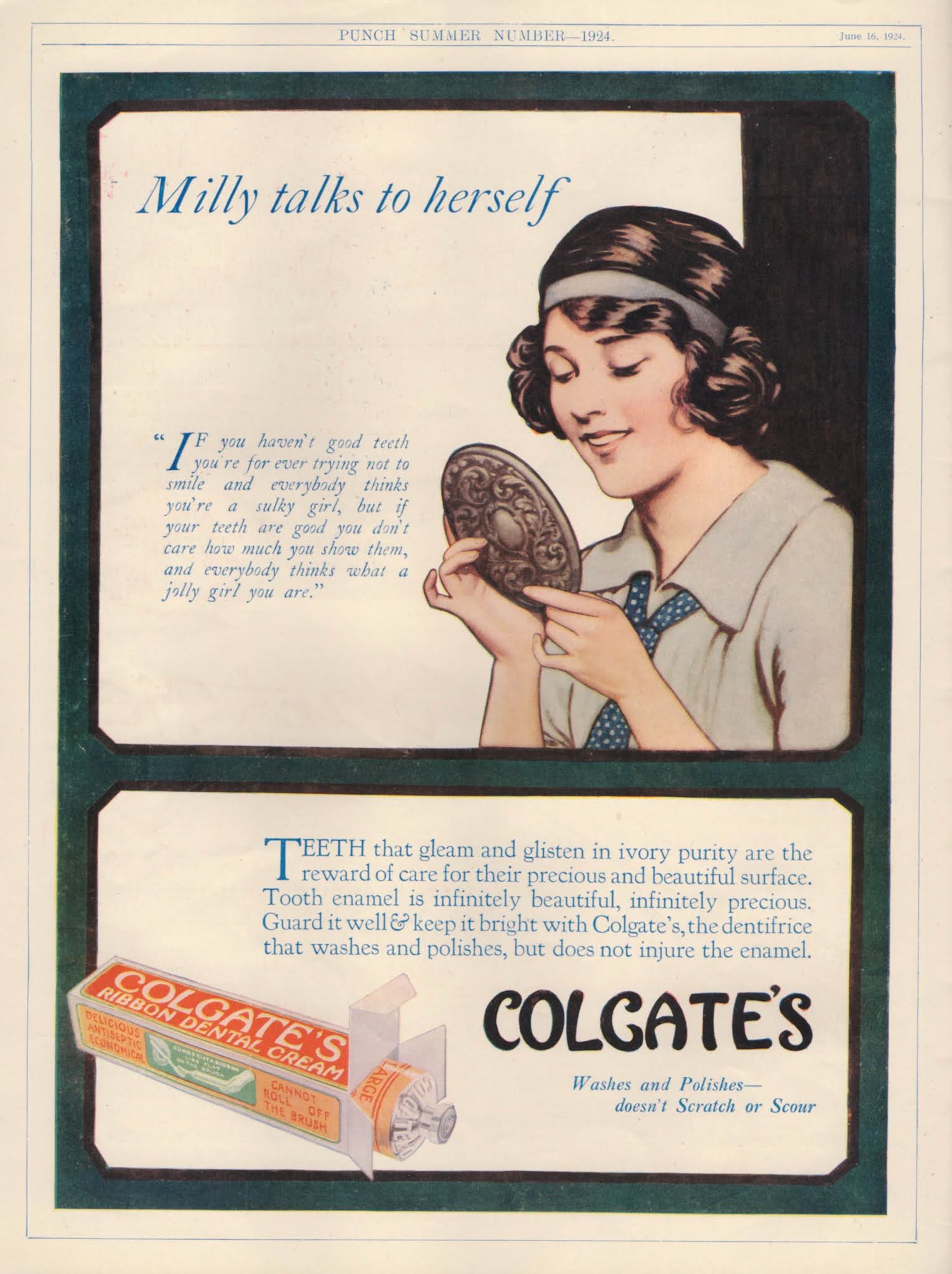
One thing on which all Americans can agree, red state and blue state alike, is the dreadful condition of British teeth.  Just compare their brilliantly enamelled, broad and confident smiles with our own tight lipped, sheepish grins, desperate to conceal the inner putrefaction and decay.  Americans are quick to attribute this to our NHS and its tradition of socialistic medicine - ineffective by definition.  More to the point may be generations of a sugar heavy diet combined with casual dental care. The most affordable confectionery items for the generation I grew up with were boiled sweets and fruit gums which could not have been more lethal to oral health if they had been designed for the purpose.  The former would crush and splinter tooth enamel while the latter would glue themselves to the tooth, force their way into cavities, and wrench the weakened teeth from their sockets.

This booklet was designed to encourage children to improve their oral hygiene by making regular use of Colgate’s Dental Cream - the message came wrapped in a simplistic tale. Patsy was dealing with feelings of inferiority brought on by a brief encounter with a pretty girl named May whose teeth shone with dazzling brightness.  A callous nurse assures Patsy that she will never be the equal of May.  All seems lost until an emotionally supportive elf intervenes and deposits a gift-wrapped tube of Colgate at the foot of a pear tree for Patsy to find via a midnight assignation.  Liberal use of Colgate swiftly dispels Patsy’s body image anxieties as she records her efforts on the Clean Teeth Chart. For Colgate this was one small step along the road to world domination. Today’s Colgate has the highest degree of global market penetration of any consumer product.


Wednesday, 12 August 2020

More Tea From Lipton’s


Following up a post from July 2007 - more examples of postcards publicising the availability of Lipton’s Tea.  Lipton made full use of traditional iconography of imperialism - a team of Indian elephants advancing to market escorted by exotic turbaned outriders. Lipton’s plantations in India and Ceylon formed an empire within an empire with a workforce of tens of thousands toiling in the fields and factories to ensure the British public was supplied with all the consolations of a nice cup of tea.  Tea drinking became embedded in the soul of Victorian Britain and to meet the ever increasing consumer demand the industry mechanised the processing and packaging to cut costs while promoting a branded product with forceful advertising campaigns.  Picking the tea was done by hand and Lipton’s took pride in offering visual proof of the scale of their operations.  Enormous crowds of anonymous labourers were rounded up in front of the camera - some were deployed in formation to spell out the hallowed name of Lipton. The British obsession with tea came at a heavy cost to the environment as vast areas of forest in the Nigiris and Assam were scoured to make space for tea cultivation, destroying the indigenous wildlife in the process.  The human cost could be seen in the deplorable working conditions and starvation wages paid to the native workforce. Throughout the Victorian era and into the 1930s, virtually all the tea production  was exported to Britain. Only when the price of tea slumped on international markets did it occur to British producers that there was an Indian market ready and waiting on the doorstep.  Which explains how tea drinking became an Indian obsession every bit as compulsive as that of the British. (Inglorious Empire: Shashi Tharoor)


Sunday, 5 July 2020

Fridge Full of Cold Cash


There are consumers out there for whom the world of contests, competitions and giveaways is their playground. With hard work and persistence, and a little good fortune they can enrich their lives by turning a box top or postage stamp into a year’s supply of dog food or a trolley-dash through Pets at Home. At the top of the profession, an exclusive minority can be found flying first class, scoffing in Michelin starred restaurants and irradiating themselves on tropical beaches in gated resorts, all at no cost to themselves. Online tools are easily available to search for opportunities and all that’s required is an unshakeable faith in the disinterested generosity of big business and a bulk supply of postage stamps.


These examples are drawn from my mid-century data dump - they have a certain rough charm with their basic, shouty graphics, designed to lift the ads off the page and capture the attention of the ever-hopeful consumer on the lookout for free stuff. New cars are the most frequent offer but a refrigerator stuffed with dollar bills is an arresting prospect that could tempt even the most sober reader. No proof of purchase required and only four statements to be deemed true or false - just spare a thought for the unhappy citizens of Nebraska and New Jersey whose state laws prohibit their participation in this bonanza. Inflation note: the contents of the fridge in 1959 would have to be uprated to $220,000 to maintain the buying power. In cryptocurrency this equates to 23 bitcoins (as at May 2020). How to store bitcoins in a fridge is another problem. Not everything is a sweepstake - sometimes there’s a test of skill where some linguistic agility could come in handy. Completing a sentence on the merits of Ivory Flakes must win the judge’s approval with wordplay or internal rhyming. Another popular task is to bestow a name upon the progeny of a brand character (Borden’s) or find a name for a little sleepyhead (Englander beds).


The most ingenious offer comes courtesy of Remington Shavers - the chance to become your own personal fund manager and launch yourself on Wall Street where unlimited wealth could be yours for the taking. The lucky winner could choose their own share stocks to the value of the sum of a single share in every quoted company on the New York Stock Exchange as at May 31st. 1957. 1957 turned out to be a bear market with a marked decline in stock values. But anyone who chose to invest $1,000 in the newly launched Disney shares would be 3 million dollars better off by 2019.


Friday, 26 June 2020

Bicycles, Watches & Books


As long ago as 1897 the British consumer was subject to all manner of ingenious inducements to favour one branded product over another. Nobody took the philosophy of competition more seriously than the hyperactive Lord Leverhulme in his mission to cleanse the Victorian working class exclusively with bars of Sunlight and Lifebuoy soap. Sunlight was a laundry soap, launched in 1884 while Lifebuoy was for personal use and had only been on the market for 2 years. Lux soap was still 2 years in the future. Plenty of long-standing competitors (Pears’, Wright’s Coal Tar, Hudson’s, Vinolia*) were prolific advertisers and Leverhulme’s response was to extend the reach of his advertising from general to specialist periodicals and launch lavishly funded promotional rewards designed to tie customers to his brands. To claim a prize a customer had to submit a minimum of 50 Sunlight or Lifebuoy wrappers. Combinations of the two weren’t acceptable. This was a major challenge for the average user and almost insurmountable for those who aspired to win a bicycle since the value of the prize was proportionate to the number of wrappers sent in. It’s safe to say that the additional sales revenue must have comfortably exceeded the value of prizes won by the fortunate few. History doesn’t record whether interested parties formed themselves into syndicates to pool their resources - even if successful they would have faced the problem of how to divide the ownership of a bicycle or a pocket watch. Advertisers are never less than one step ahead of consumer resistance and one failsafe technique is to present the manufacturer as a paragon of disinterested generosity, showering its loyal customers with munificence. In the last decade of the Victorian era, consumer business expanded at speed and famous brands intensified the battle for supremacy. A very different story from the languid Fin de Siècle decadence that prevailed in the expressive arts.

*Hudson’s Soap was acquired by Leverhulme in 1908, Vinolia in 1906 and Pears’ in 1920. When Simple Skincare was bought by Unilever in 2010, it became the owner of Wright’s Traditional Soap, as it is now known.