Showing posts with label new yorker. Show all posts

Thursday, 11 May 2023

Bruce McCall (1935-2023)

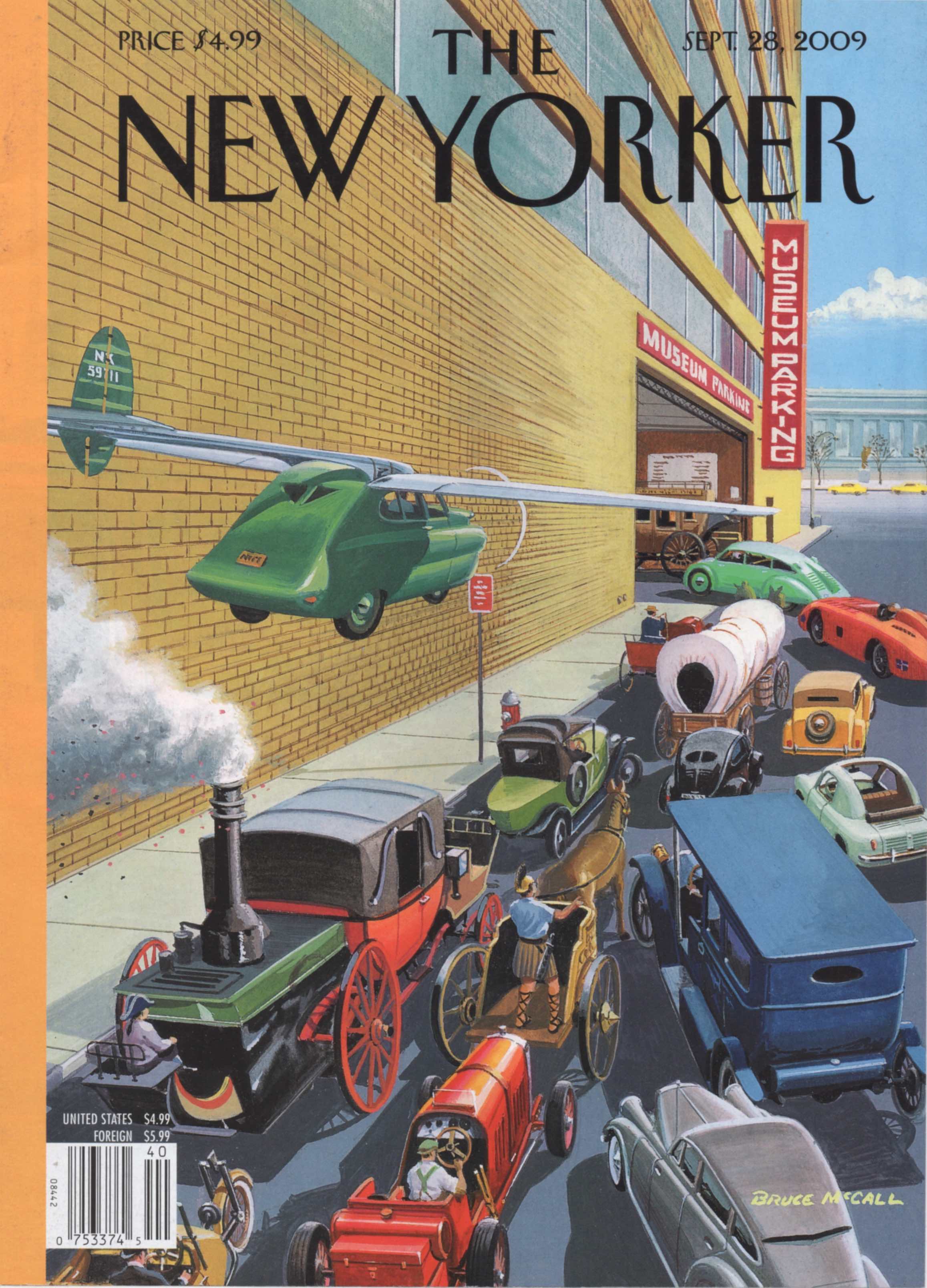
I’ve been a fan of Bruce McCall’s illustrations since I first saw his parodies of Streamline Moderne in the pages of National Lampoon (see above). When he became a regular cover artist at the New Yorker I collected his covers as well as his books (Zany Afternoons, All Meat Looks Like South America).  In the past I’ve read some snide criticism of his work - stylistically conservative, unadventurous and boring, but that ignores the ingenuity and asperity with which he undermined the conceits and social pretensions of self-conscious modernity. His experiments with the visually incongruous could rival those of Magritte, an artist whose work was greatly enhanced by conservative techniques of representation. By the time of his death he had drawn 83 New Yorker covers (almost 18 months worth) and though he kept returning to the same themes (human vanity, bears, ocean liners, aviation, motor vehicles, advertising) he always found something fresh to say in his familiar deadpan fashion. With decades of experience toiling in the advertising industry he knew whereof he spake. He died last Friday at the age of 87, by way of tribute this is a selection of my favourites of his streetscene covers for the New Yorker taken from my scrapbooks.




 Plus two examples kindly provided by Robin Benson.


Wednesday, 30 December 2020

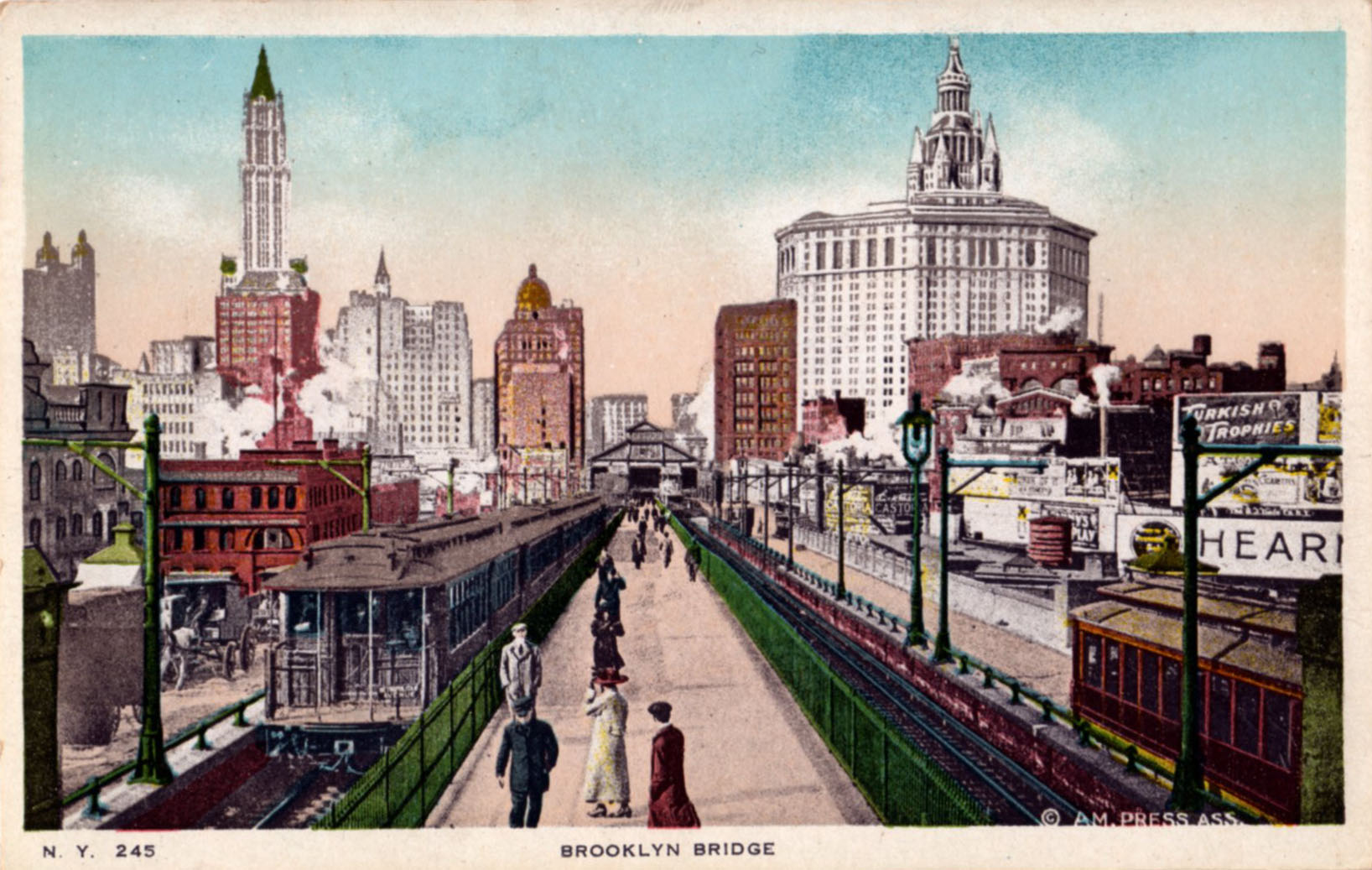
New York City Landmarks No. 3 - Brooklyn Bridge

When it opened in 1883, the Brooklyn Bridge was the longest suspension bridge in the world - a distinction it would hold for 20 years.  It spans the East River and links Manhattan with the borough of Brooklyn.  Design and construction was a family affair - John Roebling was the designer, his son, Washington was the project manager and his wife, Emily Warren Roebling, supplied additional design work.  The granite and limestone towers, each with twin gothic arch piercings went up first, followed by the cable work - constant technical details prolonged the construction to a total of 13 years.  Lengthy approach viaducts were needed to raise the roadway to the deck level, itself elevated to allow for the free passage of ocean going shipping.

Visually striking for the grandeur of scale and for the contrast between the delicate cable stays and the massive presence of the two towers, the bridge rapidly became a source of fascination to graphic artists and painters. Artists from all over the US and beyond felt the need to record their impressions of this stupendous structure. Georgia O’Keefe, Joseph Stella, John Marin, Richard Estes, Albert Gleizes, and C R W Nevinson. For the editors of the New Yorker, the bridge is one of the most powerful and emblematic symbols of the city to go by the frequency with which it appears on the front cover 


Friday, 11 September 2020

Monocle Men

Monocle Men were never short of employment opportunities in the Universe of Brand Characters. Their association with good breeding and their foppish tendencies made them ideal product ambassadors. Rea Irvin’s creation for the New Yorker, Eustace Tilley, epitomised the air of effortless superiority that a monocle confers. The updated Tilley from 2018 was drawn by Malika Favre. Heinz, of soup and ketchup fame, chose a monocled tomato (known as Mr. Aristocrat) to spearhead their advertising campaigns in the 1930s.  Often deployed in multiple, the top hats were conventional class signifiers but the rubicund features sent out a very mixed message suggestive of short temper and irritability - not the qualities looked for in a brand mascot. The breezy monocled bonhomie of the Striding Man in red frock coat and polished black boots has been around since 1909, embodying the virtues of Johnnie Walker whisky to the present day.  Mr. Brandyman does the same job for Martell with a brandy glass for a head - hand drawn in cartoon form, his raffish demeanour is amplified by the cigar or cigarette that’s never far from his lips.  In 1919 Sharps Toffee introduced Sir Kreemy Knut (biography here) who, with bow tie, briefcase and swagger stick, launched his campaign to ruin the nation’s dental health with caramelised sugar.  A final mention for Mr. Peanut whose contribution to monocled marketing has been featured extensively on this blog, most recently here in 2012.