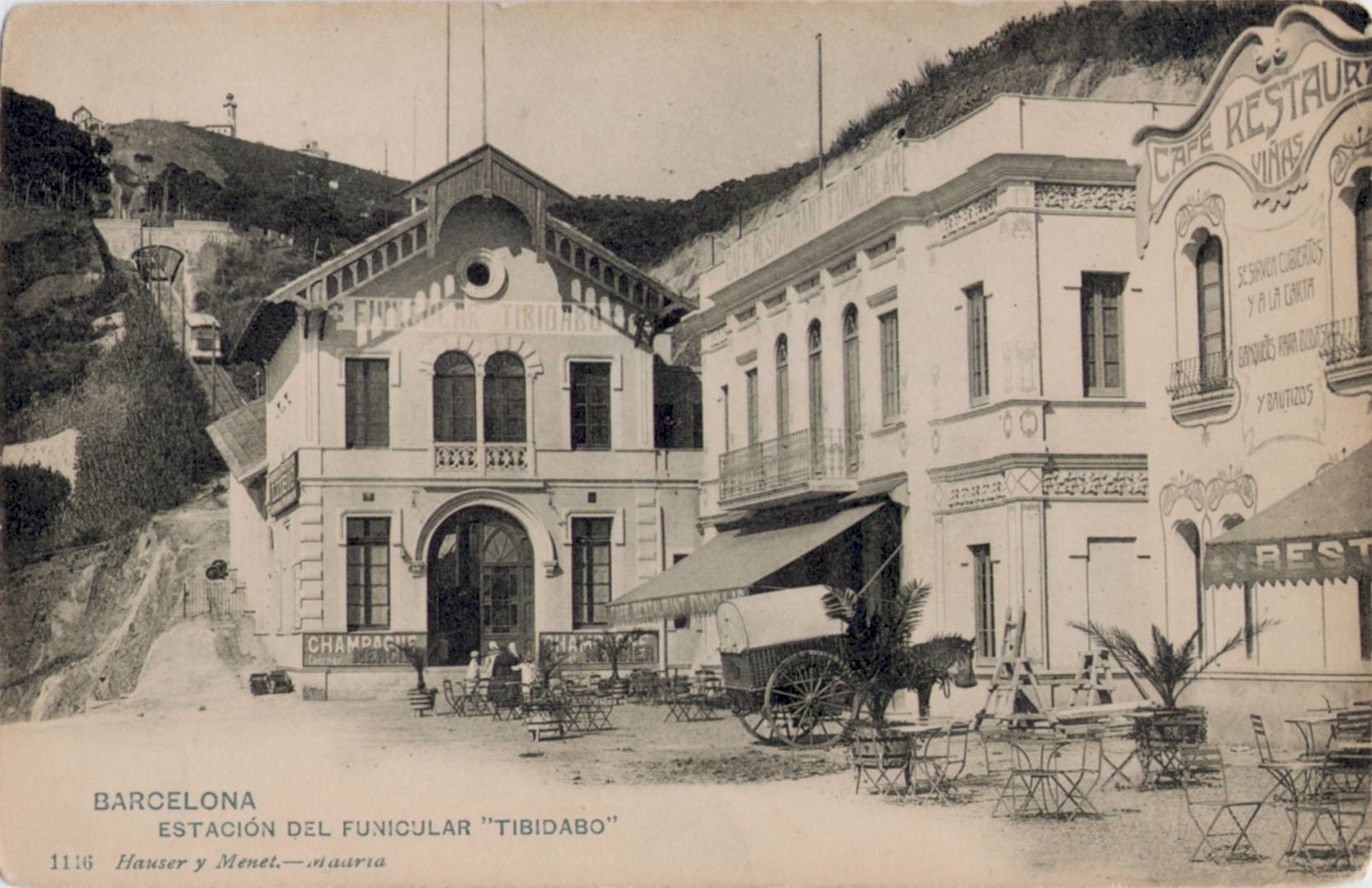
Tibidabo is a 500 meter hill overlooking Barcelona. With the example of Sacré Coeur in Paris in mind and the encouragement of Pope Leo XIII, the Spanish Roman Catholic Church began construction of the Sagrat Cor (Sacred Heart) church on the summit of Mount Tibidabo in 1902. Three years later its supremacy was challenged by the impudent arrival of the Tibidabo Amusement Park which opened in 1905 (just in time for the global boom in postcard sales). An amusement park can be thrown up in a fraction of the time needed to build a cathedral and the Sagrat Cor was only completed in 1962. Since when the pair have represented the sacred and profane in a relationship of mutual reproach. The park and most of its original rides remain in operation supplemented by the regular introduction of new attractions. Public access was via a new purpose built funicular railway that began running in 1901. Opposite the funicular station, a Moorish-styled hotel was built. A superabundance of roller coasters and white knuckle rides suggests that the citizens of Catalunya possess an unusual appetite for dramatic demonstrations of gravitational force. A suspended monorail (Laderas del Monte) conveys passengers in open capsules around the perimeter of the summit offering spectacular views of the city far below. More gentle attractions - carousels, a puppet theatre and a Museum of Automata - are available but the emphasis is on vertigo-inducing contemplation of the void. The postcard industry supplied a wide range of views of the park and recorded an exhaustive survey of the operation of the funicular railway from which this selection is drawn.
Showing posts with label funfair. Show all posts
Wednesday, 5 April 2023
Monday, 17 July 2017
Once Upon a Time in Dortmund
Zeche Zollern is a carefully preserved industrial site to the north of Dortmund that has the distinction of being Europe’s only Art Nouveau/Jugendstil colliery. Stepping from the train at Dortmund-Bövinghausen, I myopically missed all the directional signage and set off in the wrong direction. My walk took me round all four sides of a large rectangle until arriving back where I started. This time the signs were unmistakeable and the rest of the journey, uneventful. Flags, bunting and banners announced my destination, which is more than I usually expect. And the sounds of fairground organs and steam engine whistles suggested an event was underway.
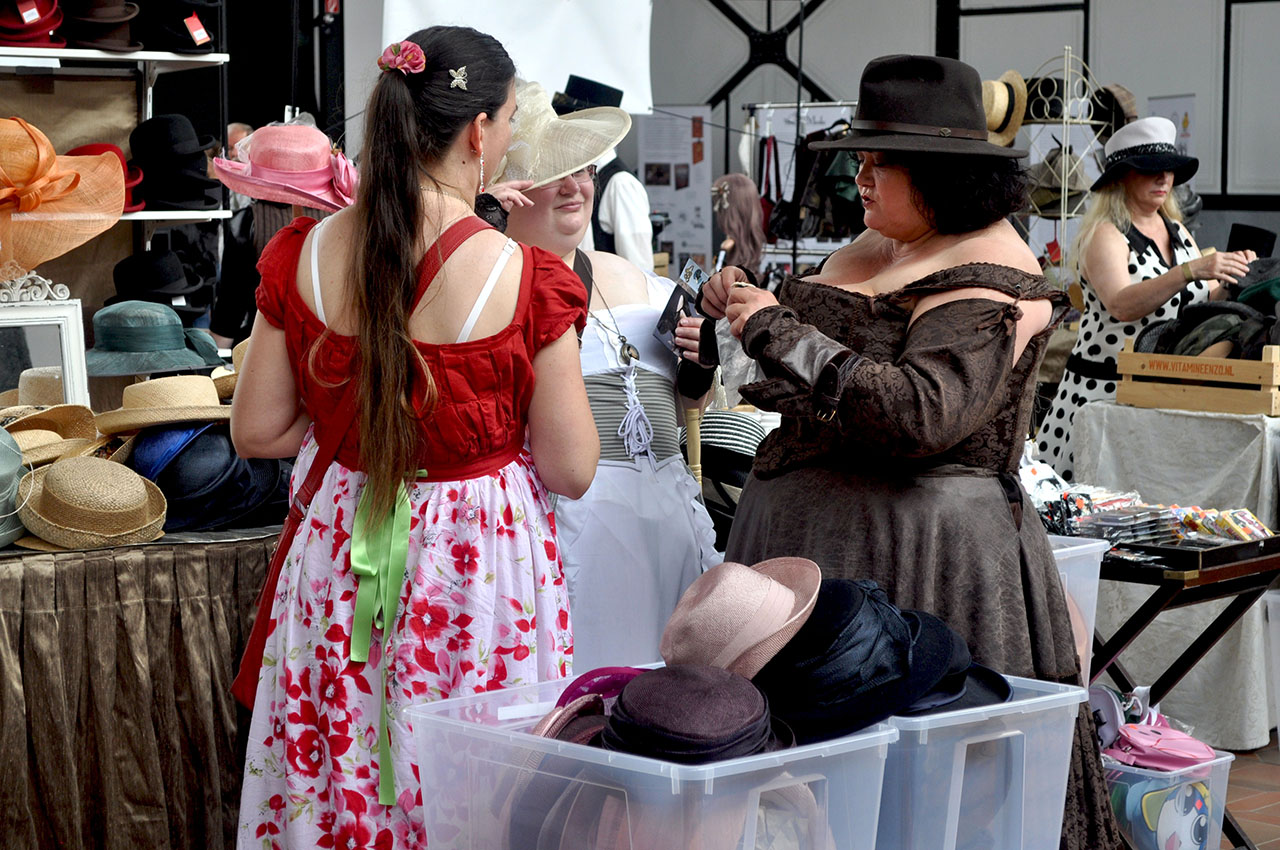
Inside the colliery site was a flurry of activity graced with top hats, fishnet tights, goggles, compasses and pocket watches. An ancient steam road roller and a brace of traction engines were on hand accompanied by the hiss of escaping steam. Stilt walkers and penny farthing cyclists meandered around the site. Recently returned big-game hunters, grouse-shooters and polar explorers mingled with the crowd. Dr. Marrax prepared to bamboozle his audience with a miracle cure – assisted by some mandrake root and assorted paraphernalia. Carousels were in full swing and the Flea Circus was open for business.
Steampunk is one of many minority cults that came into existence without me really noticing – to me it looks like a marriage between Gothic and High Victorian Heavy Engineering. It seems remarkably unthreatening and congenial and, to my knowledge, there are no records of Steampunk hate crimes or civil disorder. The choice of venue for a Steampunk gathering, titled “Once Upon a Time”, was perfect – no better place than a cluster of over-elaborate post-industrial relics.
Zeche Zollern was a prestige project from its inception in1898. Prominent Berlin architect, Bruno Möhring (1863-1929) was engaged and produced an opulent Jugendstil styled series of surface buildings. Most famously the Machine Hall with its stained glass entrance that originally included a Hector Guimard-style aedicule (now lost). The colliery was closed in 1966 and narrowly avoided demolition. Since then it has been extensively restored as a historic industrial relic and a site for cultural events. It was the industrial relic that attracted my interest and the Steampunk event was initially an unwanted distraction. My preference is for minimal human presence in my photographs but, bowing to the inevitable, I tried my hand at documentary photography with mixed results as seen here.
Labels:
art nouveau,
colliery,
dortmund,
funfair,
Germany,
heritage industry,
industry,
jugendstil,
ruhr,
ruhrgebiet,
steampunk,
zeche zollern
Subscribe to:
Posts (Atom)