Showing posts with label canada. Show all posts

Wednesday, 30 September 2020

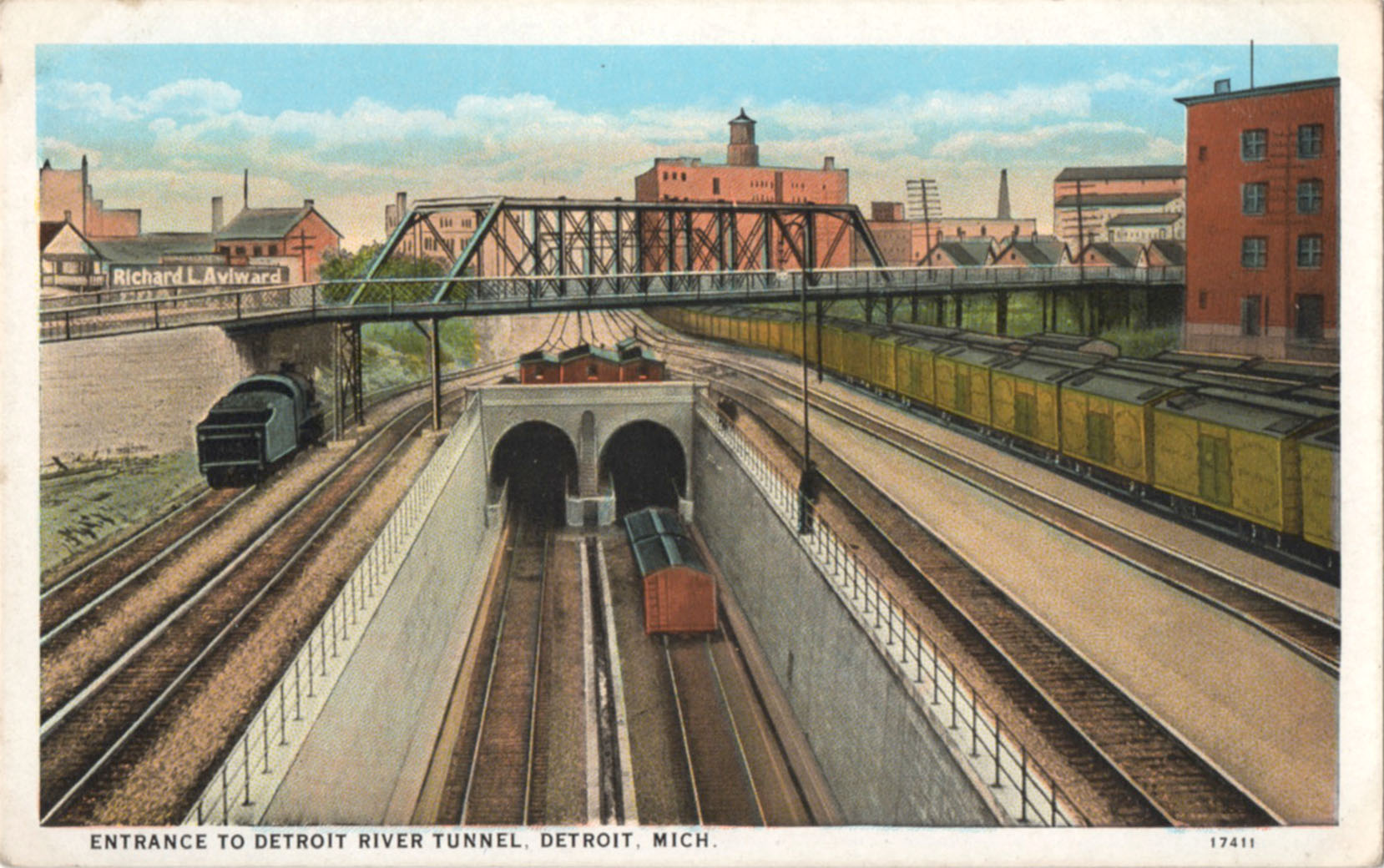
Rail Tunnel to Canada

For twenty years before Detroit was connected to Canada via a road tunnel, the only physical link was a rail tunnel built in 1909-10 by the Michigan Central Railroad. It was clearly a thing of wonder given the variety of postcards recording its scenic attractions.  There’s a certain spatial complexity with a tunnel portal located beneath an over bridge with busy tracks on either side, but hardly enough to make it a place of pilgrimage. Freight trains still run through the tunnel which is now owned by the Canadian Pacific Railway although the surrounding infrastructure has largely disappeared leaving a wasteland with even less to commend it.  According to Wikipedia the area is now extensively patrolled by Homeland Security, the Detroit Police and railroad security agents. More to follow on the city of Detroit.



Friday, 25 September 2020

Road Tunnel to Canada

There are two ways to drive from Detroit in the US to Windsor in Canada. The most favoured route is across the Ambassador Bridge (1929) that sails high above the Detroit River that separates the two nations. An alternative route is via the Detroit - Canada Tunnel (1930) - a southbound journey through an immersed tube just short of a mile in length.  Detroit is by far the larger of the two cities and some of these postcards underline the point. One shows the imposing Detroit skyline with a graphic representation of the tunnel approach while another depicts the tunnel in cross section with the humble cluster of low-rise buildings on the left, contrasted with the magnificence of Detroit on the right. Both postcards of the tunnel interior are focused on the mystical point where two countries meet at a subterranean border. Last is a dingy card view of the tunnel entrance on the Canadian side in a depressing setting between two barrack-like hotels. Not much improvement since by the look of the Streetview image.


Monday, 30 July 2018

Postcard of the Day No. 91 – Grain Elevators, Buffalo, NY


The city of Buffalo is the spiritual home of the grain elevator. At its height there were over 30 of these gargantuan storage facilities lining the river and harbour. Grain from the Midwest was shipped to Buffalo via the Great Lakes and stored prior to transhipment to the Atlantic seaboard and Europe. The end for the Buffalo grain trade came in 1969 with the opening of the St. Lawrence Seaway – only two of the surviving 15 structures are still handling grain. Elevator Alley as it is known, is still an impressive sight and has been developed as a visitor attraction – a campaign exists to have it designated as a National Park.


The example shown on today's card appears to be an early wooden cribbed construction with multiple hipped roofs. Later elevators were built in concrete and formed of cylindrical silos. Other cards show examples from Canadian ports – the last card shows a prairie elevator. Cereal growers would transport their crops to the local elevator from where they would move on by rail. In wheat growing states every small town would have its elevator. It would normally be the largest building in town, visible for miles and much valued as a landmark.


For artists and photographers grain elevators have been perpetual objects of fascination. Their overwhelming physical scale and repetition of geometric form offered rich graphic possibilities to the Modernist sensibility. They lent themselves easily to simplification and abstraction and supported the popular pre-war idea of the industrial sublime. Painters who explored them include Charles Demuth, Charles Sheeler, Ralston Crawford and a host of amateur artists, mainly from Canada, whose work (of variable quality) can quickly be found online. John Vachon, David Plowden and Andreas Feininger all produced memorable photographs of elevators. And the great Düsseldorf taxonomists, Bernd and Hilla Becher published their definitive survey in 2006. Their impassive scrutiny is extended over 200 plates.


Wednesday, 28 February 2018

Snow Scenes in Postcards


For the last ten days or so, the nation’s weather forecasters have been addressing us in their self important faux-demotic on the subject of snow. In ever more apocalyptic terms we have been warned to expect unprecedented extremes of freezing temperatures and snowfall. If it was their intention to induce fear and dread, their success is demonstrated by reports of panic-buying of basic foods and supplies. TV newsgatherers have been out and about in the snow covered uplands in anticipation of blood curdling tales of human suffering – you can sense their disappointment when their interviewees respond with stoic acceptance of the tribulations of winter. In the meantime, the red tops have reworked the weather event as The Beast from the East in a phrase that neatly evokes the national paranoia over immigration that has poisoned political discourse in recent years. As a reminder that winter hardship was, and remains so for many, a routine event, we offer a selection of vintage postcards from winters past. To see some illustrations of snow scenes posted in 2010, please follow this link.


Friday, 1 April 2016

Postcard of the Day No. 82 – Seeing Niagara


Both Canada and the United States are proud hosts to one of Nature’s greatest spectacles – Niagara Falls. With such an enormous number of visitors it’s never long before the collector of postcards encounters one of the many hundreds of cards to feature this awe-inspiring sight. I salute the anonymous buyer of today’s card for having rejected all the conventional views on offer in favour of this distinctly sidelong glance. Half a dozen of tourists encased in heavy-duty rainwear pose for the camera in a rather random grouping. They are about to depart on a cruise that will expose them to a ritual soaking at the base of the Falls, visible behind them. Below is a selection of postcards where the publishers have focused on the local infrastructure or the transformation of the Falls in the depth of winter.