Showing posts with label railway graphics. Show all posts

Tuesday, 23 February 2021

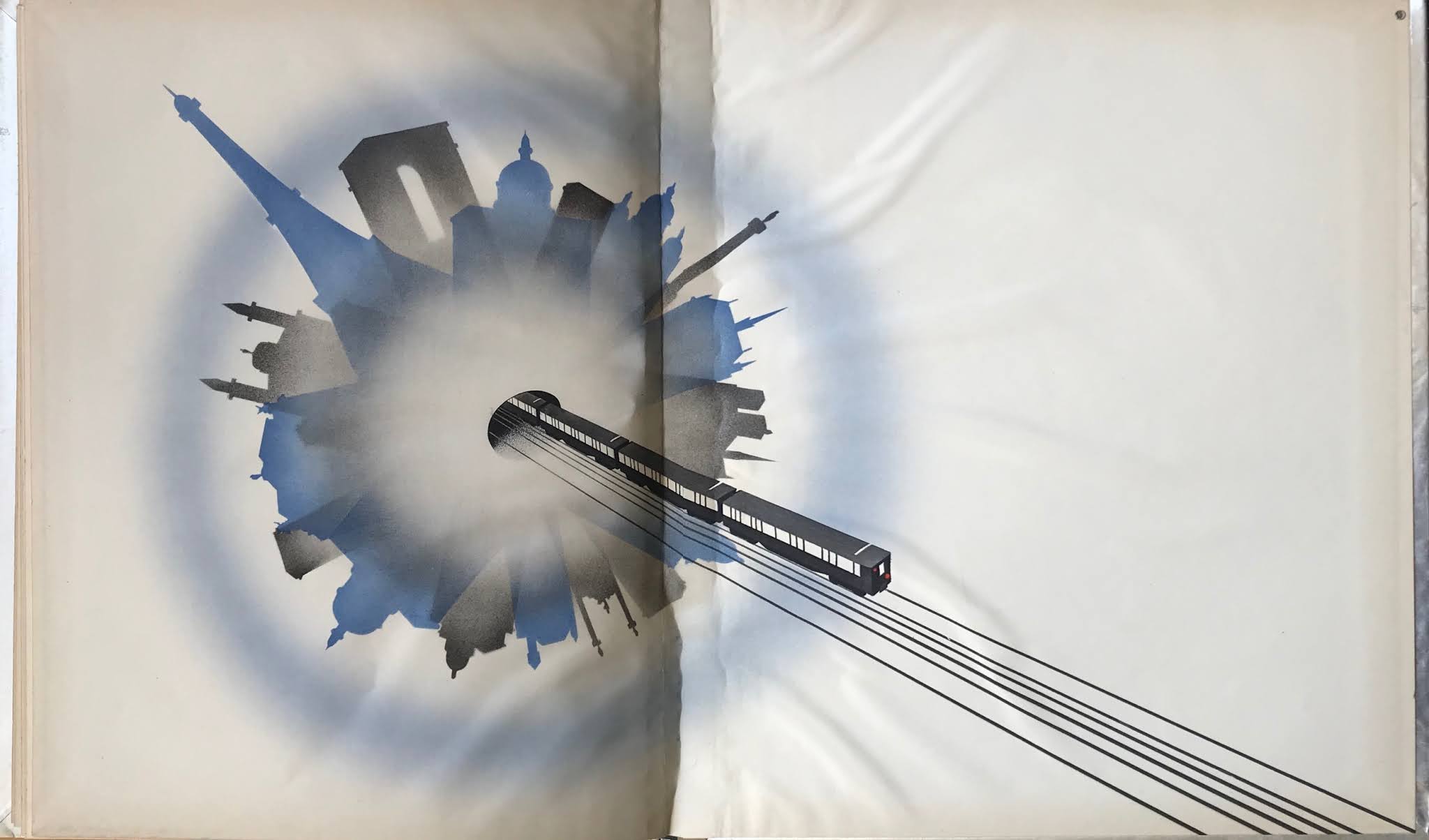
Paris Métro 1931

Every decade in the first half of the 20th. century one or other of Europe’s colonial powers would mount an exhibition to celebrate and legitimise their imperial dominions and plunder.  The principle audience was a domestic one but it also offered an opportunity to remind rival powers of France’s global reach.  Years of planning and a purpose built exhibition building was essential to do justice to the scale of the colonial project and L’Exposition Coloniale opened in May 1931. A subsidiary aim of the exhibition was to portray the French colonial presence as enlightened and benign as if colonial subjects were almost equal partners in a global French nation.  We may look back and see a shaming exercise in imperial condescension and national self-aggrandisement but that’s not how the French public would have seen it.  For them it was a powerful reminder of France’s high standing as an international player.  Reinforcing patriotic values at a time when a gathering economic crisis was threatening the stability of a nation rapidly fracturing into political extremes of Right and Left.  Outdoor exhibits were displayed in the Bois de Vincennes and a more scholarly presentation of indigenous arts and crafts was housed in the newly constructed Palais de la Porte Dorée, about which we posted in February 2015.


The public relations staff at the Paris Métro got swept along in the general fervour and marked the occasion with a lavish presentation book proclaiming the wonders and achievements of Parisian public transport, expensively packaged within a metallic finish board cover.  Inside were tipped-in reproductions of specially commissioned paintings of Métro-related subjects and tables of statistics demonstrating the superiority of the Métro over its international rivals. The endpapers were graced with air-brushed Art Deco-styled imagery of the Métro in action that added to the air of luxury the publishers were striving for.  It was not something to be casually handed out to the general public but almost certainly reserved for honoured guests, foreign diplomats and senior officials as a corporate souvenir gift.


Saturday, 21 February 2015

American Railroad Journey Planners


A selection of schedules from American railroads, mostly from the 1940s. Some are from minor operations, others from the giants of railroading such as Pennsylvania Railroad, Santa Fe and the New York Central. They all offer the opportunity to plan the trip of your choice and visit many out of the way destinations in the privacy of your own imagination. If you have the inclination unreasonable amounts of time are easily wasted, immersed in masses of obsolete data. Once the war was over, the great American passenger railroads were in decline as the volume of private cars on the roads rapidly expanded. The love affair with the open road went from strength to strength as the network of Interstate Highways reached deeper into the heart of the nation. Switching from war to peace-time construction enabled the aviation industry to scoop up the majority of long distance travel and the downfall of the passenger railroads was complete in 1971 when Amtrak took over the last viable remnants of a once dominant network of routes. 


Saturday, 25 January 2014

Missouri Pacific 1950


This colourful publication represents a worthy effort by the Missouri Pacific Lines (popularly known as Mo-Pac) to inject some excitement into marketing its services. Styled as the Route of the Eagles it operated a network of passenger and freight trains based in the Midwest city of St. Louis. It was the era of diesel powered streamliners and MPL offered five named trains under their Eagle branding to a choice of destinations, from Omaha in the northwest and the Gulf of Mexico to the south. The aquiline association was chosen from employee suggestions in 1940. The attractions of Pullman roomettes and observation cars were described in detail to tempt passengers on to the trains. Freight handling services featured prominently, including a helpful timetable confirming that a consignment departing Baton Rouge at one minute after midnight on a Monday would reach St. Louis at 3am on Wednesday. 


Thursday, 12 December 2013

Pennsylvania Railroad Serving the Nation


There’s an entertaining case-study in Roland Marchan’s Creating the Corporate Soul (1998) on the subject of the Pennsylvania Railroad (PRR) and its pioneering enthusiasm for the devious art of public relations. Second only to the New York Central in terms of passenger numbers, the railroad was unloved by both customers and employees according to an opinion survey it commissioned in 1926. Travellers were unimpressed by singularly unhelpful and discourteous staff while the workforce was confronted by an employer hostile to unions and bent on reducing wages and pensions. To break this vicious cycle, a campaign was launched with the aim of raising employee performance by celebrating instances of exceptional assistance rendered or displays of outstanding courtesy (both actual and fictional) in magazine advertising and internal newsletters. Nothing less than a corporate spirit of virtuous service would suffice. A wedge was driven between the workers and their union by assiduously promoting a company employee association. Another company ambition was to develop a close relationship with all the small communities served by its network and convince the populace that despite its monolithic scale, at heart it was a small business like any other that only existed to serve the needs and desires of ordinary folks. Every bit of publicity was designed to reinforce the notion that the PRR possessed a heart and soul dedicated at every level to the welfare and happiness of its customers. This campaign was regarded as an exemplar by the infant public relations industry but as Marchan points out, there was no conclusive evaluation of the results and such indications as there are suggest it accomplished very little. By 1933 some 67,000 workers had been laid off and the remainder casualised and an industry expert is quoted saying that the PRR was “easily the most hated railroad and General Atterbury (company president) the most hated railroad executive”. 


From 1941 the priority was to demonstrate the company’s resolute commitment to serving the military campaign – every freight train carried essential supplies and munitions and every passenger train conveyed troops to their point of embarkation. Public morale was boosted by restating the fundamental values of American greatness, elevating vast clouds of patriotic fervour into the upper atmosphere alongside the smoke from the locomotives. The rewards of victory were held out, offering a return to an era of peace and plenty to sustain the public through the privations of war. Every operational aspect was reconfigured to save waste and improve efficiency and then reported to the public via mass circulation magazine advertising. Copy was written to personalise the PRR and communicate in the voice of a concerned citizen, gently reminding the readers that all essential supplies, raw materials, power, light, energy, food etc. were dependent on the activities of the railroad. Blue-collar and white-collar put aside their differences and united in the national interest. 


When peace returned there was a focus on rebuilding the infrastructure although the deeper message was to enlist support for the campaign for tax breaks. New improved coaches offered passengers enhanced space and comfort while new freight wagons destined to transform industrial efficiency rolled off the production lines to be waved on their way by enthusiastic small boys. Then there was the moment when the military uniform was set aside in favour of a return to the railroad blue, a transition celebrated in an ecstatic hyper-real tableau that captures the resumption of peacetime normality in an effort to reinforce esprit-de-corps. Molly Pitcher was doubtless sent packing as other servicemen returned to reclaim their former positions. The sunny prospects of vacation travel replaced the exigencies of wartime that demanded that every passenger train was shown passing through an industrial underworld beneath glowering apocalyptic skies. Despite the gleaming new trains with their recreation cars, the convenience and superior speed of airlines were rapidly stealing the customers away. When the network of interstate highways was complete, the end came quickly and in 1968 the PRR was merged out of existence.