Tuesday, 31 July 2012

Under Limestone Hills

“There was a rocky valley between Buxton and Bakewell, once upon a time, divine as the Vale of Tempe... You Enterprised a Railroad through the valley - you blasted its rocks away, heaped thousands of tons of shale into its lovely stream. The valley is gone, and the Gods with it; and now, every fool in Buxton can be in Bakewell in half an hour, and every fool in Bakewell at Buxton; which you think a lucrative process of exchange – you Fools everywhere.” 
 John Ruskin, master of self-righteous Victorian bombast, thus addressed the British working-man in the pages of Fors Clavigera. Ruskin’s professed admiration for the dignity of labour did not extend to the itinerant labourers who toiled mightily on behalf of the Midland Railway carving cuttings through the limestone, drilling tunnels through the hills and bridging the rivers with viaducts, linking the fools of Buxton with their counterparts in Bakewell. After just over a century of trains from St. Pancras to Manchester, the railway that so offended Ruskin was closed in 1968. Subsequently the track-bed was converted into a footpath and bridleway (Monsal Trail) in the care of the Peak District National Park Authority. In May of last year the Park Authority completed a project to modify the former railway tunnels for public access and in doing so, eliminated the need for some lengthy diversions and greatly enhanced the walking experience. 


The subject of tunnels is one we keep returning to, offering fascination on a number of levels. Walking through tunnels it’s difficult to ignore the fact that these are places we are not meant to be in – deep in the earth, encircled by rock and scree and far from the nearest source of natural light. Then there’s the sheer volume of labour involved in construction, with primitive tools in conditions of terrifying discomfort. An enormous price was paid in terms of the amount of injury and accidental death inflicted upon the unprotected workforce. All this melancholia hovers in the back of the mind as we trudge from portal to portal through the chill and humid semi-darkness but nothing dispels it so rapidly as the need to take urgent evasive action as an army of super-fast cyclists sweep past. The risk assessments and safety cases have all been duly observed, damp proof overhead lighting has been installed and a tarmac path offers relief from the scrunchy ballast. A sooty, black squelchy gunk adheres to the tunnel lining and offers a reminder of its former existence – a notice warns of the damaging consequences of transferring this toxic post-industrial slurry to our lips. 


Monday, 23 July 2012

Park Hill – Utopia Remodelled

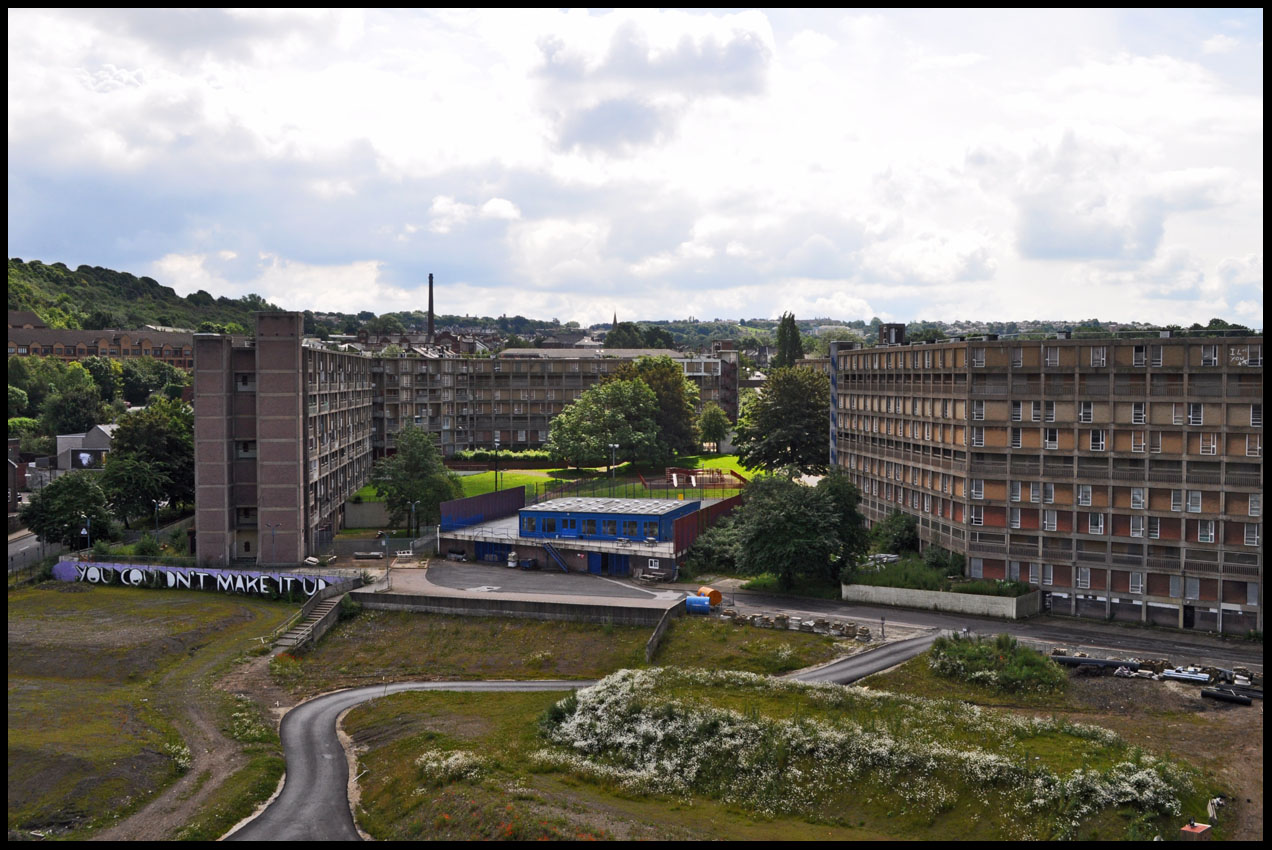
Most utopian visions go into gentle decline as the years pass by but Park Hill in Sheffield, like many high-rise social housing developments, fell from grace at speed. The fame it now enjoys is a product of its dramatic domination of the city skyline and the scale of ambition, all the more striking in a culture where the preference is for modest, provisional, interim, incremental solutions to housing needs. It was a major statement that reflected the city’s self-confidence. Almost 3,500 residents were accommodated here when the buildings were completed in 1961 but as the novelty wore off it became an increasingly unpleasant place to live – poor maintenance, sound insulation issues, sub-standard materials and anti-social behaviour all contributed. The argument about responsibility for this goes on – target-obsessed city planners insensitive to the needs of families with children, architects with grandiose ambitions, constant downward pressure on housing budgets and feckless tenants have all attracted blame from one quarter or another.

Fifty years having passed since completion, the scheme fits a historic narrative that leads back to Marseille and le Corbusier’s Unité d’Habitation and to the Karl-Marx-Hof in Vienna. The linked access decks (streets in the sky) at every third level caught the public imagination and the buildings attracted admirers and detractors in equal measure until in 1998 English Heritage awarded grade II* listing. Fourteen years later, only the southernmost low-rise buildings remain occupied by council tenants. The greater part of the scheme is vacant with the initial phase of refurbishment and internal remodelling by developers Urban Splash (closely monitored by English Heritage) nearing completion. The first block to be finished should be ready for occupation in December and a sales campaign is underway. The campaign must contend with a generalised cultural antipathy to concrete and high-rise (brutalist, unsympathetic, inhuman scale, anti-individualist, un-English) and additional hostility from enemies of the “heritage industry” and opponents of gentrification.

When you go inside, you find yourself trying to imagine exactly what it would be like to live there when the fascination of the spectacular views begins to fade into dull familiarity. Storage space is minimal, so a spare and austere lifestyle would be an advantage. An occupant with acquisitive habits would rapidly come up against the limits of what could be accommodated in rooms of modest dimensions. The original room plans were designed to Parker Morris standards – practical for 1961 but incompatible with the world of home cinema, jumbo-size fridge-freezers, walk-in wardrobes and wet-rooms. These confined spaces will have little appeal for the young professional looking forward to rolling out a four-seater leather sofa and a runway sized coffee table in a city centre loft apartment. Perhaps there’s a developing market for Modernism as nostalgia – a place where the coarse texture of brutalism serves as a corrective to the dazzling surface gloss of corporate aggrandisement. Will the rectilinear Modernist rhythms of horizontal and vertical elements appear models of restraint when compared with the computer-designed formal travesties that tower over the Gulf states or the Shards and Gherkins to be found closer to home?

Monday, 2 July 2012

Le Train Bleu


The name and the illuminated sign recall the great inter-war era of luxury rail travel but inside the restaurant at the Gare de Lyon all is Belle Époque. The Gare de Lyon was a prestige project timed to coincide with the Exposition Universelle in 1900 and the restaurant ambience is one of unrestrained glittering opulence – swags, cartouches, escutcheons, and super-size chandeliers vie for attention. Walls and ceilings are decorated with huge Salon-style paintings representing destinations served by the PLM while lascivious nude figures lounge around wrapped in a slick layer of gold leaf. Leather upholstery, fine cutlery and glassware, and condescending service from supercilious staff complete the picture.


Friday, 29 June 2012

From Dagenham With Love


These Ford Prefect cars were on the roads when I was a schoolboy – they seemed even then to be about as modest and unassertive as it’s possible for a motor car to be. A boxy shape and lack of body trim were just right for an age where nothing was more offensive than ostentation. This model was in production from 1953 to 1959 and despite its very English air of self-deprecation an effort was made to market a left-hand-drive version to the great American public whose taste in vehicle styling generally ran in the opposite direction. This included the two full page colour ads shown here from the pages of Life magazine in 1957-58. The unassuming looks appear especially incongruous in the affluent setting of a ranch-style lakeside property or the sophistication of a barbecue on a prairie-sized patio. I can’t see Don and Betty Draper taking to the highway in one of these, despite the appeal of “fine British craftsmanship” and a “curved windshield”. Clearly this was Ford’s response to the unstoppable advance of the VW beetle but for all its simple virtues the Prefect was destined for obscurity while the VW would become the object of a cult that endures to this day. The cover of Practical Motorist shows a Prefect in its natural habitat and in its natural condition – under repair. 


Tuesday, 26 June 2012

Chesterfield Girls


Tobacco’s long Age of Innocence lasted through the Thirties and Forties when these bright and breezy ads appeared in mass circulation magazines. Smoking was more than just socially acceptable – in the business environment it was probably worth making the effort to smoke to avoid any suspicion of un-American tendencies. Chesterfield was a Liggett & Myers brand that enjoyed great popularity in the last century but has declined in visibility in recent decades. The name was taken, not from the Derbyshire town or the celebrated sofa, but from Chesterfield County in Virginia. In terms of mid-century advertising it was one of the three most publicised brands, along with Camel and Lucky Strike. Many campaigns were visually conservative and might endure, with minor variations for as long as 5 years. Celebrity endorsement and entertainment tie-ins were the default approach but there were occasional departures from trusted formulae when the battle for market share demanded some refreshment of the brand. The promoters of Chesterfield were more open to innovation than their competitors and in 1926 launched the infamous Blow Some My Way campaign that directly targeted the female smoker for the first time. Despite the chorus of disapproval, the female participant did no more than express a fondness for secondary smoking. But once the barriers were down it wasn’t long before women were shown, first holding packs, later with cigarette decorously held between the fingers and finally, irrevocably descending into impropriety with a cigarette between the lips. 


Sunday, 24 June 2012

Watford in Three Lines


Félix Fénéon (1861-1944) was an intriguing character who at one point in his career had a day job as a senior civil servant in the Ministry of War that he somehow combined with an active involvement in anarchist causes. Under another hat he wrote as an art critic noted for his enthusiastic support of Neo-Impressionism and the work of Seurat, Signac, Luce and Pissaro. In 1906 Fénéon was employed by Le Matin newspaper in Paris to entertain readers with a selection of stories from the day’s news rewritten in condensed form. An anthology drawn from the total of 1200 was published in translation in 2007 under the title, Novels in Three Lines

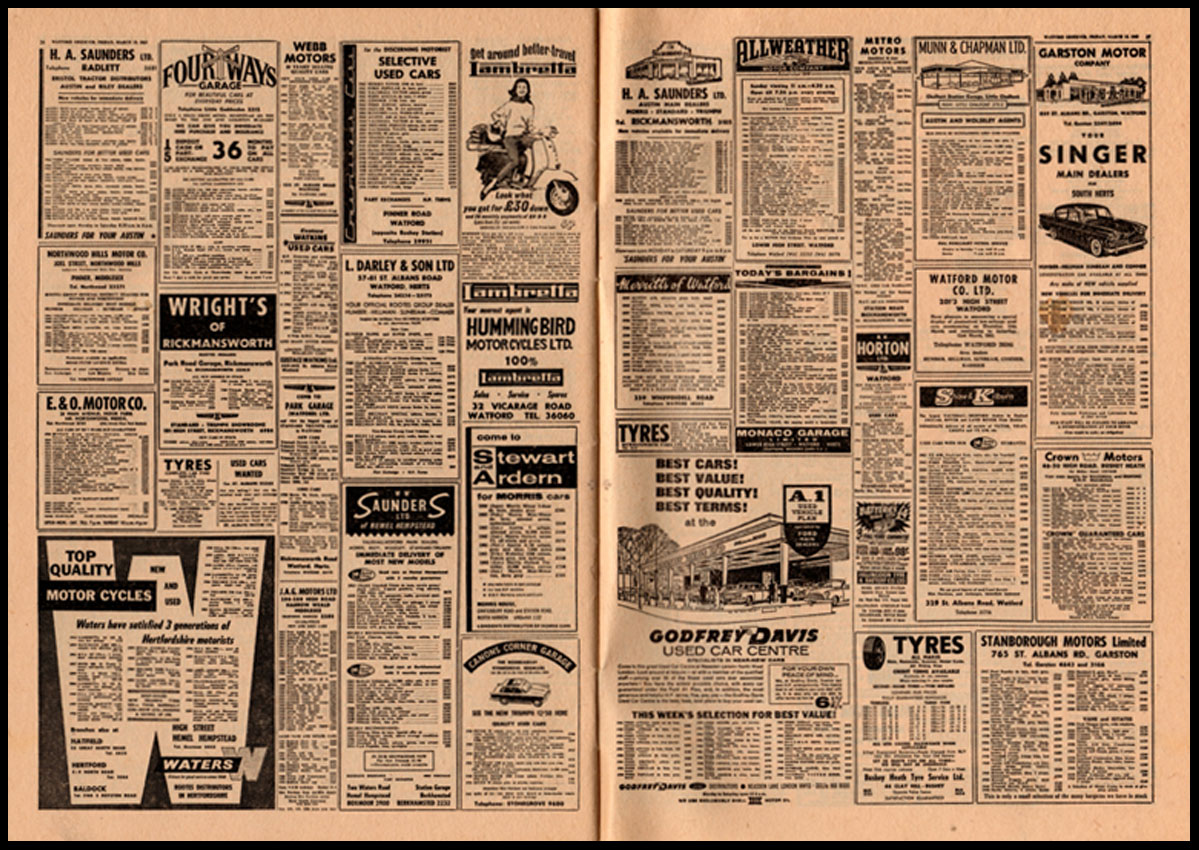
A recent discovery deep in the archive of this miniature newspaper (West Herts and Watford Observer) from March 15th. 1963 is a voice from a time when JFK was in the White House and Macmillan was in Downing Street. The back pages are full of employment advertisements for genuine full-time jobs in manufacturing. And Cliff Richard and the Shadows are performing at the local Gaumont. The news pages produced a rich harvest of dispatches from the foothills of Metro-land that seem to lend themselves to the Fénéon treatment and ten examples are presented below. 

Speaking of their 16 year old daughter, parents told a court that they had done everything for her but she had been a continual nuisance up to and including leaving the family home to live with a 20 year old man with whom she had been intimate. 

After a number of false starts, identical twin ginger haired brothers in late adolescence separately travelled by air to overseas destinations at the expense of the Royal Air Force. 

An aversion to abusive language induced a publican to arrange for a customer to be forcibly ejected from his premises. The said customer’s head impacted upon the pavement with such force that his earthly existence was terminated. 

A conscientious intruder successfully forced entry into six homes at consecutive addresses in the same street for the purpose of relieving the occupants of their most valuable possessions. 

Approaching the end of a lifetime of sorting letters and hand painting a collection of 1,000 model soldiers Mr. Harold Marsh was presented with an Imperial Service Medal by the Assistant Head Postmaster. 

Informed that he would be charged with dangerous driving and excessive speed, a van driver expressed his disappointment and requested the police officer to charge him with any offence but that. 

Noted for his ability to recall seeing swans wandering daily in search of food, Mr. Oscar Rees Gibbon died at the age of 93. For 53 years his home had been in Bushey Heath during which it had lost its rural character. 

The sum of £2 was extracted from Martin Card by way of punishment for his impudence in trespassing in search of game on land held in the possession of the Earl of Dudley who did not take kindly to this sort of behaviour. 

A performer who spoke not a word on stage during his act gripped the imagination of his club audience to such an extent that members were in turn reduced to a most untypical condition of prolonged silence. 

His second wife was a sister of his first but even the amputation of a leg in Cape Town was insufficient to extend his life beyond the age of 79, although he had in the past impressed many of his acquaintances with his intellectual stature. 


Friday, 22 June 2012

Postcard of the Day No. 55, Baling Havana Tobacco


This is another postcard trip to the island of Cuba – a soporific image of back-breaking manual labour from a century past. An air of lethargy and resignation hangs over the clearly posed workforce, captured in suspended animation. Cuban tobacco has always been a premium product generating enormous profits for producers and processors. Hand-formed into large cylinders, inserted between the lips and ignited, it endures as a marker of taste and status for connoisseurs everywhere (except the US). Before signing the US embargo on trade with Cuba in 1962, President Kennedy ordered a personal supply of 1200 Cuban cigars (H. Upmann Petit Coronas). Fifty years of boycott has had no notable impact on the Castro regime’s capacity for survival and tobacco remains one of Cuba’s principle exports. The bonus cards show a tobacco barn (where the leaves are dried and cured) and a plantation.