Assembling these incomplete jigsaws called for some exhaustive mental effort. The individual pieces were found scattered through a box of miscellaneous clutter – there were no pictures. Each piece was double-sided and progress was very slow until it dawned on me that there were two different double-sided jigsaws that were not easily separated. In the knowledge that the rewards of this task would never measure up to the effort involved I pressed on and these fragmentary assemblages are the results. Not every jigsaw in my possession is incomplete as the latter images show although even here a sharp eye will detect the occasional lacuna. And for every one of these I must have acquired at least four that were nowhere near complete.
Tuesday, 31 October 2017
Wednesday, 25 October 2017
Fats Domino (1928-2017)
There’s always been a special place in my affections for
Fats Domino whose music never fails to lift the spirits. It’s especially sad
that his death has been announced today – tonight’s movie will be “The Girl Can’t Help It”. In my early
teenage years the price of an LP was well outside my spending power but an EP
(Extended Play) with 4 tracks playable at 45 rpm was just about affordable. The
first EP I ever bought, some 50 years ago, was Be My Guest by Fats Domino.
This was my introduction to New Orleans Rhythm ‘n’ Blues and a voyage of
discovery that would lead to Professor Longhair, Huey ‘Piano’ Smith, Ernie
K-Doe, Chris Kenner, the Meters, the Showmen and Dr John over the next few
years. The Domino method of dancing your
blues away was an unusual strategy to find favour with one whose dancing days
gave rise to rather more mirth than admiration. Two qualities stand out. First,
the irresistible rhythms unique to New Orleans and second, the joyous sound of
massed horns, for which credit must go to the arranger, Dave Bartholomew (who
will celebrate his 99th. birthday on Christmas Eve). Both features
became essential parts of the musical vocabulary of Jamaican Ska. Domino was
raised in the Roman Catholic church and thus was never exposed to the visceral
power of the gospel traditions.
Musicologists argue that African musical traditions survived more
strongly in Southern Louisiana than anywhere else in America. The rhythms and vocal styles were closer to
African originals than elsewhere.
The process whereby African-American music was neutralised
and cleansed for a white audience was described to perfection by Chip Taylor in
his 1971 recording, (I Want) The Real Thing.
The UK music business was very active in this process churning out a succession
of records in which the passion and spirit of the original recording was
systematically eliminated by a mediocre and enfeebled performer. Domino’s recordings escaped this treatment
for the simple reason that their appeal depended entirely upon a quality of
delivery and personality that could not be replicated. It was impossible to
dilute something so intense and be left with anything remotely worth listening
to. The few attempts to cover Domino
hits in the UK sank without trace. In the US there’s a role of infamy headed by
Pat Boone, Ricky Nelson and Teresa Brewer all of whom profited from hi-jacking Domino
material and draining it of vitality.
In New Orleans there was no place
for the dark and down-home, hard times, lyin’, cheatin’ and dyin’ crapshootin’
blues from the Delta. There was no great
audience for the smooth toned supper club and coffee lounge blues styling of
the likes of Nat King Cole. There was a
positive, optimistic, up-beat and life-affirming defiance in the air that found
expression in a refusal to submit to the iniquity of racial segregation and a
denial of the subservience that the white establishment attempted to impose.
Rick Coleman’s biography, Blue Monday, is a fascinating account of
the way that Domino’s concerts in the 1950s became the focus of a long sequence
of riots and civil disturbance. There
was nothing in Domino’s performances to incite the crowds other than the music.
The principle provocation came from the police whose heavy handed attempts to
enforce racial segregation were calculated to incite resistance. Alcohol fuelled aggression and inter-racial
conflict also played a part. The irony of this is that the Domino songbook was
exclusively dedicated to good-time music with not a trace of insurrection or
subversion.
Domino became one of the great survivors of his generation of R & B performers. Despite the excessive consumption of alcohol and an addiction to gambling Fats continued at the top of his game while his band members and close associates perished in their numbers from drug and alcohol related illnesses. His touring days ended in 1995 enabling him to retire his infamous hot-plate and cooking pot in which he brewed up decades worth of pigs’ feet in creole sauce with which to feed himself and his band. Famously he survived Hurricane Katrina in 2005 at the age of 77 when a rescue boat plucked him and his family from the second floor of his home in the Lower Ninth Ward. He went on to perform at Tipitina’s in New Orleans in May 2007. He retained a reputation for geniality and modesty despite occasional episodes of seriously grumpy behaviour, marital infidelities and a chronic failure to turn up for scheduled appearances.
Labels:
fats domino,
music,
new orleans,
tribute
Tuesday, 24 October 2017
Children of the Fatherland
It would seem that growing up in the Weimar Republic was an unusually hazardous experience – danger lurked around every corner and only the most alert and agile escaped unscathed. These trade cards were issued by the makers of Echte-Wagner margarine with the worthy object of raising awareness of the perils of childhood. Multiple threats to life and limb are described here – a world of icy streets with out-of-control horses and a place where a juvenile kite-flyer is electrocuted. Equally improbably a small boy exits a train at speed when the carriage door spontaneously swings open – the consternation of the bourgeois gent with his newspaper is balanced by the indifference of his wife. For the illustrator involved it was not their finest hour – unconvincing clumsily drawn figures frozen in immobility. Nowhere more apparent than the spine-chilling tableau of target-shooting gone badly wrong. A dart has missed its mark and struck a hapless bystander in the eye – her inscrutable assailant makes no effort to help while his companion prepares to shoot as if nothing has happened. Somehow the ineptitude of the artist has inadvertently intensified the horror of the event we are witnessing.
Labels:
danger,
echte-wagner,
Germany,
hazards,
illustration,
incompetent drawing,
peril,
trade cards
Tuesday, 10 October 2017
Great Railway Stations Number 12: Tokyo
In 1880 the 26 year old Tatsuno Kingo was working as a student in the architectural practice of William Burges, master of the Gothic Revival. Returning to Japan after Burges’s death in 1881, he established himself as an educationalist and architect in the Western style. Banks and institutions formed the majority of his clients. Later he was appointed architect of Tokyo Station on which work began in 1908. Completion was in 1914 – it opened for business on December 20th. The original 4 platforms have expanded to more than 20 today. A three-storey extended red brick façade with two ribbed domes was designed to impress. A massive steel frame enabled the building to survive earthquake damage in 1923 but US bombing in 1945 greatly diminished it – post-war repairs saw the station reduced to two-storeys while the ruined domes were replaced by simplified angular structures as shown in the last two cards below. A threatened demolition was resisted by the public and a five-year renovation completed in 2012 restored the station to its 1914 splendour. With the singular difference that the present building must compete for attention with the enormous office blocks that tower over it.
Labels:
architecture,
architecture transport,
japan,
stations,
tatsuno kingo,
tokyo,
william burges
Monday, 2 October 2017
City Buses on Postcards
The development of motor vehicles happened in the era of the vintage picture postcard. Horse-drawn omnibuses gave way to petrol powered vehicles and major cities rapidly built up extensive networks of routes. Each of these portraits from Europe and North America seem to reflect the national characteristics of their homelands. Parisian buses came furnished with a fussy Gallic scalloped fringe to the protective roof canopy as well as some fashionably fancy coachwork. At the other extreme is the utilitarian no-frills Detroit bus where the passengers are exposed to the elements via the unglazed windows. The sole grace note being the provision of highly polished brass light fittings. The Berlin bus has the feel and solidity of well-made furniture while the London bus is conceived as a mobile display of public information. Appropriately for a city famous for criminality, the Chicago bus is built like a military vehicle – it’s easy to imagine armed guards on every other seat. In comparison the Manhattan bus appears slender and restrained.

Wednesday, 27 September 2017
Indian Graphics
Above are some Visit India poster designs featured in an advertising insert in Commercial Art magazine for June 1929 (Vol 6, No 36). On the reverse is a quartet of designs for well known European consumer products presented in an Asian context. It’s impossible to be certain (at this scale) but the hand of William Spencer Bagdatopoulos (WSB) (1888-1965) may be detected here. WSB was the master when it came to applying an Asian flavour and chromatic brilliance to unglamorous Western products – something we examined in a post dated March 2010. More background information has emerged in online sources – follow this link for a brief biography. It’s interesting to discover his Anglo-Greek parentage – in my ignorance I had convinced myself that he was of Indian origin and had invented this exotic name to advance his career.
Labels:
graphic design,
illustration,
india,
posters,
w s bagdatopoulos
Monday, 18 September 2017
Darmstädter Künstlerkolonie
There’s a long tradition of princely enthusiasts of the Arts indulging their passion with a grand project – the Prince of Wales’s fantasy township at Poundbury being a more recent example. In Darmstadt the Grand Duke of Hesse, Ernst Ludwig chose some higher land in the north east of his capital (visible on the 1905 Baedeker map) for the construction of an artists’ colony. The site was already graced by the newly completed Russian Orthodox Chapel built for Tsar Nicholas II whose wife had been born in Darmstadt. Ernst Ludwig was swept up in the late 1890s enthusiasm for the fashionable Jugendstil and fancied himself as the leading patron of this Germanic version of Art Nouveau for which he obtained the services of Joseph Maria Olbrich, co-founder of the Vienna Secession as lead architect. The master plan called for a substantial centre containing multiple studios for artists and craft-workers and a modest number of individually designed houses to be occupied by the most prominent artists. There were three phases of development beginning in 1899 with completion in 1908.
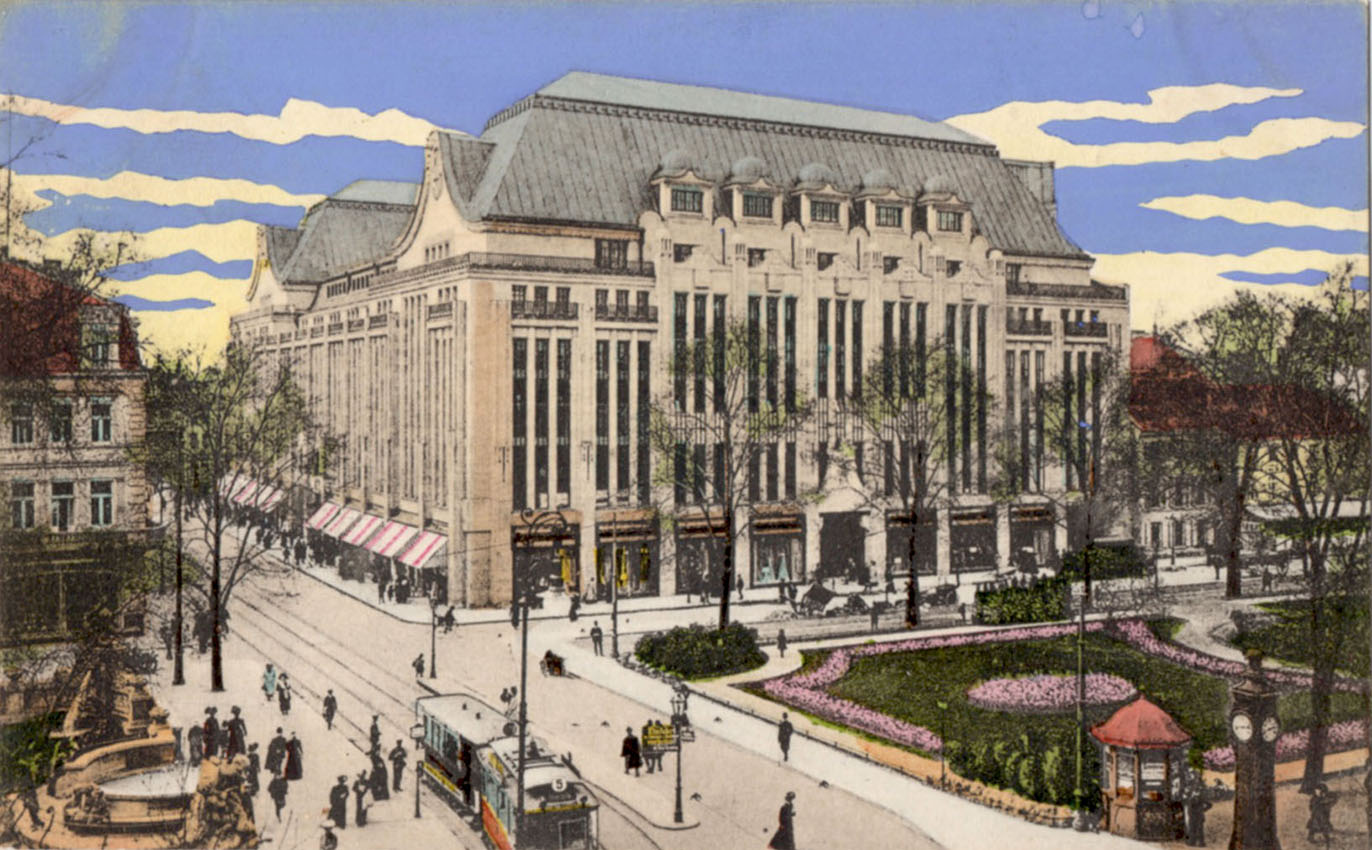
A major exhibition in 1901 featured the newly opened Ernst Ludwig Haus with its shared studio facilities and the newly constructed artists’ homes, several of which had run significantly over-budget. Like many such royal vanity projects the exhibition ended in a large financial loss. A more modest exhibition followed in 1904 and the final exhibition took place in 1908 where the highlights included a new exhibition building and the dedication of the landmark Wedding Tower (Hochzeitsturm) designed by Olbrich and gifted to the Grand Duke on the occasion of his marriage by the grateful citizens of Darmstadt. Olbrich died in August 1908 at the age of 40 while his last building, the Tietz department store in Düsseldorf was still under construction.
Five of the first six artists’ houses were designed by Olbrich. The sixth was the work of Peter Behrens, better known as an artist and graphic designer. It was his first excursion into architecture and every detail inside and outside had his mark on it. All internal fixtures and fittings, including the furniture, cutlery and fabrics were designed by Behrens. Despite this personal involvement, Behrens never actually lived there and actually sold it on within a year of construction. In 1909 Behrens designed the influential and monumental AEG turbine factory in Berlin. His legacy was stained by his involvement in Albert Speer’s Prachtstrasse plan – a redesigned Berlin for a thousand year Reich. AEG commissioned an absurdly grandiose design from Behrens for a new corporate HQ. Although it never got built, the design pleased the eye of the Führer who had been a Behrens admirer since he saw the Embassy in St. Petersburg that Behrens designed in 1913.
![]() |
| Russische Kapelle (1899) |
There was no place for Guimard’s whiplash curves or Horta’s swooning organic forms in the visual language of Jugendstil. Exuberance and extravagance gave way to a rationalist’s version of Art Nouveau in which visual rhythms were employed with restraint in surface decoration and monumental figure sculptures could still find a home they were denied elsewhere. Floral motifs were invariably anchored by a formal geometry. Ceramic decoration (tiles, mosaic and glazed bricks) was extensively used internally and externally. An especially opulent mosaic of a tender embrace can be seen high on the wall of the main entrance to the Hochzeitsturm (Wedding Tower). The tower itself seems a little problematic – not really a building, more a monument or a landmark. As a seven storey landmark it succeeds, being highly visible across the city and capped by the distinctive and imaginative five spires. Any other function it possesses is secondary. Indeed other than the site specific art works inside, it serves as a modest office space and accommodates a few family treasures and not much else. The scale is intriguing in the context of Olbrich’s work in Düsseldorf where a much larger but no taller building was taking shape. The Tietz department store marked Olbrich’s major step into the architectural mainstream – had he lived longer we might have seen more commercial buildings, perhaps a theatre or even a railway station, with an Olbrich signature.
![]() |
| Mosaic sundial on the Wedding Tower designed by Wilhelm Kleukens. |
![]() |
| Hochzeitsturm (Wedding Tower) designed by Joseph Maria Olbrich (1867-1908) - a gift from the city of Darmstadt to Grand Duke Ludwig II in 1906. |
![]() |
| This opulent mosaic of a tender embrace is high on the wall of the main entrance to the Hochzeitsturm (Wedding Tower). |
![]() |
| Decorative mosaic ceiling designed by Olbrich - part of the Hochzeitsturm (Wedding Tower) ensemble. |
![]() |
| Alcove with bench seating and 1914 Jugendstil mosaic by Albin Müller on Olbrichweg. |
![]() |
| The Lily Basin mosaic by Albin Müller (1914) . |
![]() |
| The top of the Hochzeitsturm (Wedding Tower). |
![]() |
| Main entrance to the Haus Behrens - Behrens' choice of decorative motifs is restrained and mainly rectilinear. |
![]() |
| Elevation of the Großes Haus Glückert (1901) Akademie für Sprache und Dichtung. Architect: Joseph Maria Olbrich. |
![]() |
| Ovoid entrance to the Großes Haus Glückert (1901), Akademie für Sprache und Dichtung. Architect: Joseph Maria Olbrich. |
![]() |
| Haus Deiters (1901), designed by Joseph Maria Olbrich. |
![]() |
| Tietz department store in Düsseldorf. |
Subscribe to:
Posts (Atom)