Tuesday, 3 December 2019

Motoring Pioneers in Postcards


The early years of motoring coincided with the height of postcard frenzy – the decade leading up to the First World War. It made a popular subject for humorous novelty cards. The mechanical wonder of the age seized the public imagination and despite being only available to a privileged few, the motor car became an object of intense curiosity and fascination to many. For the pioneer motorists times were good – no requirement to be insured, no speed limits and no driving licences to obtain. Mechanical reliability could not be taken for granted and postcard publishers were quick to portray the potential for misfortune. The romance of the open road was born in these times and the motor car rapidly acquired a reputation as an enabler of another type of romance. There were few better ways for the male motorist to make a positive impression on the object of his affections than a road trip to Box Hill or the Thames at Maidenhead - the motor vehicle as an agent of seduction. The driving seat was all but monopolised by the male but there is one card where the females have taken control and relegated the uniformed chauffeur to the humiliation of the back seat. This is the world of adventure described in these postcards. 


Tuesday, 19 November 2019

Chicago Under the Loop


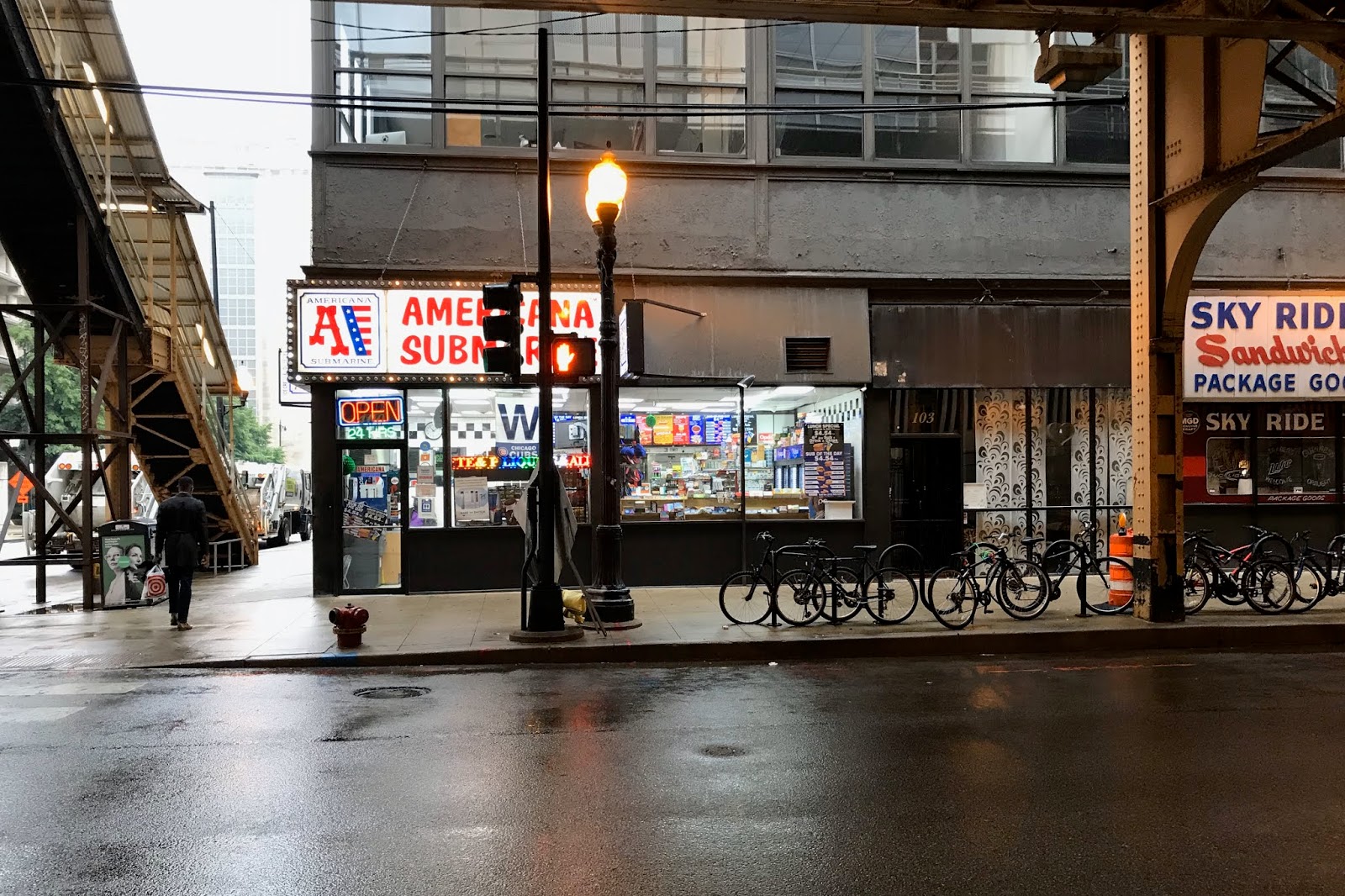
The Chicago Loop is a unique transport solution. Transit lines from all points of the city converge on a central elevated loop, entering and circulating until they spool off in another direction to complete their journeys. Underneath the elevated railway is a zone of semi-darkness where a shadow is cast on traffic and trade. An elevated railway was an attractive option for transport planners working to a budget - the cost per mile is a fraction of the cost of constructing underground. Road networks of broad and straight boulevards encouraged American city planners to adopt this solution and Boston, Philadelphia and New York City still have significant sections of elevated tracks although only Chicago operates them in the central business district. In other cities they have retreated to the suburbs.


Artists and photographers were quick to spot the novel visual drama of a railway that passed over the street and recorded the scene with fascination. Visual Telling of Stories has a concise summary of the appeal. But for those existing at ground level it produced a degraded environment in which the roar of the traffic was amplified by the overhead structures, to which was added the percussive rumble of passing trains. Intensified by the lack of daylight, mounting hostility to elevated railways from property owners and business interests forced them out of Manhattan by 1955 but in Chicago they persisted. Sections of elevated railway are common in Berlin and Hamburg, while in Paris, lines 2 and 6 of the Métro run overhead for significant parts of their journeys. Somehow none of these systems has anything like the impact on its surroundings as the Chicago “L”. The reason for this may lie in the constrained character of the Loop that serves to concentrate and magnify its effects. In other cities, many routes follow central reservations, a mitigation unavailable in Chicago.


To this visiting observer all this is very fascinating and it’s an easy matter to walk the entire circuit and appreciate how it impacts on its surroundings while enjoying the brutal and unadorned heavy metal structures that keep all that stuff up in the air where it belongs. Where the streets are broad it sails overhead with little disturbance, the sidewalks being open to the elements. It’s a much more intrusive presence in narrower streets where our field of vision is greatly restricted and there’s an obvious decline in business where this happens. Prestige retail happily thrives on the wider avenues while more marginal retail dominates as the streets get narrower and feel like caged spaces. In essence, the system was developed in accordance with the prevailing American infrastructure aesthetic where every dollar must be worked to the utmost using hard materials, military quality build, with a scrupulous avoidance of any extraneous design elements that might make it easy on the eye. If American transit had been designed to the same standard as the Detroit auto industry in its mid century glory, it would be the wonder of the world for its extravagance and futuristic embellishment.


The disruptive dazzle of sunlight spattering on the streets below is much favoured by photographers but I found more of interest to record after nightfall and in the rain when halogen and LED lights are reflected off hard surfaces. Busy thoroughfares empty out at nights to express a sense of desolation and urban melancholy. This selection of photographs taken last June are not intended as a photo-essay - just a series of images inspired by a strange and forbidding urban structure.


Tuesday, 12 November 2019

Postcard of the Day No. 95 - Animals on Board


Today’s card offers the arresting site of an elephant in a sling, hanging in space as it’s manoeuvred on or off a cargo ship. A desperately uncomfortable position in which to find such an imperious and dignified creature. The location is a port in Colonial Burma where the British authorities had many uses for elephants as a source of cheap, and uncomplaining labour. They were especially valued on timber plantations where they could be put to work hauling enormous loads of logs out of the forests for processing. Elephant traders got rich by capturing the creatures in the wild and selling them on to commercial interests for whom they were a prized asset. Elephants didn’t join trade unions or support campaigns for independence from the colonial masters. On the second card, a rudimentary steam powered crane is hauling an ox carcass on to the quayside in the port of Casablanca where it is about to be unceremoniously dumped. These are discomforting images and worrisome examples of indifference to animal suffering.


Tuesday, 5 November 2019

Charleston, South Carolina 1978


Over the last few months I’ve been digitising some old slides and negatives from the analog era. The device I’m using is better than the budget examples widely on sale but the results bear no comparison with what can be achieved with professional quality negative scanners. It’s a necessary compromise given the astronomical price of the best equipment. For every interesting discovery there’s a major disappointment when the technical shortcomings of what I had fondly imagined to be a pleasing photograph are ruthlessly exposed. So, with apologies for the technical limitations and general fuzziness of imagery, I plan to post some occasional examples. The first selection come from a visit to Charleston, South Carolina in the summer of 1978, some 41 years ago.


My notes tell me we stayed on the tenth floor of the Francis Marion Hotel - “a twelve-storey dinosaur, overlooking the Cooper River, the bridge, the port and the Yorktown aircraft carrier”. As one of America’s oldest cities, Charleston was well stocked with colonial-era public buildings and residences, of which a few can be seen here. The camera recorded some shopfronts, eccentric on-street commercial signage, a Colonial Revival style Exxon gas station and an Art Deco cinema - much as I might do today. In a small downtown gallery there was an exhibition of photography that included work by Weegee, Berenice Abbott and Moholy-Nagy. My recollection is that they came from the Wagstaff Collection which is now in the Getty Museum. It’s quite possible the black and white photos of Marion Square from the hotel window were taken in imitation of Moholy-Nagy.


While we were there, Bruce Springsteen came to town and delivered one of his three hour marathon shows to promote his recent album, Darkness on the Edge of Town. Not yet 30, he had more than enough energy to race around stage, clowning and screaming, and driving a rather sober audience into a frenzy of appreciation. Much to my delight the second, and final, encore was Quarter to Three, a 1961 US number-one for Gary US Bonds. The bus trip to the Isle of Palms didn’t quite live up to the exotic promise in the name - but the beach was long and sandy with Atlantic rollers driven by a strong onshore wind.


Friday, 1 November 2019

Loschwitz Schwebebahn Dresden


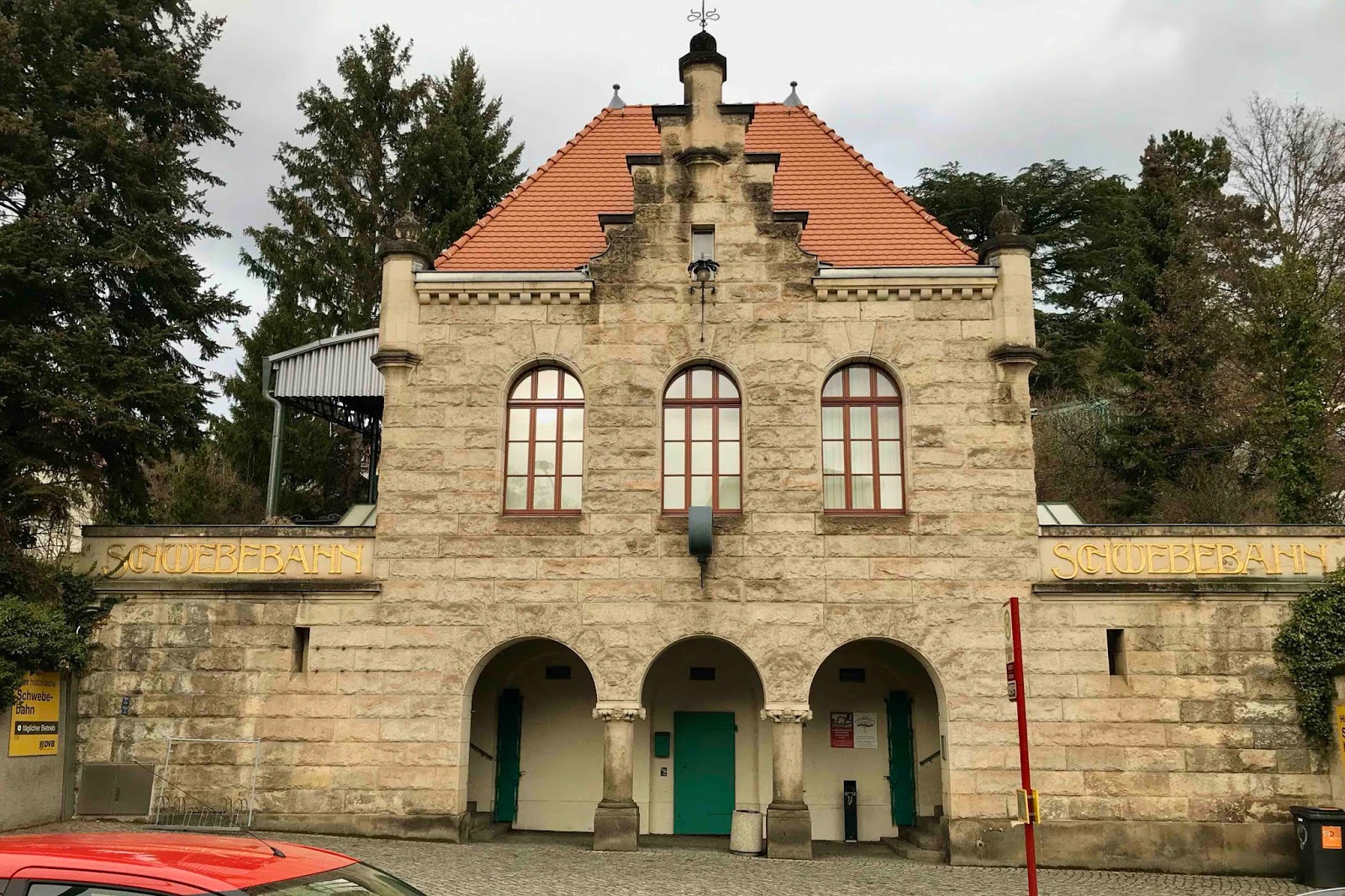
A three mile tram ride from Dresden city centre and a short walk across the river Elbe brings us to the Loschwitz Schwebebahn. Loschwitz is a comfortable, long established suburb untouched by the fire-bombing, built on the slopes leading down to the Elbe. The Schwebebahn is a suspended monorail built in 1901 that carries passengers to and from the heights of Oberloschwitz where the most grandiose of Dresden’s 19th. century suburban villas are to be found. Eugen Langen, designer of the much more extensive Wuppertal Schwebebahn was responsible for this cumbersome project with its complicated support structure - an orthodox funicular railway would have done the job at a lower cost. There’s a vaguely Jugendstil station building at the lower level on Pillnitzer Landstraße - built in rough finished stone, it has an arcaded entrance and a jaunty stepped gable. It suggests an intention to bring a sense of occasion to the Schwebebahn experience. At the summit is a tall tower built to house the winding engine but detailed as if it were a baronial fortress. Local residents use the Schwebebahn to reach the amenities at the foot of the slope and return, avoiding a breathless footslog up the fierce gradient. It makes for an incongruous sight as the two cabins slowly rise and descend over the sedate townscape with its network of twisting footpaths and narrow roads - especially strange when it inches forward across the public highway.


Those with an appetite for white knuckle rides can relive this thrilling descent in its entirety via this embedded video. Highlights include the ghostly reflections of the production team, one of whom grows increasingly restive at the imposition of a ban on conversation.

Tuesday, 29 October 2019

Mr. Elwell’s Neighbour


Mr. Elwell lived most of his life in the prosperous East Yorkshire market town of Beverley where he must have been on good terms with his neighbour. A degree of trust is required before inviting an artist through the front door to make a painting of the interior. Looking at his subject matter suggests that Elwell would have presented a most respectable face to the world without a shadow of impropriety. Modernism left no mark upon him as he pursued a long career as portrait painter to the second rank of eminence - Brigadiers and Aldermen, Clergymen and Yorkshire businessmen. The portraits display the sense of duty and self-importance that goes with responsibility and high office - occasionally relieving the gravity with a hint of a half-smile. Glacially observed and attentive to all the badges and accessories of the great and good, Elwell certainly delivered value for money. All too easy to dismiss as banal and unimaginative.


We can safely assume that Elwell was of a conservative disposition and his more personal paintings make that very clear. Rooted in his Yorkshire homeland, Elwell’s lovingly realised paintings of local pig farms and cow sheds outshine his portraits in terms of emotional depth. Progress made him uncomfortable and he was drawn to subjects such as “The Last Hansom Cab” and “The Last Pipe-maker in Beverley” to resist the passage of time. The language of gesture and capturing movement was not a strong point - most human figures resembled laboratory specimens, cryonically frozen in their discomfort. The effect of this could be unintentionally alarming - the claustrophobic “Birthday Party” makes for an unsettling joyless image where the peeling of an orange, the gleam of a monocle and the gripping of a pipe all take on a sinister air. Animation was only achieved when there was a degree of identification with the subject as in the full-length portrait of a sturdy pub landlord or the posthumous portrait of the 16 year old hero of the Battle of Jutland, “John Travers Cornwell VC”.


Inside his neighbour’s house, Elwell discovered a sequence of well ordered domestic spaces that reminded him of the Golden Age Dutch Interiors with which he would have been familiar. His easel was placed accordingly to take advantage of the measured spatial recession through four defined volumes all the way to the conservatory at the back of the house. Most of Elwell’s major set-piece interiors with group portraits were presented in a closed box-like space giving them the appearance of a diorama - this was an opportunity to break out of the box and drill deeper into private space. Dark varnished wainscoting and surrounds on the central arch and doorframes set the tone. An ancestral portrait stares down over a display of family treasures including silver chargers and porcelain figures while a malevolent coal scuttle gleams in the corner. (A typical supplier of this style was Waring & Gillow’s department store as shown in this advertising.) A solid Victorian dresser draws the eye into the centre of the house where a figure descends a staircase on our left. A shaft of sunlight floods down the stairs, reflecting off the chandelier and defining the back of the descending figure. Deeper into the composition brings us to a carpeted room beyond which a wall of glazing gives on to a conservatory with flowering plants. The human presence is diffident, hesitant and slow moving - she holds a box and a drawstring purse but there is no narrative drive to make further sense of this. Objective scrutiny and dispassionate recording dominate the painting.


Elwell leads us into a private space, minutely describing what falls in his visual field while withholding any sense of the lives lived therein. We can infer material wellbeing from the scale of the house and the value of the contents. All is dusted and polished to a fault by domestic servants. Vintage furnishings and an accumulation of antiques would suggest elderly residents with a need to surround themselves with the trappings of tradition in moderation, a very English avoidance of ostentation. Alongside this, reticence and suppression of all things emotional help maintain an air of calm. I realise I’m beginning to describe things witnessed in childhood when obliged to join in family visits to unmarried great-aunts born in the 1870s and 1880s, whose vast Victorian villa in Stockton-on-Tees looked much like this. Inside the drapery sagged with inertia and the bookshelves were lined with the works of Carlyle, Macaulay, Thackeray, Dickens and the Waverley novels, all in the minutest of fonts, and the most exciting reading material was back issues of the Christian Science Monitor. Not even the Readers’ Digest could penetrate this citadel of resistance to the post-war settlement. In the gloomiest of rooms, the aunts could hardly be distinguished from the soft furnishings in which they were sunk - their utterances were largely confined to disconcertingly direct interrogation (What do you intend to do with your life?), candid observations (Hasn’t he got a lot of spots?) or behavioural injunctions (Do sit up straight and stop scowling). All three wore hearing-aids of generous dimensions giving rise to raised voices on all sides and much mutual incomprehension. They could be graded by analysing the sub-atomic clouds of disapproval they radiated that ranged from average to full-on nuclear. Not to be wondered at when you consider that we visitors had absolutely nothing of interest to communicate. It was years before it occurred to me that their relief at our departure could well have exceeded our own. Upon which, out came the State Express and the Bushmills as hands of cards were dealt and the Christian Science Monitor was examined for its horse-racing tips.

Back to the matter in hand - Elwell, without any conscious intention of doing so, has created something of mystery that defies understanding. We can guess but we cannot fully know what it is we are seeing. The figure on the stairs remains stubbornly present, yet devoid of significance. There may be a corpse laid out on the polished floor of the room on the right. There may be an armed intruder pursuing the figure on the stairs. Or there may be a riotous luncheon party in progress in the room next to the conservatory. None of this is likely. But what we can say is that the way the sunlight splashes on the stair carpet or the mirror reflection opens up another perspective recession have a visual poetry as unexpected as it is enriching. 

The painting can be seen in the Bristol Museum and Art Gallery.