Wednesday, 27 September 2023

The Fortnight in September

The advancing tide has driven the holidaymakers ever closer to the sea wall to the point where they huddle together in uncomfortable proximity.  Just such a scene is described in R C Sherriff’s novel, The Fortnight in September, along with the social anxiety it gives rise to.  It tells the story of a lower middle-class South London family meticulously planning and making the best of their annual late summer holiday in the south coast resort of Bognor - when the holiday ends the novel ends too. Published in 1931 just a few years after Sheriff’s First World War drama, Journey’s End, had been a great success on the stage on both sides of the Atlantic. Sherriff followed up his great drama with a novel in which drama is entirely absent.  No action or event is too insignificant to be described in detail along with the inner voices of the characters as they attempt to conduct themselves with decency and propriety while at all costs avoiding stepping into the sea of embarrassment that never ceases to threaten. Painfully aware of their modest status in the hierarchy of social class, the head of the family must lead his dependants safely through the social minefield and he’s never more tormented than when he finds himself in the company of his social superiors with every muscle tensed to avoid transgressing the boundaries of class.

The Stevens family is a model of English decency and emotional restraint, ever polite and respectful to all, never allowing a mean thought to enter their heads.  Their ambitions are tempered by realism and they share the capacity to take pleasure in simple things.  They enjoy each other’s company much more than the company of strangers.  Routine is what holds the family together and builds a fortress against negligence and chaos.  In the Great March to Bognor, everyone must play their part as assigned by Father and his masterplan.  Before it has even begun, he contemplates the end of the holiday and the accompanying sense of melancholy - his glass is resolutely half empty. The holiday is the single great annual event in their lives and has followed the same pattern for 15 years.

In those 15 years the children have grown up while the boarding house where they stay has aged and decayed. It’s impossible to ignore the declining quality of service and the impact of the ageing process on their hostess.  All of which signals that change is on the horizon - and change is the enemy of routine. Another sign of change is the growing independence of the older children as they move into a future outside the family.  Mary is the oldest, at 19 increasingly aware of the male gaze and in a mood to take her chances with the opposite sex.  After a year working in a white collar job, Dick (17) is restless and has begun to dream of training to become an architect. Forces are gathering that will drive the family apart.  Quietly and incrementally, the universe that Father created is collapsing around him.  His own future is equally uncertain - his much valued post as secretary to the local football club has deviously been taken away from him. At work his thoughts of promotion to senior management have come to an end with a discreet message that this can never happen. Mother is the least contented character and the least likely to articulate her unhappiness.  She scarcely has a voice and her very existence is overlooked by all while she labours night and day at the endless domestic tasks that make family life possible.  The sea terrifies her, yet when she goes missing at the seaside, the family display only limited concern. Typical of the silly goose to get lost and cause a lot of unnecessary fuss.

Sherriff created a single event in the life of an unexceptional family and explored some major themes as he recorded their addiction to ritual and resistance to change.  There’s no peace of mind to be had while survival seems poised on the edge of disintegration. Despite eternal vigilance not everything can be controlled. How to live with unfairness and small failures.  Loss is one of life’s great certainties and Sherriff placed it at the heart of this book with his subtle account of the passage of time eroding everything that we value and depend upon for emotional wellbeing.


Tuesday, 12 September 2023

Past and Present No. 13: Berlin Bülowstraße Bhf


The station at Bülowstraße was on Berlin’s first U-Bahn line and opened in 1902.  It is now on line U2 on a short section of elevated track that runs from Gleisdreieck as far as Nollendorfplatz after which it continues underground. Despite heavy war damage and a 20 year period out of use (1972-1993) due to geo-politics, the building exterior is as close to original condition as any other example of its age.  Comparison with the period postcard shows that little has been lost other than ornamental flourishes on the train shed and some decorative ironwork.  Bruno Möhring (1863-1929), Jugendstil specialist and skyscraper enthusiast, was the architect - elsewhere in the city he designed the Swinemünder Brücke (1902-1905) that crosses the railway tracks to the east of the station at Gesundbrunnen. Another of Möhring’s notable achievements - the Jugendstil Machine Hall at Zeche Zollern colliery in Dortmund - was featured in this blog in 2017 and can be seen here.


Thursday, 31 August 2023

Airways 1939

This is a slim pictorial board covered, large format picture book for children published by Blackie in 1939. There are 13 colour illustrations (including the cover) and most of them bear the signature of T E North who has been identified as Thomas Edward North (1916-1985), a lifelong resident of Hull - his career has been well documented at Bear Alley Books. Airways is the earliest example of his illustration work I’ve seen, all the more remarkable for having been produced at the age of 23.  How North broke into the world of book illustration is an unknown story but he did well to find his work published by the illustrious firm of Blackie. Unlike most of his contemporaries, North was unafraid to experiment with unusual angles and unorthodox compositions in search of visual dynamics.  There’s a formal crispness and clarity that wouldn’t be seen in his post-war production.  When his career resumed after war service in the RAF he seems to have specialised in transport related material in ever smaller formats, mass produced pocket sized books for children. The illustration style is conventional for the period - descriptive but nothing more. At the end are two examples of card covered illustrated books and a jigsaw - whether the latter were based on new material or recycled images from books would be interesting to know.


Saturday, 29 July 2023

Great Railway Stations No. 21, Penzance

The westward rails run out at Penzance, there’s nowhere else to go except back.  After 326 miles from Paddington it’s the end of the line. A first station opened in 1852 and in 1859 it was connected to London with the opening of the Royal Albert Bridge across the River Tamar. In 1876 a new and larger station was built and for a century or so, the Cornish Main Line was the first choice of travellers and holiday makers heading for the resorts of the far South West. When traffic declined sharply as passengers piled into family cars for the journey west, rail managers responded by cutting services and track work to balance the books.  Today’s station is substantially the layout built by the GWR in 1937 but despite all the rebuilds and extensions nobody ever thought it worth providing the sort of grand entrance its importance might have merited.  The single modest entrance to the cramped concourse is via the side of the building.  Only the overall roof offers any sense of occasion.  If the Thatcher government had implemented the recommendations of the Serpell Report in 1983 there would now be no railway lines in Cornwall (or Devon and Somerset for that matter).


The overview below of Penzance Station approximates the vantage point of Stanhope Forbes when he painted "A Terminus in the West" in 1925 when it was a 2 platform station. The GWR commissioned Forbes to make paintings of Cornish subjects for publicity purposes and the Penzance station painting is now in the collection of the National Railway Museum. Forbes was born in Dublin where his father was manager of the Midland Great Western Railway of Ireland suggesting an affinity with railway subjects. He also produced poster designs for the LMS in his characteristically robust realism style, all of which brought some relief from the pilchards and fisherfolk.  Penzance is a station to be valued for its remoteness, its individuality - the only overnight sleeper train to run in England terminates here - and the blunt fact that there’s no further to go.


Friday, 21 July 2023

Arts & Crafts on the NHS

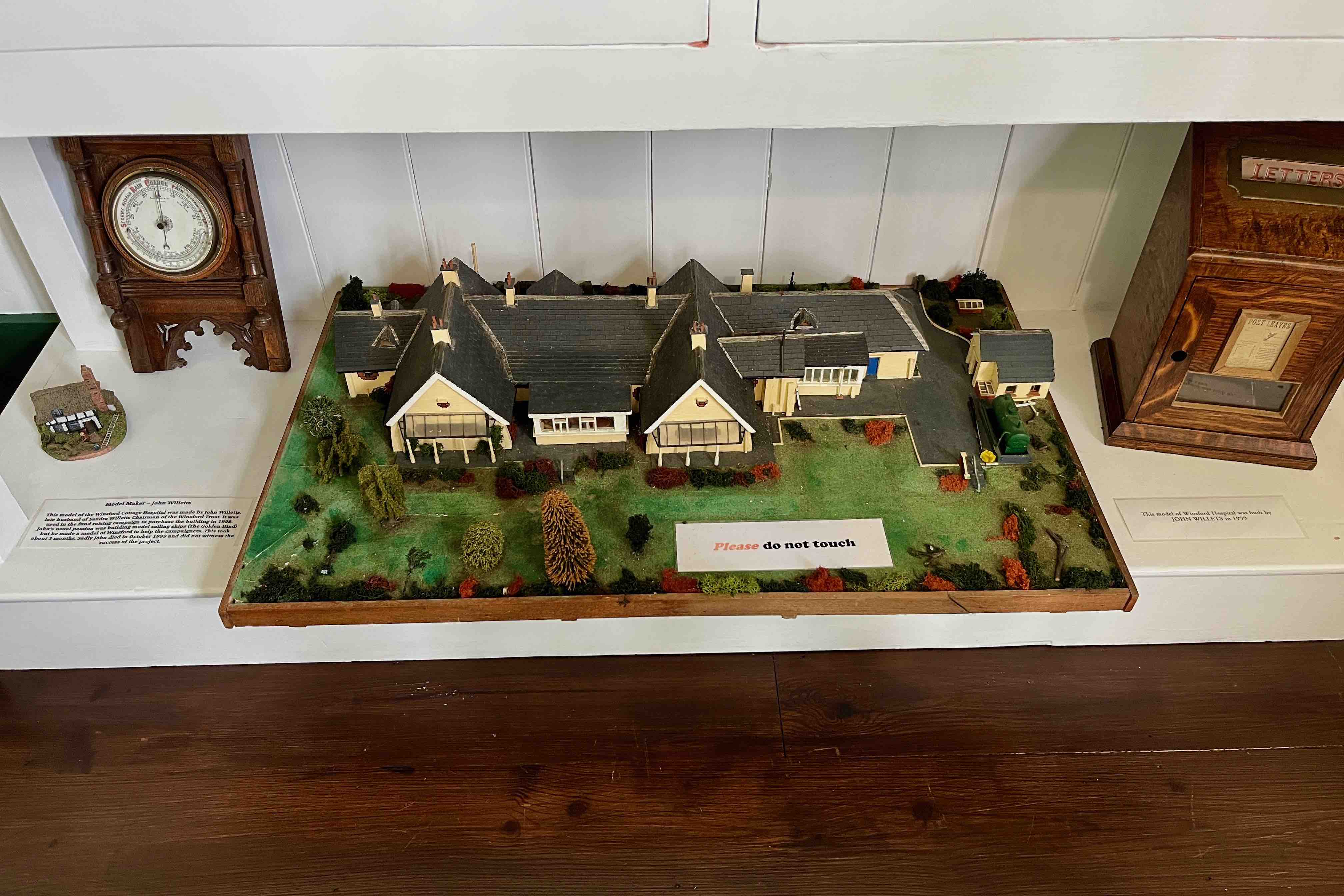
Winsford Cottage Hospital


It’s easy to imagine the scene.  Outside his church near Piccadilly, the Reverend Charles Voysey listens attentively as a wealthy widow from his congregation describes her plan to honour her late husband’s memory by funding the construction of a Cottage Hospital to serve the rural communities close to her  country house in North Devon.  “My eldest son is a successful practising architect, a man of sober habits and an industrious disposition and I’m sure your altruistic proposal would appeal to him. If you will permit me, I shall effect an introduction.”  Due to his theistic views, Rev. Voysey had antagonised the Anglican hierarchy and like all good dissidents he launched his own church, attracting some wealthy and influential followers.  One of whom was the recently widowed benefactor, Mrs Maria Louise Medley of Winsford Towers.  Designs for Winsford Cottage Hospital were drawn up in 1899 by C F A Voysey who over the previous decade had refined his own very individual Arts & Crafts influenced style designing substantial homes for affluent clients, including H G Wells.

Voysey’s design was modest in scale - a long single storey building with gabled projecting wings at each end.  There was a generous entrance hall and a linear layout with rooms accessed from a corridor with a mosaic floor of glazed sandstone tiles that ran the length of the building.  Furnishings and fittings drew heavily on Voysey’s favoured decorative devices (hearts, spades, etc) to enhance the homely and welcoming feel that he strove for, all the while scrupulously avoiding anything excessive.  Agricultural labour was the main source of employment in the area, wages were low and housing conditions often primitive. The subsidised care and treatment offered by the new facility was much needed. When it opened in 1900 there were only seven beds which in stages rose to fifteen by 1998 when it closed.  It had been absorbed into the NHS since 1948 but many of its original features were still intact although some, like the mosaic floor, had been covered up for many years.

There was a train station (Halwill Junction) only two minutes walk away that connected this remote rural village with Okehampton and Exeter to the south and east. Just to the north of the station three separate lines radiated - one to Bude, one to Launceston and Padstow, and a third to Torrington and Barnstaple. An abattoir stood alongside the station and trainloads of carcases were dispatched and daily trains of produce passed through enroute for London markets.  In summer, frequent holiday trains bound for North Devon and North Cornwall resorts, including the famous Atlantic Coast Express ran to and fro.  Voysey thoughtfully designed the children’s ward at the hospital to give the young patients a panoramic view of activity at the station.

In 2019 the Landmark Trust completed a long programme of work to restore original features and convert the west wing to holiday accommodation - a suite of repurposed rooms sensitively accessorised in period furnishings and decor.  Most of the walls were re-plastered and the roof of Delabole slate was completely replaced. In the corridor, teams of volunteers laboriously scraped away the screed that concealed the golden mosaic floor to reveal it in all its glory.


Thursday, 22 June 2023

Postcard of the Day No. 112, Starcross

Captain George Peacock was born in 1805 into a naval family in Exmouth. He served in the Royal Navy and the Merchant Navy as well as pursuing a career as a surveyor and inventor.  In 1831-32 when sailing in the Royal Navy in South America he surveyed some potential  routes for a future Panama Canal.  The value of his pioneering work was recognised by de Lesseps 50 years later when the canal was finally constructed.  Four years later he surveyed the Corinth Isthmus and proposed a route for a canal, for which he was, many decades later, honoured by the Greek sovereign. By 1840 he was sailing with the Pacific Steam Navigation Company in South America for whose benefit he set about developing business opportunities. In Chile he established the first coal mine in the continent, after which he explored nitrates in Chile and located guano deposits in Peru.  In 1841 he supervised the construction of the first railway on the west coast of South America. Inventions were many and various, including an improved screw propellor for steamships, a desalination treatment for sea water on board ship, an early form of life jacket and anti-fouling paint for the protection of iron hulled ships.


Not content with all this, after retirement to Starcross on the Exe Estuary he designed and built the Swan of the Exe in the 1860s, a 10 berth sailing yacht in the form of a swan, equipped with two large wings that served as sails. Internal fixtures and fittings were said to be comparable with those in a First Class railway carriage. Four small swan-shaped launches were built, one of which, known as Cygnet was employed to ferry passengers from the shore to the yacht and can be seen in these postcards.  This eccentric vessel became a celebrity in the Exe Estuary and was written up in the press.  By the time these postcards were on sale the Peacock Swan was over 50 years old and in the care of his descendants.  There’s a mass of conflicting information about its ultimate fate, some witnesses claim to have seen it afloat in the 1930s after which it seems to have become unseaworthy and downgraded to the status of garden ornament. Cygnet did survive and is now on display at the Museum of Topsham on the opposite bank of the Exe.  Artist and designer Enid Marx (1902-98) made a colour linocut of the Starcross swans in 1936 that can be seen by following this link.

Friday, 9 June 2023

In a Dorset Hollow Way (Part Two)

The soft sandstone sides of the Shutes Lane Hollow Way have become a home for rural graffiti, much of which follows familiar formulae but the exceptions are intriguing.  Interestingly there’s virtually no sex or politics to be seen.  Names and initials are present in great numbers as are images of eyes (evil and all-seeing) and hearts, most of which are simple incisions. Many have been scratched in haste while some display an interest in more finished letter forms with serifs and downstrokes.  A few have taken the time to record aphorisms and more enigmatic text elements.  The images of human heads fall broadly into three categories - simple incisions, basic formal modelling and complex modelling with spatial recession.  Examples of non-human heads are usually non-specific while reflecting the visual clichés of the horror genre.  I have been told I missed the single example of an unambiguously female head but many are gender non-specific.  Homer Simpson makes two appearances alongside Stewie from Family Guy but nobody else can easily be recognised.  More than a few share the characteristics of Outsider Art and communicate a genuine sense of human despair with conviction on a sliding scale from expressions of mild despondency to an existential scream of desperation drawn from the inorganic depths.  There are expressionless eyes that appear to stare back at us as if they’ve been witnesses to unimaginable terrors and mouths that exhale the odour of brimstone. Then there are those that promise more than they can deliver - hours of hard labour carving out an emblem of terror and ending up with something faintly comic.  Happiest of all are the unambitious mark makers whose scratchy efforts have a light charm. Finally - a salute to the five-legged elephant.