Sunday, 5 June 2011

Going Global in Swanage


The Great Globe can be found perched near the cliff edge in Durlston Country Park near the Dorset resort of Swanage. It was carved in sections out of Portland Stone in 1887 in Greenwich and transported to Dorset by sea. Weighing over 40 tons it is described as one of the largest stone spheres in the world. In 1891 a group of stone slabs were placed around the globe and inscribed with some handy facts about the natural world. Geopolitically it is frozen in the late Victorian era and likely to remain so. It makes an unusual visitor attraction – it possesses no associations with the great and good, it commemorates no historic event, there are no religious or spiritual connotations – all it has is curiosity value. Publishers of postcards found a ready demand for images of the globe and this little group was assembled very quickly with no great effort involved. I went to see it about twenty years ago and will post some photographs when I locate them. It may be time for a return trip – the globe was restored last year.


Tuesday, 31 May 2011

High Shoals: a Postcard Portrait


Buying old postcards in bulk lots is an inexpensive way to acquire rubbish but every so often a batch of cards will emerge that sheds light on a place of surpassing obscurity, except for the 729 people who, according to Wikipedia, live in High Shoals, North Carolina. The cards paint a picture of a neat, orderly, pious community with fine vernacular buildings of the type at which Walker Evans directed his camera in the 1930s when on assignment for the WPA. The Baptist and Methodist churches display a pleasing simplicity of design and some expert carpentry. The only significant human presence is at the Cotton Mill where hired hands transfer cotton bales from the horse-drawn vehicles into the mill. High Shoals today seen from Google Earth still looks neat and orderly and surrounded by forest. A little exploration, courtesy of Street View, located an apparently abandoned building on Dallas Road of the same proportions and profile (though with bricked up windows) as the cotton mill on the postcards.


Friday, 27 May 2011

Tour et Taxis


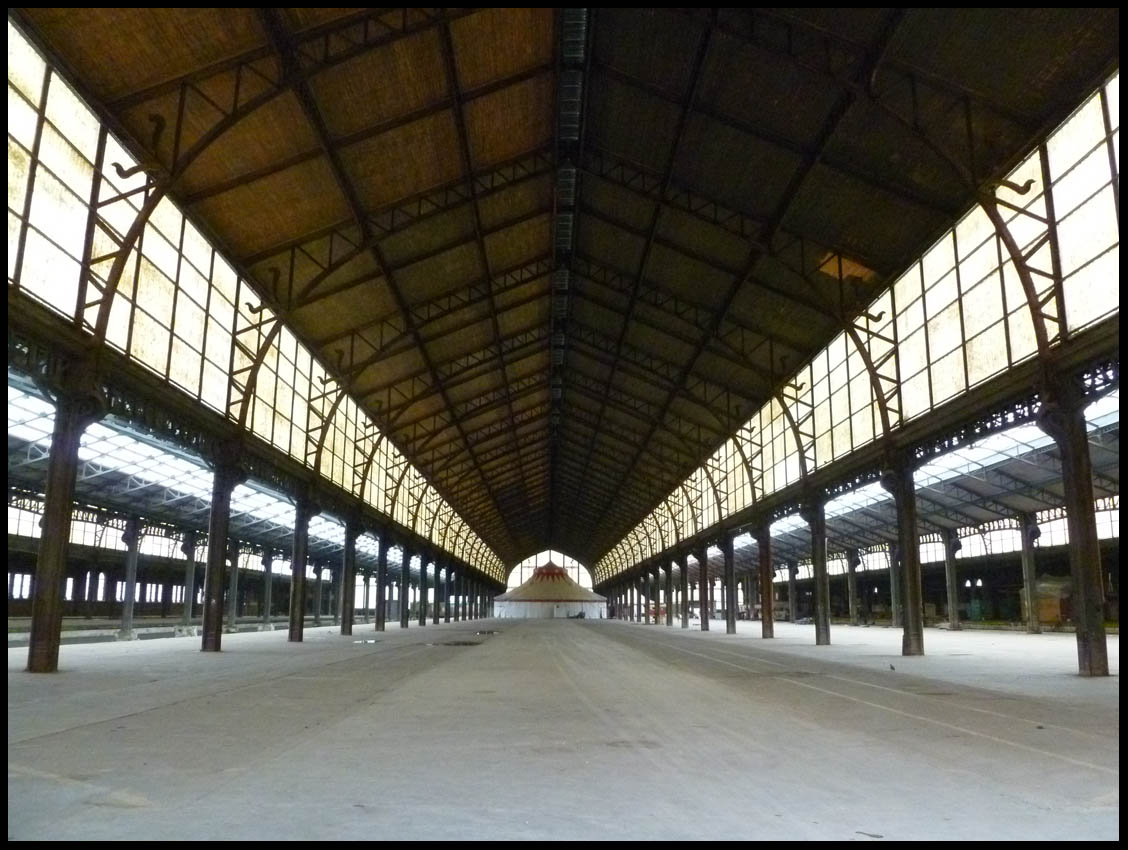
A favourite book of mine is Industria: Industrial Architecture in Belgium from 1986. It’s mainly a book of superb documentary photographs by Christine Bastin and Jacques Evrard that prioritise the need to record with absolute clarity over personal expression - somewhere between Bernd and Hilla Becher and Walker Evans. There are pit-heads, pumping stations, forges, boat-lifts, paper mills, sugar refineries, tanneries, maltings, kilns and blast furnaces – almost all out of use and unrestored. Prominent among them were photos of a vast complex of canal and rail served bonded warehouse (Entrepôt Royal) and storage facilities in Brussels known as Tour et Taxis (being the Gallicised form of Thurn und Taxis, a German dynasty of entrepreneurs that played a leading role in establishing European postal services) and built mainly between 1903 and 1906. After being finally abandoned in 1987 it presented a serious challenge to conservationists and it was more than a decade before work began to restore and convert the main building for a new use.


The main building, designed by architect, E Van Humbeek, was constructed with a concrete structure on the Hennebiq system to provide 100 storage chambers over four levels with a single rail track to move goods in and out. In its enormous scale it was a perfect expression of Belgian economic power (Belgium was Europe’s fifth largest economy in 1900) and ambition and externally the warehouse was finished to a very high standard and clad in fine brick-work. We must imagine wave after wave of colonial plunder arriving by rail or canal on which excise duty would be levied prior to onward shipment. Additional building were constructed on the site and included a customs office (Hôtel des Douanes) and other substantial warehouses (Halles aux Poissons et Huiles and la Gare Maritime). By 1922 when the entire complex was finally completed there was a power station (Centrale Électrique), an exotic copper domed water tower (Château d’Eau) and a railway station for the exclusive use of employees (la Gare de Service – la Chapelle). At its peak almost 3,000 workers were employed on the site.


The refurbished Entrepôt Royal opened in 2007 and houses fashion and media businesses on the upper levels (to which there is no public access) and celebrity-chef restaurants and bars on the ground floor. There is exhibition and conference space on the lower ground floor. It all looked rather forlorn and relatively deserted on my recent visit – a small number of suits attempting to stride around purposefully and a handful of latte drinkers staring at their iPads. There are probably busier times than a damp Wednesday morning but despite the splendour of the restoration work, a wonderful glazed roof and an invigorating sense of scale, it all seemed lacking in dynamism. If this is, as stated, the vanguard of regeneration then much work needs to be done. The rest of the site still awaits its fate – the master-plan provides for waterfront residential and retail developments on a large scale and a public park but at present it is still possible to wander around and view the other buildings and structures. The station is a semi-ruin after a fire in 1998 but the Gare Maritime is an enormous structure with great potential and does see occasional use for major performances and exhibition. The water tower and power station are buildings of distinction, eclectically styled and finished in Flemish brick and blue Belgian limestone. The regeneration project may turn out to be a future triumph but at present there is a vaguely depressing provisional air about the place that gives little cause for optimism.


Tuesday, 24 May 2011

Sheet-Metal Memories


Each time that Bob Dylan, 70 today, passes a milestone there’s a tidal wave of commentary and hagiography. The ten best tracks, the ten worst tracks, the five worst movies, the ten best concerts, the five worst interviews, the ten best cover versions, the five worst put-downs, send him a birthday present, buy him a book, send him a recipe, choose him a tie, boil him an egg, shine his shoes, tell him a joke, paint him a picture, peg out his clothes, wash his car, crawl out of his window. Despite all this I must confess that I’ve been a dedicated follower of the Bob Dylan route-map along the Great American Highway of Song for more than 40 years. The trip passes some familiar landmarks such as Woody Guthrie, the Harry Smith Anthology, the Delta Blues and the world of Gospel, Doo-wop, Bluegrass, Country and Vaudeville and some that are less familiar such as Western Swing, Honkers and Shouters, Brother Bands, Minstrel Shows and Hellfire Preachers. All these threads and more are woven together in his recordings before being taken apart and presented to us in the sublime Theme Time Radio Hour. Railroad trains run through the Dylan songbook on an intensive timetable – if you miss the “D” train the “Double E” or the Danville train won’t be far behind. Or you can take a ride on board the unique “D for Dylan” subway line from the cool clear air of Bear Mountain to the lost souls and insomniacs on Desolation Row.


Friday, 20 May 2011

Postcard of the Day No. 48, Paris, les Guichets du Louvre


Today we have two postcards based on photographs taken on virtually the same spot, just a few years apart. The location is the great arches through which road traffic passes enroute from place du Carrousel on to the Quai François Mitterand. Two open-top vehicles pass – one with four wheels and eight legs, the other with four wheels and twelve legs. The vehicle on the right has trundled up from Porte de Versailles on the southern fringe of the 15th. arrondissement via rue de Sèvres and passing Saint-Germain des Près on the way. An elegant touch is the provision of colour-co-ordinated teams of horses. In the second card, the stench of dung gives way to the smell of petrol as one of Paris’s first double-decker motor buses heads south through the archway. The bus is a Brillié-Schneider P2 introduced in 1906 and probably travelling from Montmartre to Saint-Germain des Près. These new buses were built by recycling the coachwork from redundant horse-drawn vehicles. The interest in these cards is due to the photographer waiting for the buses to enter the viewfinder before taking the photo – without the buses we would be left with a dull and undistinguished view. Even today there are five RATP bus routes that pass through the arches.


Thursday, 19 May 2011

Eric Fraser in Art and Industry


It’s over three years since my last post on the subject of Eric Fraser. In that time several more relevant items have surfaced including this feature from the magazine, Art and Industry dated May 1937 (Vol. 22, No. 131) written by R Haughton James. Interestingly the writer presents Fraser as a satirist and subversive reminding us that what appears in hindsight to be stylisation might have taken on a very different meaning for the contemporary audience. What is also striking is how an artist, notable for exquisite elegance of line and composition could occasionally produce an image of disturbing crudity. The cover design for Olaf Stapledon’s science-fiction novel of the übermensch, Odd John (1935) falls into that category for me. The latter plus three other examples of Fraser’s work in colour have been gleaned from the pages of various Penrose Annuals.


Wednesday, 18 May 2011

Old England


The glass and steel tower of the Old England department store in Brussels is an extraordinary sight with a wealth of intricate decorative detail heavily influenced by Art Nouveau. Occupying an imposing position above the heights of the Mont des Arts, close to the place Royale, it was completed in 1899 to a design by architect Paul Saintenoy (1862-1952). For Saintenoy it represented an astonishing stylistic leap into the future when compared with the Pharmacie Delacre that he designed only a year earlier. The Pharmacie Delacre (below) is a fantasia of Flemish architecture in which traditional forms are given a Gothic twist and piled high in a Romantic accumulation of arches, turrets, spires and dormers – a world away from the assertive modernity of the Old England store. The chain of Old England department stores was founded by a Paris-based Scotsman, James Reid and included branches in Paris, Bordeaux, Geneva and Rome before arriving in Brussels in 1886. Tailoring for gentlemen and supplies of provisions and stationery were the specialities. Business must have been good – within 10 years new, much larger, premises were commissioned and Saintenoy’s shiny new Art Nouveau extravaganza opened in 1900. This was annus mirabilis for Saintenoy who was quick to abandon Art Nouveau in favour of more classical styles. In 1910 he took up a teaching appointment in the Académie Royale des Beaux Arts and his career as a practising architect dwindled to the occasional restoration project and never again approached the achievements of 1898-1900.


The store ceased trading in 1973 by which time local planning laws had obliged the owners to remove much of the decorative ironwork and paint the superstructure in white to conform to the colour code of the place Royale district. After decades of decay the building was purchased by the State to re-house the Musée des Instruments de Musique. Restoration began in 1989 and over the next 10 years the façade was returned to its original condition while internally it was adapted to function as a museum. The Musée des Instruments de Musique finally opened in 2000, the only addition to the façade being the strips of musical notation attached to the balconies.


Saintenoy’s design was basically that of an industrial building with a steel frame, glazing on the front to maximise daylight throughout the store and concrete floors. The seven floors were needed to replace selling space lost when city planners seized part of the site to widen the road. The profile is greatly enhanced by the central cupola flanked by an obelisk and a six-sided turret topped with an extraordinary lantern in wrought iron. Wrapping the steel on the front with sprays and tendrils of organic ironwork, brass and copper detailing and large ceramic panels spelling out the store name made the building stand out from anything else in the area. Compared with Horta’s À l’Innovation store on rue Neuve (1900), that exists only in photographs, having burned down in 1967, Old England appears determined to impress even at the cost of being considered unrestrained and flashy. It is curious that the pre-eminent Art Nouveau building in central Brussels should be the work, not of Victor Horta, acknowledged master of the style or even a lesser light, such as Paul Hankar, but of an architect who experimented in the idiom just once and quickly moved on.