The Punch Almanack for 1925 offers a snapshot from 100 years ago of a long defunct popular humorous magazine. Contributors had a long tradition of expressing offence at the vagaries of fashion in the broadest sense - anything novel or remotely faddish was a subject for mockery. Less attractive was the tendency to direct their scorn downwards towards the poor and ill-educated as well as those with the misfortune not to have been born British. Non-white imperial subjects were an especially favoured target for ridicule. Resistance to change was an enduring topic - defence of the vanishing countryside and assault on the tyranny of Modernism and its Cubist sideshow. Turning to the colour cartoons of 1925, Frank Reynolds was the cover artist, not really at his best with this sombre image of Mr. Punch on horseback but fully compliant with the magazine’s veneration of fox-hunting. HM Bateman was in an uncharacteristic mellow mood, his habitual malice under restraint. The dancing girl with her legion of admirers is relatively benign while the Plumber’s Paradise in its ramshackle complexity is a nod to W Heath Robinson. Kenneth Bird (1887-1965) signed his distinctive work as Fougasse - his simple style was instantly recognisable and first appeared in Punch in 1916. In 1949 he became the first cartoonist to occupy the editor’s chair at Punch having previously served as art editor since 1937. Rugby Across the Ages is a product of his lifelong obsession with rugby - speculative projections from the present to the long distant past was a Punch staple. In a sceptical look at modern media Through the Seasons with the Magazine Cover he makes fun of reliance on cliché. There’s an excellent anthology of Punch cartooning in colour, Best of Punch Cartoons in Colour (2012) edited by Helen Walasek - very easy to find on sale online.
Monday, 22 December 2025
Tuesday, 27 May 2025
Bourneville 1925 Transport
Another Cadbury brochure published to explain the business of chocolate manufacturing to the general public, based on the notion that the public appetite for geography and economics was as great as the appetite for chocolate. A hundred years have passed since Frank Newbould was commissioned to provide the illustrations - a perfect choice given his expertise in transport and industrial process. Newbould’s cover combines road, rail and maritime traffic into a single composition, enhanced by an elevated viewpoint. Designed to impress with the unstoppable energy of commerce, Newbould has omitted any distracting details to focus on the triumph of mechanisation. There’s a map to show us the global presence of Cadbury, drawing in raw materials from every continent via a network of commercial shipping - what we would now call the mysteries of the supply chain. Export cargoes were nailed into wooden packing cases requiring enormous supplies of raw timber from Russia and Scandinavia, moved by rail to Bourneville to be machined in the company saw mills. Cocoa beans, sugar and hazel nuts were stuffed into sacks, that in turn were lashed into nets to be craned on and off mixed cargo ships. Newbould shows an early stage in the travels of the cocoa bean where local labour loads heavy sacks into small boats that rendezvous out at sea with cargo liners too large to enter the port. A fair weather vision of breezy skies and surf in which hard labour looks effortless.
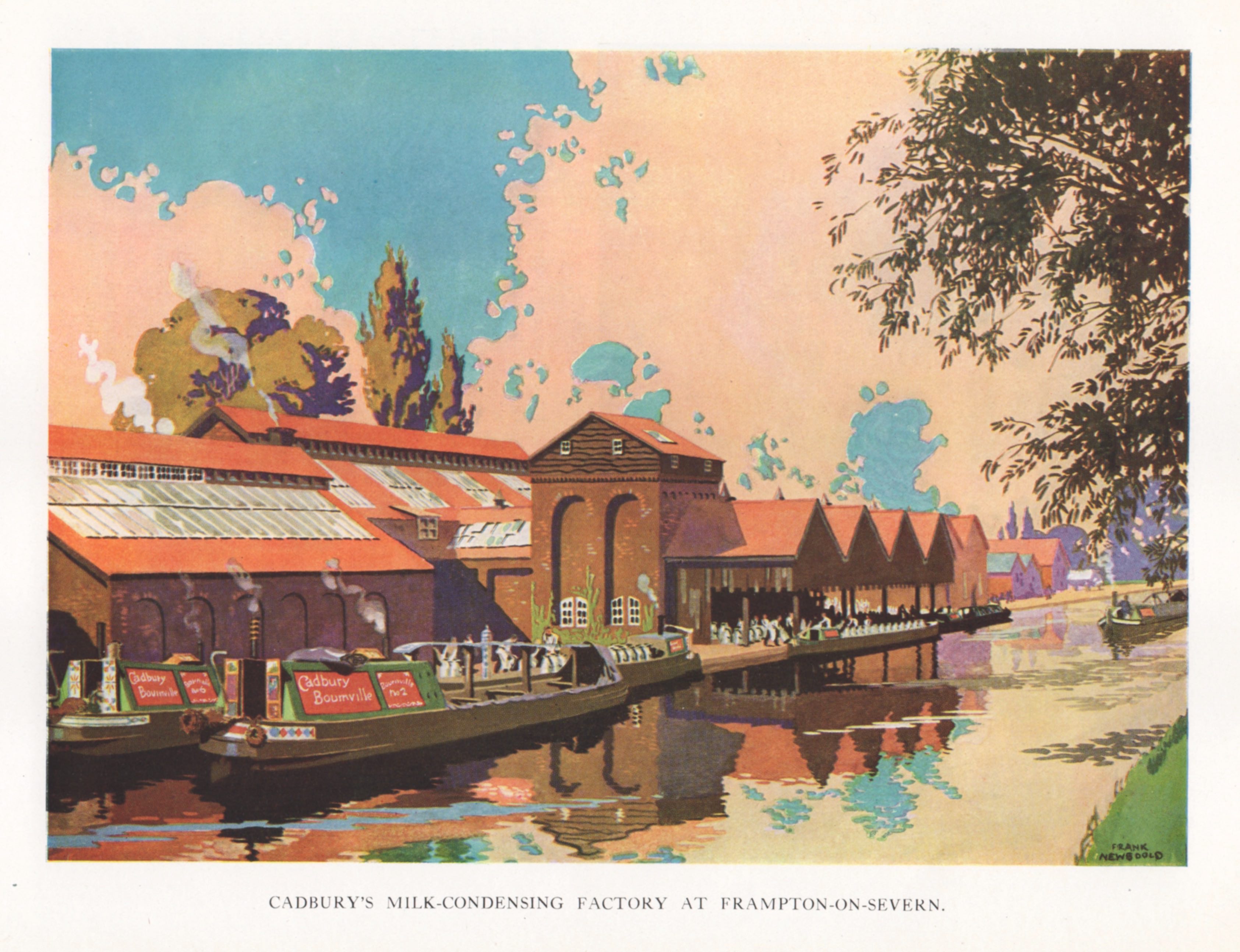
Equally idyllic is Newbould’s bucolic vision of a canal-side milk processing factory built in a restrained vernacular, barges and narrow-boats serenely chugging by. In a double page illustration across the centre pages, Newbould’s attention turns to the Bourneville factory in an aerial view that attempts to balance the vastness of raw industrial power with the sense of the factory cosily enveloped by the splendour of a verdant English countryside in high summer. To finish, Newbould observes the end of the process when the boxed finished products are loaded on to trains by sack truck and trolley. The facility has all the features of a conventional station minus the passengers. Once again we are invited to admire the scale and complexity of operations thanks to Newbould’s control of colour to create a perfect sense of clarity. Cadbury invested heavily in a wide output of promotional publishing from collectors’ cards and albums to factory guides and brochures like this. Newbould was re-employed in 1927 and dispatched to Trinidad where he made a varied portfolio of location images that featured in Bourneville 1927, Cocoa Story. It can be seen in my post from August 2010.
Thursday, 26 August 2021
On the Railway in 1925
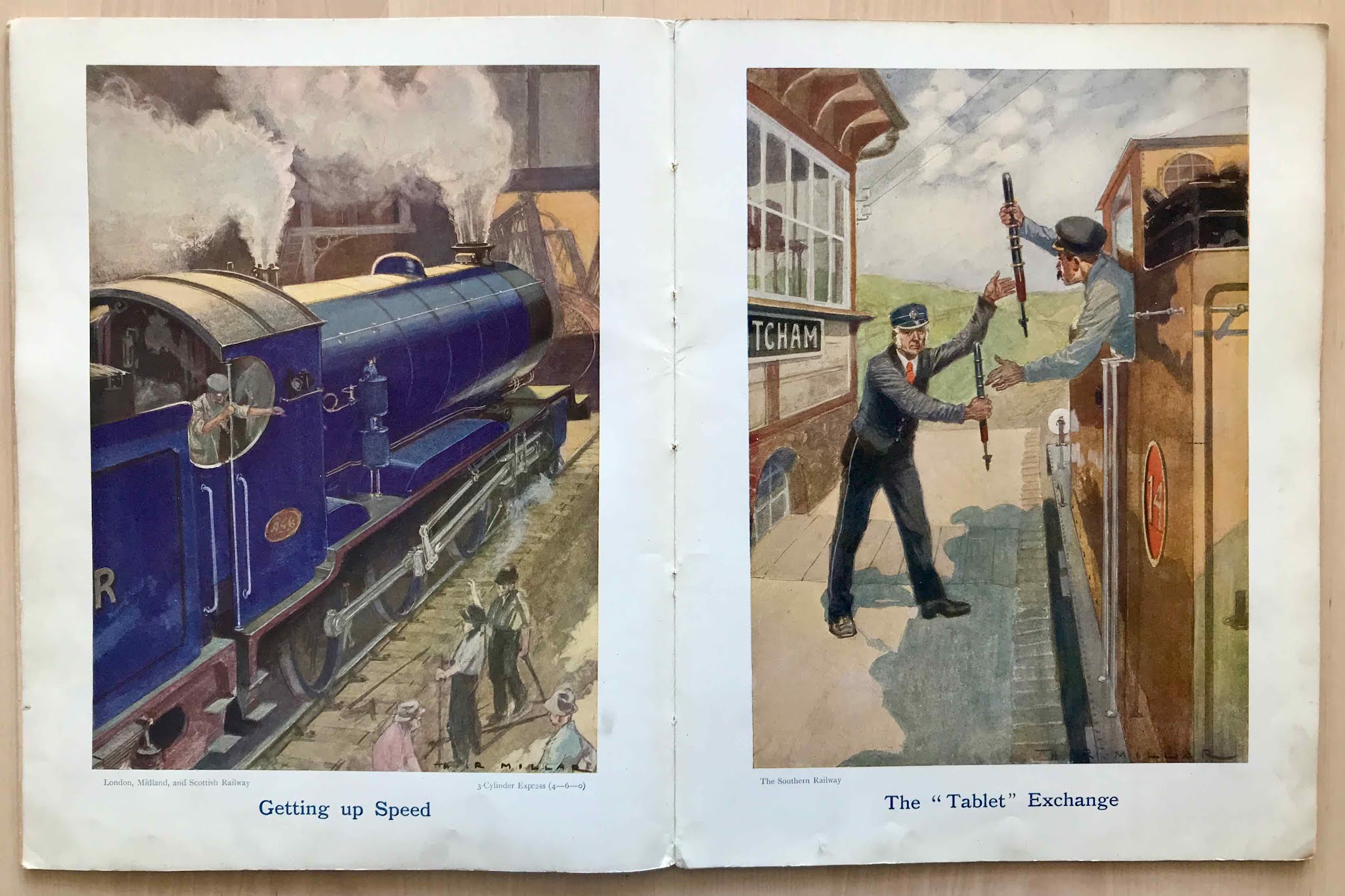
This slender but large format illustrated book dates from around 1925 when it was presented to Master Norman Dore by the Fulham Baptist Band of Hope. Norman’s good conduct and regular attendance had earned him Second Prize; he also took good care of his book, resisting all temptation to embellish it with his handiwork. Published by Blackie and illustrated by H R Millar it was one of many such books launched on the market to engage the interest of the junior railway enthusiast. The illustrations are atmospheric and impressionistic in execution and while paying due respect to the mechanical features on display no attempt has been made to describe them in detail. Scottish born Millar (1869-1942) was a regular contributor of drawings for Punch and Strand Magazine as well as a prolific book illustrator. Before attending art school he had some training in civil engineering which may have influenced the linear precision to be found in much of his other published work. His collaboration with Edith (Railway Children) Nesbit, best selling author of fantasy books for children, may have been his most fruitful. Beginning in 1899 he illustrated all her best known books until 1913. Nesbit, intriguing for her lifelong devotion to socialism, held him in high esteem and his success in bringing her tales of fantastical creatures to life may have encouraged him to write and illustrate his own books. Almost a century after her death in 1924 many of Nesbit’s books remain in print, often reissued with new illustrations including examples by Inga Moore, Brian Robb and Edward Ardizzone.