

A trip to Essex is a rare event so we took the opportunity to take a c2c (owned by Trenitalia) train from Barking to East Tilbury where Bata shoemakers established factories and an industrial village in the 1930s. Public awareness of Modernism in 1930s England was minimal and in the Essex village of East Tilbury even less. It must have been a shock to the villagers when Modernism landed on their doorsteps in 1932 as they watched towers of welded steel and reinforced concrete rising out of the potato fields of the former marshland. This marked another stage in the global advance of the Bata Shoe Company founded by Tomas Bata in 1894 in the town of Zlin, Czechoslovakia. A visit to the Ford factory in Detroit had inspired Bata to adapt the latest production line technology to the manufacture of footwear and the company had expanded rapidly across Europe and beyond. Bata was attracted to the social ideals and paternalism of the Garden City movement but his aesthetic preference was for Modernism rather than Arts and Crafts or Tudor revivalism.

Czechoslovakia was much more receptive to Modernism than Britain and a company team of Czech architects led the project. Planning and design principles that had been established in Zlin were applied in East Tilbury and included material specifications and the use of reinforced concrete frames. As originally planned there would have been 3 ten-storey factory blocks plus a rail connection to what was then part of the LMS railway with sidings for loading and unloading. These were scaled down to five-storey blocks and the rail connection never materialised. When the factory opened in 1933 in the Depression, locals welcomed the employment prospects although their eyes must have been startled by the Modernist geometry and the acreage of glazing in the brand new, multi-storey factory buildings. New housing for workers (a significant number of whom were Czech) and their families along with a clinic, sports ground and village hall were provided and despite the challenge of inducing the English to live under flat roofs, this concern for their welfare was fondly remembered by former employees. Manufacturing in East Tilbury petered out in 2006 by which time the factory buildings had already been disposed of to an uncertain future. The Bata Company is still in business and based in Switzerland. Its products are sold in many countries from East Asia to Latin America, Europe, Africa to Australia but UK is not one of them.
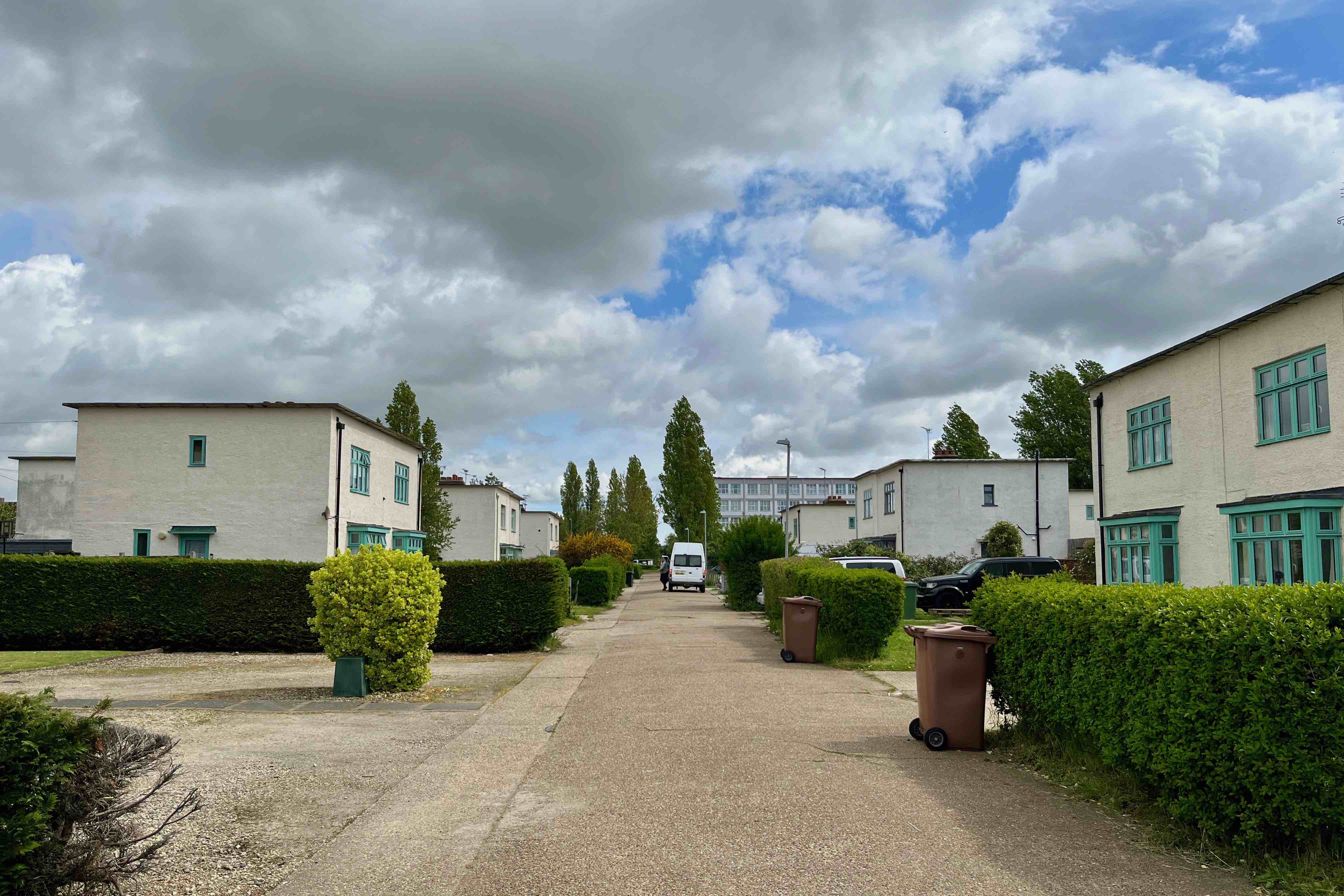
At the peak in the 1950s there were 3000 employees at East Tilbury and over 200 Bata shops on Britain’s high streets but the business was not immune to Britain’s industrial decline and in the 1960s production began moving overseas, mainly to developing countries. The design influence of the Czech parent had gradually faded away and the worker housing became entirely conventional - semi-detached with pitched roofs. The last company housing was completed in 1966 and in the 1980s the houses were sold off to private buyers in the spirit of the time. The process of adjustment has been difficult. Converting the major buildings for new uses has been expensive and attracting investment has been hard but most of the factory premises have found new tenants over the years and the only major building still in need of renovation is Nelson House (the former leather factory) on top of which sits a water tank, lettered on all four sides with the Bata logo, easily visible to railway passengers almost a mile away.

In 1939 Bata completed a new 16-storey HQ in its Czech hometown of Zlin that included a top floor office for the Chief Executive, Jan Bata, designed as a giant lift capable of descending to ground level at the stately pace of 75 cm per minute. The Nazi annexation of the Sudetenland in 1938 and occupation of Czechoslovakia stopped the project in its tracks and despite Jan Bata’s personal appeals to the Nazi overlords, the factory was closed. The Bata diaspora gathered pace and new businesses were opened in the US and Canada and production expanded in India and Singapore. When Bata refocused on emerging economies it withdrew from most European operations leaving an architectural legacy of design excellence that became a serious problem for planners in Bataville in France and Batadorp in the Netherlands (as well as in East Tilbury) as they grappled with the challenge of adapting the buildings without compromising the features that made them worthy of preservation. There are two further sources of detailed commentary on Bata, the first is a Historic Area Appraisal of East Tilbury carried out for English Heritage in 2007 and the second is a wider historic survey of Bata’s global presence from the magazine Azure.


