Showing posts with label elevated railroad. Show all posts

Tuesday, 12 September 2023

Past and Present No. 13: Berlin Bülowstraße Bhf


The station at Bülowstraße was on Berlin’s first U-Bahn line and opened in 1902.  It is now on line U2 on a short section of elevated track that runs from Gleisdreieck as far as Nollendorfplatz after which it continues underground. Despite heavy war damage and a 20 year period out of use (1972-1993) due to geo-politics, the building exterior is as close to original condition as any other example of its age.  Comparison with the period postcard shows that little has been lost other than ornamental flourishes on the train shed and some decorative ironwork.  Bruno Möhring (1863-1929), Jugendstil specialist and skyscraper enthusiast, was the architect - elsewhere in the city he designed the Swinemünder Brücke (1902-1905) that crosses the railway tracks to the east of the station at Gesundbrunnen. Another of Möhring’s notable achievements - the Jugendstil Machine Hall at Zeche Zollern colliery in Dortmund - was featured in this blog in 2017 and can be seen here.


Tuesday, 19 November 2019

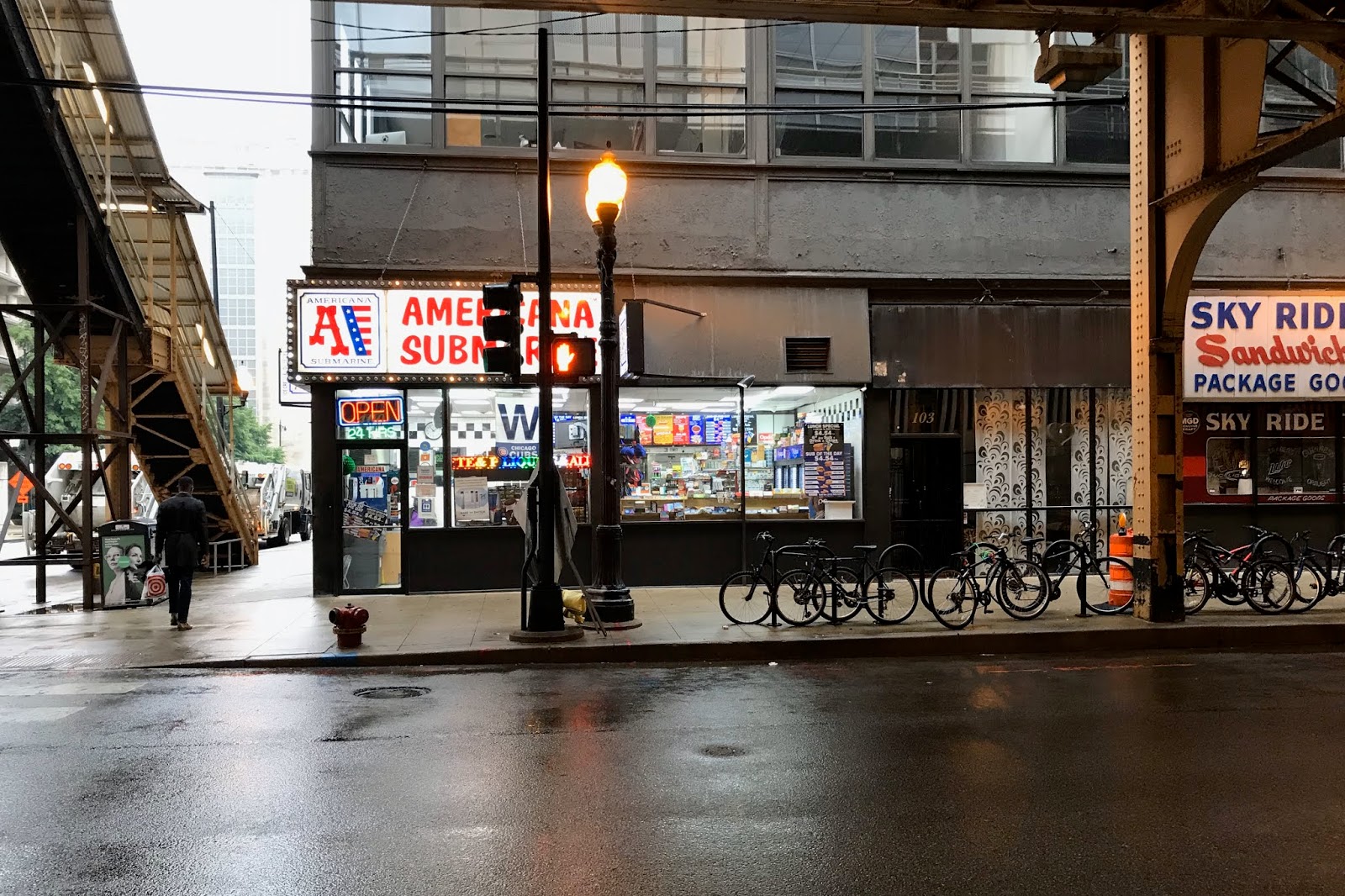
Chicago Under the Loop


The Chicago Loop is a unique transport solution. Transit lines from all points of the city converge on a central elevated loop, entering and circulating until they spool off in another direction to complete their journeys. Underneath the elevated railway is a zone of semi-darkness where a shadow is cast on traffic and trade. An elevated railway was an attractive option for transport planners working to a budget - the cost per mile is a fraction of the cost of constructing underground. Road networks of broad and straight boulevards encouraged American city planners to adopt this solution and Boston, Philadelphia and New York City still have significant sections of elevated tracks although only Chicago operates them in the central business district. In other cities they have retreated to the suburbs.


Artists and photographers were quick to spot the novel visual drama of a railway that passed over the street and recorded the scene with fascination. Visual Telling of Stories has a concise summary of the appeal. But for those existing at ground level it produced a degraded environment in which the roar of the traffic was amplified by the overhead structures, to which was added the percussive rumble of passing trains. Intensified by the lack of daylight, mounting hostility to elevated railways from property owners and business interests forced them out of Manhattan by 1955 but in Chicago they persisted. Sections of elevated railway are common in Berlin and Hamburg, while in Paris, lines 2 and 6 of the Métro run overhead for significant parts of their journeys. Somehow none of these systems has anything like the impact on its surroundings as the Chicago “L”. The reason for this may lie in the constrained character of the Loop that serves to concentrate and magnify its effects. In other cities, many routes follow central reservations, a mitigation unavailable in Chicago.


To this visiting observer all this is very fascinating and it’s an easy matter to walk the entire circuit and appreciate how it impacts on its surroundings while enjoying the brutal and unadorned heavy metal structures that keep all that stuff up in the air where it belongs. Where the streets are broad it sails overhead with little disturbance, the sidewalks being open to the elements. It’s a much more intrusive presence in narrower streets where our field of vision is greatly restricted and there’s an obvious decline in business where this happens. Prestige retail happily thrives on the wider avenues while more marginal retail dominates as the streets get narrower and feel like caged spaces. In essence, the system was developed in accordance with the prevailing American infrastructure aesthetic where every dollar must be worked to the utmost using hard materials, military quality build, with a scrupulous avoidance of any extraneous design elements that might make it easy on the eye. If American transit had been designed to the same standard as the Detroit auto industry in its mid century glory, it would be the wonder of the world for its extravagance and futuristic embellishment.


The disruptive dazzle of sunlight spattering on the streets below is much favoured by photographers but I found more of interest to record after nightfall and in the rain when halogen and LED lights are reflected off hard surfaces. Busy thoroughfares empty out at nights to express a sense of desolation and urban melancholy. This selection of photographs taken last June are not intended as a photo-essay - just a series of images inspired by a strange and forbidding urban structure.


Monday, 3 September 2018

Postcard of the Day No. 92 – Interior of Elevated Car, Philadelphia


An air of deepest gloom and melancholy hangs over this sombre group of passengers. Mostly seated and facing the viewer, they appear resigned to their fate – trapped on the infamous Long Black Train, bound for extinction. The dark mood is intensified by the way the passengers huddle in the back of what could easily be taken for convict transport. It makes a stark contrast with Coffee & Cigars and Afternoon Tea in the Salon-de-Luxe. In the former we see a trio of captains of industry browsing the news while in the latter, three ladies of leisure sip tea in plush upholstered surroundings. Both groups have the air of late Victorian narrative painting and scrupulously avoid making eye contact. Prosperity and privilege in locomotion.


Friday, 22 June 2018

Past and Present No. 12: Hamburg Hochbahn


The postcard is captioned – Hamburg, Hafen mit Hochbahn. It dates from 1905-10 and shows a train departing from Landungsbrücken station. Over a century later the details have changed but the topography is easily recognisable. I took the contemporary photo on June 6th. and got as close as possible to the viewpoint of the postcard. To enable a closer comparison, the photo had to be cropped, which all but eliminated the latest addition to Hamburg’s river frontage. The uncropped original shows the elevated railway follows the same path but the skyline is now dominated by the Elbphilharmonie, designed by Herzog and De Meuron and completed in 2017. It’s a remarkable building – the glass walled wedge with pointy roof has been constructed on top of a brick built warehouse dating from 1963. There’s a public observation deck at the point where the two elements meet – as well as fascinating views over the port, it offers the visitor a chance to wander through some of the strange interiors where rippling curtains of curving glass confuse the eye.


Wednesday, 4 November 2015

Postcard of the Day No. 79 – New York Blizzard


We can trace the photographic origin of today’s card to an 8 by 10 inch glass negative in the collection of the Library of Congress. Taken in the Great Blizzard of 1899 on behalf of the Detroit Publishing Co. and cropped for a postcard that was copyrighted in 1906. Colour was applied and the result has an almost cinematic sense of immediacy. Bright light reflected from the wet paving stones haloes the foreground female figure that strides purposefully into the composition. An elevated train rumbles overhead, a streetcar passes by and snow shovellers are making desultory efforts to clear the street. According to Robert C Reed (in The New York Elevated, 1978, p. 114) the location is midtown on the Sixth Avenue elevated, probably near Herald Square.


Below is another example of a street scene recorded from the sidewalk, this time underneath the elevated tracks in the Bowery. Most street photography on postcards takes a distant, more detached viewpoint and images taken from the sidewalk are relatively unusual. Which is a shame as we get a much more intense documentary feel – a powerful evocation of the sights and sounds of a busy city street. Trains thrash overhead, horse-drawn vehicles and streetcars occupy the roadway and all the long lost detail – shop windows, theatrical poster, cast-iron balustrading and the ties that span the street and brace the twin viaducts supporting the elevated railroad can be examined at leisure. The final card shows a scene that even Edward Hopper may have rejected as excessively dystopian. A street corner where two trains, vertically stacked clatter past with an ear-piercing grinding of metal on metal that can hardly be imagined. Magnificent as it was as an emblem of the metropolitan sublime, it’s easy to see why the presence of the elevated was so greatly resented by those compelled to live and work in its perpetual shadow.