Showing posts with label tribute. Show all posts

Sunday, 12 April 2026

In Honour of Glen Baxter

In a long career Glen Baxter (who died at the end of last month) created a fine body of work that resisted categorisation. Evolving a style of drawing that gently parodied the banalities of mass market illustration, his imagery had the clarity and simplicity of a textbook diagram combined with the sense of mystery that lay beneath the expressionless surfaces of Magritte’s paintings. In vintage picture books for children he discovered the joys of captions that stated the obvious in utilitarian language with a reckless disregard for the perils of the double-entendre or misinterpretation.  Many of his regular cast of characters came from the same source - the intrepid but hapless explorer, the denizens of Sherwood Forest, cowboys, boy scouts, ancient mariners and deep sea divers. The frisson generated when caption and image pull in separate directions amplified the incongruities that he delighted in exploring. Defining his work by genre or designation feels like a fool’s errand. For some, he was a cartoonist, others saw an illustrator, for me, he was simply an artist. Art world references abounded and it’s intriguing that he exhibited in such disparate galleries as Nigel Greenwood (home of Artists’ Books, Conceptualism and Gilbert and George) and Chris Beetles (citadel of figurative illustration).

In his 1980s prime, Baxter found himself approached by advertising agencies and his artwork began to appear in newspapers and magazines.  In 1987/88 Brooke Bond tea made use of his talents in a trio of full colour amusing drawings - the image of tea-making on the ocean floor was especially arresting.  A commission from Gilbey’s Gin was not without problems due to the client’s persistent efforts to include a ‘pack shot’, it eventually appeared in both newspapers and magazines.  Art postcards enjoyed a season of popularity in the 1980s and many Baxter drawings were reprinted in this format. A further ‘brand extension’ came in a range of Poole Pottery with Baxter designs. There are few more prestigious clients for editorial illustration than the New Yorker and the Glen Baxter Wall Art page displays 79 examples. And the books kept coming, in which every few pages an image guaranteed to astound and amuse would surface. As long ago as 1983, Miles Kington in a slightly ungracious review concluded that Glen Baxter needed to find a new act. Thanks perhaps to never scaling the heights of celebrity status he was able to refresh and renew his distinctive offer, while avoiding ubiquity and the deathly slide into unfashionability.


Thursday, 11 May 2023

Bruce McCall (1935-2023)

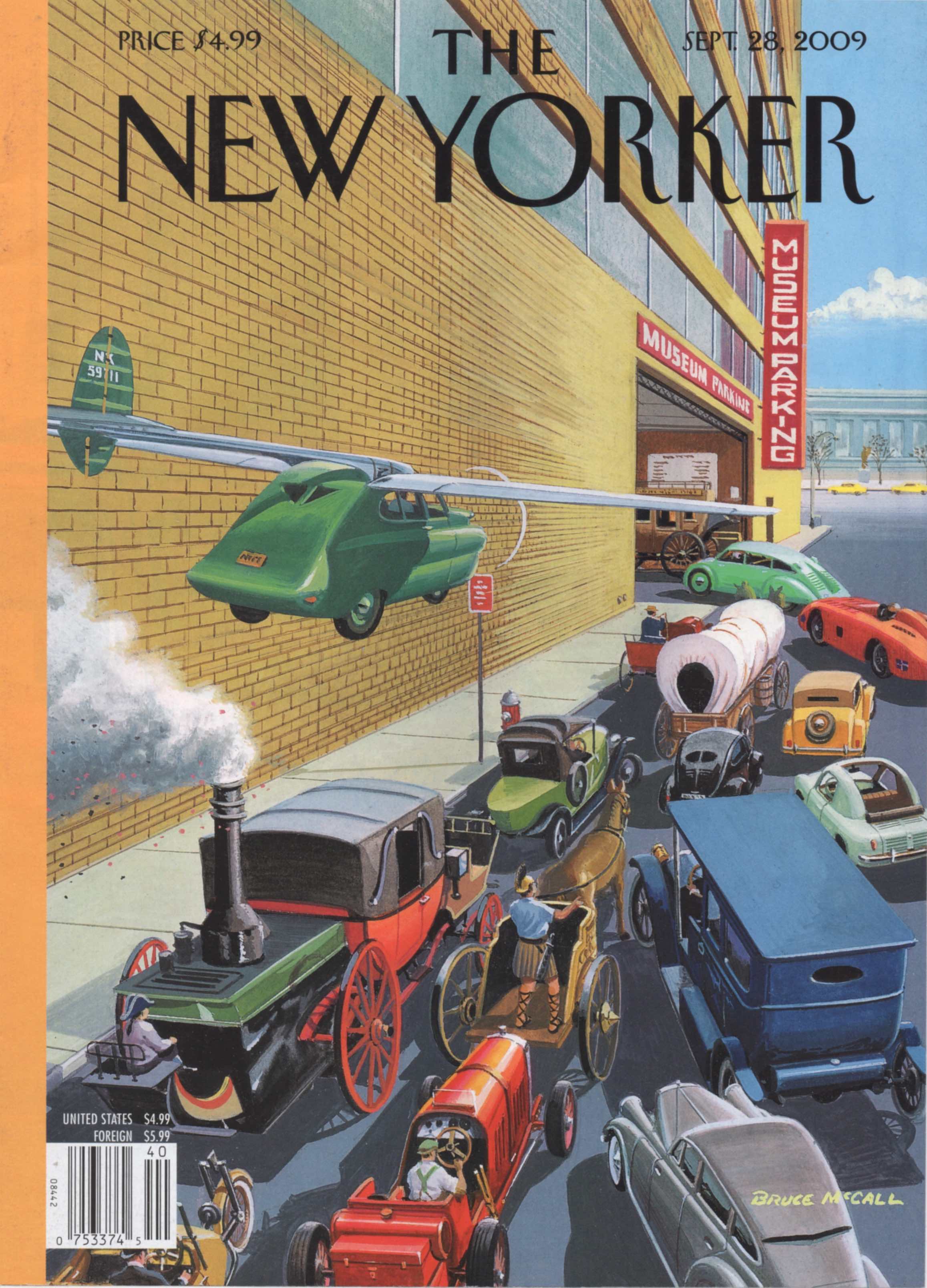
I’ve been a fan of Bruce McCall’s illustrations since I first saw his parodies of Streamline Moderne in the pages of National Lampoon (see above). When he became a regular cover artist at the New Yorker I collected his covers as well as his books (Zany Afternoons, All Meat Looks Like South America).  In the past I’ve read some snide criticism of his work - stylistically conservative, unadventurous and boring, but that ignores the ingenuity and asperity with which he undermined the conceits and social pretensions of self-conscious modernity. His experiments with the visually incongruous could rival those of Magritte, an artist whose work was greatly enhanced by conservative techniques of representation. By the time of his death he had drawn 83 New Yorker covers (almost 18 months worth) and though he kept returning to the same themes (human vanity, bears, ocean liners, aviation, motor vehicles, advertising) he always found something fresh to say in his familiar deadpan fashion. With decades of experience toiling in the advertising industry he knew whereof he spake. He died last Friday at the age of 87, by way of tribute this is a selection of my favourites of his streetscene covers for the New Yorker taken from my scrapbooks.


 Plus two examples kindly provided by Robin Benson.


Wednesday, 25 October 2017

Fats Domino (1928-2017)


There’s always been a special place in my affections for Fats Domino whose music never fails to lift the spirits. It’s especially sad that his death has been announced today – tonight’s movie will be “The Girl Can’t Help It”. In my early teenage years the price of an LP was well outside my spending power but an EP (Extended Play) with 4 tracks playable at 45 rpm was just about affordable. The first EP I ever bought, some 50 years ago, was Be My Guest by Fats Domino.  This was my introduction to New Orleans Rhythm ‘n’ Blues and a voyage of discovery that would lead to Professor Longhair, Huey ‘Piano’ Smith, Ernie K-Doe, Chris Kenner, the Meters, the Showmen and Dr John over the next few years.  The Domino method of dancing your blues away was an unusual strategy to find favour with one whose dancing days gave rise to rather more mirth than admiration. Two qualities stand out. First, the irresistible rhythms unique to New Orleans and second, the joyous sound of massed horns, for which credit must go to the arranger, Dave Bartholomew (who will celebrate his 99th. birthday on Christmas Eve). Both features became essential parts of the musical vocabulary of Jamaican Ska. Domino was raised in the Roman Catholic church and thus was never exposed to the visceral power of the gospel traditions.  Musicologists argue that African musical traditions survived more strongly in Southern Louisiana than anywhere else in America.  The rhythms and vocal styles were closer to African originals than elsewhere.

The process whereby African-American music was neutralised and cleansed for a white audience was described to perfection by Chip Taylor in his 1971 recording, (I Want) The Real Thing. The UK music business was very active in this process churning out a succession of records in which the passion and spirit of the original recording was systematically eliminated by a mediocre and enfeebled performer.  Domino’s recordings escaped this treatment for the simple reason that their appeal depended entirely upon a quality of delivery and personality that could not be replicated. It was impossible to dilute something so intense and be left with anything remotely worth listening to.  The few attempts to cover Domino hits in the UK sank without trace. In the US there’s a role of infamy headed by Pat Boone, Ricky Nelson and Teresa Brewer all of whom profited from hi-jacking Domino material and draining it of vitality.

In New Orleans there was no place for the dark and down-home, hard times, lyin’, cheatin’ and dyin’ crapshootin’ blues from the Delta.  There was no great audience for the smooth toned supper club and coffee lounge blues styling of the likes of Nat King Cole.  There was a positive, optimistic, up-beat and life-affirming defiance in the air that found expression in a refusal to submit to the iniquity of racial segregation and a denial of the subservience that the white establishment attempted to impose.

Rick Coleman’s biography, Blue Monday, is a fascinating account of the way that Domino’s concerts in the 1950s became the focus of a long sequence of riots and civil disturbance.  There was nothing in Domino’s performances to incite the crowds other than the music. The principle provocation came from the police whose heavy handed attempts to enforce racial segregation were calculated to incite resistance.  Alcohol fuelled aggression and inter-racial conflict also played a part. The irony of this is that the Domino songbook was exclusively dedicated to good-time music with not a trace of insurrection or subversion.


Domino became one of the great survivors of his generation of R & B performers.  Despite the excessive consumption of alcohol and an addiction to gambling Fats continued at the top of his game while his band members and close associates perished in their numbers from drug and alcohol related illnesses.  His touring days ended in 1995 enabling him to retire his infamous hot-plate and cooking pot in which he brewed up decades worth of pigs’ feet in creole sauce with which to feed himself and his band. Famously he survived Hurricane Katrina in 2005 at the age of 77 when a rescue boat plucked him and his family from the second floor of his home in the Lower Ninth Ward.  He went on to perform at Tipitina’s in New Orleans in May 2007.  He retained a reputation for geniality and modesty despite occasional episodes of seriously grumpy behaviour, marital infidelities and a chronic failure to turn up for scheduled appearances.

Monday, 28 December 2015

Ellsworth Kelly (1923-2015)


It wouldn’t seem right not to mark the passing of Ellsworth Kelly, who died yesterday. I was still a schoolboy when I first saw his painting Broadway (1958) hanging in the Tate as a new acquisition. I recall that I had just subjected myself to the dubious delights of a Francis Bacon retrospective in which I had struggled to find any merit. So the clarity, simplicity and starkness of Kelly’s image was a cleansing experience and the start of a lifelong interest in his work. The early 1960s was the high point for Abstract Expressionism and Kelly’s work was clearly not part of that. Nor did it have anything in common with the Pop Art of the mid 1960’s. There was a misleading and superficial resemblance to late 1960s Minimalism but Kelly was following his own path and his inspiration came from a very different place to that of say, Donald Judd or Carl Andre. Six years of living in Paris made Kelly an object of suspicion in the nationalistic fervour of a New York art scene swaggering with pride at its newly acquired status as global capital of the visual arts. Kelly made no secret of the fact that his abstract images had links to perceptions of the natural world and the built environment, placing him at odds with the prevailing Greenberg orthodoxy of an abstraction that lived by its own autonomous rules and rejected any linkage with banal reality.


Kelly was never quite an All-American artist – there was greater affinity with the work of Max Bill or Jean Arp than with Barnett Newman or Clifford Still. That often lead to an assumption that his was a European sensibility, for which, read effete and over sophisticated. It makes more sense to consider his work on its own terms without attempting to allocate it to one tradition or another. Indeed much of its power to attract lies in the independence of the artist and his resistance to categorisation. The 1997 Tate exhibition was one of the most exhilarating retrospectives I ever saw. A magnificent display of stilettos and wedges of intense flat colour, appearing to float, orbit and detach from the enormous canvases to which they were tethered. Move in close and your vision is dominated by vast slabs of colour, separated by the sharpest of contours, step back and the massive forms become weightless and mobile. Precise, controlled, fastidious to a fault – that’s more than good enough for me.