Showing posts with label london. Show all posts

Friday, 8 August 2025

Ludgate Circus in Illustration and Postcard

This unsigned illustration comes from an Ernest Nister illustrated children’s book, The Scrapbook of Trains (c.1900). An atmospheric rendering of a busy Victorian street scene populated by some unconvincing rigid figures. When the railway bridge in these views was constructed in 1865 there was a storm of protest from the Victorian public angry at losing the view of St Paul’s up Ludgate Hill. All to enable the London, Chatham & Dover Railway to extend its services into the City of London. The line formed a link with the Metropolitan Railway near Farringdon and much later was used by Thameslink for cross-London services. Ludgate was one of the 6 gates in Roman London’s city wall. The bridge came down in 1990 when the Thameslink tunnel was completed, thus restoring the lost view of St. Paul’s after 125 years.

The King Lud pub (left) opened in 1870 and would finally close after various changes of identity in 2005 - the building remains and the ground floor is occupied by a Leon restaurant. Among a number of reminiscences on the Closed Pubs website is a recollection of a lively performance by the famous Blues piano player Champion Jack Dupree. A minority of the many postcard views have chosen to capture the scene at ground level but most opted for an aerial view from the upper floors of neighbouring buildings - a few waited for a train to pass over the bridge. Businesses come and go, advertising signs are repainted while horse drawn buses are replaced by petrol driven vehicles. An archive search of commercial and property directories might enable them to be assembled in chronological order. To nobody’s surprise, when the bridge was demolished, for every voice greeting the newly restored sightline to St. Pauls, another was deploring the loss of a ‘much loved’ bridge.

There’s a fine contemporary diatribe quoted below that John Ruskin would have been proud of.


Of all the eyesores of modern London, surely the most hideous is the Ludgate Hill Viaduct– that enormous flat iron that lies across the chest of Ludgate Hill like a bar of metal on the breast of a wretch in a torture-chamber.

Let us hope that a time will come when all designs for City improvements will be compelled to endure the scrutiny and win the approval of a committee of taste. The useful and the beautiful must not for ever be divorced. The railway bridge lies flat across the street, only eighteen feet above the roadway, and is a miracle of clumsy and stubborn ugliness, entirely spoiling the approach to one of the finest buildings in London.

The five girders of wrought iron cross the street, here only forty-two feet wide, and the span is sixty feet, in order to allow of future enlargement of the street. Absurd lattice-work, decorative brackets, bronze armorial medallions, and gas lanterns and standards, form a combination that only the unsettled and imitative art of the ruthless nineteenth century could have put together. Think of what the Egyptians in the times of the Pharaohs did with granite! and observe what we Englishmen of the present day do with iron. Observe this vulgar daubing of brown paint and barbaric gilding, and think of what the Moors did with colour in the courts of the Alhambra!

A viaduct was necessary, we allow, but such a viaduct even the architect of the National Gallery would have shuddered at. The difficulties, we however allow, were great. The London, Chatham, and Dover, eager for dividends, was bent on wedding the Metropolitan Railway near Smithfield; but how could the hands of the affianced couple be joined? If there was no viaduct, there must be a tunnel.

Now, the bank of the river being a very short distance from Smithfield, a very steep and dangerous gradient would have been required to effect the junction. Moreover, had the line been carried under Ludgate Hill, there must have been a slight detour to ease the ascent, the cost of which detour would have been enormous. The tunnel proposed would have involved the destruction of a few trifles –such, for instance, as Apothecaries' Hall, the churchyard adjoining, the Times printing office– besides doing injury to the foundations of St. Martin's Church, the Old Bailey Sessions House, and Newgate.

Moreover, no station would have been possible between the Thames and Smithfield. The puzzled inhabitants, therefore, ended in despair by giving evidence in favour of the viaduct. The stolid hammermen went to work, and the iron nightmare was set up in all its Babylonian hideousness."


Friday, 28 June 2024

John Soane and the Bank of England

When the profession of architect emerged in the Western tradition, typical clients were drawn from the ranks of Dukes, Princes, Sovereigns, Archbishops and Popes.  Sir John Soane who worked for 45 years as architect to the Bank of England must have been the first to be employed by corporate finance, designing a group of major banking halls and a grand rotunda. He oversaw every detail of the construction process from the acquisition of land to the choice and sourcing of materials. Soane’s property dealing enabled the bank to realise its ambition to detach itself from the tightly packed jumble of city streets around its boundaries and develop an island site, fit to repel intruders.  Whenever the nation’s leaders embarked on a military conflict or a naval adventure they turned to the bank to raise the finance.  Britain’s colonial expansion was financed from the same source.  The great families of the landed gentry and the rising merchant class looked to the bank as a secure resting place for their assets to generate revenue.  It was a private company whose existence was absolutely crucial to the imperial project from the mastery of the seas to the murky business of extracting value from colonial possessions via the deployment of slave labour.

In a business where trust was vital, the bank had to maintain a spotless reputation for integrity and financial rectitude - it’s instructive to browse the official portraits of past Governors and Deputy Governors to observe their formidably impassive and callous expressions, radiating moral certainty with a flavour of the parsimonious, ill-concealed behind luxuriant displays of facial hair.  It was equally important that the buildings should play their part - on the exterior by presenting facades of impregnability while internally impressing the visitor with grand spaces supported and enclosed by substantial forms designed to convey an overwhelming impression of stability and probity. Soane went above and beyond the call of duty to meet his employer’s requirements in every respect throughout his 45 years in office.

The Bank that Soane built was an institution that dealt directly with the public and the great banking halls, each dedicated to a specific type of investment would be thronged with customers for most of the working day.  This changed over the years as some of the Bank’s functions migrated over the road to the Royal Exchange while financial transactions became increasingly paper-based requiring much less handling of currency while documentation could be delivered by the postal service. By the 1920s all of the Soane-designed public spaces had been sub-divided into cubicles as the Bank ran out of office space and it was decided to embark on a major rebuilding programme of expansion.  Sir Herbert Baker was the chosen architect. Baker had moved from South Africa with a reputation for designing mediocre and pompous civic buildings to England where these qualities were easily mistaken for greatness. Monumental imperialist bluster was his trademark with a sideline in war cemeteries and memorials. By the time Baker’s work was complete the Bank had more than doubled in height leaving Soane’s facade overshadowed by a massive classical portico.  All four of the lofty, light filled, beautifully proportioned banking halls were demolished, an action denounced by Pevsner as “the greatest architectural crime in the City of London of the twentieth century”. this judgement was unlikely to trouble Walker who was knighted shortly after his ruination of the Bank and would go on to work alongside Lutyens on the rebuilding of New Delhi in the 1930s. When he died in 1946 he was buried in Westminster Abbey.

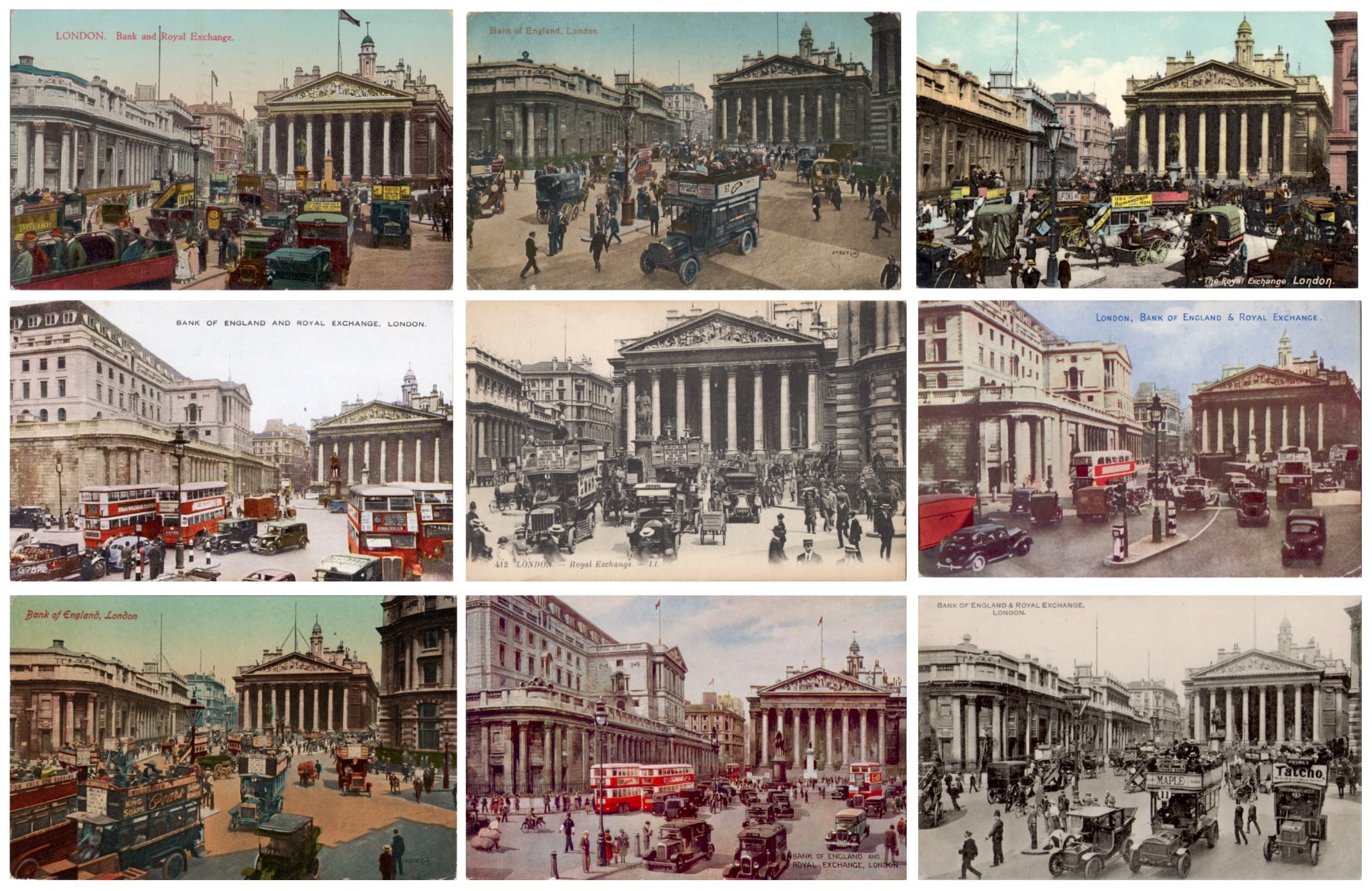
Postcard publishers would regularly dispatch their photographers to record the Bank and the Royal Exchange, a motif that would comfortably sit within the top ten London subjects.  In the montage we have before and after views of the Bank with three of them revealing the overpowering presence of Baker’s additions.  Next is a rare postcard view of the measured proportions of Soane’s frontage follow by three images of Soane-designed banking halls.  The interior views are based on official photographs from 1894, still in circulation in 1910 when these cards were posted to an address in Maida Vale. Last is a YouTube link to a curiously informal natter about Soane and the Bank - a trifle long-winded but authoritative and informing.


Wednesday, 22 May 2024

London Stations - Southwark (Jubilee Line)

Opened in 1999 as part of the Jubilee Line Extension (JLE) to Stratford, Southwark has a unique design thanks to the physical constraints of its site close to Waterloo East, the only station to which it has a direct link.  Sir Richard MacCormac, who designed the controversial  Hampstead home of Thierry Henry, was the architect and somehow came up with a subdued theatrical presentation that combined spatial intrigue with formal elegance, all of which is achieved in an understated way, free of grandiose gestures and set pieces.

The ground level entrance is a compact homage to Charles Holden and his preference for circular ticket halls (Arnos Grove, Southgate etc), from which escalators descend to an unexpected  tall and top lit concourse. On one side is a shimmering deep blue wall of triangular glazed tiles, opposite is an austere block built wall pierced by openings for up and down escalators - the sight of the escalators folded into steep dark apertures is strangely unsettling as if they were links to a sinister underworld.  The blue wall is the work of Alexander Beleschenko and has the effect of leading the eye upwards following the tonal trajectory to the crescent of light overhead.  For Simon Jenkins writing in Britain’s 100 Best Stations (Penguin, 2017), Southwark is the jewel of the JLE and he describes it as “idiosyncratic and hard to place in the modernist spectrum”


Saturday, 9 December 2023

Mother of Parliaments

It’s our very own National Theatre of Cruelty, an antiquated forum of futility.  On one side the benches are occupied by the defenders of property rights and privilege, drawn from the products of private education and Oxbridge, supported by subaltern recruits from the lower orders attracted by the prospect of personal enrichment and all too happy to identify with the interests of their social superiors.  All of which enables them to operate in a culture of impunity. Opposite them is a motley assortment of lost causes including sundry nationalists, an official opposition with a nominal commitment to social justice, minority parties and some empty spaces that the most intransigent of nationalists refuse to occupy.  Bewigged courtiers in pantomime costume strut back and forth bearing fundamentally useless objects of veneration without which proceedings cannot go ahead.  

Teams of scribes and record keepers toil away in the orchestra pit while the Remembrancer lurks in the under gallery, poised to intervene should anything arise that is less than favourable to the interests of the City of London. (The Wikipedia description of this shady character is at such great pains to point out how little influence he has, that you may wonder why he exists at all.)  The chamber has been designed to facilitate the exchange of insults and though much time is devoted to this, it’s an offence of the utmost gravity to accuse another member of lying.  Otherwise accountability is nugatory, members may attend as little as they wish without sanction and their degree of participation and voting is for them to decide.  As a general rule the greater their majority, the poorer the service offered to constituents leaving them well placed to take on additional, often better paid jobs.  These tend to be in the legal profession, in business and financial services (in an advisory capacity) or as well rewarded gobshites on GB News. There is no inspectorate of MPs and no requirement to report their activities to constituents.

Supporters of these anachronisms loudly proclaim that they are what makes Parliament so unique and special while remaining silent on the point that they act as enforcers of the status quo, inhibiting any change that might result in wealth redistribution or rebalance the existing power structure.  Even the architecture has a part to play - Barry and Pugin’s Gothic Revival extravaganza invokes the England of stately homes, medieval Oxbridge colleges and ancient private schools - a Hogwarts orgy of ornamentation entirely familiar to members who have grown up with it but disconcerting and intimidating to those of more humble origins for whom the message is “this place is not for you”. Every attempt to update facilities and procedures fails in the face of furious opposition and an exorbitant refurbishment plan is currently stalled while ongoing repairs are costing the taxpayer £2 million a week.  There’s an almost irresistible impulse in British public life to employ delay as an avoidance strategy (contaminated blood scandal, Grenfell, Hillsborough, Post Office/Fujitsu IT scandal) so it seems inevitable that Parliament itself should fall victim to institutional procrastination.  In the spirit of doing more with less (so often commended by government), a budget solution would be a repurposed fulfilment centre in the Northumbria town of Haltwhistle, the geographic centre of the UK.  Appleby Parva in Leicestershire is the centre of population in the UK and suggests an alternative location.  Ancillary services and committee rooms could be housed in site offices and Portakabins which would have the merit of giving parliamentarians a taste of the working conditions enjoyed by millions of their constituents.  Compulsory annual reports to constituents could include attendance, voting and speaking record, donations received and freebies, income earned from additional occupations, assistance to constituents, links to lobby groups and details of overseas jollies. A little bit of accountability and transparency, could be simply posted online once a year - it’s never going to happen.


Monday, 20 March 2023

London Stations in Postcards and Photos - Charing Cross

Not the most celebrated of London stations.  There are no books that tell the story of Charing Cross station and there is no record of it serving as a movie location.  The 1865 Charing Cross Hotel (now the Clermont) frontage on the Strand has survived more or less intact but seen from the Thames much of its distinctiveness has been buried beneath Sir Terry Farrell’s 1986-1990 Po-Mo vanity project.  The station itself opened in 1864 - after a protracted battle with parliamentary opposition and obstruction from its competitors, the South Eastern Railway (SER) extended a line through London Bridge station across the Thames via Hungerford Bridge to its present site.  A long history of mismanagement, disputation and fatal accidents (one of which, at Staplehurst almost killed Charles Dickens) ended in 1866 when a new Chairman, Edward Watkin was appointed.  Watkin was a busy man - he was Chairman of the Manchester, Sheffield and Lincoln Railway as well as the Metropolitan Railway, and also a director of the Chemins de Fer du Nord.  He would sponsor the first attempt to build a Channel Tunnel and nursed an ambition to run through trains from Manchester to Paris. Forty years later in 1905, the single span glass and wrought iron roof collapsed, triggering the fall of the western wall. Six lives were lost but despite there being 4 trains at the platforms, no passengers were among them.  In just 3 months the roof was replaced with a basic ridge and furrow design and the station was back in business.  Its days as a gateway to Europe with boat trains to Dover and Folkestone are long gone and today’s station serves commuters in Kent and East Sussex reaching the coast at Ramsgate, Margate, Dover, Folkestone and Hastings. 


Tuesday, 24 January 2023

More London Life

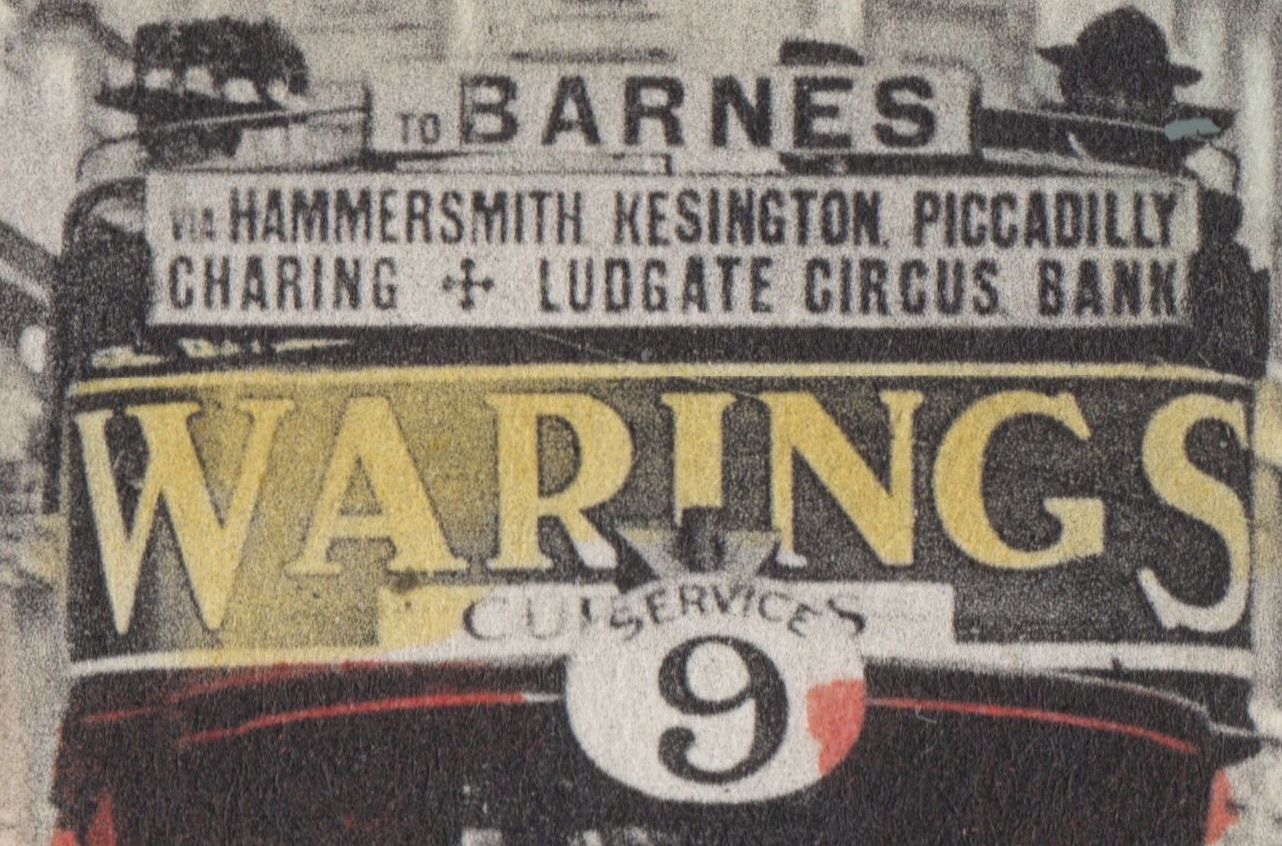
Thanks to German printing technology, this is an unusually well produced postcard with a detailed image of London buses posed outside the Bank of England. A somewhat diffident constable holds up the traffic alongside a young messenger boy who succeeds in occupying the centre of the picture. A handful of pedestrians stare in a desultory fashion as the camera operator prepares for the shot.  History records that the advertised play, The Ogre by Henry Arthur Jones, opened to lukewarm reviews on September 11th. 1911 at St. James’s Theatre which dates the postcard to the late summer of 1911.

Route 7's history can be traced back to 1 November 1908, when an un-numbered daily route operating between Wormwood Scrubs and Liverpool Street station, was allocated route number 7. Today’s route 7 connects East Acton with Oxford Circus. Route 9 is one of several claimants to the title of London’s oldest bus route, dating back to 1851. In its present form it runs between Hammersmith and Aldwych. Both routes are a lot shorter than in their heyday and neither penetrate as far east as Bank, making this an unrepeatable encounter. Pedantic note - both buses display spelling mistakes. An extra letter B has been added to Wormwood Scrubs on the 7, while the first letter N has been omitted from the word Kensington on the 9.


Monday, 3 October 2022

Postcard of the Day No. 110, Regent Circus

There’s no Regent Circus on today’s map of London but, according to Hermione Hobhouse in her History of Regent Street the intersection with Oxford Street was confusingly known as both Oxford Circus and Regent Circus in the first decade of the 20th. century.  It’s no surprise that in later years the name Oxford Circus would prevail, given that Oxford Street has its origin in medieval times whereas Regent Street was a product of more recent city planning.  Indeed the plans of John Nash included a grandiose Regent Circus far to the north of Oxford Street of which only a single quadrant was ever built.

The ornate shopfronts in the first postcard display a Victorian passion for embellishment in the pursuit of customers. Prominent among them are the premises of Peter Robinson, a department store that later expanded into a chain of more than 20 with a flagship store at Oxford Circus. Unusually, the card shows what would then be called a public convenience in an animated street scene including horse-drawn omnibuses and flower girls selling their blooms on traffic island. These itinerant traders made a popular subject for postcard publishers, often under the label of “London Life”. It wouldn’t have been an occupation for the faint-hearted, finding and securing a pitch, resisting extortioners and local bureaucracy alike.  Wherever they gathered the photographer wasn’t far away, even under the railway arches in Brixton.


Wednesday, 8 June 2022

London Stations in Postcards and Photos - Waterloo

London’s south facing railway termini have never quite achieved the sense of occasion found in those that face east, west and south.  Victoria, Charing Cross, Cannon Street and Waterloo are all less architecturally ambitious than most of their neighbours to the north.  Victoria is compromised as a result of evolving as two adjacent stations while Charing Cross lost all its best features when it was submerged beneath Terry Farrell’s Po-Mo conceit. Waterloo is the only terminus south of the Thames and what we see today is an Imperial Baroque design, years in the planning and construction and only completed in the 1920s.  Two distinguishing features are the ridge and furrow glazing and the generous crescent shaped concourse.  There’s a flood of overhead natural light, unmatched in any of the great Victorian London stations and the lofty, expansive concourse makes a fine space through which to pass. Working against this is the heavy, ponderous feel of the Portland stonework and ornamentation. It has the air of being designed by the Ministry of War, something that’s enhanced by the pompous Victory Arch that serves as the main pedestrian entrance. Since 2012 a retail balcony has run almost the full length of the concourse - it offers a great location from which to observe the activity but at the expense of a coherent sense of the long façade of the main station building.  With 24 platforms, Waterloo is often claimed to be the largest station in Britain.  Post-Covid, Waterloo has lost its position as Britain’s busiest station to Stratford.


Waterloo Station Network Day, October 1st. 1988