Showing posts with label cartoon. Show all posts

Tuesday, 12 August 2014

Hard Times, Soft Sell


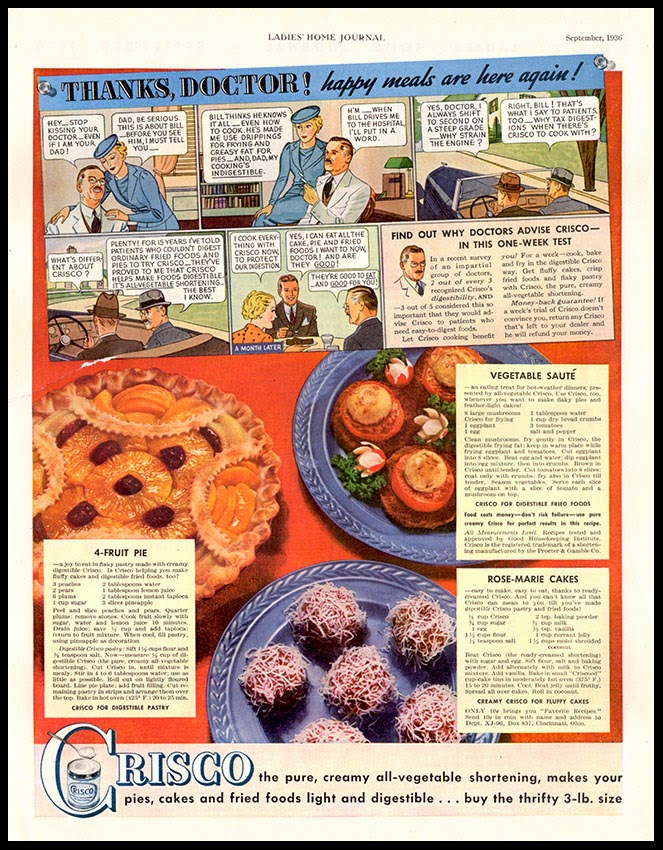
When times are hard and money is in short supply, advertisers are forced to rethink their strategies and fight for every dollar of domestic expenditure. In the Great Depression, new upstart advertising agencies threw away the text heavy, grandiose styles of the 1920s and developed a pared-down model that borrowed the typography and layouts of the tabloid press to suit the mood of the times. This enabled the advertiser to purloin some of the authority of the press, creating the impression that their claims were facts and if the careless reader was confused between promotional and editorial matter, this was no bad thing. At the same time, advertisers became increasingly dependent on another format from the popular press – the strip cartoon. 


The onward march of the Funny Papers into the affections of the American populace generated a small army of highly skilled cartoon artists only too happy to enhance their earnings offering their talents to the advertising industry. Specialists in figure drawing, backgrounds and speech bubbles combined in an assembly line approach to the task as the workload expanded throughout the 1930s. Where artists worked on more than one campaign, great care was taken to conceal their identities. Raymond Rubicam (of Young & Rubicam) was an early adopter and coined the phrase “sequence-picture copy” to avoid the words “cartoon” or “comic” passing his lips. There was no television to compete with print media – only radio and the cinema offered alternative outlets for the advertiser’s message, simultaneously creating opportunities for cross-promotion with personalities from radio and Hollywood frequently migrating into print as cartoon characters. 


Best of all was the ability to address the consumer directly in his or her favoured medium with simple messages and undemanding dialogues delivered by a repertoire of much loved comic book characters. Children clipped them out and pasted them into scrapbooks, extending the reach of the message. For an adult audience they met another corporate objective by putting a human face on to an otherwise impersonal and monolithic corporation such as General Foods. Hostility to the activities of the giants of capitalism ran high in the course of the Depression leading to valiant, if not always successful, campaigns to promote a warm and cuddly presence in the marketplace. Stylistically these examples are very conservative – they display little evidence of the dynamic sense of movement to be seen in adventure comics that would find its way into the visual vocabulary of the 1940s and 1950s. But their two-dimensional quality and the curious blankness of expression offer a certain enigmatic charm all their own. An earlier posting on this subject can be read here


Tuesday, 11 September 2012

Living the High Life


What unites this selection of mid-century strip cartoons publicising Camel cigarettes is a focus on high risk activities or occupations. Eternal vigilance and self-discipline in the face of the force of gravity is not for the faint-hearted and each character testifies to the therapeutic value of smoking. The message is that Camel is the choice of the strong and the brave and by association a little of that may rub off on us less adventurous smokers. Beneath that, yet another message is that surely we smokers can show a little courage of our own and not be intimidated by public health fanatics and their alarmist talk of heart, lung and respiratory disease. Today’s smokers are mature enough to know their own minds and handle a little risk, look death in the eye and continue undaunted to enjoy the pleasure of a fine cigarette. These were early days in the epic battle for hearts and minds between the tobacco manufacturers and the medical establishment but the time for civilised discourse had passed and matters were destined to get a lot dirtier. In a later phase, prefigured by the footnote to these ads (More Doctors Smoke Camels Than Any Other Cigarette), the manufacturers would co-opt and corrupt a small army of doctors to counteract the health warnings of their fellow professionals as we shall see in a future posting. 


Monday, 6 September 2010

Bottles (1936)


I first saw this superb 10 minute animation more than 20 years ago when watching Rolf’s Cartoon Time en famille. Displaying all the crassness for which he was so famous, Rolf droned over the opening sequence with his own banal observations and at the end the credits were amputated so that all the audience knew was the title. But what came in between was sheer delight – a small masterpiece of visual invention all contained within an enclosed penumbral space typical of early animation. A little research in Leonard Maltin’s book revealed it to be the work of Hugh Harman and Rudolf Ising who worked as a team for almost every animation studio, having started in the 1920s at Disney when it was located in Kansas City. Bottles was produced for MGM by their own production company that went by the name of Harman-ising. Their cartoons were branded as Happy Harmonies.


The action takes place in an old pharmacy on a dark and stormy night. When the ancient pharmacist falls victim to a poison of his own devising his body is shrunk to the dimensions of the thousands of bottles that reside shoulder to shoulder on the towering shelves. The bottles and containers come to life in a frantic parade of singing and dancing. The gallery of characters includes rubber gloves, a hot water bottle, a soda siphon and cocktail shaker plus a wide range of cosmetics and medication. The mood develops from cute and whimsical through zany to the predictable but essential, macabre. The skeleton bottle takes charge and the diminutive pharmacist is propelled at speed through a jungle of chemical apparatus to his ultimate indignity when his hapless form is squeezed through an enormous garlic press to emerge in 8 tiny replicas of his former self. The colours are rich and gorgeous and the energy is irresistible.


To obtain this gem I had to buy a Region 1 dvd of the W S Van Dyke movie, San Francisco, that includes it as an extra, presumably because both first appeared in 1936. The following year MGM would dispense with the services of Harman and Ising on the grounds that their perfectionist tendencies made them unaffordable. There is a very blurry upload on YouTube that conveys some of what makes this cartoon so special.