Showing posts with label stations. Show all posts

Tuesday, 17 March 2026

Arrivals and Departures

A trio of evocative photos from the 1950s for those with long memories of British train stations. Commissioned as archive photographs by British Railways, they record information systems that have long since vanished from platforms and concourses. The first photo (dated July 31, 1957) was taken at Portsmouth and Southsea station. Most of the services in the right hand columns appear to have been suspended or withdrawn. As well as District Line trains, Richmond station (photo dated April 4, 1957) was the terminus for a service to the long defunct Broad Street station in the City that traveled along the North London Line. The third photo (dated June 23, 1959) is from Sheerness-on-Sea on the Isle of Sheppey. A caption on the reverse identifies it as a Benn and Cronin Indicator. This station (and Richmond) feature posters advertising day and evening excursions at bargain prices, a tradition that seemed to die out in the early 1980s. An unwelcome feature, often found in terminal stations is the recent practice of restricting access to trains until less than 5 minutes before departure time. Especially common in London - if it was devised to promote onboard chaos as hyper-stressed passengers jostle for space, it’s been a triumph. Finally we have a few more contemporary examples photographed at London King’s Cross, Ogilvie Transportation Centre Chicago, Hamburg Hbf, Lubeck and Paris, Gare d’Austerlitz. 


Monday, 20 March 2023

London Stations in Postcards and Photos - Charing Cross

Not the most celebrated of London stations.  There are no books that tell the story of Charing Cross station and there is no record of it serving as a movie location.  The 1865 Charing Cross Hotel (now the Clermont) frontage on the Strand has survived more or less intact but seen from the Thames much of its distinctiveness has been buried beneath Sir Terry Farrell’s 1986-1990 Po-Mo vanity project.  The station itself opened in 1864 - after a protracted battle with parliamentary opposition and obstruction from its competitors, the South Eastern Railway (SER) extended a line through London Bridge station across the Thames via Hungerford Bridge to its present site.  A long history of mismanagement, disputation and fatal accidents (one of which, at Staplehurst almost killed Charles Dickens) ended in 1866 when a new Chairman, Edward Watkin was appointed.  Watkin was a busy man - he was Chairman of the Manchester, Sheffield and Lincoln Railway as well as the Metropolitan Railway, and also a director of the Chemins de Fer du Nord.  He would sponsor the first attempt to build a Channel Tunnel and nursed an ambition to run through trains from Manchester to Paris. Forty years later in 1905, the single span glass and wrought iron roof collapsed, triggering the fall of the western wall. Six lives were lost but despite there being 4 trains at the platforms, no passengers were among them.  In just 3 months the roof was replaced with a basic ridge and furrow design and the station was back in business.  Its days as a gateway to Europe with boat trains to Dover and Folkestone are long gone and today’s station serves commuters in Kent and East Sussex reaching the coast at Ramsgate, Margate, Dover, Folkestone and Hastings. 


Wednesday, 8 June 2022

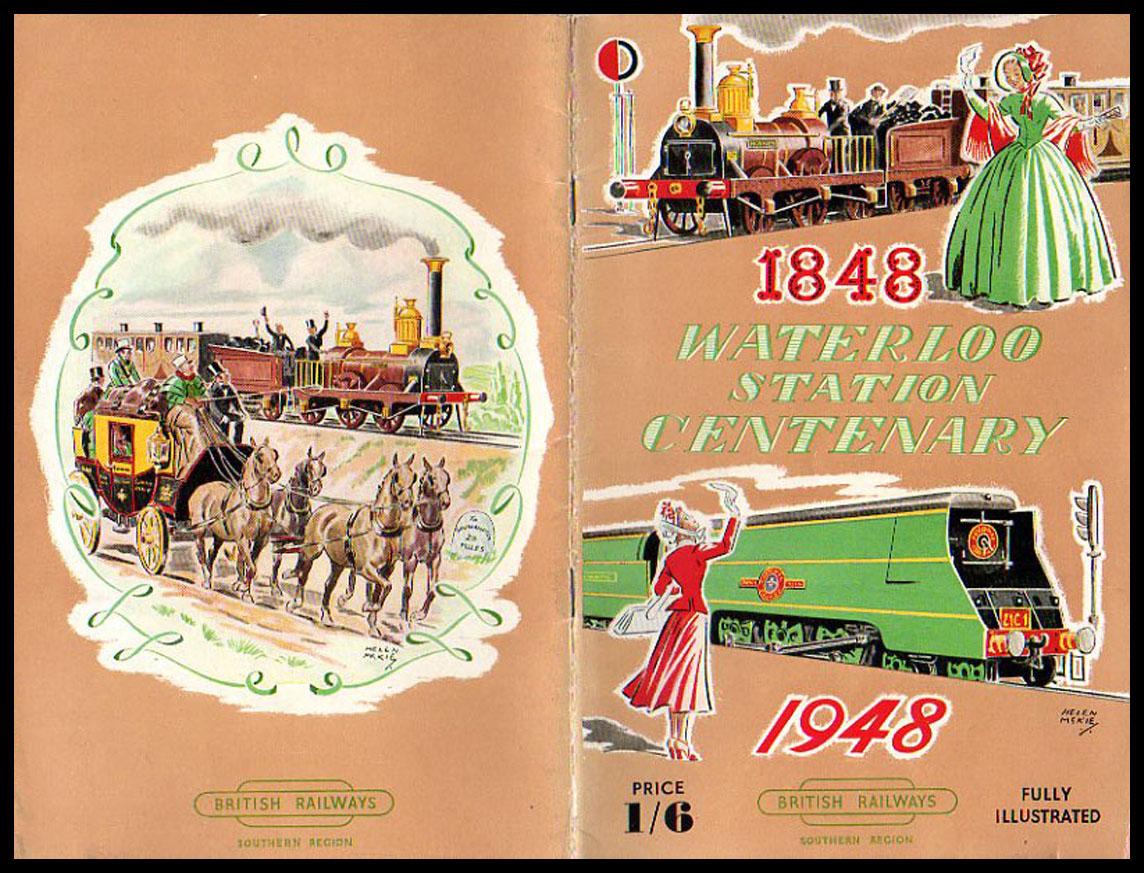
London Stations in Postcards and Photos - Waterloo

London’s south facing railway termini have never quite achieved the sense of occasion found in those that face east, west and south.  Victoria, Charing Cross, Cannon Street and Waterloo are all less architecturally ambitious than most of their neighbours to the north.  Victoria is compromised as a result of evolving as two adjacent stations while Charing Cross lost all its best features when it was submerged beneath Terry Farrell’s Po-Mo conceit. Waterloo is the only terminus south of the Thames and what we see today is an Imperial Baroque design, years in the planning and construction and only completed in the 1920s.  Two distinguishing features are the ridge and furrow glazing and the generous crescent shaped concourse.  There’s a flood of overhead natural light, unmatched in any of the great Victorian London stations and the lofty, expansive concourse makes a fine space through which to pass. Working against this is the heavy, ponderous feel of the Portland stonework and ornamentation. It has the air of being designed by the Ministry of War, something that’s enhanced by the pompous Victory Arch that serves as the main pedestrian entrance. Since 2012 a retail balcony has run almost the full length of the concourse - it offers a great location from which to observe the activity but at the expense of a coherent sense of the long façade of the main station building.  With 24 platforms, Waterloo is often claimed to be the largest station in Britain.  Post-Covid, Waterloo has lost its position as Britain’s busiest station to Stratford.


Waterloo Station Network Day, October 1st. 1988


Monday, 28 February 2022

Great Railway Stations No. 20, Newcastle Central Station

Two abiding memories of this grand and impressive station.  First from a Saturday evening in 2015 when I wandered into the vastness of the Centurion Bar that occupies the former First Class Passenger Lounge.  The lavish ornamentation for which it is famous, including some spectacular Burmantofts faience, was lost in the gloom - every table was packed with voluble drinkers whose voices strained to be heard over the grossly amplified music that oscillated on the threshold of pain and stunned the senses.  In the 1960s the lounge was converted to provide the British Transport Police with a suite of prison cells for miscreants. Second is a childhood memory of stepping through the slick of blood that smeared the pavement and puddled on the cobbled street as it flowed from a nearby slaughterhouse in the vicinity of the station. The latter image is attached to my late 1950s recollections of time spent watching trains pass through on the East Coast mainline - an exciting procession of prestigious expresses and filthy freight trains dragging long lines of coal wagons destined for local furnaces and power stations.

The most striking feature of the station interior is the elegant curving form of three cast-iron barrel vaults each supported on slender columns - the eye is drawn to the central glazing sections and the formal repetitions enhance the sense of generous overhead space.  The platforms are spanned by a footbridge that inscribes a gentle arc across the tracks.  Platforms 7 and 8 were built to accommodate four tracks of which two remain in place, enhancing the sense of scale and space.  There’s an air of grandeur that reflects the ambition and confidence of the North Eastern Railway.  All these features were part of the station as originally completed in 1850 (a year before Paxton’s Crystal Palace) and have survived all subsequent rebuilding.  This was all the work of a versatile local architect, John Dobson, who also designed churches, chapels and cemeteries, shops, markets and arcades, and banks, gaols and country houses. The building is protected by a Grade 1 listing dating from 1954 and is one of only 10 examples to earn a 5 star rating from Simon Jenkins in his 2017 anthology, Britain’s 100 Best Railway Stations.


Thursday, 20 May 2021

Great Railway Stations No.19: Hamburg Hauptbahnhof

The vast steel and glass train shed that spans 14 platforms at Hamburg Hbf was based on the Galerie des machines built in Paris for the Exposition Universelle of 1889 (casually and callously disposed of by the city authorities in 1910 to improve the view of the Champ de Mars).  An uninterrupted span was achieved with the support of steel trusses that flared out as they rose upwards and the hinged arch profile was identical to its Parisian ancestor.  It’s a through station with platforms set below street level - dramatic overviews of the station interior can be seen from the Nordsteg and Südsteg overbridges. The span measured 135 meters compared with 115 for the Galerie des machines.  Administration buildings and the main entrance were at the north end of the station, marked by two clock towers, one of which survived wartime bombing in 1943.  As planned, the buildings would have been decorated in Art Nouveau style but the story goes that Kaiser Wilhelm II took an interest and had them replaced with more austere Neo-Renaissance detailing giving a militaristic appearance more to his liking.  Planning the station was a complex exercise in rationalisation to combine the rail traffic from four existing termini, in and around the city centre, into a single through station.  An architectural competition was held and construction of the winning design took place between 1902 and 1906.  Today the city is connected by ICE trains to every major population centre in Germany and serves as a point of entry to European destinations for rail  travellers from Scandinavia.  Changes are on the way - in 2021 the city announced a competition for redevelopment of the station and surrounding area.