Showing posts with label ruhrgebiet. Show all posts

Sunday, 27 June 2021

Der Pott, Industriekultur im Ruhrgebiet

A massive block of a book - 640 pages of colour photographs of heavy industry in the Ruhr, mostly relics of the past but a few from the present.  Deindustrialisation wiped out an enormous amount of industrial structures in the region. Some of the more viable plant was exported to China but much of what remained was repurposed as spectacular heritage visitor attractions. More than 70 sites have been combined into a 400 kilometre heritage trail that reaches from Duisburg in the east to Hamm in the west.  Co-ordinating the scheme depended on a level of regional organisation that seems to be impossible in Britain where such sites are numerous but rarely work together.  Another factor that is less common in Germany is the British tendency to eliminate all traces of defunct industrial activity at the earliest opportunity. In part this reflects the shortage of development land in Britain and a pattern of land ownership that is always looking to extract maximum value from land assets. The same forces are at work in Germany but they are subject to stronger regulation in terms of public interest.

There’s long been a sense in Britain that industrial relics are intrinsically unsightly and unworthy of preservation and often the best examples get swept away with the worst.  In the north-east of England an enormous amount of industrial heritage was lost after the deindustrialisation of the region in the 60s and 70s as the ship yards, coal mines and steel works disappeared - it was left to Beamish Museum to salvage what it could but a regionally planned scheme would have been much more comprehensive.  It sometimes felt as if a Ground Zero policy was unofficially sanctioned as if removing the visual evidence of past industry would smooth the transition to a post-industrial future of low-wage insecure employment by breaking the links with lost occupations and the cultural traditions that sustained them.  It’s a process that still goes on - the Mayor of Tees Valley recently posed with indecent pride in front of the closed steelworks at Redcar and proudly announced its total demolition, having rejected all proposals for preservation as a visitor attraction.  The need for regeneration land is held to be paramount despite the vast amount that already exists.

Back to the book - each section has a map or plan, some historic images and explanatory text in English (as well as German and French). Stylistically the photography is primarily intended to record but without the studied neutrality of tone and compositional uniformity found in the work of Bernd and Hilla Becher.  There’s a sense of frontality emphasised by rigorous perspective correction. An interesting comparison is with the photographs of Albert Renger-Patzsch who recorded several of these sites soon after construction in pristine condition before the stresses of intensive operation and the ravages of fire, water, steam and oxidisation brought them to their present state.  Photographs make clear the tension that exists between the architecture of industrial buildings (admin blocks, pit-head enclosures, turbine halls) and the anti-architecture of industrial structures (blast furnaces, smelters, coke ovens, gas tanks, overhead conveyors, cooling towers).  While the buildings are often sensitively proportioned and detailed to incorporate contemporary idioms (Jugendstil, Gründerzeit, Brick Gothic), the industrial plant, despite being meticulously planned in terms of operational requirements, often has an improvisational, bricolage-like appearance, as if random forms have been welded together, as much in hope as expectation.  Functionality is the only consideration whereas architects like to set their sights on higher things in the pursuit of artistic expression. 

So what’s the appeal of the industrial landscape - why is it endlessly fascinating for some while others respond with indifference or outright hostility? Mine is the last generation to be born and raised in a world where the industrial landscape was commonplace, especially so in the north-east where I lived.  Every journey to and from school would pass collieries, shipyards and factories - an unceasing spectacle where welding torches flashed in smoke filled gloom while overhead cranes and hoists propelled massive components in a display of perpetual motion. Pit-head winding gear could be seen spinning at speed, hauling cage-loads of coal to the surface where it was washed, graded and tipped into railway wagons around the clock.  All this industrial activity was so deeply embedded into the locality that to the eyes of a child it seemed it would continue unchanged, for ever.  This is the power of the industrial sublime - to induce nostalgia for jobs that were massively physically demanding and ruinous to health in an environment where water courses were lethally polluted, where the sea was stained charcoal grey from colliery waste and the air quality was laden with toxic fumes. Despite this, displaced industrial workers can often be heard waxing lyrical on the lost camaraderie of the workplace where unions enjoyed 100% support and stood together to resist management’s unreasonable demands. They often recall taking pride in the finished article as the embodiment of their skills and expertise. The continuing appeal of the industrial landscape has cultural, social and aesthetic elements of which the last may prove the most enduring - there’s nothing else in the man-made environment that’s left behind so many extraordinary physical structures enhanced by the patina of ageing and replete with formal repetition wrapped in complex networks of contrasting forms (tubes, cones, pipes, cylinders, grids, filters) on such a vast scale.


See also:


Gelsenkirchen 1914


Past and Present No. 10: Henrichenburg Schiffshebewerk


Ruhrgebiet in Close-up


Margaretenhöhe - refuge from dystopia


Essen Zollverein


Sunday, 12 April 2020

Essen Zollverein


One of the star attractions of the Route der Industriekultur (Industrial Heritage Trail) in the Ruhr is the Zeche Zollverein in Essen - a carefully preserved colliery and coking works designated a UNESCO World Heritage Site in 2001. Coal mining on this site goes back to 1851 but the principal shaft and associated buildings date from 1932 and were designed by industrial architects Fritz Schupp and Martin Kremmer in a style that’s often described as Bauhaus, although the term Industrial Rationalism may be more accurate. In its rectilinear brick built forms and its symmetry it seems to have more in common with the functionality of Albert Kahn’s work in Detroit than with the formal purity of Mies van der Rohe although there is some affinity with the Fagus factory design of Walter Gropius. The massive forms of the pit head buildings with its trestle shaped winding gear and coal washery are handled with great confidence and contrasted with the angular presence of enclosed conveyor belts that criss cross the site. Highlights of the coking works include the skeletal remains of cooling towers and spectacular reflections of the coke ovens in the vast cooling reservoir.


In 1937 just under 7,000 workers were employed in the mine and coking works. Almost undamaged by the war, the Zollverein was Germany’s most productive coal mine in the 1950s, yet by the end of 1986 it was closed. Six years later the coking plant closed down after many decades converting waste gases into such delights as ammonia, tar and benzine. Local pride in the region’s industrial past inspired the city of Essen to acquire the site and transform it into a visitor attraction without compromising the ravages of industry - making it accessible while preserving its industrial character. Architects OMA with Rem Koolhaas delivered the masterplan which took a decade to implement, finally concluded in 2010. Included in the plan were museums of local industry and industrial design. It’s an extensive site and a thorough exploration could easily take all day for those with an appetite for the strange and wonderful forms of industrial processes. Those with deep pockets can assemble a scale model of the complex on a table top at home by shopping online at Minitrix and purchasing all 3 components.


Tuesday, 7 November 2017

Gelsenkirchen 1914


Abraham Auty, the writer of these postcards, arrived in Gelsenkirchen from Yorkshire only 2 days after the assassination of Archduke Franz Ferdinand in Sarajevo – in just over a month Germany would be enemy territory. His first postcard, addressed to his son in Wakefield was written and postmarked June 30th. 1914. Assuming he is the Abraham Auty whose birth in 1860 was registered in the West Yorkshire village of Emley, he would have been 54 years old at the time he was dispatched by his employer to the Ruhrgebiet to demonstrate an automatic coal cutting machine to prospective customers. In the 1911 census Auty was described as a coal miner resident in Morley, Yorkshire. To have been entrusted with this task suggests he was well regarded by his employer. It represents one small episode in the immensely important trading relationship between Britain and Germany that in the previous decade had developed to the point where each nation was the other’s major trading partner. Britain at that time still retained a formidable manufacturing capacity but it had been comfortably overtaken by that of Germany – the difference, just as today, was made up by financial services where London held the advantage.


On the first postcard of a colliery in Gelsenkirchen, Abraham assures his family of his safe arrival, explains that there are 27 collieries in the town, and says he expects to stay between 2 and 3 weeks. The following Saturday Abraham writes home again, spreading his pencilled message across a handful of postcards consigned to the mail in an envelope. He is missing the comforts of home and the absence of tea occupies his mind (“But, But, But, No Tea, Tea, Tea”). On Sunday he observes the local population at leisure with a disapproving eye. “Sunday I am sorry to say is a day of amusements – acrobats, wrestling, racing and parade(s). Church and state militarism all round.” Abraham places a high value on religious observance and writes, “Last Sunday I went to Protestant and Catholic (worship), singing Latin hymns and Litany. Burning incense till we could not breath.” He finds the hot and thundery weather unsettling and even the familiar presence of the Salvation Army brings no comfort – “They are as bad as the rest for talk – you cannot tell what they say any more than interpreting thunder.”


When he gets to work, Abraham sends a full account to his family as follows. “I have cut for the first time today. We are at an inclination of 25 degrees. Machine would shatter to face bottom if not prevented by timber, etc. Our difficulty here was getting oil to the crank pin. I think we have overcome it as I have cut 20 metres German (over 20 yards English) without oiling machine. So if it cuts downhill and keeps its oil we are then very likely to sell 4 machines to go to Silesia, 400 miles away from here.” With the Great War about to break out we can safely assume the Silesia deal never came to pass. Abraham’s impressions of life in Germany are never less than fascinating and expressed in lively prose tinged with humour. As paterfamilias and a man of strong religious principles he remained concerned that his absence from home might lead to backsliding on the part of his offspring – witness the scribbled instruction on the face of a postcard “Eliz. H. Auty go to Chapel in Market St. Sunday”.


Sunday, 3 September 2017

Margaretenhöhe - refuge from dystopia


Essen is the heartland of the industrial Ruhr. For 400 years it was the centre of the Krupp dynasty with its massive iron and steel producing plants, coalmines and manufacturing from armaments to locomotives. In 1887 control of the business passed to Friedrich Alfred Krupp (known to all as Fritz) who profitably refocused the company on arms production, including warships and U-boats. Leaving behind his wife, Margarethe and his two daughters he would spend several months each year in his villa on the island of Capri. There he would indulge his passions for oceanography and the company of Italian adolescent males. Following his arrest by Italian police for immoral conduct in October 1902 he returned to Germany to be utterly overwhelmed by public scandal as the news filtered back to his homeland. Meanwhile Margarethe, having received anonymous evidence of Fritz’s proclivities, appealed to the Kaiser, a close family friend for assistance in protecting the reputation of the company. Her reward was to be declared insane and confined to an institution on the orders of the Kaiser. Despite the support of the Kaiser, prosecution seemed inevitable and it was Fritz’s sudden death in November that brought matters to a conclusion. There is no agreement on whether he died by his own hand or from natural causes but Margarethe was returned to the family home and managed the business on behalf of her daughter (who inherited the controlling shares from her father) until she came of age in 1906.


After all this turbulence, Margarethe Krupp chose to embark on a personal philanthropic project in 1906 to establish Germany’s first Garden City in the southern suburbs of Essen. She donated the land plus a major sum for construction costs and established a foundation (Stiftung von Margarethe Krupp) to build and administer the new settlement. Guided by the principles of Ebenezer Howard, the first homes were occupied in 1910 and the project proceeded in phases under the supervision of architect, Georg Metzendorf (1874-1934) until completion in 1938. Until 1933 there was a small artists’ colony, prominent among them being the photographer Albert Renger-Patzsch, associated with Die Neue Sachlichkeit movement. Renger-Patzsch specialised in cool dispassionate recording of industrial landscapes and photographs of still-life and the natural world in which he expressed a strong preference for serial imagery.


Allied bombing destroyed many of the buildings in World War 2 – by 1945 less than half of homes were habitable. After a long rehabilitation it was meticulously restored to its original character by 1955. Protected status as an architectural monument was obtained in 1987. The Foundation continues to manage and allocate the letting of houses and apartments. Applications are considered in reference to the Foundation criteria and many are unsuccessful. The Foundation also takes a close interest in protecting the building fabric from unauthorised additions or modifications – tenants wishing to relay a tiled or parquet floor must have their plans approved, special permission is required for dogs or cats and gardens must be maintained to an agreed standard and formula. Satellite dishes are forbidden.


Surrounded by woodland and entered via an archway in the sprawling gateway complex (seen in the vintage postcard above) gives a sense of enclosure and separation from the clamour of the world outside. This quality must have been much more apparent in the days when Essen was an industrial metropolis with 291 collieries and thousands of chimneys and cooling towers venting dark, toxic fumes into the atmosphere. Since the 1990s and the advent of globalisation, Essen has massively de-industrialised while the relics of heavy industry have been transformed into heritage attractions and public amenities. In this context, while the Margaretenhöhe has lost none of its foliage-sheltered charm, it is no longer such a precious refuge from industrial dystopia. The architecture has echoes of Arts & Crafts and German vernacular traditions in its proliferation of quirky features and contrasting rooflines designed to refute any accusation of dull uniformity. Streets were expressly kinked to compose a scene that constantly changes and intersections offset to offer the greatest variety of views. Generous tree planting and amenity space, a central square for markets and community events, a hotel and retail premises and places of worship complete the picture.


Tuesday, 25 July 2017

Past and Present No. 10: Henrichenburg Schiffshebewerk


This innovative boat lift on the Dortmund to Ems Canal was constructed in 1899. Connecting the inland port of Dortmund with the North Sea involved a change of levels in the Waltrop area – the lift eliminated the need for a long and slow series of locks. Kaiser Wilhelm performed the opening ceremony in August 1899 – commemorated by belligerent Prussian Eagles that glare down from the heights at both ends of the lift. The lift took just 2 minutes to raise or lower a vessel but the whole operation took 45 minutes. The average number of daily operations was 40. It was retired in 1962 when an electrically operated replacement was commissioned nearby. The abandoned lift remained in a derelict condition until 1995 when it was restored as part of the Ruhrgebiet Route Industriekultur – an ambitious programme of repurposing redundant industrial relics as heritage attractions.


Monday, 17 July 2017

Once Upon a Time in Dortmund


Zeche Zollern is a carefully preserved industrial site to the north of Dortmund that has the distinction of being Europe’s only Art Nouveau/Jugendstil colliery. Stepping from the train at Dortmund-Bövinghausen, I myopically missed all the directional signage and set off in the wrong direction. My walk took me round all four sides of a large rectangle until arriving back where I started. This time the signs were unmistakeable and the rest of the journey, uneventful. Flags, bunting and banners announced my destination, which is more than I usually expect. And the sounds of fairground organs and steam engine whistles suggested an event was underway.


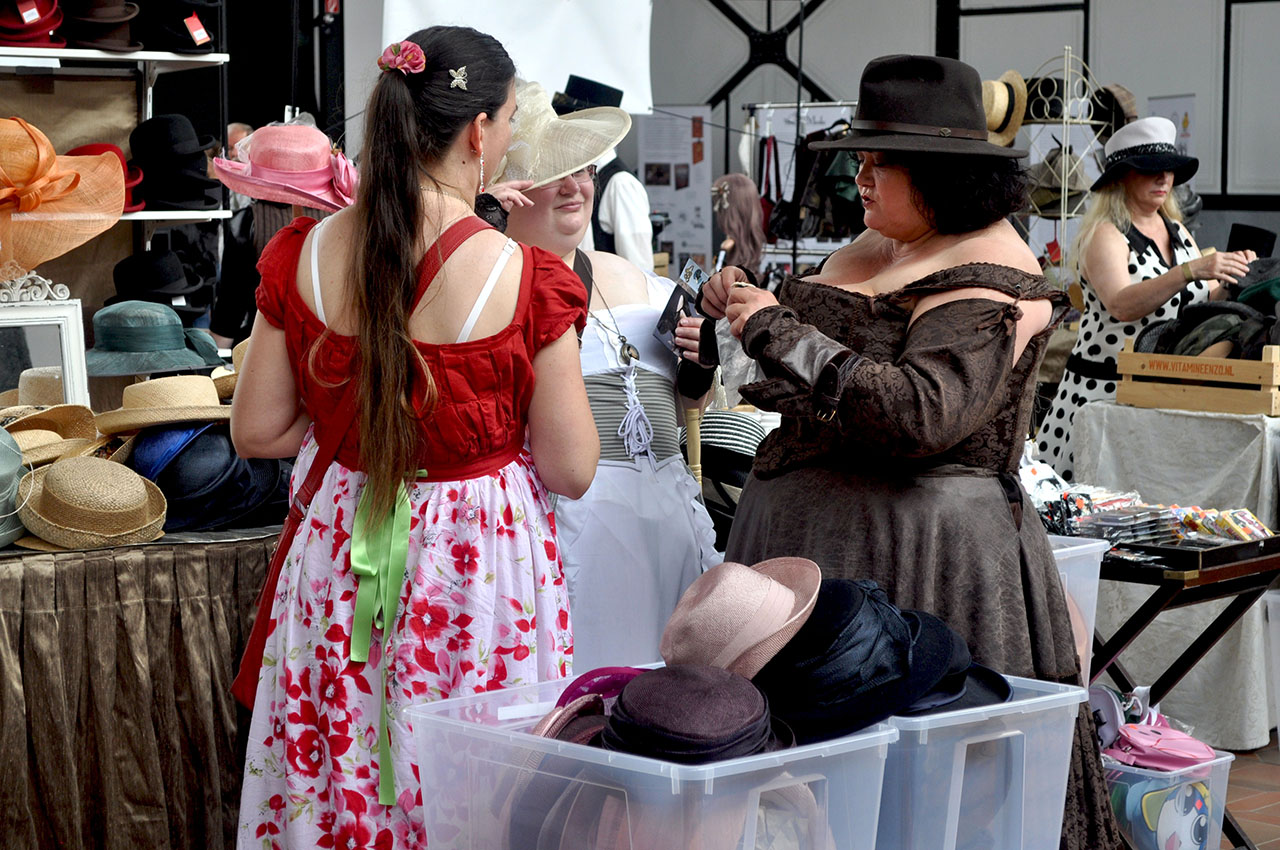
Inside the colliery site was a flurry of activity graced with top hats, fishnet tights, goggles, compasses and pocket watches. An ancient steam road roller and a brace of traction engines were on hand accompanied by the hiss of escaping steam. Stilt walkers and penny farthing cyclists meandered around the site. Recently returned big-game hunters, grouse-shooters and polar explorers mingled with the crowd. Dr. Marrax prepared to bamboozle his audience with a miracle cure – assisted by some mandrake root and assorted paraphernalia. Carousels were in full swing and the Flea Circus was open for business.


Steampunk is one of many minority cults that came into existence without me really noticing – to me it looks like a marriage between Gothic and High Victorian Heavy Engineering. It seems remarkably unthreatening and congenial and, to my knowledge, there are no records of Steampunk hate crimes or civil disorder. The choice of venue for a Steampunk gathering, titled “Once Upon a Time”, was perfect – no better place than a cluster of over-elaborate post-industrial relics.


Zeche Zollern was a prestige project from its inception in1898. Prominent Berlin architect, Bruno Möhring (1863-1929) was engaged and produced an opulent Jugendstil styled series of surface buildings. Most famously the Machine Hall with its stained glass entrance that originally included a Hector Guimard-style aedicule (now lost). The colliery was closed in 1966 and narrowly avoided demolition. Since then it has been extensively restored as a historic industrial relic and a site for cultural events. It was the industrial relic that attracted my interest and the Steampunk event was initially an unwanted distraction. My preference is for minimal human presence in my photographs but, bowing to the inevitable, I tried my hand at documentary photography with mixed results as seen here.