Showing posts with label industrial architecture. Show all posts

Tuesday, 16 May 2023

East Tilbury, the Bata Legacy in Essex

A trip to Essex is a rare event so we took the opportunity to take a c2c (owned by Trenitalia) train from Barking to East Tilbury where Bata shoemakers established factories and an industrial village in the 1930s. Public awareness of Modernism in 1930s England was minimal and in the Essex village of East Tilbury even less.  It must have been a shock to the villagers when Modernism landed on their doorsteps in 1932 as they watched towers of welded steel and reinforced concrete rising out of the potato fields of the former marshland.  This marked another stage in the global advance of the Bata Shoe Company founded by Tomas Bata in 1894 in the town of Zlin, Czechoslovakia.  A visit to the Ford factory in Detroit had inspired Bata to adapt the latest production line technology to the manufacture of footwear and the company had expanded rapidly across Europe and beyond.  Bata was attracted to the social ideals and paternalism of the Garden City movement but his aesthetic preference was for Modernism rather than Arts and Crafts or Tudor revivalism.  

Czechoslovakia was much more receptive to Modernism than Britain and a company team of Czech architects led the project. Planning and design principles that had been established in Zlin were applied in East Tilbury and included material specifications and the use of reinforced concrete frames. As originally planned there would have been 3 ten-storey factory blocks plus a rail connection to what was then part of the LMS railway with sidings for loading and unloading. These were scaled down to five-storey blocks and the rail connection never materialised. When the factory opened in 1933 in the Depression, locals welcomed the employment prospects although their eyes must have been startled by the Modernist geometry and the acreage of glazing in the brand new, multi-storey factory buildings.  New housing for workers (a significant number of whom were Czech) and their families along with a clinic, sports ground and village hall were provided and despite the challenge of inducing the English to live under flat roofs, this concern for their welfare was fondly remembered by former employees.  Manufacturing in East Tilbury petered out in 2006 by which time the factory buildings had already been disposed of to an uncertain future. The Bata Company is still in business and based in Switzerland. Its products are sold in many countries from East Asia to Latin America, Europe, Africa to Australia but UK is not one of them. 
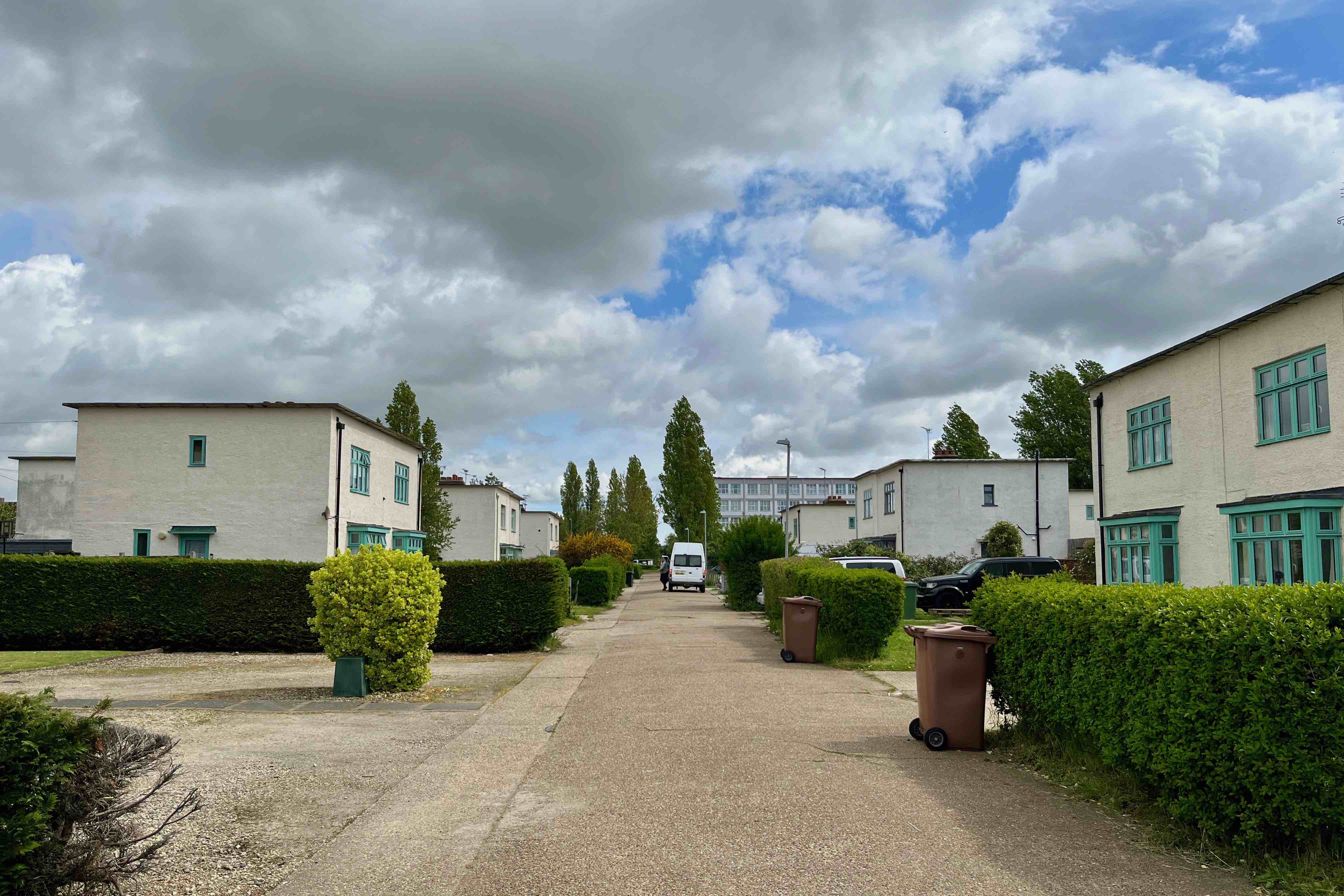
At the peak in the 1950s there were 3000 employees at East Tilbury and over 200 Bata shops on Britain’s high streets but the business was not immune to Britain’s industrial decline and in the 1960s production began moving overseas, mainly to developing countries. The design influence of the Czech parent had gradually faded away and the worker housing  became entirely conventional - semi-detached with pitched roofs. The last company housing was completed in 1966 and in the 1980s the houses were sold off to private buyers in the spirit of the time.  The process of adjustment has been difficult.  Converting the major buildings for new uses has been expensive and attracting investment has been hard but most of the factory premises have found new tenants over the years and the only major building still in need of renovation is Nelson House (the former leather factory) on top of which sits a water tank, lettered on all four sides with the Bata logo, easily visible to railway passengers almost a mile away.

In 1939 Bata completed a new 16-storey HQ in its Czech hometown of Zlin that included a top floor office for the Chief Executive, Jan Bata, designed as a giant lift capable of descending to ground level at the stately pace of 75 cm per minute. The Nazi annexation of the Sudetenland in 1938 and occupation of Czechoslovakia stopped the project in its tracks and despite Jan Bata’s personal appeals to the Nazi overlords, the factory was closed.  The Bata diaspora gathered pace and new businesses were opened in the US and Canada and production expanded in India and Singapore.  When Bata refocused  on emerging economies it withdrew from most European operations leaving an architectural legacy of design excellence that became a serious problem for planners in Bataville in France and Batadorp in the Netherlands (as well as in East Tilbury) as they grappled with the challenge of adapting the buildings without compromising the features that made them worthy of preservation. There are two further sources of detailed commentary on Bata, the first is a Historic Area Appraisal of East Tilbury carried out for English Heritage in 2007 and the second is a wider historic survey of Bata’s global presence from the magazine Azure.


Saturday, 2 July 2022

Noisiel Revisited in Postcards

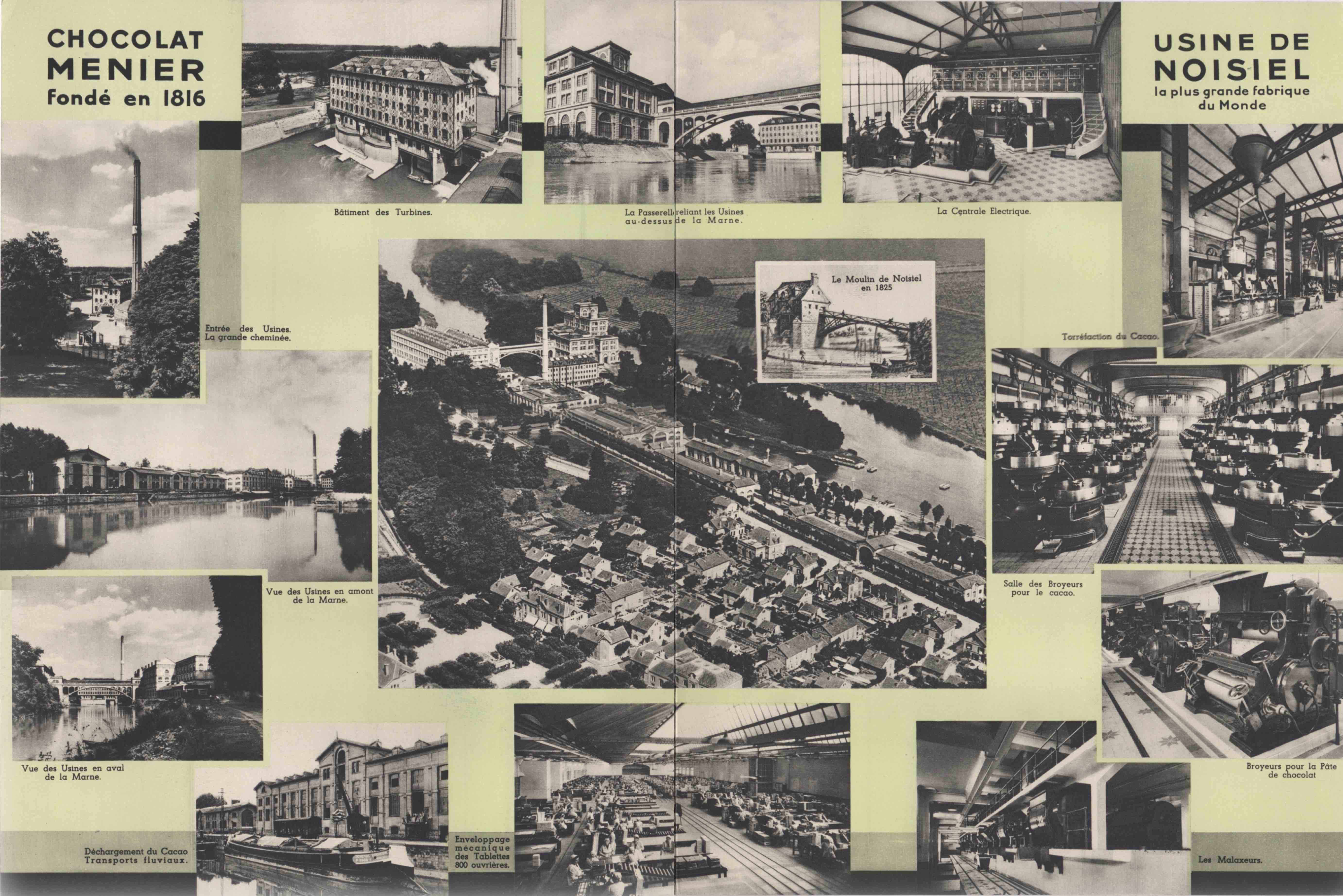
Twelve years ago I visited Noisiel to see the unique Chocolat Menier factory complex designed by Jules Saulnier on the banks of the River Marne, east of Paris.  The factory was in production from 1871 to 1993 and in 1997 was remodelled to serve as the headquarters of Nestlé France. Le Moulin Saulnier is the landmark building - behind the chromatic brilliance of its ceramic cladding lies an interior in which iron box girders and arched roof trusses create uninterrupted floor space for machinery.  Since 2010 I’ve acquired some vintage postcards of Noisiel that can be seen below, what they confirm is how well everything appears to have been conserved. A recent acquisition is this corporate prospectus of the Noisiel factory published by Menier in the 1930s to mark more than a century of progress. On the cover is a familiar school girl figure in use in Menier publicity since 1892, as airbrushed and updated 50 years later for the 1930s. There’s a double page spread of photos illustrating the major buildings and the manufacturing process at the Usine de Noisiel.  Alongside a chance to win a Peugeot 302 “luxe”, more photos can be seen on the back, including views of the internal railway that ran through the premises.  

In 2020 Nestlé France moved out of Noisiel to new premises in Issy-les-Moulineaux and disposed of the entire site to a developer, leaving the buildings to face an uncertain future.  Much wrangling is now going on between developers, local authorities and nearby residents - developers want to maximise the residential potential while locals are looking for community and cultural facilities.  The buildings have some protection as National Monuments but many spectacular interiors could be lost whichever way the argument is settled. Some reports say that the developers intend to permit a number of community enterprises to operate within the site on a temporary basis until 2024, the date set for launching the redevelopment.  This is unlikely to offer any public access to the site. More Chocolat Menier posts can be seen here and here.


Thursday, 27 January 2022

Cornish Mining in the St. Just District

In the 1890s the Great Western Railway operated a weekly train to Southampton calling at Redruth and Camborne to collect Cornish miners on the first stage of their journey to the gold and diamond mines of South Africa.  Cornish mining technology was among the most advanced in the world and Cornish mining engineers were in demand throughout the 19th. century.  In the same period, unemployed Cornish miners were recruited to work in Australia, New Zealand, Mexico, Brazil, United States and Canada, in step with fluctuations in the local labour market.  Copper and tin had been mined in Cornwall for centuries before the invention of steam power made it possible to access deposits via vertical shafts rather than by digging into hill sides.  Ancillary industries - steam engine building, pump and rock drill manufacturers, compressor and boiler producers flourished - mostly located in the Camborne and Redruth area where the major mines were concentrated.

When the great Cornish land owning families, the Bassets, Rashleighs, Boscawens, Treffrys, et al  invested in mineral extraction, the last thing on their minds was landscape value - they had quite enough of that on their secluded country estates.  While the majority of mines were to be found inland there were two clusters of mines along the north Cornish coast around St. Just and St. Agnes. The environmental damage inflicted on the landscape in a county widely celebrated for the rugged beauty of its dramatic coastline must have seemed especially egregious to the anti-industrial segment of Victorian opinion typified by John Ruskin. The legacy of all this can be seen today in the ruins of engine houses, chimney stacks and industrial buildings that cling to the granite cliff tops between St. Just and Zennor on the north facing coast of West Penwith where these photos were taken. 

Curiously, in accordance with another strand in Ruskin’s thinking - the need to conserve the past - these ruins have acquired new significance as powerful enhancements to the landscape. With the passage of time a new narrative has emerged and these sites have acquired a beauty of their own as well as bearing witness to past experience and endeavour.  They form a lens through which we can examine the working lives and culture of mining communities and the economic forces that brought the mines into existence. These photos are a record of the industrial relics that follow the coastline between Geevor Mine and Levant Mine.  Geevor was one of the very last Cornish mines to maintain production and continued investment in the 1980s but global economic conditions forced it to close in 1990.  Some of the associated infrastructure remains in place and forms the core of a museum exhibit under the broader umbrella of the UNESCO designated Cornwall and West Devon Mining Landscape. 


Thursday, 23 September 2021

Fear and Loathing on Teesside

It is strange how those who would die in a ditch to defend a statue of a slave trader have no hesitation in erasing the industrial legacy that is such a vital source of local pride in places like Middlesborough and Redcar that have been ravaged in the era of post-industrialisation.  Within 4 hours of taking up her post as Culture Secretary, Ms Nadine Dorries was contacted by Mr Ben Houchen, Tees Valley Mayor, and reversed Historic England’s temporary listing of the Dorman Long coal storage tower at Redcar.  Much to the delight of Mr Houchen, it was demolished in the early hours of Sunday September 19 at 1.55 am.  Not so much a case of levelling up as levelling down. Ms Dorries is described as a best selling novelist and was commended by Ben Wallace, Minister of Defence as ideal for her new post because her second career shows she is in touch with what ordinary people think. Hilary Mantel is a best selling novelist but I can’t imagine Mr Wallace having much good to say about her.  Back to Ms Dorries, she is certainly an accomplished gobshite and avowed opponent of left-wing snowflakes, political correctness, gay marriage and easy access to abortion.  So she comes fully armed into the present government’s inspirational ‘war on woke’.

The real villain of this piece is the Mayor of Tees Valley who fought tooth and nail to successfully oppose the local campaign to preserve the redundant blast furnace at Redcar as a significant part of the regional industrial heritage. Demolition of the Redcar steelworks took place in August and the depressing saga of the Mayor’s intrigues and u-turns that made it happen is well told by local blogger, Scott Hunter.  Mr Houchen has a Taliban-like enthusiasm for destroying the symbols of the past that sustain a sense of local identity. Replacing them with retail parks, big box fulfilment centres, a freeport for tax evasion and a handful of affordable jerry-built dog-kennels is designed to prepare the locals for a bright shiny future of low-wage, long hours and insecure employment where the profits will be whipped offshore in the blink of an eye. The images of Houchen’s victims come from Google Earth, the industrial panorama (in which the Dorman Long tower can be seen on the skyline in the centre) was photographed by myself from the top of the Transporter Bridge in  April 2016.


Sunday, 27 June 2021

Der Pott, Industriekultur im Ruhrgebiet

A massive block of a book - 640 pages of colour photographs of heavy industry in the Ruhr, mostly relics of the past but a few from the present.  Deindustrialisation wiped out an enormous amount of industrial structures in the region. Some of the more viable plant was exported to China but much of what remained was repurposed as spectacular heritage visitor attractions. More than 70 sites have been combined into a 400 kilometre heritage trail that reaches from Duisburg in the east to Hamm in the west.  Co-ordinating the scheme depended on a level of regional organisation that seems to be impossible in Britain where such sites are numerous but rarely work together.  Another factor that is less common in Germany is the British tendency to eliminate all traces of defunct industrial activity at the earliest opportunity. In part this reflects the shortage of development land in Britain and a pattern of land ownership that is always looking to extract maximum value from land assets. The same forces are at work in Germany but they are subject to stronger regulation in terms of public interest.

There’s long been a sense in Britain that industrial relics are intrinsically unsightly and unworthy of preservation and often the best examples get swept away with the worst.  In the north-east of England an enormous amount of industrial heritage was lost after the deindustrialisation of the region in the 60s and 70s as the ship yards, coal mines and steel works disappeared - it was left to Beamish Museum to salvage what it could but a regionally planned scheme would have been much more comprehensive.  It sometimes felt as if a Ground Zero policy was unofficially sanctioned as if removing the visual evidence of past industry would smooth the transition to a post-industrial future of low-wage insecure employment by breaking the links with lost occupations and the cultural traditions that sustained them.  It’s a process that still goes on - the Mayor of Tees Valley recently posed with indecent pride in front of the closed steelworks at Redcar and proudly announced its total demolition, having rejected all proposals for preservation as a visitor attraction.  The need for regeneration land is held to be paramount despite the vast amount that already exists.

Back to the book - each section has a map or plan, some historic images and explanatory text in English (as well as German and French). Stylistically the photography is primarily intended to record but without the studied neutrality of tone and compositional uniformity found in the work of Bernd and Hilla Becher.  There’s a sense of frontality emphasised by rigorous perspective correction. An interesting comparison is with the photographs of Albert Renger-Patzsch who recorded several of these sites soon after construction in pristine condition before the stresses of intensive operation and the ravages of fire, water, steam and oxidisation brought them to their present state.  Photographs make clear the tension that exists between the architecture of industrial buildings (admin blocks, pit-head enclosures, turbine halls) and the anti-architecture of industrial structures (blast furnaces, smelters, coke ovens, gas tanks, overhead conveyors, cooling towers).  While the buildings are often sensitively proportioned and detailed to incorporate contemporary idioms (Jugendstil, Gründerzeit, Brick Gothic), the industrial plant, despite being meticulously planned in terms of operational requirements, often has an improvisational, bricolage-like appearance, as if random forms have been welded together, as much in hope as expectation.  Functionality is the only consideration whereas architects like to set their sights on higher things in the pursuit of artistic expression. 

So what’s the appeal of the industrial landscape - why is it endlessly fascinating for some while others respond with indifference or outright hostility? Mine is the last generation to be born and raised in a world where the industrial landscape was commonplace, especially so in the north-east where I lived.  Every journey to and from school would pass collieries, shipyards and factories - an unceasing spectacle where welding torches flashed in smoke filled gloom while overhead cranes and hoists propelled massive components in a display of perpetual motion. Pit-head winding gear could be seen spinning at speed, hauling cage-loads of coal to the surface where it was washed, graded and tipped into railway wagons around the clock.  All this industrial activity was so deeply embedded into the locality that to the eyes of a child it seemed it would continue unchanged, for ever.  This is the power of the industrial sublime - to induce nostalgia for jobs that were massively physically demanding and ruinous to health in an environment where water courses were lethally polluted, where the sea was stained charcoal grey from colliery waste and the air quality was laden with toxic fumes. Despite this, displaced industrial workers can often be heard waxing lyrical on the lost camaraderie of the workplace where unions enjoyed 100% support and stood together to resist management’s unreasonable demands. They often recall taking pride in the finished article as the embodiment of their skills and expertise. The continuing appeal of the industrial landscape has cultural, social and aesthetic elements of which the last may prove the most enduring - there’s nothing else in the man-made environment that’s left behind so many extraordinary physical structures enhanced by the patina of ageing and replete with formal repetition wrapped in complex networks of contrasting forms (tubes, cones, pipes, cylinders, grids, filters) on such a vast scale.


See also:


Gelsenkirchen 1914


Past and Present No. 10: Henrichenburg Schiffshebewerk


Ruhrgebiet in Close-up


Margaretenhöhe - refuge from dystopia


Essen Zollverein


Sunday, 12 April 2020

Essen Zollverein


One of the star attractions of the Route der Industriekultur (Industrial Heritage Trail) in the Ruhr is the Zeche Zollverein in Essen - a carefully preserved colliery and coking works designated a UNESCO World Heritage Site in 2001. Coal mining on this site goes back to 1851 but the principal shaft and associated buildings date from 1932 and were designed by industrial architects Fritz Schupp and Martin Kremmer in a style that’s often described as Bauhaus, although the term Industrial Rationalism may be more accurate. In its rectilinear brick built forms and its symmetry it seems to have more in common with the functionality of Albert Kahn’s work in Detroit than with the formal purity of Mies van der Rohe although there is some affinity with the Fagus factory design of Walter Gropius. The massive forms of the pit head buildings with its trestle shaped winding gear and coal washery are handled with great confidence and contrasted with the angular presence of enclosed conveyor belts that criss cross the site. Highlights of the coking works include the skeletal remains of cooling towers and spectacular reflections of the coke ovens in the vast cooling reservoir.


In 1937 just under 7,000 workers were employed in the mine and coking works. Almost undamaged by the war, the Zollverein was Germany’s most productive coal mine in the 1950s, yet by the end of 1986 it was closed. Six years later the coking plant closed down after many decades converting waste gases into such delights as ammonia, tar and benzine. Local pride in the region’s industrial past inspired the city of Essen to acquire the site and transform it into a visitor attraction without compromising the ravages of industry - making it accessible while preserving its industrial character. Architects OMA with Rem Koolhaas delivered the masterplan which took a decade to implement, finally concluded in 2010. Included in the plan were museums of local industry and industrial design. It’s an extensive site and a thorough exploration could easily take all day for those with an appetite for the strange and wonderful forms of industrial processes. Those with deep pockets can assemble a scale model of the complex on a table top at home by shopping online at Minitrix and purchasing all 3 components.