Showing posts with label banking. Show all posts

Friday, 28 June 2024

John Soane and the Bank of England

When the profession of architect emerged in the Western tradition, typical clients were drawn from the ranks of Dukes, Princes, Sovereigns, Archbishops and Popes.  Sir John Soane who worked for 45 years as architect to the Bank of England must have been the first to be employed by corporate finance, designing a group of major banking halls and a grand rotunda. He oversaw every detail of the construction process from the acquisition of land to the choice and sourcing of materials. Soane’s property dealing enabled the bank to realise its ambition to detach itself from the tightly packed jumble of city streets around its boundaries and develop an island site, fit to repel intruders.  Whenever the nation’s leaders embarked on a military conflict or a naval adventure they turned to the bank to raise the finance.  Britain’s colonial expansion was financed from the same source.  The great families of the landed gentry and the rising merchant class looked to the bank as a secure resting place for their assets to generate revenue.  It was a private company whose existence was absolutely crucial to the imperial project from the mastery of the seas to the murky business of extracting value from colonial possessions via the deployment of slave labour.
In a business where trust was vital, the bank had to maintain a spotless reputation for integrity and financial rectitude - it’s instructive to browse the official portraits of past Governors and Deputy Governors to observe their formidably impassive and callous expressions, radiating moral certainty with a flavour of the parsimonious, ill-concealed behind luxuriant displays of facial hair.  It was equally important that the buildings should play their part - on the exterior by presenting facades of impregnability while internally impressing the visitor with grand spaces supported and enclosed by substantial forms designed to convey an overwhelming impression of stability and probity. Soane went above and beyond the call of duty to meet his employer’s requirements in every respect throughout his 45 years in office.

The Bank that Soane built was an institution that dealt directly with the public and the great banking halls, each dedicated to a specific type of investment would be thronged with customers for most of the working day.  This changed over the years as some of the Bank’s functions migrated over the road to the Royal Exchange while financial transactions became increasingly paper-based requiring much less handling of currency while documentation could be delivered by the postal service. By the 1920s all of the Soane-designed public spaces had been sub-divided into cubicles as the Bank ran out of office space and it was decided to embark on a major rebuilding programme of expansion.  Sir Herbert Baker was the chosen architect. Baker had moved from South Africa with a reputation for designing mediocre and pompous civic buildings to England where these qualities were easily mistaken for greatness. Monumental imperialist bluster was his trademark with a sideline in war cemeteries and memorials. By the time Baker’s work was complete the Bank had more than doubled in height leaving Soane’s facade overshadowed by a massive classical portico.  All four of the lofty, light filled, beautifully proportioned banking halls were demolished, an action denounced by Pevsner as “the greatest architectural crime in the City of London of the twentieth century”. this judgement was unlikely to trouble Walker who was knighted shortly after his ruination of the Bank and would go on to work alongside Lutyens on the rebuilding of New Delhi in the 1930s. When he died in 1946 he was buried in Westminster Abbey.

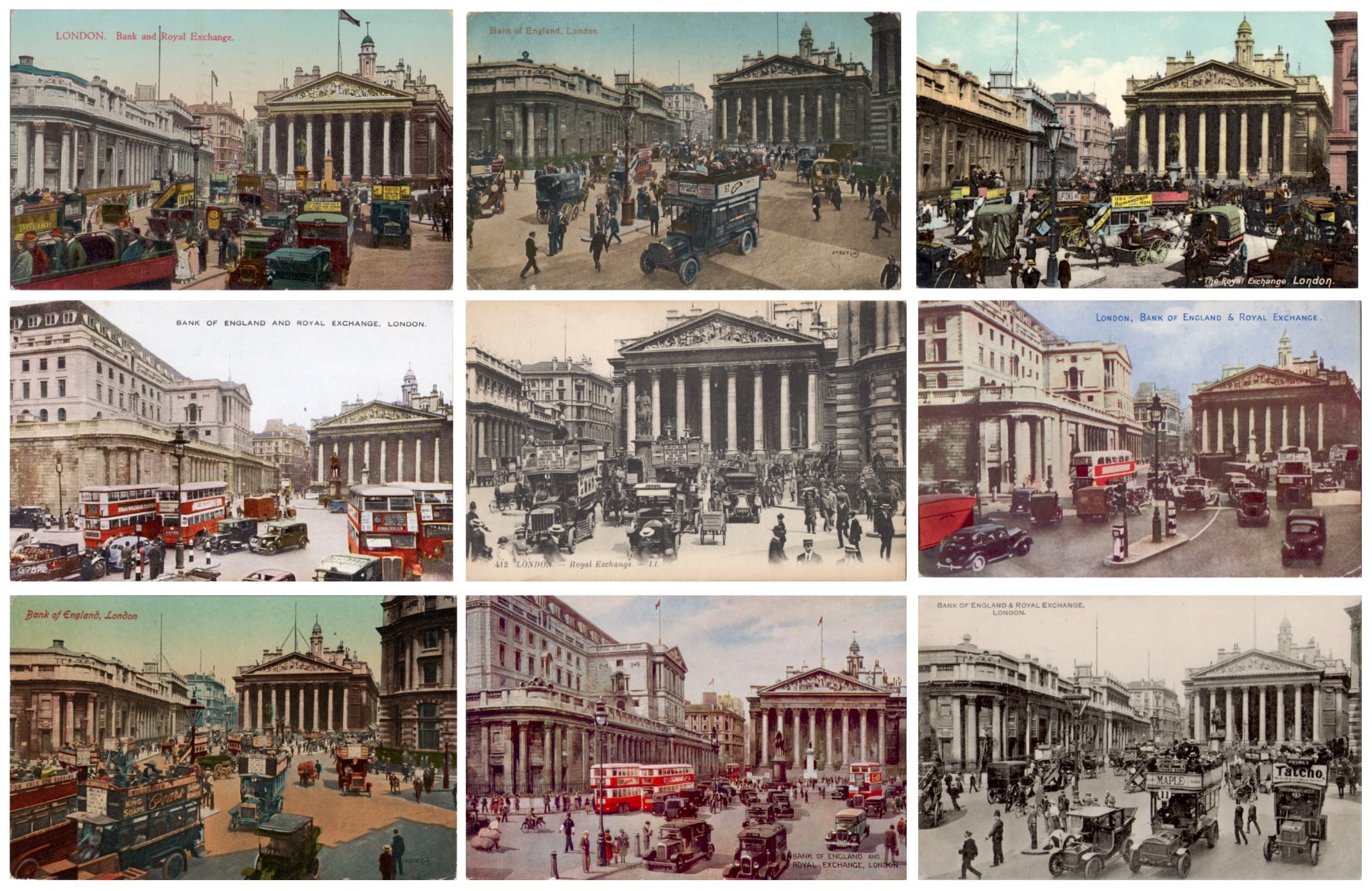
Postcard publishers would regularly dispatch their photographers to record the Bank and the Royal Exchange, a motif that would comfortably sit within the top ten London subjects.  In the montage we have before and after views of the Bank with three of them revealing the overpowering presence of Baker’s additions.  Next is a rare postcard view of the measured proportions of Soane’s frontage follow by three images of Soane-designed banking halls.  The interior views are based on official photographs from 1894, still in circulation in 1910 when these cards were posted to an address in Maida Vale. Last is a YouTube link to a curiously informal natter about Soane and the Bank - a trifle long-winded but authoritative and informing.


Thursday, 24 August 2017

Too Big To Fail


Britain can take pride in its contribution to the Global Financial Crisis. The first signs of contagion were detected here when Northern Rock subsided under the weight of unsecured debt. British bankers introduced us to such new concepts as Libor Rate Manipulation, Coercive Insolvency, Quantitative Easing and Too Big To Fail while the UK taxpayer saved them from total collapse with funds amounting to £19,900 for every child, woman and man. Banks are the best friends we could possibly have – one look at their aspirational life-affirming TV advertising is enough to convince. Images of happy healthy children, active and sporty adolescents, high achieving students, fun-loving mums and dads sharing chores while doting grandparents busy themselves setting up trust funds for the little ones roll endlessly across our screens, numbing the senses as they do so. Positioning themselves as agents of human happiness and gateways to all the pleasures of a consumer society serves to conceal their desperation to turn a profit on every transaction. Money laundering for drug lords and totalitarian regimes is yet to feature in any publicity.


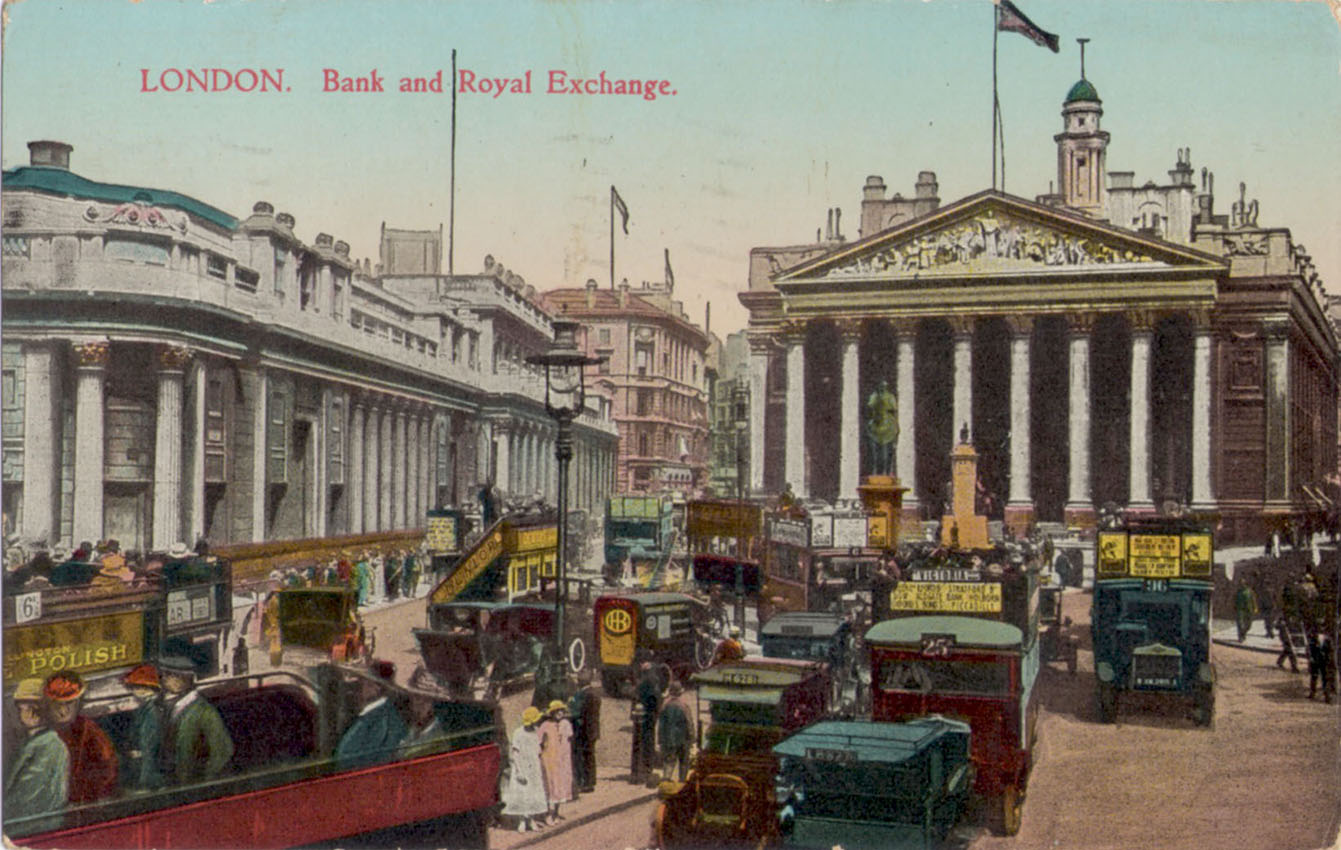
Today’s postcards are views of the Bank of England from the early decades of the last century – a popular landmark for postcard photographers, in part due to the endemic traffic chaos that expressed the excitement of new technology. It was the Bank that brought us Quantitative Easing (QE) – priming the economy with money conjured up out of a vacuum, a form of fiscal alchemy. Freshly created cash was handed over to banks in return for financial assets such as bonds – all the online guides to this process omit to explain just how the parties to these deals agree a price. If somebody approached you offering ‘free’ cash for unspecified assets it would only be natural to give up as little as possible for the maximum amount of that cash. The plan was that the additional money in the system would enable banks to lend more to business which in turn would expand their activities and hire more staff whose wages and salaries would boost consumer spending and before you know it our problems are over. There is no agreement among economists on whether QE has done any good for the wider economy beyond a generally stabilising effect. The only known beneficiaries are the banks for whom it presented an opportunity to rebuild their balance sheets and strengthen their depleted reserves.


Monday, 21 August 2017

The Banks are Made of Marble


The tenth anniversary of the first signs of the Global Financial Crisis of 2007-08 is being marked, rather than celebrated, by much media commentary – platitudinous hindsight for the most part. Thanks to the tireless efforts of Messrs. Osborne, Cameron and Clegg (aided and abetted by a supine opposition) we now know that that the world economy crashed due to the incompetence of Gordon Brown and the profligacy of the Labour government’s reckless public spending. Anyway, enough of fake narratives – we pay homage here to the spiritual home of casino banking, the USA. Birthplace of the Collateralised Debt Obligation, Credit Default Swaps and the Subprime Mortgage. After 30 years of assiduous creation of their legendary status as brutal and callous deal-makers, the banking community had finally over-reached.


The Los Angeles bank vault is a tribute in gleaming metal to the efforts of the rich to defend their property and the corresponding efforts of the criminal class to get their hands on them without the inconvenience of earning them. All cool reflective surfaces and empty spaces. Most of these cards pre-date the crash of 1929 and include some small town retail banks of the type that failed in the thousands as well as large faceless operations concealed within skyscraper towers and lesser buildings of varying degrees of architectural pomposity.


A New York State farmer named Les Rice wrote the song, The Banks are made of Marble in the late 1940s and Pete Seeger, who was a near neighbour and acquaintance, included it in his repertoire for the rest of his career. In the 2012 clip below, Pete’s accompanied by the Rivertown Kids, a notorious bunch of brain-washed, alt-left, merchants of hate. Watch and shudder. The most stirring version is the one performed by Leo Kottke and Iris DeMent on Prairie Home Companion. Sadly, only the corpse remains visible on YouTube.