Showing posts with label shipping. Show all posts

Wednesday, 22 November 2023

T E North on the High Seas

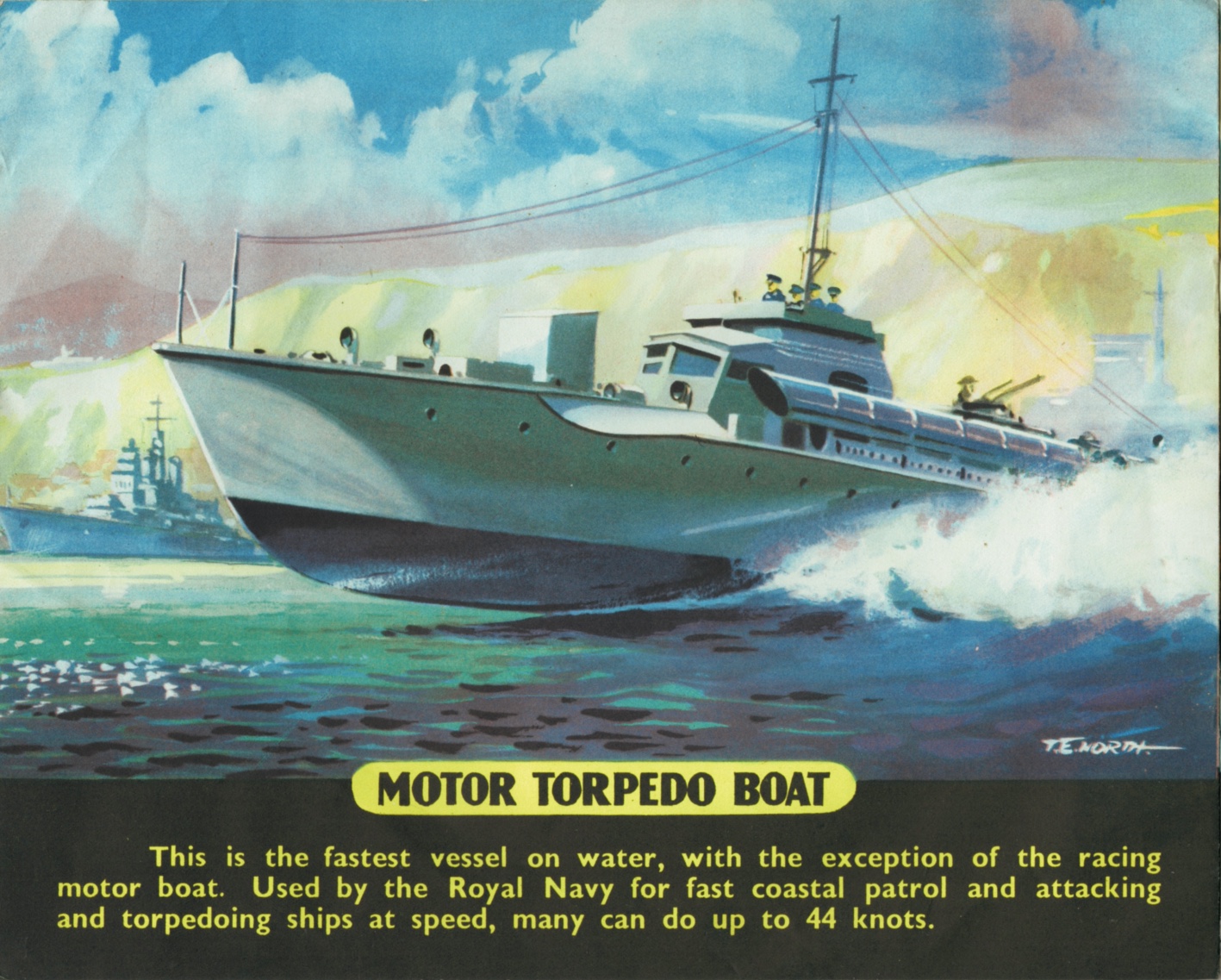
The book illustrations of T E North were featured here a few months ago when we posted about an aviation picture book (Airways) published in 1939.  Notable for compositional originality and precision drawing, the qualities displayed in Airways faded in his post-war output in line with contemporary trends.  After 6 years of war during which he served in the RAF, rebuilding his career and adapting to a much changed commercial situation would have been difficult. The services of an assiduous agent would have been essential and it may have been an agent who spotted his affinity for transport subjects and marketed his skills to publishers. Appropriately for an artist born and bred in Hull this example is a book of maritime illustrations for young people. Atmospheric effects predominate, brought to life by more gestural brushwork and a dramatically intensified colour palette.  Perhaps the romance of the age of the great ocean liners and the cargo ship demanded a more vigorous approach.  Recent collective memory of war fought at sea and the prestige invested in building ever larger and more luxurious liners fixed all things maritime firmly in the mid-century popular imagination in a way that’s inconceivable today.  The image of the ship’s captain was a figure of steely resolve, commanding the loyalty of the crew in the face of danger from the elemental terrors of hostile seas. Young readers could be enthralled by the exotic network of international shipping, at the centre of which they were assured, Britain stood supreme and unchallenged - a supremacy that evaporated at breathtaking speed over the next decade as the nation first decolonised and later de-industrialised. 


Wednesday, 29 March 2023

Cargo Handling 1932

A set of 1932 collector cards from Liebig, a portfolio of dockside views showing the loading and unloading of cargo ships.  Motor vehicles and locomotives are craned through the air along with minerals, while grain is loaded on board via a system of tubes and pipes.  These scenes have largely disappeared from today’s ports where the shipping container reigns supreme.  Very few items can’t be compressed or disassembled into a container. It was a spectacle that would have appealed to the technically minded child of the time growing up in the era of the Meccano Magazine (which itself featured many such illustrations on its covers).  The style of illustration has evolved with the times - gone is the precision and finesse that graced the cards of earlier decades to be replaced by more simplified drawing with heavier contours and a heightened colour palette.


Wednesday, 14 April 2021

Down the Mississippi in Monochrome

Recent lockdown rooting through old negatives and digitising turned out to be a lot less rewarding than I hoped. Resulting scans were often hazy, unfocused, poorly exposed and tonally flat.  The passage of time has stubbornly failed to confer much in the way of retrospective luminosity. This group of photographs are from a $7 boat trip from Canal Street, New Orleans along the Mississippi river, the Algiers Canal and the Harvey Canal. It was a heavily overcast and humid day - the photos correspondingly low-key and devoid of shadow. It’s striking to see so much decay and dereliction - even the ships are drowning carcasses with flaking paint streaked with oxidisation.  Surprisingly some of them are from the Soviet Union and Iran. Waterside warehouses crumble into the river while fishing boats moulder at their moorings. The most viable economic activity appeared to be servicing the oil rigs in the Gulf of Mexico.  This was 1978 - by some measures the high point of the post-war era of universally rising incomes, taxation funded benefits and social care and a shrinking gap between income extremes. Jimmy Carter was in the White House but Ronald Reagan was on stand-by to roll out the great neocon pushback.  Major US cities were sliding into bankruptcy, the drug culture had crossed over into the mainstream and a sense of profound exhaustion seemed to have set in. The stage was set on which Reagan would declare “Morning in America.”

Part of the itinerary was a visit to the Rene Beauregard House at Chalmette, owned and cared for by the National Park Service.  The ante-bellum mansion overlooks the site of the Battle of New Orleans of 1815 in which a smaller, nimbler American force trounced a much larger, belligerent but incompetent British invading force.  Americans have every reason to celebrate this engagement while the British, who swaggered into battle with every expectation of an easy victory were taught a lesson that to this day appears less than fully learned.  A team of Southern Belles in period costume were on hand to explain - they were silent on explaining how the prosperity of the plantation depended on the labour of slaves.

Revisiting these photographs involves a little, lightweight soul-searching.  The question is whether the air of decay was a result of selection on my part, overlooking anything that didn’t fit with my preconceptions. This is where I suspect the influence of David Plowden whose gritty, beautifully composed  photos of the depredations of the industrial landscape in America I much admired.  Instead of looking through my own eyes, I was looking through what I thought were the eyes of Plowden.  All this speculation leads to an uncomfortable place where there needs to be a reckoning with the way that over familiarity with the work of eminent photographers can easily generate a culture of imitation - something I’m all too aware of when I take a hard look at my own efforts. Looking from another angle, perhaps expectations are just too high and the pursuit of authenticity and originality is best left to those with greater ability.  Thanks to the mobile phone there have never been so many photographers on the planet as there are now. As their efforts multiply in the cloud in their millions and billions of images I get no sense of widespread agonising over issues of authenticity and it’s only to be expected that some (or many) of these photos will quite transcend our own in boldness of conception.


Tuesday, 12 November 2019

Postcard of the Day No. 95 - Animals on Board


Today’s card offers the arresting site of an elephant in a sling, hanging in space as it’s manoeuvred on or off a cargo ship. A desperately uncomfortable position in which to find such an imperious and dignified creature. The location is a port in Colonial Burma where the British authorities had many uses for elephants as a source of cheap, and uncomplaining labour. They were especially valued on timber plantations where they could be put to work hauling enormous loads of logs out of the forests for processing. Elephant traders got rich by capturing the creatures in the wild and selling them on to commercial interests for whom they were a prized asset. Elephants didn’t join trade unions or support campaigns for independence from the colonial masters. On the second card, a rudimentary steam powered crane is hauling an ox carcass on to the quayside in the port of Casablanca where it is about to be unceremoniously dumped. These are discomforting images and worrisome examples of indifference to animal suffering.


Monday, 13 August 2018

Elbtunnel – some postcard views


The Elbtunnel in Hamburg was one of the wonders of the age when it opened in 1911 at the height of the picture postcard boom. This small selection shows how postcard publishers marked this triumph of technology. The cameras have been focused on the tunnel entrance or the tiled roadway and associated vehicle traffic. The second from last is, unusually for a postcard, almost a documentary image foregrounded by two working men, presumably on their way to or from Blohm & Voss shipyard. Most of the other figures and vehicles have been clumsily imported from another source. This applies to nearly all the figures visible in these cards – all victims of slapdash montage and heavy-handed re-touching. The antiquated vehicles enhance the period charm of the images – a charm that is purely retrospective and would have been invisible to contemporary purchasers.


Monday, 2 July 2018

Rendsburg Hochbrücke


This rather nondescript postcard was acquired more than 40 years ago at a time when I was looking for cards of bridges. I can even recall where I found it – in a box of cards at the back of an antique shop on Kensington Church Street. The card fails to do justice to the engineering splendour of the subject. Although I found out for myself when I visited last month just how difficult it is to reveal its wonders in a single photograph. Rendsburg is in Schleswig-Holstein on the Nord-Ostsee Kanal (what we would call the Kiel Canal), in territory that was for centuries contested by Denmark and Germany – it was finally incorporated into Prussia in 1866. Arriving on a train from Hamburg, I consulted a map and satisfied myself that a left and left again would soon bring me to the bridge I’d come to see. I couldn’t have been more wrong as I strode into the suburbs – but when I looked left while crossing at traffic lights I observed an extraordinary sight in the distance. The vast superstructure of a cruise ship was inching along, its upper decks towering over a Lidl store, offering a valuable clue to the location of the Canal. My route took me through the working port of Rendsburg via an avenue of warehouses and grain elevators, to the bridge itself.


The reason this bridge is special is that in addition to carrying a busy railway line over the canal at a height that permits ocean-going vessels to pass underneath, it is also a Transporter Bridge enabling a handful of vehicles and pedestrians to traverse in a suspended gondola (Schwebefähre). It was built in just 2 years between 1911 and 1913 to carry the Neumünster to Flensburg railway across the canal. Regrettably, since January 2016 when a myopic navigator allowed his ship to collide with the gondola the transporter function has been inactive. The gondola has been removed and remains in store while its future is debated. Given the very small number of surviving Transporter Bridges, it would be a great loss if it wasn’t restored to use.


Another feature to admire is the engineering solution to the problem of how to route trains to the deck of a bridge that stands 42 metres above the water level. The southern approach involved constructing a 5.5km inclined ramp at a gradient of 1/150. Space on the northern bank was more limited and had to be found by building what has become known as the Rendsburg Loop – a 360 degree circuit (5.5km in length) over the eastern suburbs that crosses over itself before finally returning to ground level on the approach to Rendsburg Bahnhof. It makes for an exhilarating, if occasionally vertigo-inducing, train ride. In a short-lived spirit of optimism I set out on foot to trace the Loop but had to admit defeat as it swooped off into the distance over a hundred gardens before suddenly turning up again in a place that made no sense. I found a place where a public footpath ran underneath, between the towering bridge supports but hopeless confusion soon set in and it was a relief to find the station more or less by accident.


There’s a handily placed waterside bar/restaurant (Brückenterrassen Rendsburg), more or less underneath the bridge where the overhead rumble of passing trains adds to the atmosphere. When a big ship passes the rooms overlooking the canal go dark. They also serve a monumental plate of Bratkartoffeln mit Ei und Schinken. Recommended.


 Note: The well-travelled Bridgehunter has a much more informed description of this bridge on his blog.