Showing posts with label sheffield. Show all posts

Friday, 28 August 2026

Industrial Sheffield at Kelham Island


The city of Sheffield had a great industrial economy based around steel, heavy engineering, cutlery and tool making that declined in the post-war era due to increased competition from Europe and Japan - it all but expired in the 1980s as Thatcher-led deindustrialisation took effect.  Free market fanatics inspired and applauded the project, taking inordinate pride in following up with a policy of having no economic planning of any sort over the following decades. The local authority-run, free admission museum at Kelham Island does an excellent job explaining and illustrating the scale of steel and engineering enterprise in the days when it was known internationally as “Steel City”.


The museum entrance is dramatically marked by the towering presence of the UK's last working Bessemer Converter used by British Steel until 1974. Invented in 1856 by Henry Bessemer for the conversion of iron into steel at a substantially lower price than hitherto. The first working examples were installed at Bessemer’s works in Sheffield in 1858. At the centre of the museum is the imposing River Don Engine - built at the John Brown Atlas Works (Sheffield Brightside) in 1904, a 3-cylinder 12,000hp steam engine designed to power the process  of armour plating by rolling steel backward and forwards in rapid succession. Hence the ability to reverse the driving wheel in an instant, which is demonstrated in a two minute gas-powered firing twice a day. It remained in use into the 1970s at British Steel River Don works before removal to the museum site in 1978. Described as the most powerful steam engine operational in Europe and still an awe-inspiring sound and motion experience! Watch the brief video at the end of the post to get a flavour.


Other moving exhibits include an impressive Crossley Gas Engine built in 1915, once employed in a rolling mill in Penistone - now powered by electricity for demonstration purpose. Crossley Brothers was formed in Manchester in 1867, building pumps and presses. Their most successful development was  building 4 cylinder gas engines. Enemies of the demon drink, they steadfastly refused to do business with breweries. In the upper gallery there’s a display of locally built Sheffield-Simplex cars - this business was active from 1907 to 1920.  Despite a reputation for innovation and experimentation, the company never broke through to the mass market and left little trace apart from these examples.  On the ground floor is a recreation of a Victorian street occupied by the premises of master cutlers at least one of whom is still working. The cutlery trade is represented by period examples of lavish displays of bladed items, cutlery and hand tools.


Stored alongside the museum car park is a 1951 built Diesel Electric 0-4-0 shunting locomotive designed for internal use at the Templeborough Steel Works in Rotherham. Constructed at the Sheffield works of the Yorkshire Engine Co. It has languished here since at least 2005 and obviously deserves a better fate but most local authority museums lack the resources to restore and display items like this. Sheffield native and Reform Party supporter, Mr. Christopher Harborne found £5 million pounds to slip into Nigel Farage's already well stuffed pocket. It will never happen but would be good if he could find some spare cash to help out the museum service in his old home town. It’s impressive that the city museum service still occupies a key position in cultural life in a time when resources have never been under greater pressure.


Friday, 14 August 2026

Natural Peas in Crosspool

In 2024 a Ghost Sign was revealed in the Sheffield suburb of Crosspool when a large advertising billboard was removed from a gable end at the neighbourhood shopping centre. It was a much faded version of what can be seen here.  A story of local reaction unfolded in the local press - elderly residents recalled seeing the original sign in their youth. As an exercise in graphic design it has to be said it’s very basic. But, perhaps its very simplicity spoke to the omnipresent popular yearning for  simpler times and a campaign to see it reinstated was widely supported. A year later the sign was restored to its former self, modestly promoting the virtues of tinned processed peas to the wider world. Follow this link to see how it was achieved. Not everyone was delighted, some felt it should have been preserved in its damaged condition, maintaining its identity as a Ghost Sign.  Others believed the sign had little merit and preferred to see the entire gable end as a potential space for Street Art. The last photo features the frequently elusive 51 bus, behind which the billboard can be seen as it was in 2007.


Monday, 23 July 2012

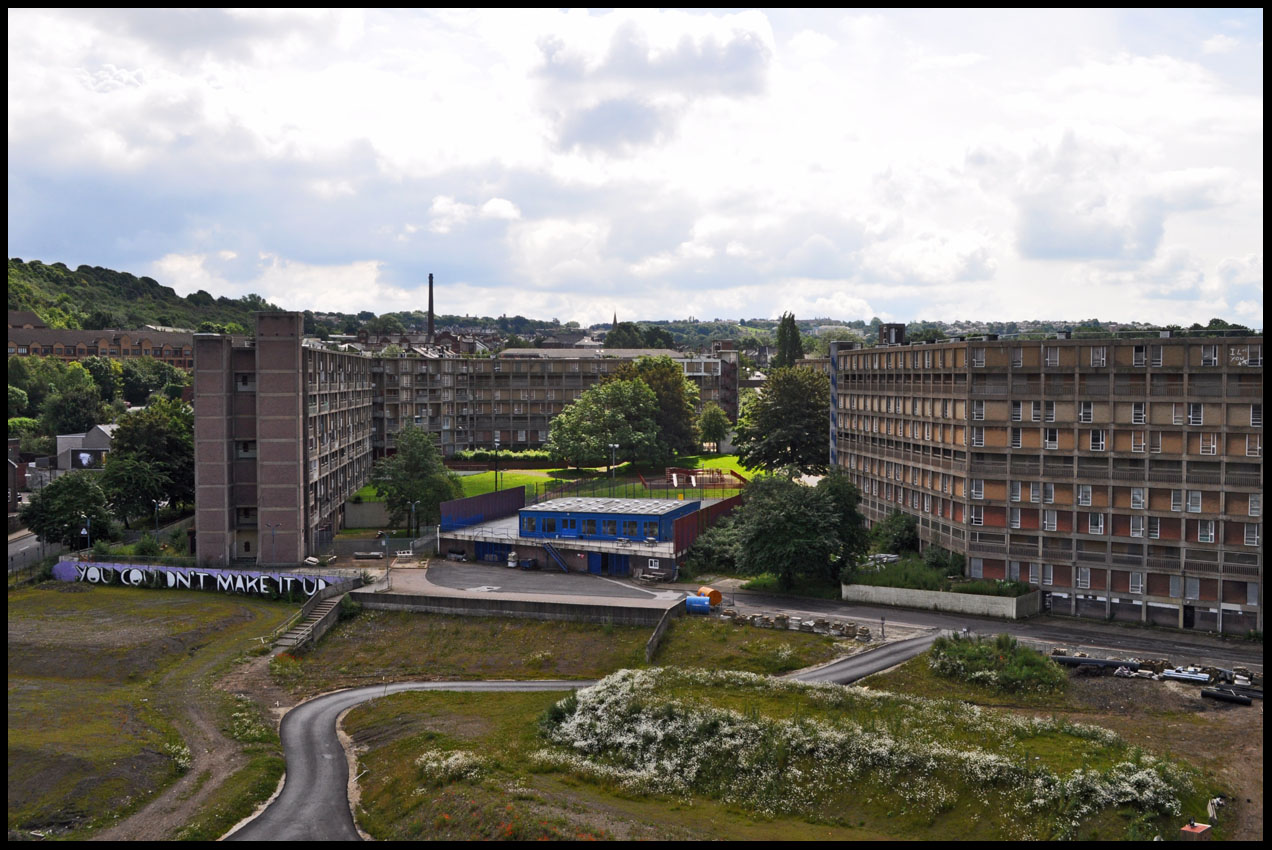
Park Hill – Utopia Remodelled

Most utopian visions go into gentle decline as the years pass by but Park Hill in Sheffield, like many high-rise social housing developments, fell from grace at speed. The fame it now enjoys is a product of its dramatic domination of the city skyline and the scale of ambition, all the more striking in a culture where the preference is for modest, provisional, interim, incremental solutions to housing needs. It was a major statement that reflected the city’s self-confidence. Almost 3,500 residents were accommodated here when the buildings were completed in 1961 but as the novelty wore off it became an increasingly unpleasant place to live – poor maintenance, sound insulation issues, sub-standard materials and anti-social behaviour all contributed. The argument about responsibility for this goes on – target-obsessed city planners insensitive to the needs of families with children, architects with grandiose ambitions, constant downward pressure on housing budgets and feckless tenants have all attracted blame from one quarter or another.

Fifty years having passed since completion, the scheme fits a historic narrative that leads back to Marseille and le Corbusier’s Unité d’Habitation and to the Karl-Marx-Hof in Vienna. The linked access decks (streets in the sky) at every third level caught the public imagination and the buildings attracted admirers and detractors in equal measure until in 1998 English Heritage awarded grade II* listing. Fourteen years later, only the southernmost low-rise buildings remain occupied by council tenants. The greater part of the scheme is vacant with the initial phase of refurbishment and internal remodelling by developers Urban Splash (closely monitored by English Heritage) nearing completion. The first block to be finished should be ready for occupation in December and a sales campaign is underway. The campaign must contend with a generalised cultural antipathy to concrete and high-rise (brutalist, unsympathetic, inhuman scale, anti-individualist, un-English) and additional hostility from enemies of the “heritage industry” and opponents of gentrification.

When you go inside, you find yourself trying to imagine exactly what it would be like to live there when the fascination of the spectacular views begins to fade into dull familiarity. Storage space is minimal, so a spare and austere lifestyle would be an advantage. An occupant with acquisitive habits would rapidly come up against the limits of what could be accommodated in rooms of modest dimensions. The original room plans were designed to Parker Morris standards – practical for 1961 but incompatible with the world of home cinema, jumbo-size fridge-freezers, walk-in wardrobes and wet-rooms. These confined spaces will have little appeal for the young professional looking forward to rolling out a four-seater leather sofa and a runway sized coffee table in a city centre loft apartment. Perhaps there’s a developing market for Modernism as nostalgia – a place where the coarse texture of brutalism serves as a corrective to the dazzling surface gloss of corporate aggrandisement. Will the rectilinear Modernist rhythms of horizontal and vertical elements appear models of restraint when compared with the computer-designed formal travesties that tower over the Gulf states or the Shards and Gherkins to be found closer to home?