Showing posts with label railways. Show all posts

Monday, 20 March 2023

London Stations in Postcards and Photos - Charing Cross

Not the most celebrated of London stations.  There are no books that tell the story of Charing Cross station and there is no record of it serving as a movie location.  The 1865 Charing Cross Hotel (now the Clermont) frontage on the Strand has survived more or less intact but seen from the Thames much of its distinctiveness has been buried beneath Sir Terry Farrell’s 1986-1990 Po-Mo vanity project.  The station itself opened in 1864 - after a protracted battle with parliamentary opposition and obstruction from its competitors, the South Eastern Railway (SER) extended a line through London Bridge station across the Thames via Hungerford Bridge to its present site.  A long history of mismanagement, disputation and fatal accidents (one of which, at Staplehurst almost killed Charles Dickens) ended in 1866 when a new Chairman, Edward Watkin was appointed.  Watkin was a busy man - he was Chairman of the Manchester, Sheffield and Lincoln Railway as well as the Metropolitan Railway, and also a director of the Chemins de Fer du Nord.  He would sponsor the first attempt to build a Channel Tunnel and nursed an ambition to run through trains from Manchester to Paris. Forty years later in 1905, the single span glass and wrought iron roof collapsed, triggering the fall of the western wall. Six lives were lost but despite there being 4 trains at the platforms, no passengers were among them.  In just 3 months the roof was replaced with a basic ridge and furrow design and the station was back in business.  Its days as a gateway to Europe with boat trains to Dover and Folkestone are long gone and today’s station serves commuters in Kent and East Sussex reaching the coast at Ramsgate, Margate, Dover, Folkestone and Hastings. 


Wednesday, 1 September 2021

The Dreamland Express

A group of children - boys and girls - lying face down on the ground, staring over the edge of a precipice.  One of the boys is upright and racing towards the edge in the company of a snake.  Is he planning to jump? The scene has been visualised from above giving a strong sense that they are looking into a terrifying void.  They are, in fact, at the edge of the world.  Beyond is the limitless emptiness of space. This anxiety inducing glimpse of infinity comes from a book for children, written and illustrated by H R Millar (1869-1942), the subject of our previous post.

The Dreamland Express was published by Oxford University Press in 1927 and copies are hard to find. A new edition was issued in 1989 and these scans come from one such copy.  Millar put his heart and soul into this book, writing an adventure story in which a trio of schoolboys follow a voyage of discovery through fantastical and other worldly landscapes, encountering a bewildering sequence of wild and dangerous animals, dragons, giants and citizens of exotic and eccentric civilisations.  Holding it all together was the series of trains in which the young adventurers travelled that enabled Millar to indulge his lifelong passion for railways and spice his narrative with romantic vignettes of life on the rails.  Millar begins his tale with a haunting description of the children discovering a passenger train all but concealed in dense woodland, headed by a majestic steam engine entangled in foliage. A full complement of crew are ready and waiting to welcome them on board and get the journey underway.

In the first half of the book the train races through imaginary cities on bridges and viaducts that have all but escaped the laws of gravity, arriving at an extraordinary cavernous station built in the style of Ancient Egypt. Along the way our heroes meet a flirtatious girl, always an uncomfortable moment of potential disruption to the simple pleasures of male companionship. Unlike John, Peter and George she is not granted the dignity of a name but she wins their respect by revealing an unexpected interest in trains, enough to admit her to the travelling band. Later the group is joined by a school swot whose function is to irritate with displays of pedantry.  The second half of the book involves an enforced change of train - the new locomotive is a decrepit specimen apparently riveted together from a motley assortment of life expired parts in the manner of W Heath Robinson. A Mysterious Oriental with a private train carrying a magnificent retinue of slaves and devoted followers enters the story and by sleight of hand substitutes their locomotive for something even worse - an Oriental fantasy made from porcelain and timber with a silken canopy covering the cab.  Despite the handicap of a disintegrating locomotive our heroes find time to rescue a slave from execution, win the favour of a Giant and emerge unscathed from a pitch-black Canyon of Darkness.

Millar’s visions of alternative worlds are brought to life with pen and ink drawing combined with colour washes - the results are close to the visual conventions of the comic strip. Echoes of Lyonel Feininger and Winsor McCay can be seen in Millar’s eccentric architectural fantasies although no evidence that he ever saw their work exists. Millar employed the voice of a narrator throughout to offer context and commentary and he didn’t flinch from challenging subject matter.  The image of the eternally burning city and the desperation of its inhabitants is the stuff of young nightmares and evokes a sense of dread equal to the confrontation with the edge of the world where the journey ends. Millar resolves this situation by having the three boys simultaneously awaken in their beds back home.  Normality has been restored and the boys can resume their natural progression to adulthood where John flies a Spitfire in the Battle of Britain, eventually becoming a Conservative MP, Peter survives the privations of a Japanese prisoner-of-war camp, later rising through the ranks of the Anglican Church to become a Suffragan Bishop and George, having served as a Junior Officer in the Royal Navy, studies Fine Art at the Slade, briefly exhibits his paintings of railway disasters at the Beaux-Arts Gallery while becoming a notorious habitué of the Colony Room, bantering the night away with George Melly and Francis Bacon.


Thursday, 26 August 2021

On the Railway in 1925

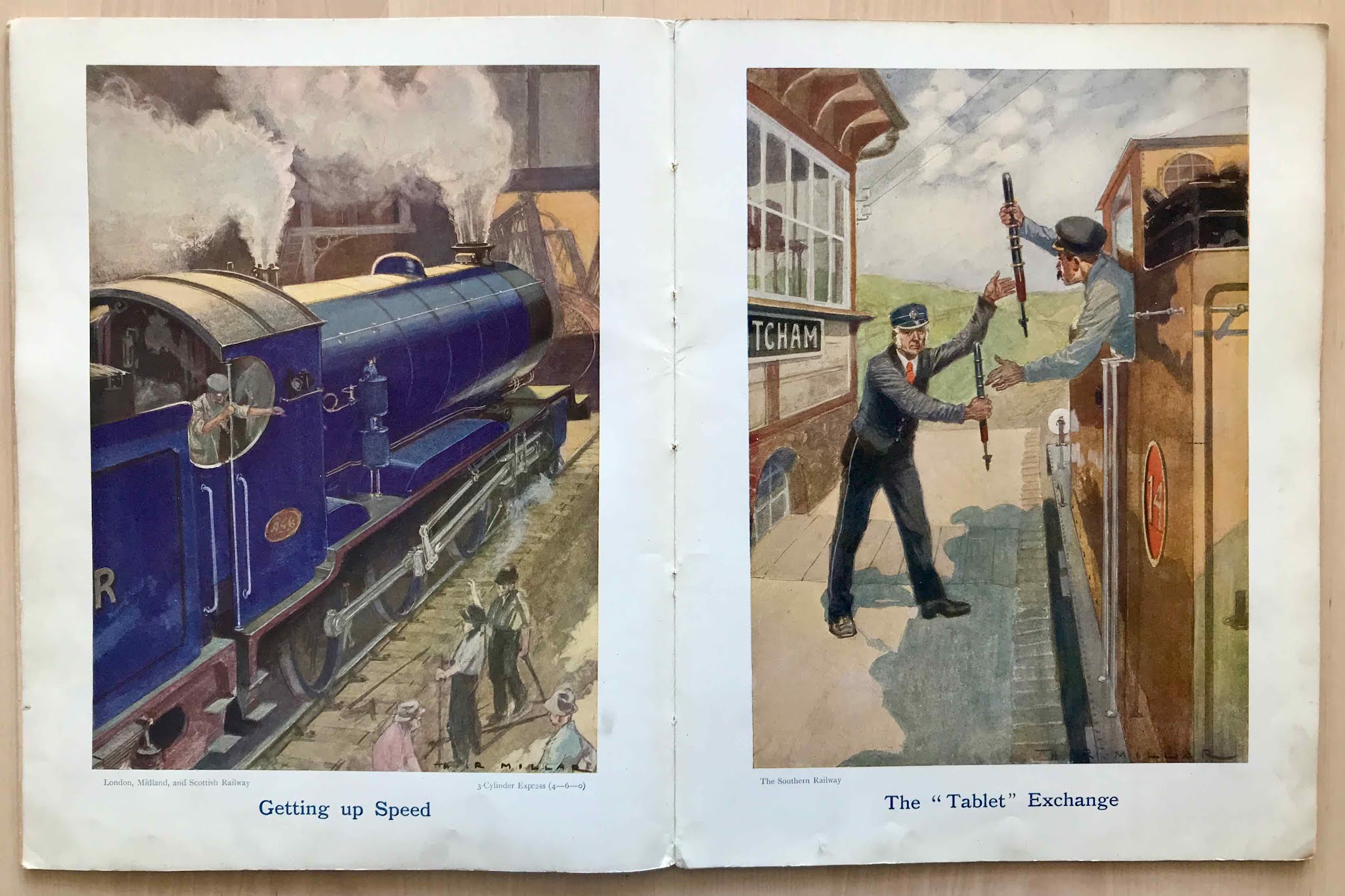
This slender but large format illustrated book dates from around 1925 when it was presented to Master Norman Dore by the Fulham Baptist Band of Hope.  Norman’s good conduct and regular attendance had earned him Second Prize; he also took good care of his book, resisting all temptation to embellish it with his handiwork.  Published by Blackie and illustrated by H R Millar it was one of many such books launched on the market to engage the interest of the junior railway enthusiast.  The illustrations are atmospheric and impressionistic in execution and while paying due respect to the mechanical features on display no attempt has been made to describe them in detail. Scottish born Millar (1869-1942) was a regular contributor of drawings for Punch and Strand Magazine as well as a prolific book illustrator.  Before attending art school he had some training in civil engineering which may have influenced the linear precision to be found in much of his other published work. His collaboration with Edith (Railway Children) Nesbit, best selling author of fantasy books for children, may have been his most fruitful.  Beginning in 1899 he illustrated all her best known books until 1913.  Nesbit, intriguing for her lifelong devotion to socialism, held him in high esteem and his success in bringing her tales of fantastical creatures to life may have encouraged him to write and illustrate his own books. Almost a century after her death in 1924 many of Nesbit’s books remain in print, often reissued with new illustrations including examples by Inga Moore, Brian Robb and Edward Ardizzone. 


Tuesday, 27 July 2021

Some Victorian Steel Engraving

Victorian printing technology steadily advanced through the 19th. century towards the ultimate goal of mass production of photographic imagery.  Along the way the process of printing from engraved imagery on steel plates was constantly refined and improved.  Engraving specialists were kept busy by the demands of mass circulation magazines (The Graphic, Illustrated London News, The Sketch, Punch) for new material to entertain the readers. Pictorial representations of current events, portraits of the great and the good, celebrity portraits and cartoons were especially in demand. Another army of engravers were preparing print versions of critically approved paintings  as shown in Royal Academy exhibitions to enable the rising middle classes to display their taste for the visual arts on the walls of their own homes.  Even more were engaged on topographical subjects - scarcely a manor house, ruined abbey or castle, riverbank, forest, lake, moorland or mountain went unrecorded. There was an affordable prospect for every affluent customer.  The finest of these practitioners achieved spectacular effects in terms of describing detail and creating subtle and dramatic tonal effects through the precision of their mark making.  Reproducing engineering drawings was a highly specialist skill requiring perfect clarity of visual description - this is a section of examples taken from the plates of various encyclopaedias.  They offer impressively analytical images of new applications of steam power and increasingly complex machine technology. Starting with the printing industry, the application of steam in shipping and railways, the selection is completed with a variety of mechanical wood saws. Admire the delicate subtleties of tone, the impersonal drawing and the complete absence of visual rhetoric. 


Sunday, 18 April 2021

Postcard of the Day No. 103 Morlaix

A busy scene in the Breton market town of Morlaix where a narrow-gauge train operated by Chemins de Fer Armoricain, a metre-gauge network of lines built to connect small towns and neighbouring coastal settlements along the north coast of Finistère.  The Morlaix section opened in 1912 which may well be the year of the postcard. A group of women in Breton headdress are making their way into town, passing the modest but decoratively detailed station building, complete with édicule.  Above the train, the massive piers of a railway viaduct can be seen on its march across the steep sided valley in which the town is located.  What we see here is just the first level of the structure which has 9 arches - the upper level is more than 60 metres in height and has 14 arches.  Its presence is inescapable - it dominates the view from all districts of the town and must have been a hugely resented intrusion when it was under construction in 1861-63.  The lower level incorporated a pedestrian walkway but last time I was in Morlaix (more than 10 years ago) I discovered it locked and barred in a way that suggested it was unlikely to ever reopen.

After several years of construction the viaduct was fully opened in 1865 as a vital link in the main line from Paris to Brest operated by Chemins de Fer de l’Ouest. Today, up to 7 TGV services from Paris-Montparnasse cross overhead each day and the viaduct is protected as a national monument. These postcards are a reminder of how private commercial interests could transform a townscape that had evolved over many centuries by promising connectivity and future prosperity. At the same time public perception changes from outright hostility via gradual acceptance to popular veneration as a monument to engineering achievement.  The narrow-gauge railway was barely viable from the start and never generated enough traffic to pay its way - the convenience of delivering passengers to the heart of the town was offset by the lack of potential business in the sparsely populated hinterland. It closed for good in 1934 after only 22 years of service. Despite several visits to Morlaix over the years, I had no idea of its existence until I saw this postcard.