Showing posts with label paris transport. Show all posts

Thursday, 29 April 2021

Bridges of Paris: 2 Pont de Bir-Hakeim

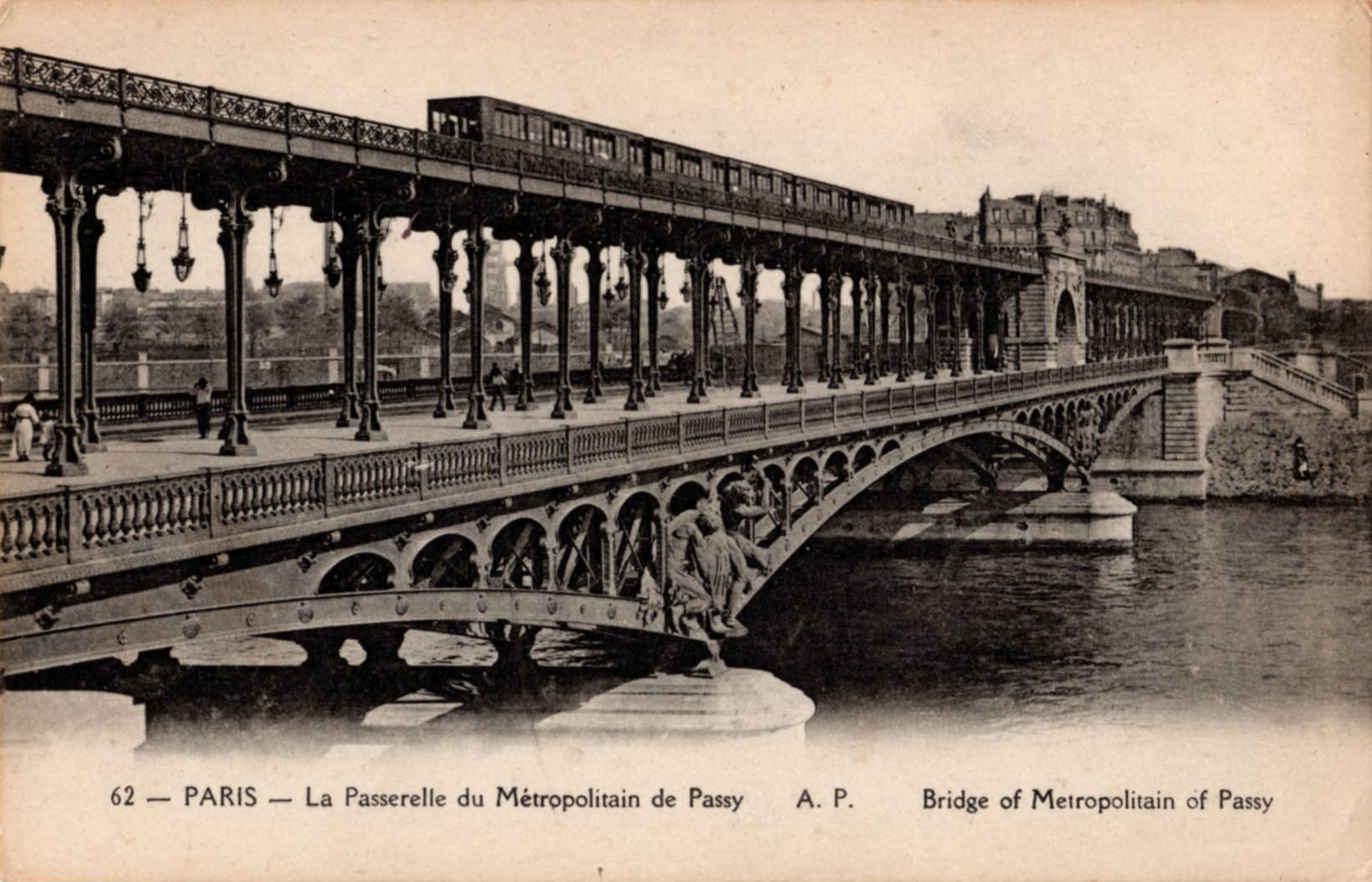
Pont de Bir-Hakeim links the Parisian districts of Passy (16th.) and Grenelle (15th.) and carries Métro line 6 over the Seine on one of two such crossings on its circuitous arc from Charles De Gaulle - Étoile in the west to Nation in the east. Approaching the Passy Métro station on rue de l’Alboni ends in a deep visual dive over the river Seine as if poised at the top of a ski slope.  From the railings at the end of the street the view takes in the platforms and canopies of Passy station and the ribbons of steel rail leading to the next station and beyond, deep into the 15th. arrondissement. Less obvious are the bridge abutments that mark the passage over the Seine which is the reason for this spectacular view opening up. 

The bridge itself is a two tier viaduct for road and rail (Métro) - in the centre of the roadway a pedestrian walkway and cycle route runs underneath the rail bridge.  The railway runs on a concrete deck supported by tall slender steel columns, each formed from four plate sections that taper and flare to make them easier on the eye. There’s more beautification in the form of Classical reliefs representing Electricity and Commerce on the stone built central arch. Additional sculptures grace the steel substructure where it rests on the stone pier of the Île aux Cygnes.  The bridge designer was Jean-Camille Formigé whose work can be seen all over the city on Métro infrastructure and the Viaduc d’Austerlitz. When the bridge was completed in 1905 it was known as the Viaduc de Passy – in 1948 it was renamed in honour of the Free French military victory at Bir-Hakeim in 1942.

The colonnade is a popular location for fashion photo-shoots and the bridge has made many appearances on screen, most notably in Zazie dans le Métro and Last Tango in Paris. The photos conclude with images of the elevated platforms at Métro Bir-Hakeim (formerly Quai de Grenelle).




Tuesday, 19 January 2021

Bridges of Paris: 1 Viaduc d’Austerlitz

While most Paris Métro lines (with the notable exception of line 6) burrow underneath the Seine, line 5 crosses over the Seine between Quai de la Rapée and Quai d’Austerlitz by courtesy of the graceful Viaduc d’Austerlitz, a single arch steel bridge built in 1904, slender in appearance but rich in decorative ironwork.  On the north bank the bridge approach is via a curving steel ramp that lifts the tracks to the required height. At the other end the bridge extends over the Quai d’Austerlitz and the roadway before plunging into the roof space of the Gare d’Austerlitz - the only terminal station in Paris where the Métro platforms are situated above the station rather than safely interred beneath.  The view from downstream includes glimpses of the clock tower at the Gare de Lyon and the offices of RATP, the nerve centre of Parisian public transport.  There are houseboats tied up alongside the Quai d’Austerlitz - in an early series of The Spiral, the stocky figure of the eternally compromised Gilou (aka Escoffier) could be seen there, going aboard for a critical meeting with an organised crime boss to whom he would offer his services as an informer from inside the police.

Jean-Camille Formigé (1845-1926) designed the bridge with the engineer, Louis Biette. Formigé is no household name but he left a distinctive mark on the city around the turn of century.  He designed the Pont de Passy (1905) and the extended viaducts that supported Métro line 2 on its aerial sections through northern Paris. His taste for decorative moulded reliefs can be seen on all these structures. The nautical themed coat-of-arms for the City of Paris with its anchor and trident, is stretched and extended and draped with fronds of seaweed and undulating fish, then repeated at intervals across the Viaduc from the main arch to the balustrades.  Robustly carved bulls’ heads surmount the stonework of the massive abutments to amplify the sense of structural strength.


Sunday, 13 December 2015

Ligne de Sceaux 1946


This elegant book was published in 1946 by the Paris Métro to mark the centenary of the Ligne de Sceaux – a suburban service, one of the earliest railways in Paris, and for most of its existence, unconnected to the national network. From 1846 until 1895 the line terminated at the Place Denfert-Rochereau (below) before being extended closer to the city centre at Gare de Luxembourg. In 1937 the Paris Métro assumed ownership of the line and embarked on a programme of electrification and new station building. It would be 1977 before the line was fully integrated into the Parisian RATP network when it formed part of the new RER line B. The commemorative book only becomes interesting in the final section when describing the modernised line and illustrating new stations and infrastructure in crisp line drawings. The post-1937 stations as shown were boxy but imposing and suggest an affinity with some of Charles Holden’s London Underground designs for the southern end of the Northern Line, especially Morden. Sceaux remains one of the most salubrious and prosperous Parisian suburbs.


Tuesday, 11 August 2015

Postcard of the Day No. 76 – Métro Station Sèvres-Lecourbe


A return to the Paris Métro for today’s postcard. A Métro employee stands at the platform end observing an approaching train sweeping round the curve of the viaduct. The caption tells us that the train is on Ligne 2 Sud which enables us to date the card between April 1906 and October 1907 (after which it was designated Ligne 5). Later still it became Line 6. The sharp-eyed viewer may recall this card made an earlier appearance in a previous post about Line 6. The excuse for showing it again is this brief video clip that I recorded last year and has remained undisturbed and unseen on a mislaid HD card until its recent reappearance. Now available for the first time it turns out to have been filmed at the same station – Sèvres-Lecourbe. Fractionally over 1 minute in length, every second is time well spent. One of the highlights is that most evocative of Parisian sounds – the warning note of a Métro door closure. 

Tuesday, 31 March 2015

Paris Métro Line 6


Métro Line 6 starts and finishes north of the Seine but for most of its length loops through the outer southern arrondissements flying high above the boulevards with intermittent subterranean descents. From east to west it begins underground at L’Etoile, emerging into the daylight at Passy before launching itself across the river on the Pont Bir-Hakeim. It follows a green corridor on a viaduct through the 15th. and 14th. until descending to tunnel beneath the Montparnasse district after which a second elevated section extends to Place d’Italie where it dips below ground again. Another rooftop glide leads via Quai de la Gare, recrossing the river at Pont de Bercy whence the line runs underground to Nation with only a brief burst of daylight at Bel-Air. 

Westbound train entering Bir Hakeim station

Line 6 as seen from the top of Tour Montparnasse


Aerial view of Sèvres Lecourbe station


Platforms at Quai de la Gare

Bel-Air where the train briefly surfaces

Tuesday, 19 August 2008

Vous devez valider votre titre de transport


Seasoned visitors to Paris will often tell you that the bus offers the best way to see the ‘real’ Paris. They do have a point – the open-air street level views are endlessly fascinating and for the most part, tourists use the Métro leaving the buses to ‘genuine’ Parisians. The route network often leads through some of the most neglected areas into some of the most opulent providing a more diverse experience than the Métro. The street scene is not the only diversion. Fellow passengers tend to be working Parisians with an aversion to the Métro. Most bus drivers will find that there is always one passenger who will stand next to him at the front of the bus and keep him entertained with an interminable monologue. Invariably male and of advancing years they often have the air of former employees. Travelling on an 86 bus from Bastille to Saint-Mandé we noted that they were operating a relay system, as one got off at Nation, another got on board. To be fair, the bus drivers appear grateful for the company and actively participate in the conversations.


Another point of interest is to observe how few actually pay for their journey. Tickets (or Navigos) have to be validated as you board but only a minority seem to do so. Most seem to have calculated the cost of being fined in an inspection would be less than the amount spent on paying for tickets. It’s quite common to see people manoeuvre items of furniture on board, my favourite being a wardrobe which was manhandled on and off a bendy-bus.


When it does happen, an inspection is a sight to behold. A group of 10 to 15 paramilitaries in navy blue uniforms split up to cover every exit and entrance to the vehicle and send a task force on board to check every passenger. Despite the mob-handed security there always seems to be at least one that makes a break for freedom and disappears at speed into the crowds. The impact of Parisian buses on art and literature has not been great but a notable example is Raymond Queneau’s virtuoso Exercices de Style (1947) in which he retells a brief anecdote set on a bus in 99 different, and always entertaining, ways. The 84 bus, on which Queneau posed for a photograph, still runs from Panthéon to Porte de Champerret.