Showing posts with label tunnel. Show all posts

Monday, 22 November 2021

Building a Tunnel in New Zealand

There’s a tunnel mouth with a block built portal and some stone retaining walls under construction beneath a steeply rising hillside. A temporary narrow-gauge railway has been built to carry away the spoil and bring materials to the site. Many of the labourers appear to be non-European and a gent in a top hat appears to be supervising activities. The workforce have paused their toil for the camera and a handful of bystanders observe the event from above. The photo bore no caption but I am reliably informed that it shows a tunnel linking the city of Christchurch with the port of Lyttleton on New Zealand’s South Island.  Work on the mile long tunnel began in 1861 and trains started running in 1867.  It would be 1874 before it was fully complete due to a combination of persistent ingress of water and the challenge of drilling through exceptionally hard rock. There are no passenger trains but it remains in operation for freight trains transporting cargoes from Lyttleton Port.  Wikipedia has more.


Wednesday, 30 September 2020

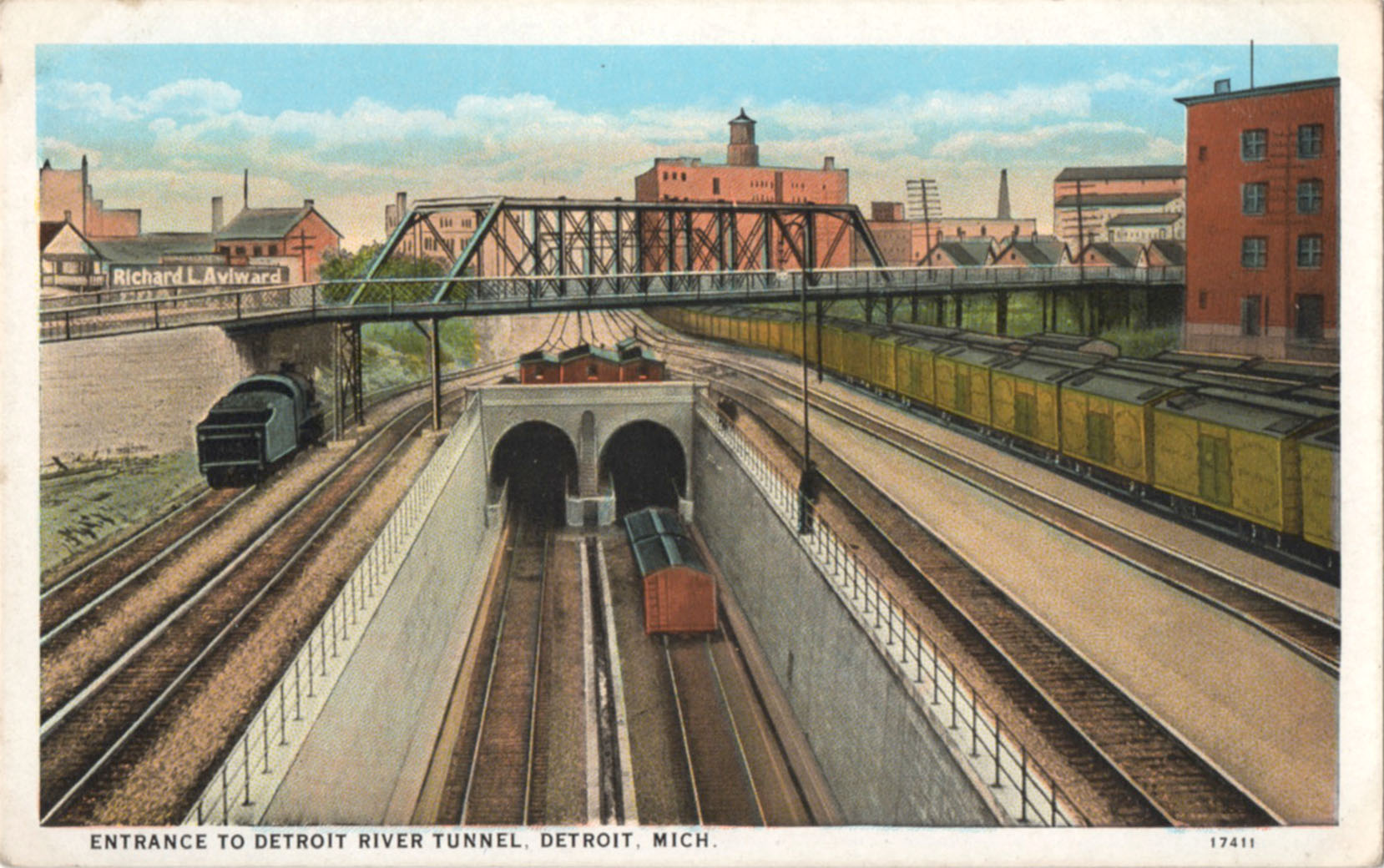
Rail Tunnel to Canada

For twenty years before Detroit was connected to Canada via a road tunnel, the only physical link was a rail tunnel built in 1909-10 by the Michigan Central Railroad. It was clearly a thing of wonder given the variety of postcards recording its scenic attractions.  There’s a certain spatial complexity with a tunnel portal located beneath an over bridge with busy tracks on either side, but hardly enough to make it a place of pilgrimage. Freight trains still run through the tunnel which is now owned by the Canadian Pacific Railway although the surrounding infrastructure has largely disappeared leaving a wasteland with even less to commend it.  According to Wikipedia the area is now extensively patrolled by Homeland Security, the Detroit Police and railroad security agents. More to follow on the city of Detroit.


Friday, 25 September 2020

Road Tunnel to Canada

There are two ways to drive from Detroit in the US to Windsor in Canada. The most favoured route is across the Ambassador Bridge (1929) that sails high above the Detroit River that separates the two nations. An alternative route is via the Detroit - Canada Tunnel (1930) - a southbound journey through an immersed tube just short of a mile in length.  Detroit is by far the larger of the two cities and some of these postcards underline the point. One shows the imposing Detroit skyline with a graphic representation of the tunnel approach while another depicts the tunnel in cross section with the humble cluster of low-rise buildings on the left, contrasted with the magnificence of Detroit on the right. Both postcards of the tunnel interior are focused on the mystical point where two countries meet at a subterranean border. Last is a dingy card view of the tunnel entrance on the Canadian side in a depressing setting between two barrack-like hotels. Not much improvement since by the look of the Streetview image.


Monday, 13 August 2018

Elbtunnel – some postcard views


The Elbtunnel in Hamburg was one of the wonders of the age when it opened in 1911 at the height of the picture postcard boom. This small selection shows how postcard publishers marked this triumph of technology. The cameras have been focused on the tunnel entrance or the tiled roadway and associated vehicle traffic. The second from last is, unusually for a postcard, almost a documentary image foregrounded by two working men, presumably on their way to or from Blohm & Voss shipyard. Most of the other figures and vehicles have been clumsily imported from another source. This applies to nearly all the figures visible in these cards – all victims of slapdash montage and heavy-handed re-touching. The antiquated vehicles enhance the period charm of the images – a charm that is purely retrospective and would have been invisible to contemporary purchasers.


Tuesday, 7 August 2018

Tunnel walking in Hamburg


There are two tunnels under the River Elbe in Hamburg. The most important is the Neue Elbtunnel, large enough to carry 8 lanes of traffic on the Bundesautobahn 7. Built in 1975 (and extended in 2002), it can take up to 150,000 vehicles per day. The other is the 1911 Elbtunnel, which although superseded by the 1975 tunnel has been kept in use and still offers pedestrians, cyclists and motorists the opportunity to cross the Elbe. The original Elbtunnel took 4 years to construct and has two large lifts to transport vehicles down to the tunnel entrances. Only one of the two tunnels is in use at present so the traffic flow is regulated to provide for north to south crossings in the morning and the reverse in the afternoon. The principal aim of the tunnel was to enable the 40,000 workers employed at Blohm & Voss shipyard on the south bank of the river to make the journey from their homes in St. Pauli without the need to queue for a ferry.


The Elbtunnel entrance is a grandiose, domed building, designed to impress. The lifts and balances occupy half the volume while a metal staircase winds around and through the cavernous space in the other half. A high level of decorative finish was applied as befits a prestige project. The entrance lobby is lined with mosaic tiling and Jugendstil fonts have been used for public notices. Inside the tunnel, the tiled lining is embellished with terra-cotta panels of marine creatures. Entry is free and the tunnel is well used by pedestrians and cyclists. Motorists must pay €2 per trip and observe a speed limit of 15kph. Many cyclists ride at much greater speeds and frequently display a casual disregard for the safety of those who must rely on their feet for locomotion.


On the southern side are the still busy Blohm & Voss shipyards (now part of Thyssenkrupp Marine) and the suburb of Steinwerder. There’s a viewing area overlooking the Elbe and two bilingual signs that relate some of the wartime atrocities involving the use of forced labour in the shipyards.


Friday, 12 June 2015

Tunnel walking in Rotterdam


It seemed like the perfect entertainment for a rainy morning in Rotterdam – a ride on a 44 bus southbound through the Maastunnel followed by a northbound stroll through the pedestrian tunnel. The miscalculation arose in not appreciating just how far the 44 bus travels before the first stop after the tunnel exit. The result was an interminable footslog alongside a frenetic dual carriageway on a footway that simply ceased to exist in several places. A waste incinerator, a graveyard for ancient rusting shipping containers and a scrapyard were the best of the diversions enroute. The cycle and pedestrian tunnels share an entrance in the depths of the ventilation tower. Access is via elderly elevators where local cyclists demonstrate their expertise in handling their machines on a moving staircase. Then a short winding staircase leads to the pedestrian tunnel below. 


Tunnels are a lifelong source of fascination and back in 2012 I posted here on the subject of tunnel walking along the Monsal Trail in Derbyshire. The dislocating sense of being in an unauthorised or artificially created space is not unpleasurable. Even on train journeys there’s a childlike satisfaction to be had from the sense of passing through a completely alien geology in a protective space. Especially when travelling through the Alps or under the Channel. Walking through the Maastunnel was a solitary experience – I was halfway before meeting the only other traveller. An elderly chap pushing a supermarket trolley laden with paint tins and DIY stuff that he must have somehow manoeuvred successively down an escalator and a winding staircase. The exit on the north bank is again underneath a ventilation tower – opposite is an undistinguished café/bar and an entrance to a public park. It was still raining. 


Work on the Maastunnel began in 1937 – it was to be the first vehicle tunnel in the Netherlands when completed in 1942. It was built by submerging prefabricated tunnel sections into trenches in the riverbed. By the time it opened the city was under Nazi occupation and there was no official opening ceremony. The austere institutional tiled finish and absence of decoration is typical of a wartime economy. In 1944 the German authorities primed the tunnel with high explosives so they could destroy it as a parting gift but happily they failed to do so. The tunnel remains a vital traffic artery and is well used by cyclists if not by pedestrians. 


Tuesday, 31 July 2012

Under Limestone Hills

“There was a rocky valley between Buxton and Bakewell, once upon a time, divine as the Vale of Tempe... You Enterprised a Railroad through the valley - you blasted its rocks away, heaped thousands of tons of shale into its lovely stream. The valley is gone, and the Gods with it; and now, every fool in Buxton can be in Bakewell in half an hour, and every fool in Bakewell at Buxton; which you think a lucrative process of exchange – you Fools everywhere.” 
 John Ruskin, master of self-righteous Victorian bombast, thus addressed the British working-man in the pages of Fors Clavigera. Ruskin’s professed admiration for the dignity of labour did not extend to the itinerant labourers who toiled mightily on behalf of the Midland Railway carving cuttings through the limestone, drilling tunnels through the hills and bridging the rivers with viaducts, linking the fools of Buxton with their counterparts in Bakewell. After just over a century of trains from St. Pancras to Manchester, the railway that so offended Ruskin was closed in 1968. Subsequently the track-bed was converted into a footpath and bridleway (Monsal Trail) in the care of the Peak District National Park Authority. In May of last year the Park Authority completed a project to modify the former railway tunnels for public access and in doing so, eliminated the need for some lengthy diversions and greatly enhanced the walking experience. 


The subject of tunnels is one we keep returning to, offering fascination on a number of levels. Walking through tunnels it’s difficult to ignore the fact that these are places we are not meant to be in – deep in the earth, encircled by rock and scree and far from the nearest source of natural light. Then there’s the sheer volume of labour involved in construction, with primitive tools in conditions of terrifying discomfort. An enormous price was paid in terms of the amount of injury and accidental death inflicted upon the unprotected workforce. All this melancholia hovers in the back of the mind as we trudge from portal to portal through the chill and humid semi-darkness but nothing dispels it so rapidly as the need to take urgent evasive action as an army of super-fast cyclists sweep past. The risk assessments and safety cases have all been duly observed, damp proof overhead lighting has been installed and a tarmac path offers relief from the scrunchy ballast. A sooty, black squelchy gunk adheres to the tunnel lining and offers a reminder of its former existence – a notice warns of the damaging consequences of transferring this toxic post-industrial slurry to our lips.