Showing posts with label park. Show all posts

Wednesday, 5 April 2023

Tibidabo, Barcelona

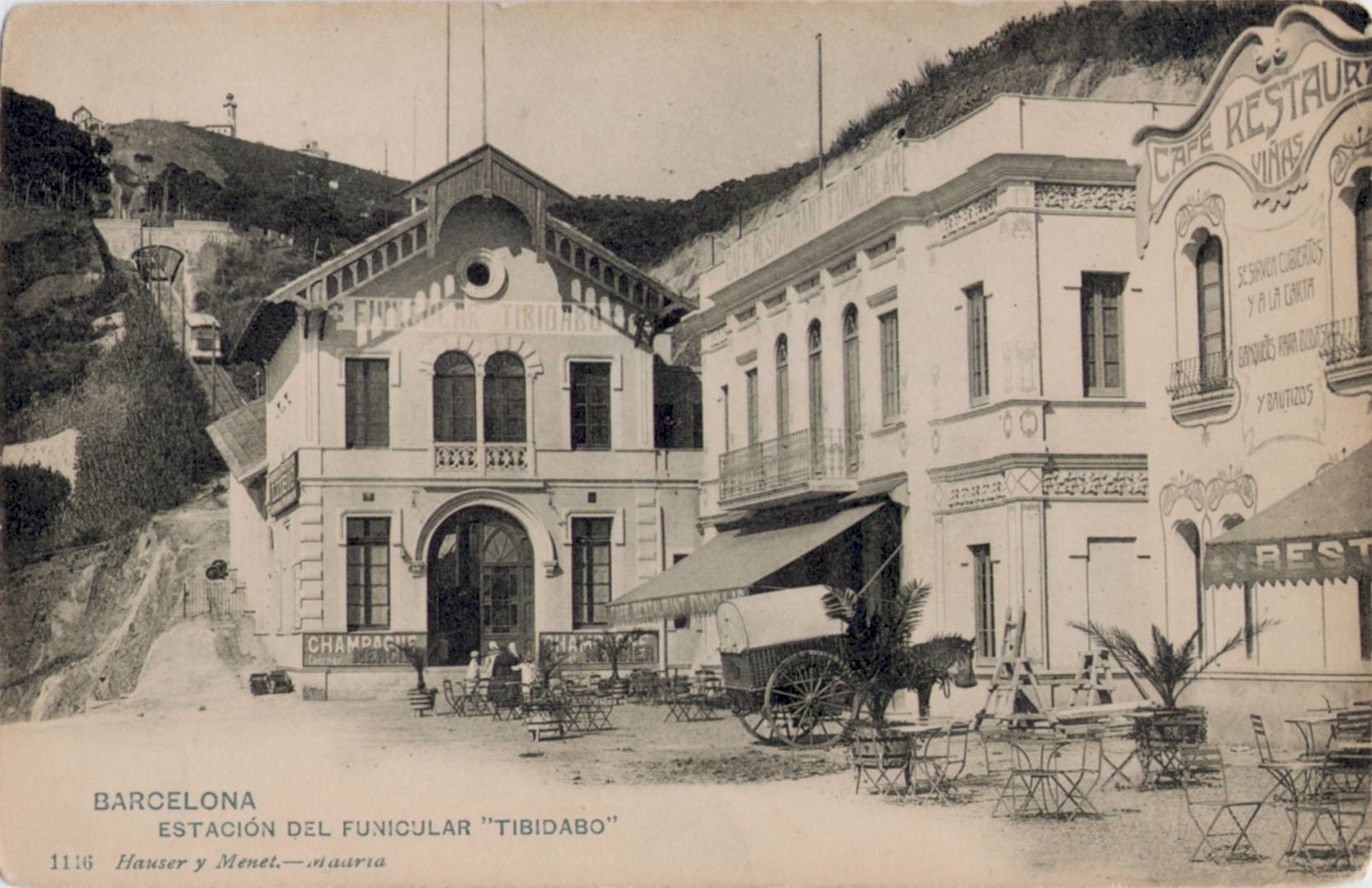
Tibidabo is a 500 meter hill overlooking Barcelona.  With the example of Sacré Coeur in Paris in mind and the encouragement of Pope Leo XIII, the Spanish Roman Catholic Church began construction of the Sagrat Cor (Sacred Heart) church on the summit of Mount Tibidabo in 1902. Three years later its supremacy was challenged by the impudent arrival of the Tibidabo Amusement Park which opened in 1905 (just in time for the global boom in postcard sales). An amusement park can be thrown up in a fraction of the time needed to build a cathedral and the Sagrat Cor was only completed in 1962. Since when the pair have represented the sacred and profane in a relationship of mutual reproach. The park and most of its original rides remain in operation supplemented by the regular introduction of new attractions.  Public access was via a new purpose built funicular railway that began running in 1901. Opposite the funicular station, a Moorish-styled hotel was built.  A superabundance of roller coasters and white knuckle rides suggests that the citizens of Catalunya possess an unusual appetite for dramatic demonstrations of gravitational force.  A suspended monorail (Laderas del Monte) conveys passengers in open capsules around the perimeter of the summit offering spectacular views of the city far below.  More gentle attractions - carousels, a puppet theatre and a Museum of Automata - are available but the emphasis is on vertigo-inducing contemplation of the void.  The postcard industry supplied a wide range of views of the park and recorded an exhaustive survey of the operation of the funicular railway from which this selection is drawn.




Thursday, 26 September 2019

Crystal Palace Dinosaurs


An unexpected pleasure in a South London park is to encounter these replica dinosaurs posing on their island enclosure. When Joseph Paxton’s Crystal Palace migrated from Hyde Park to Sydenham Hill, the area was greatly remodelled and the dinosaur display was one of many new ancillary attractions in what would become Crystal Palace Park. It was a great mid-Victorian project that rested on the popularity of palaeontology and the discovery of ever more exotic fossil records. At the same time it was conceived to meet the Victorian public appetite for bizarre attractions, making for a perfect combination of high mindedness and sensationalist entertainment.


The task of design and construction fell to Benjamin Waterhouse Hawkins. Drawings were produced in consultation with scientific experts and manufacture took place in Hawkins’s Sydenham workshop illustrated here. The figures were cast in concrete using moulds derived from original clay models. When complete they were installed on a string of three islands and following a celebratory dinner hosted by Hawkins in the interior of the Iguanadon, opened to the public in 1854. The public imagination was instantly captured and has remained so to the present day.


Conservation is a massive challenge and the most recent efforts in 2003 and 2016 brought much needed improvements. Since 2007 the site has been protected by a Grade I listing from Historic England. A community-led charitable trust (Friends of Crystal Palace Dinosaurs) has brought fresh energy to ensuring long term survival since its formation in 2013. Their latest project is the construction of a bridge which will enable guided visits much closer access (under supervision). It seems the funding is in place to achieve this in the near future.


Crystal palace iguanodon

The "Crystal Palace" from the Great Exhibition, installed at Wellcome V0013783