Showing posts with label newcastle. Show all posts

Wednesday, 26 November 2025

High Level Bridge over the Tyne

The ensemble of bridges old and new that cross the River Tyne between Newcastle and Gateshead offers an unusually varied assortment of types for the connoisseur of all things pontine. The best views of this can be seen from the High Level Bridge, a double decker construction where trains run over the top while road traffic and pedestrians share the lower deck. Victorian railway development reached a frenzied climax in the mid 19th. century and the origins of this bridge lie in the protracted conflicts between rival promoters in a saga too tedious to repeat here. When the dust settled, the chosen design was the work of Robert Stephenson (son of the famous railway pioneer, George Stephenson). Wrought iron construction and a bow-string structure were specified. Building began in 1847 and all was complete in time for Queen Victoria to perform the opening ceremony in September 1849. Walking over the bridge is an exhilarating experience - trains still pass overhead but road traffic is restricted to southbound buses and taxis, the views downstream are spectacular and the curiously deserted roadway encased in structural steel has an unsettling quality.  Historic England has the bridge listed at Grade 1.


Monday, 17 February 2025

Centurion Bar, Newcastle Station

I first glimpsed this extraordinary interior about 10 years ago from the doorway.  Within was the intimidating spectacle of a vast darkened room, echoing to the declamatory racket of a regiment of raucous drinkers, their attention fixed on a Premier League football game showing on an enormous plasma screen. On that occasion I went no further but promised to return at a more opportune moment.  Last August was my chance to revisit and we must thank the North Eastern Railway for this dazzling space - in 1892-93 the space was transformed by architect William Bell from a conventional waiting room into a beautiful ceramic clad First Class Refreshment Room. A Baroque styled decorative scheme was applied in faience supplied by Burmantofts of Leeds that not only covered the walls but extended upward to enclose the lantern ceiling surround. Browns, yellows and greens predominate. There was an interlude in the 1960s when the room was converted for British Transport Police use as holding cells for Geordie miscreants and it was only in 2000 that the stud walls came down to reveal the concealed ceramic splendour. When restoration was complete the only absent feature was the semicircular faience-clad bar that was lost at some point. It’s a reminder of how unusual it is in this country that the public are permitted to patronise such opulent premises without paying a premium for the privilege.


Sunday, 5 January 2025

Great Railway Stations No. 22, York

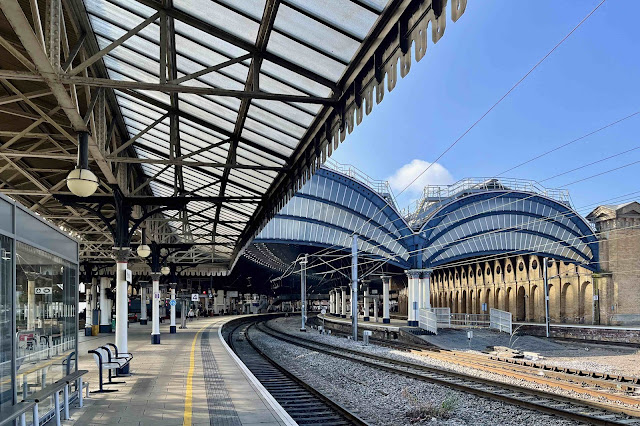
Many years ago Michael Palin pointed out the association between railway towns and footballing mediocrity. There are exceptions - Derby and more recently Brighton have played in the Premier League, but for York, Darlington, Crewe, Gateshead, Doncaster, Swindon, Eastleigh, Ashford and Horwich, success on the pitch has been hard to come by. Not to mention Newton Abbot, Melton Constable and Woodford Halse.  The railway arrived in York long before football was organised into leagues and the North Eastern Railway built a station of epic proportions, in the process demolishing significant portions of the old city walls in the casual manner that Victorians displayed toward ancient relics that got in the way of progress and profits.  York was well connected with both East Anglia, the Midlands and the industrial North West from its position on the main route linking London with Edinburgh and developed into a major railway town.

The station we see today dates mostly from 1877 and a modest exterior of no great merit is no guide to what lies within.  A curving track dictated 13 curving platforms and a triple span curving roof built to awesome proportions. Polychromed Corinthian capitals support the roof and tapering iron ribs, elegantly perforated to save weight.  Spandrels are decorated with the letters NER (for the North Eastern Railway) and the white rose of Yorkshire. The roof trusses make a glorious sight soaring overhead in repetition, especially when viewed from the station footbridge. On platform 4, to the right of the entrance is a repurposed signal box that contains a WHS shop and a café above. Bracketed to the roof structure over the steps to the footbridge is a massive clock with three faces.

The other great station built by the North Eastern Railway with a broad curving roof is Newcastle Central, completed in 1850 at which date it had 6 platforms. Following a series of expansions, by 1877 when York opened, Newcastle had 12 platforms (by 1892 there were 15). Interestingly though Newcastle is listed at Grade I by Historic England, York is listed at Grade II*. Newcastle has by far the best entrance (designed by John Dobson) and there is nothing at York to equal the extended sweep of the curving portico with its catering and retail services at Newcastle.  Despite the York Tap’s interior of restrained elegance, it’s easily upstaged by the scale and ceramic splendour of the Centurion Bar at Newcastle.  But having recently visited both stations on the same day, my impression is that a comparison of the train sheds alone favours York in terms of magnitude where the slender iron ribs almost deceive the eye into anticipating its imminent launch into the stratosphere. For a better written and more detailed comparison, I recommend this from the great Beauty of Transport blog.


Monday, 30 December 2024

Bridges of 2024

This year’s choice of bridges (mostly) crossed and photographed would be very modest but for a visit to Newcastle, which it must be admitted has some fine specimens. From west to east along the Tyne, our first is the High Level Bridge designed by Robert Stephenson (1845-49), with T E Harrison - the rail deck is supported by cast-iron box columns while the road deck is suspended from the rail deck by wrought-iron hangers encased in the box sections. Grade I listed by Historic England. Next is the Swing Bridge of 1868-76, designed and built by W G Armstrong & Co. - a wrought-iron structure supported on cast-iron rollers to allow free movement of shipping, operated by the original Armstrong-built hydraulic engines and controlled from the cupola that spans the deck. Listed by Historic England as a Scheduled Monument and last opened in November 2019. The New Tyne Bridge (1925-28) comes next, built by Dorman & Long of Middlesbrough and designed by Mott, Hay & Anderson - the profile of its single span is often employed as a symbol of the city.  The design is a reduced version of the 1916 design produced for the Sydney Harbour Bridge - the four massive pylons, faced in Cornish granite were intended to house warehouses with freight and passenger lifts, none of which came to pass.  Grade II* listed by Historic England.  Finally to the only bridge over the Tyne designated for pedestrian and cyclist use - the Gateshead Millennium Bridge (1995-2001) designed by Wilkinson Eyre. The deck is suspended from an elegant parabola that can be rotated through 45 degrees to permit the movement of passing ships - a major element in the riverside regeneration project as an artistic and cultural quarter that in turn led to the conjoined coinage of Newcastle-Gateshead.

Finally, two views of the Scarborough Cliff Bridge, a pedestrian footbridge opened in 1827 when it was known as the Spa Bridge, it's an unusual example of a multiple-span cast iron bridge. Connecting the town centre with the Spa, it originally operated as a toll bridge. In the view from the deck the imposing bulk of Cuthbert Brodrick's Grand Hotel looms over the scene. Grade II listed structure.


Monday, 21 October 2024

Central Arcade Newcastle

Even in a city well supplied with buildings of quality, the Central Arcade stands out for its sumptuous ceramic decoration. In plan, it links two sides of a triangular island building with a spur connecting to the third side (see diagram below).  The original building of 1840 was intended to serve as a Corn Exchange but before opening, it was remodelled as a conference hall with a coffee house and subscription newsroom included.  In its third iteration it was converted into a concert hall and art gallery in 1870. By 1897 it had become a vaudeville theatre which 4 years later was destroyed by fire. During rebuilding as shops and offices in 1906 the toffee coloured Central Arcade was cut through the centre to a design by J Oswald and Son. It is listed at Grade II* by Historic England.

Like the opulent, theatrical County Arcade in Leeds (1900) the faience decoration was supplied by Burmantofts of Leeds.  Renaissance motifs with rococo flourishes strike a more sober note on Tyneside than the exuberant floral swags and polychromed ironwork arches to be seen in Leeds. Central Arcade offers a café crème experience with a rich depth of colour in place of the dazzle of Leeds.  At each end, twin-arched entrances are topped by operatic ensembles of ornamental ceramics designed to impress. The shop fronts are restrained and close to the originals, there are no banners or intrusive signage to confront us with the vulgarity of commerce. Mostly specialist shops trade here as in many other arcades, less reliant on passing trade. Footfall is light despite the surrounding streets teeming with pedestrians - most who make there way under the arches are taking a short cut for the sake of protection from the elements and a time saving of about a single minute.  A more economically viable future for such places is difficult to imagine but for now at least the Central Arcade continues to delight the eye with its superb interior.

The immaculate condition of the arcade is a tribute to the owners and city planners who have enabled such sensitive conservation of an architectural treasure that despite a city centre location is unable to attract the prime retail that draws the Leeds public into the County Arcade in great numbers.  Perhaps it’s an act of contrition for permitting the demolition of one of the finest arcades in the country. This happened in the 1960s when the Royal Arcade of 1832 got in the way of an urban motorway project. There’s a low-res image that gives some impression of its magnificence below but what seems to have doomed it was the originally chosen location on the very edge of the city centre where it struggled from the start to attract custom.


Royal Arcade (1832 - 1963)


Monday, 28 February 2022

Great Railway Stations No. 20, Newcastle Central Station

Two abiding memories of this grand and impressive station.  First from a Saturday evening in 2015 when I wandered into the vastness of the Centurion Bar that occupies the former First Class Passenger Lounge.  The lavish ornamentation for which it is famous, including some spectacular Burmantofts faience, was lost in the gloom - every table was packed with voluble drinkers whose voices strained to be heard over the grossly amplified music that oscillated on the threshold of pain and stunned the senses.  In the 1960s the lounge was converted to provide the British Transport Police with a suite of prison cells for miscreants. Second is a childhood memory of stepping through the slick of blood that smeared the pavement and puddled on the cobbled street as it flowed from a nearby slaughterhouse in the vicinity of the station. The latter image is attached to my late 1950s recollections of time spent watching trains pass through on the East Coast mainline - an exciting procession of prestigious expresses and filthy freight trains dragging long lines of coal wagons destined for local furnaces and power stations.

The most striking feature of the station interior is the elegant curving form of three cast-iron barrel vaults each supported on slender columns - the eye is drawn to the central glazing sections and the formal repetitions enhance the sense of generous overhead space.  The platforms are spanned by a footbridge that inscribes a gentle arc across the tracks.  Platforms 7 and 8 were built to accommodate four tracks of which two remain in place, enhancing the sense of scale and space.  There’s an air of grandeur that reflects the ambition and confidence of the North Eastern Railway.  All these features were part of the station as originally completed in 1850 (a year before Paxton’s Crystal Palace) and have survived all subsequent rebuilding.  This was all the work of a versatile local architect, John Dobson, who also designed churches, chapels and cemeteries, shops, markets and arcades, and banks, gaols and country houses. The building is protected by a Grade 1 listing dating from 1954 and is one of only 10 examples to earn a 5 star rating from Simon Jenkins in his 2017 anthology, Britain’s 100 Best Railway Stations.