Showing posts with label leeds. Show all posts

Thursday, 10 February 2022

Postcard of the Day No. 107, County Arcade Leeds

This postcard view of the County Arcade in Leeds shows something of what was on sale in the first decade of the arcade’s existence (1900-1910) - there was a Jeweller, Hairdresser, Optician, Confectioner and seller of umbrellas. The opulent architecture is identical to what we see today. On my annual visit to Leeds I always pay my respects to the splendour of the County Arcade. Although the gleaming mahogany shopfronts stock little of interest to me, the sheer visual exuberance of Frank Matcham’s theatrical fantasy always captivates. The repetition of ornamental cast iron ribs decorated with brilliantly coloured Burmantofts faience, Sienna marble pilasters, balustraded balconies, stone ball finials, and wonderful gilded mosaic panels combine to delight the eye. The Victoria Quarter in Leeds has been valued and cherished as a priceless civic asset offering a sense of continuity with the Victorian heyday of a proud industrial city.  Click here to read a previous post from 2008 on this subject.


Monday, 6 July 2015

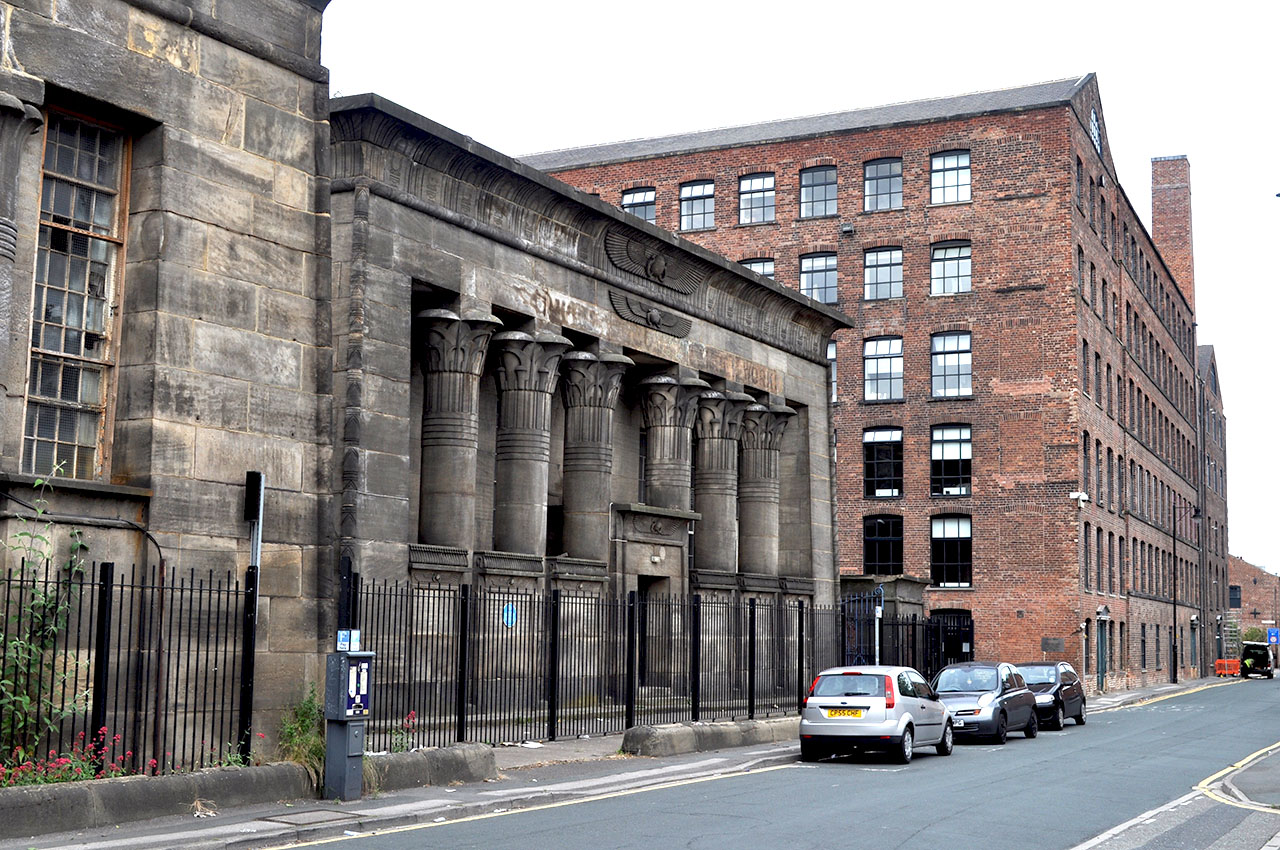
Temple Mills, Leeds


Temple Mills in Leeds is a precariously placed survivor of England’s brief love affair with all things Egyptian. When the John Marshall company planned the construction of a new flax mill adjacent to their existing premises (built between 1791 and 1831) it was decided to build in the fashionable Egyptian style to add prestige to the project. The services of the much travelled painter David Roberts were sought to advise on authenticity and the final design produced by Joseph Bonomi the Younger was based on the Temple of Horus at Edfu. The result was a muscular frontage with extraordinary presence behind which was a two acre factory floor, illuminated by circular sky-lights in a ceiling supported by slender columns. The roof was originally turfed over to supply grazing for a flock of sheep. To overcome the inability on the part of sheep to climb steps a hydraulic lift was installed. There’s no documentary record of the story that a sheep fell through a skylight fatally injuring a worker below but for whatever reason the grazing experiment was short lived. 


This is a serious minded effort to reproduce Egyptian architectural forms and very different from the playful polychromatic freestyle approach seen in the Egyptian House in Penzance or the Odd Fellows Hall in Devonport. The application of colour did come under consideration and Bonomi produced colour drawings but it seems to have been seen as a step too far. The client, Marshall wrote, “To an English eye the painting of the exterior walls appears a very bold step; I hardly know whether we shall screw up our courage to do that.” (Quoted from p.273 of Egypt in England, Chris Elliott, 2012) 


The building is in use as an occasional cultural event space but the overall condition is very poor. More than a third of the frontage is supported by scaffolding and shrouded in plastic sheeting and there are no signs of any work in progress. Only the office block can still be seen as originally built. Despite a Grade I listing for many years the mill has featured on lists of buildings at risk and as yet there appears to be no fully funded plan to restore the fabric of the building and find a viable future use.


Sunday, 24 January 2010

Postcard of the Day No. 34, Vanished Leeds


By the time it was completed in 1941, Quarry Hill Flats was the largest such development in England and was home to 3,280 citizens. The city planners had sought inspiration in the 1930s by visiting the Karl Marx Hof in Vienna and La Muette at Drancy (northeast of Paris, later infamous during the Occupation as the reception point for Jewish deportees en route for Auschwitz). The provision of communal laundries, kindergartens and a waste disposal system was not enough to overcome the traditional English antipathy to high-density living and the flats were demolished in 1978. A large office block occupied by the Department of Work & Pensions / Department of Health now stands on the site. This postcard includes two features that no longer exist in Britain. Local authority housing schemes and municipally owned and operated bus services are both a thing of the past. All these services have been transformed since they became the responsibility of private enterprise and the monopolistic uniformity of the corporation bus has been replaced by the monopolistic uniformity of Stagecoach, National Express and First Bus.

Friday, 7 November 2008

Corn Exchange, Leeds


On a recent visit to Leeds I had a wander around the city’s Corn Exchange (1860-62), a building designed by Cuthbert Brodrick and described as “of national, maybe international importance.” The design, like much of Brodrick’s work owes much to French precursors, in this case, the Halle au Blé in Paris built almost a hundred years earlier. Unusually for a domed building it has an oval footprint and the central oculus is elliptical. There is an additional asymmetric wedge shaped area of glazing that admits north light and can be seen in some of these photos. Order, symmetry and repetition of forms prevail in the interior space while the absence of internal structural support greatly enhances the exhilarating sense of scale.


After a protracted but thorough renovation, involving opening up the basement to create a third level, the Corn Exchange reopened in 1992 as an indoor shopping centre. Until recently it prospered, the retail units being let out, for the most part to independent traders. In November 2007 these traders were given notice to quit by new operators, Zurich Assurance. The displaced traders make a strong case in their blogspot. In the meantime, Zurich’s programme of refurbishment is almost complete as these photos confirm and they are pressing ahead with a scheme to transform the Corn Exchange into an up-market palace of food. Behind all this lurks a corporate imperative to maximise an investment by increasing rentals to the point where only high turnover, premium business can afford them. It’s an exercise in exclusivity, the objective being to provide goods and services that only those in the highest income groups can afford to buy. A landmark building of such grace and distinction should be accessible to all especially as the ownership still resides with Leeds City Council.