On the north side of Dresden Hauptbahnhof on Wiener Platz there’s an unexceptional low rise modern office block in which is embedded a tribute to one the city’s great lost landmark buildings - the Kugelhaus. Designed as a spherical building by Munich architect, Peter Birkenholz for the 1930 International Health Exhibition in Dresden’s Grossen Garten park. Inspired by the unbuilt visions of Claude-Nicolas Ledoux it was quickly adopted as an emblem of the city and hosted a series of exhibitions of technology and engineering. By the mid-1930s as the novelty faded, it fell out of favour. Maintenance was expensive and the recently ascendant Nazis took exception to it. When an operator could not be found it was demolished in 1938. It was Dresden’s misfortune that it fell under the control of an especially brutal Gauleiter, Martin Mutschmann. The preservation of traditional Saxon arts and crafts was Mutschmann’s obsession when he wasn’t occupied with matters of torture and execution, suggesting he was even less receptive to Modernism than the average Nazi. It remains the case that spherical buildings always come with problems and often have a short life. Had it been spared by the Nazi culture warriors, it would have been very unlikely to have survived the Allied firestorms of February 1945. There’s an additional tribute to the Kugelhaus in the form of a spherical cinema in the lobby of the Volkswagen Transparent Factory which now stands on the same spot.
Showing posts with label dresden. Show all posts
Friday, 7 October 2022
Friday, 27 December 2019
Bridges of 2019
This is the regular end-of-year pontine presentation of bridges seen through the camera lens in the last 12 months. With a single exception, all come from Chicago in June. Moveable bridges of various types are a Chicago speciality with at least 20 in the downtown area and as many as 43 across the city. There are double-decker road and rail bridges, lifting bridges and bascule bridges to be seen. Every major road running north or west of the Loop has to cross the Chicago River and their presence adds a vital element to the city’s spectacular cityscape. The exception is from Dresden in January - die Blaue Brücke that crosses the River Elbe connecting the affluent eastern suburbs of Blasewitz and Loschwitz. Also known as Loschwitzer Brücke, and der Blaues Wunder (or Blue Wonder), it’s a cantilever truss bridge and opened in 1893 after a two year build. In 1945 the efforts of the SS to destroy the bridge were thwarted when two civilians cut the wires connecting the detonator with the explosives.
Labels:
bridges,
chicago,
dresden,
swing bridge
Friday, 1 November 2019
Loschwitz Schwebebahn Dresden
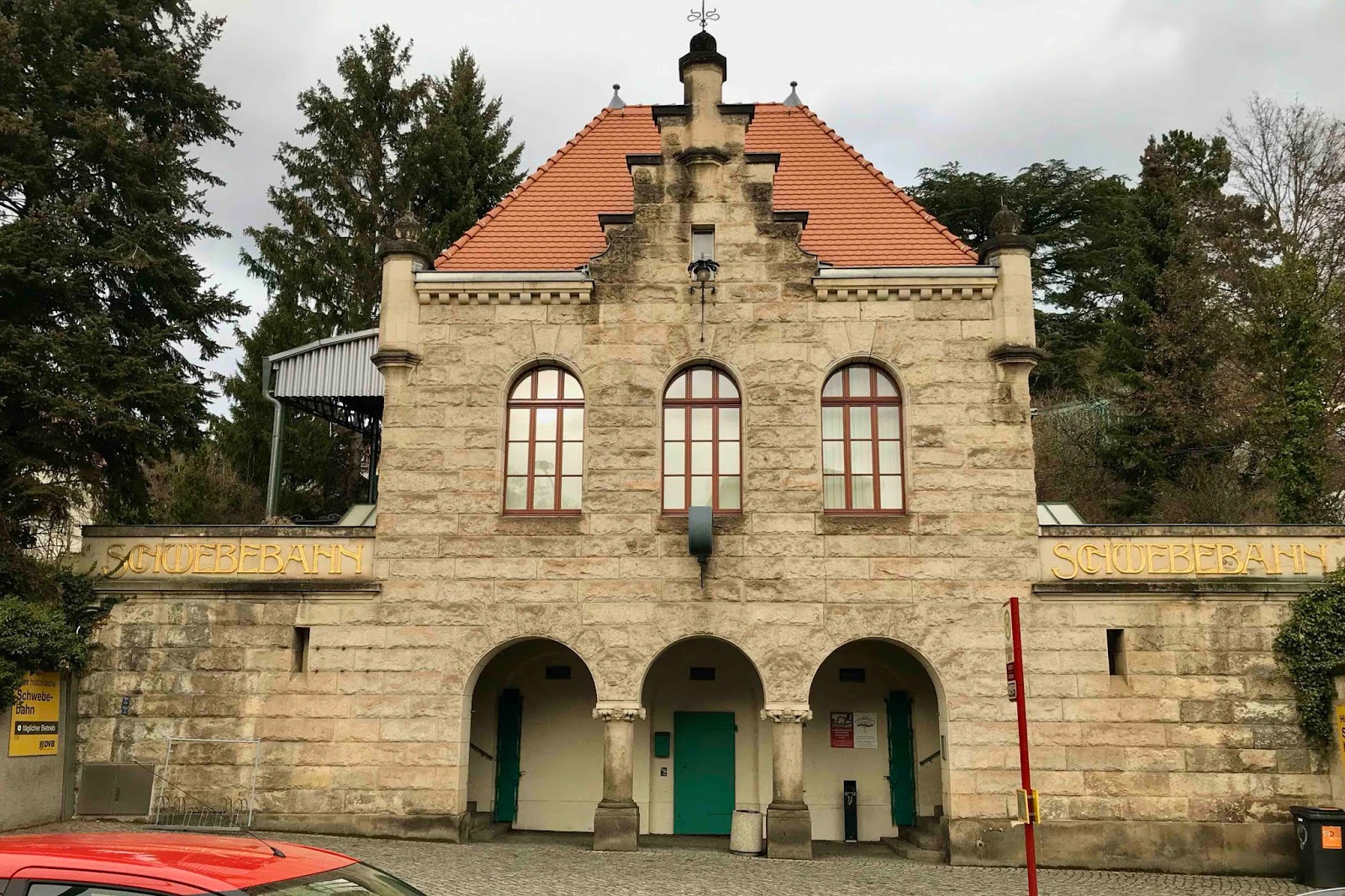
A three mile tram ride from Dresden city centre and a short walk across the river Elbe brings us to the Loschwitz Schwebebahn. Loschwitz is a comfortable, long established suburb untouched by the fire-bombing, built on the slopes leading down to the Elbe. The Schwebebahn is a suspended monorail built in 1901 that carries passengers to and from the heights of Oberloschwitz where the most grandiose of Dresden’s 19th. century suburban villas are to be found. Eugen Langen, designer of the much more extensive Wuppertal Schwebebahn was responsible for this cumbersome project with its complicated support structure - an orthodox funicular railway would have done the job at a lower cost. There’s a vaguely Jugendstil station building at the lower level on Pillnitzer Landstraße - built in rough finished stone, it has an arcaded entrance and a jaunty stepped gable. It suggests an intention to bring a sense of occasion to the Schwebebahn experience. At the summit is a tall tower built to house the winding engine but detailed as if it were a baronial fortress. Local residents use the Schwebebahn to reach the amenities at the foot of the slope and return, avoiding a breathless footslog up the fierce gradient. It makes for an incongruous sight as the two cabins slowly rise and descend over the sedate townscape with its network of twisting footpaths and narrow roads - especially strange when it inches forward across the public highway.
Those with an appetite for white knuckle rides can relive this thrilling descent in its entirety via this embedded video. Highlights include the ghostly reflections of the production team, one of whom grows increasingly restive at the imposition of a ban on conversation.
Labels:
dresden,
Germany,
loschwitz,
postcards,
schwebebahn,
suspended monorail,
transport
Wednesday, 30 January 2019
A Dresden Landmark – Yenidze Tabakfaktur
In February 1945, when the city of Dresden was bombed into oblivion by Bomber Command and the USAF in a firestorm of epic proportions, it might have seemed like the worst had happened. But Dresden was destined to be one of those unfortunate places where one kind of tyranny was immediately succeeded by another, in more than half a century of totalitarian governance. Victor Klemperer was a Professor of French Literature at the Technical University and a long time Jewish resident of Dresden when he began keeping a diary in 1933, the year the Nazis took power in Germany. In spare and unemotive prose, he described how he and his Aryan wife experienced the incremental but remorseless process of dispossession of property, basic human rights and legal status to the point where, as a Jew, he was forbidden to own a radio, a bicycle or a pet and compelled to travel on the open rear platform of the tram, while shopping for food was restricted to the hours of 18.00 to 19.00. Klemperer and his wife escaped their fate by simply walking out of the city, unobserved in the chaotic aftermath of the firestorm.
The painter, Otto Dix came to Dresden in 1910 to study at the city’s art college (Kustgewerbeschule) where he adopted an Expressionist style, until in 1914 he volunteered for military service. When he returned to Dresden in 1919, Dix was a traumatised veteran of the First World War, having fought in the Somme, the Eastern front and Flanders. Once again he studied painting and evolved a style of heightened realism. The award of an Iron Cross had done little to soften his hatred of the mindless cruelties of war that would preoccupy his work for many years. When his attention turned to the decadence and conflict of the Weimar years, he brought the same savagery and brutality to his portrayal of the social scene. In 1933, the new Nazi regime quickly identified him as a degenerate artist and dismissed him from his teaching post at the Dresden Academy.
Vladimir Putin was posted to Dresden in 1985 and remained there until the collapse of the DDR in 1989. His duties are a matter for speculation but it is likely they exceeded collecting press cuttings as his biographer (Masha Gessen) alleged. Last December his Stasi pass turned up in the Dresden state archive, confirming his closeness to the DDR security service. It can safely be assumed that the Dresden years supplied Putin with valuable experience in surveillance and intimidation, helping to form the master of misinformation and arms length aggression that graces the world stage today. The story goes that when the old order collapsed in 1989, an angry crowd turned up and demanded entry to the KGB office. The door was opened by Putin, who brandished a weapon and successfully dispersed the mob by threatening to shoot to kill. Perhaps it was in the afterglow of this event that Putin felt the first flicker of a sense of destiny that he was born for higher things.
Which brings us to Dresden’s most bizarre landmark building. Approaching the city by train it appears as an exotic Orientalist apparition on the right hand side, shortly after crossing the river Elbe on the Marienbrücke. A 5 storey building with an elaborately decorated parapet, surmounted by a Moorish glazed dome, alongside is a minaret, comfortably taller than the height of the dome. The minaret was built as a factory chimney and the main building was given over to cigarette manufacture. Hugo Zietz had been the proprietor of a business producing Turkish cigarettes sold under such names as Salem Aleikum and Mameluk, since 1886. Zietz saw the commercial potential of building a factory inside the envelope of an Orientalist fantasy building and commissioned architect Hermann Martin Hammitzsch (1878-1945) to produce a design. Hammitzsch reached for his Islamic reference books, threw in a few Gothic details and came up with the amazing Orientalist pastiche we still see today. The finished building opened in 1909 and was recognised as a classic example of architecture as advertising - high visibility and a permanent reminder of the exotic origins of the product. One third of the building was destroyed in the war but after patching up by the German Democratic Republic (DDR) it remained in use until 1989 as the central tobacco office of the DDR, (the “VEB Tabakkontor”). Full restoration to its present condition took place in 1996. Since when it has been mostly used as office accommodation, with a restaurant on the 7th. floor.
It turned out to be the only building of note that Hammitzsch would design. Indeed, there are no records online of any other building that could be attributed to him with any certainty. We do know that in later life he married Hitler's sister, Angela. On the basis of this connection that he was appointed in 1939 by the egregious Gauleiter of Saxony (Martin Mutchsmann, master embroiderer and underwear manufacturer) to direct a programme for the modernisation of Dresden along Nazi-approved lines. It was in this capacity that, after the burning of Germany’s largest Synagogue (originally designed by Gottfried Semper) on Kristallnacht, Hammitzsch ordered that the smouldering ruins be demolished and cleared. A rare incidence of the Nazis taking action without first obtaining the legal agreement of their victims. And a depressing display of architectural vandalism directed by a mediocrity against the work of an immeasurably superior colleague. History doesn’t record how Hammitzsch survived the post-war reckoning - he simply faded into obscurity, having irredeemably stained his reputation in the eyes of posterity. In recent years Dresden has acquired some notoriety as the birthplace of the anti-Islamic Pegida movement. They still gather in the city centre for some casual racism every Monday night despite having been overtaken by other hard-right parties (AFD) who forced their way into the Bundestag in last autumn’s elections.
Wednesday, 23 January 2019
Transparent Factory, Dresden
Dresden's Transparent Factory (Die Gläserne Manufaktur) was built in 2002 for Volkswagen to a design by Gunter Henn, just less than a mile from the city centre in a corner of the Großer Garten at Straßburger Platz. Not strictly a factory, more of an assembly plant. No foundry, no metal bashing, no casting or forging. All the heavy work takes place 80 miles away in the city of Zwickau where VW inherited the former Trabant factory after the demise of the DDR. Vehicle components and chassis are shipped to a logistics centre in Dresden and onwards by a 150 ton CarGoTram that runs on the city’s tram network.
The principle assembly building extends along Stübelallee where a handful of workers, clad in white lab-coats, can be observed supervising the automated production line. For several years the VW Phaeton was “hand-built” on the premises but since 2017 production has moved to the e-Golf, VW’s first all electric vehicle. Rather than being conceived to take advantage of economies of scale, this factory seems like a vanity project, intended to generate publicity through high visibility and to function as a statement of faith in the commercial potential of the old DDR territory. A Visitor Centre and a Restaurant are provided to attract the curious to step inside. The great glass rotunda where finished vehicles are temporarily stacked certainly succeeds as a spectacle and the operation offers a brightly lit window into the workings of the motor industry. But the extent to which it’s profitable is for others to calculate.
Subscribe to:
Posts (Atom)