Showing posts with label planned community. Show all posts

Tuesday, 16 May 2023

East Tilbury, the Bata Legacy in Essex

A trip to Essex is a rare event so we took the opportunity to take a c2c (owned by Trenitalia) train from Barking to East Tilbury where Bata shoemakers established factories and an industrial village in the 1930s. Public awareness of Modernism in 1930s England was minimal and in the Essex village of East Tilbury even less.  It must have been a shock to the villagers when Modernism landed on their doorsteps in 1932 as they watched towers of welded steel and reinforced concrete rising out of the potato fields of the former marshland.  This marked another stage in the global advance of the Bata Shoe Company founded by Tomas Bata in 1894 in the town of Zlin, Czechoslovakia.  A visit to the Ford factory in Detroit had inspired Bata to adapt the latest production line technology to the manufacture of footwear and the company had expanded rapidly across Europe and beyond.  Bata was attracted to the social ideals and paternalism of the Garden City movement but his aesthetic preference was for Modernism rather than Arts and Crafts or Tudor revivalism.  

Czechoslovakia was much more receptive to Modernism than Britain and a company team of Czech architects led the project. Planning and design principles that had been established in Zlin were applied in East Tilbury and included material specifications and the use of reinforced concrete frames. As originally planned there would have been 3 ten-storey factory blocks plus a rail connection to what was then part of the LMS railway with sidings for loading and unloading. These were scaled down to five-storey blocks and the rail connection never materialised. When the factory opened in 1933 in the Depression, locals welcomed the employment prospects although their eyes must have been startled by the Modernist geometry and the acreage of glazing in the brand new, multi-storey factory buildings.  New housing for workers (a significant number of whom were Czech) and their families along with a clinic, sports ground and village hall were provided and despite the challenge of inducing the English to live under flat roofs, this concern for their welfare was fondly remembered by former employees.  Manufacturing in East Tilbury petered out in 2006 by which time the factory buildings had already been disposed of to an uncertain future. The Bata Company is still in business and based in Switzerland. Its products are sold in many countries from East Asia to Latin America, Europe, Africa to Australia but UK is not one of them. 
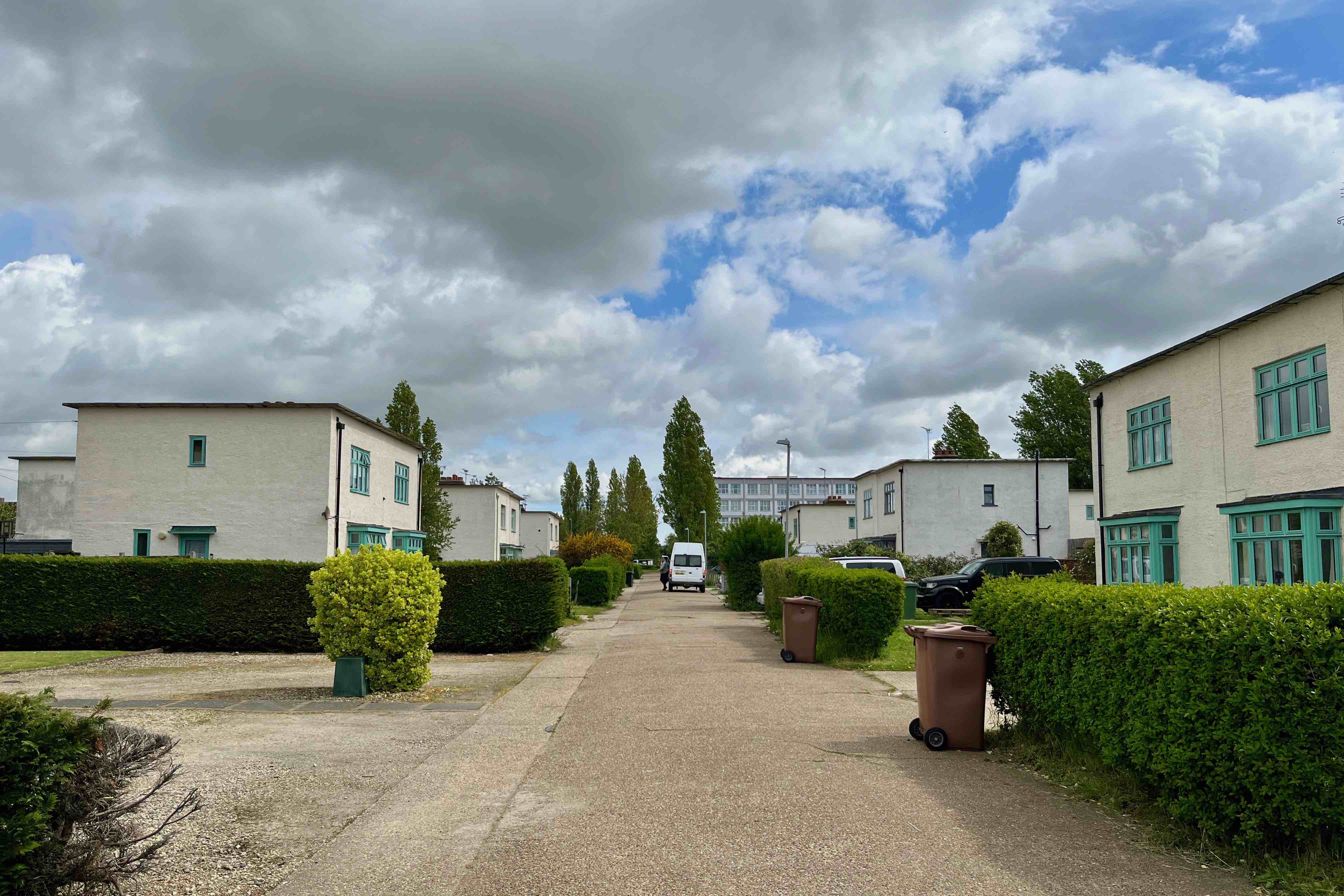
At the peak in the 1950s there were 3000 employees at East Tilbury and over 200 Bata shops on Britain’s high streets but the business was not immune to Britain’s industrial decline and in the 1960s production began moving overseas, mainly to developing countries. The design influence of the Czech parent had gradually faded away and the worker housing  became entirely conventional - semi-detached with pitched roofs. The last company housing was completed in 1966 and in the 1980s the houses were sold off to private buyers in the spirit of the time.  The process of adjustment has been difficult.  Converting the major buildings for new uses has been expensive and attracting investment has been hard but most of the factory premises have found new tenants over the years and the only major building still in need of renovation is Nelson House (the former leather factory) on top of which sits a water tank, lettered on all four sides with the Bata logo, easily visible to railway passengers almost a mile away.

In 1939 Bata completed a new 16-storey HQ in its Czech hometown of Zlin that included a top floor office for the Chief Executive, Jan Bata, designed as a giant lift capable of descending to ground level at the stately pace of 75 cm per minute. The Nazi annexation of the Sudetenland in 1938 and occupation of Czechoslovakia stopped the project in its tracks and despite Jan Bata’s personal appeals to the Nazi overlords, the factory was closed.  The Bata diaspora gathered pace and new businesses were opened in the US and Canada and production expanded in India and Singapore.  When Bata refocused  on emerging economies it withdrew from most European operations leaving an architectural legacy of design excellence that became a serious problem for planners in Bataville in France and Batadorp in the Netherlands (as well as in East Tilbury) as they grappled with the challenge of adapting the buildings without compromising the features that made them worthy of preservation. There are two further sources of detailed commentary on Bata, the first is a Historic Area Appraisal of East Tilbury carried out for English Heritage in 2007 and the second is a wider historic survey of Bata’s global presence from the magazine Azure.


Friday, 14 February 2020

Off the Shelf - Villages of Vision, Gillian Darley


There are three editions of Villages of Vision on the shelf, including the hardback version from 1975. But this paperback from Paladin Books, issued in 1978, is my personal favourite. It came with a superb cover illustration by much under-rated artist/illustrator, Tony Meeuwissen, of meticulously painted vignettes of vernacular detail presented as if they were Victorian scrapbook stickers, seeming as fresh and inventive today as it did more than 40 years ago. The intersecting themes of this book embrace social history, industrial architecture, garden cities, capitalist paternalism, rural life, utopianism, philanthropy, political activism and noblesse oblige as the writer explores the subject of planned settlements and communities in the British Isles. It tells a story of good intentions, unfulfilled ambitions, broken dreams and social experimentation that extends into every corner of the country. A cast of mill-owners, Quaker businessmen, charlatans, utopians, idealists, and social reformers march across the pages. The Gazeteer has been an essential guide and companion on many a journey leading to such destinations as Saltaire and Port Sunlight, Bedford Park and Akroydon, Blaise Hamlet and Tremadog, and Edensor and Letchworth. Some of these trips have inspired posts on this blog, including Bedford Park, Blaise Hamlet, Saltaire, and Port Sunlight. The author is writer and broadcaster, Gillian Darley, whose 2003 book Factory has been equally inspirational. For the last 6 years Gillian Darley has been President of The Twentieth Century Society.

Sunday, 3 September 2017

Margaretenhöhe - refuge from dystopia


Essen is the heartland of the industrial Ruhr. For 400 years it was the centre of the Krupp dynasty with its massive iron and steel producing plants, coalmines and manufacturing from armaments to locomotives. In 1887 control of the business passed to Friedrich Alfred Krupp (known to all as Fritz) who profitably refocused the company on arms production, including warships and U-boats. Leaving behind his wife, Margarethe and his two daughters he would spend several months each year in his villa on the island of Capri. There he would indulge his passions for oceanography and the company of Italian adolescent males. Following his arrest by Italian police for immoral conduct in October 1902 he returned to Germany to be utterly overwhelmed by public scandal as the news filtered back to his homeland. Meanwhile Margarethe, having received anonymous evidence of Fritz’s proclivities, appealed to the Kaiser, a close family friend for assistance in protecting the reputation of the company. Her reward was to be declared insane and confined to an institution on the orders of the Kaiser. Despite the support of the Kaiser, prosecution seemed inevitable and it was Fritz’s sudden death in November that brought matters to a conclusion. There is no agreement on whether he died by his own hand or from natural causes but Margarethe was returned to the family home and managed the business on behalf of her daughter (who inherited the controlling shares from her father) until she came of age in 1906.


After all this turbulence, Margarethe Krupp chose to embark on a personal philanthropic project in 1906 to establish Germany’s first Garden City in the southern suburbs of Essen. She donated the land plus a major sum for construction costs and established a foundation (Stiftung von Margarethe Krupp) to build and administer the new settlement. Guided by the principles of Ebenezer Howard, the first homes were occupied in 1910 and the project proceeded in phases under the supervision of architect, Georg Metzendorf (1874-1934) until completion in 1938. Until 1933 there was a small artists’ colony, prominent among them being the photographer Albert Renger-Patzsch, associated with Die Neue Sachlichkeit movement. Renger-Patzsch specialised in cool dispassionate recording of industrial landscapes and photographs of still-life and the natural world in which he expressed a strong preference for serial imagery.


Allied bombing destroyed many of the buildings in World War 2 – by 1945 less than half of homes were habitable. After a long rehabilitation it was meticulously restored to its original character by 1955. Protected status as an architectural monument was obtained in 1987. The Foundation continues to manage and allocate the letting of houses and apartments. Applications are considered in reference to the Foundation criteria and many are unsuccessful. The Foundation also takes a close interest in protecting the building fabric from unauthorised additions or modifications – tenants wishing to relay a tiled or parquet floor must have their plans approved, special permission is required for dogs or cats and gardens must be maintained to an agreed standard and formula. Satellite dishes are forbidden.


Surrounded by woodland and entered via an archway in the sprawling gateway complex (seen in the vintage postcard above) gives a sense of enclosure and separation from the clamour of the world outside. This quality must have been much more apparent in the days when Essen was an industrial metropolis with 291 collieries and thousands of chimneys and cooling towers venting dark, toxic fumes into the atmosphere. Since the 1990s and the advent of globalisation, Essen has massively de-industrialised while the relics of heavy industry have been transformed into heritage attractions and public amenities. In this context, while the Margaretenhöhe has lost none of its foliage-sheltered charm, it is no longer such a precious refuge from industrial dystopia. The architecture has echoes of Arts & Crafts and German vernacular traditions in its proliferation of quirky features and contrasting rooflines designed to refute any accusation of dull uniformity. Streets were expressly kinked to compose a scene that constantly changes and intersections offset to offer the greatest variety of views. Generous tree planting and amenity space, a central square for markets and community events, a hotel and retail premises and places of worship complete the picture.


Monday, 26 April 2010

Noisiel Insolite

Only 40 minutes from central Paris on RER A brings us to the small town of Noisiel. The station is positioned at the centre of a new (post-1970) community of apartment blocks and shopping centres. The streets and apartments have been named after notable philosophers and a mischievous municipal bureaucrat has arranged for the Catholic church to be blessed with an address in Allée Jean-Paul Sartre. It’s a 20 minute walk via the Parc de Noisiel to the bank of the River Marne and the assorted buildings of the Usine Menier dedicated to the manufacture of what was once France’s leading brand, Chocolat Menier.

In the 19th. century a channel was diverted from the river to supply the factory with water power and a turbine mill designed by the company architect, Jules Saulnier (1817-1881) was constructed in 1871. It was the first significant building to be supported by a steel box girder construction with an external skin of brick and ceramic infill. Three large turbines were powered by the river and supplied electricity to the entire site. It’s a magnificent building to be treasured for its audacious engineering and the polychrome splendour of the surface treatment. Manufacturing ended in 1993 and in 1997 the Menier site was renovated and converted into office accommodation as the corporate HQ of Nestlé France. The restoration work on the Saulnier building was especially detailed due to its status as a Monument Historique.


Another building of interest is located between the channel and the riverbank. This reinforced concrete structure dates from 1906-1908 and was known as la Cathédrale. The intention was to create a public showcase for the chocolate manufacturing process in the double height internal spaces. The project engineer was Armand Considere. There is a covered bridge to connect the building with its neighbour across the water.


There is no public access to the site and the only way to get a closer look is to join one of the guided tours that are offered every few months. A public footpath follows the perimeter fencing but views across the site have been obscured, deliberately or otherwise, by planting. The photo below of the Saulnier mill from the riverside was taken by my son and guide whose height and agility is greatly superior to mine. The interpretation boards seem a little redundant in the absence of decent sightlines.


The association of chocolate and philanthropy crosses national boundaries and the Menier family built a small community opposite the factory between 1874 and 1911 to house the workforce known as the Citè Menier. Some 300 dwellings were provided together with public buildings. All have survived in good condition and remain occupied.