Showing posts with label paris postcards. Show all posts

Wednesday, 10 November 2021

Postcard of the Day No. 105, Paris - Halles Centrales

Few districts of Vieux Paris have been so frequently romanticised as Les Halles, the city’s produce market that was unceremoniously demolished in 1971 and relocated to the suburbs at Rungis.  For more than a century the market was housed in a series of twelve interconnected glass and cast iron pavilions (designed by Victor Baltard) but in the era of the vainglorious Georges Pompidou these masterpieces from the age of cast iron architecture were all too easily swept aside in favour of a meretricious and soulless shopping centre that was so unloved that it had to be replaced in less than three decades.  The exuberant vitality that had inspired Emile Zola to write “Le Ventre de Paris” (1873) was lost forever. A significant working class population would be relocated and never again would the neighbouring streets resound with the noise of thousands of heavily laden trucks, trolleys and trailers battling for space - one of the great urban spectacles would be totally erased.  These were unnerving times for Parisians who sought to defend their city from the intrusion of grossly inflated modern development. To the south the 56 floors of the Tour Montparnasse were already rising out of the ground and in the west the high-rise blocks at La Défense were taking shape.  A vocal campaign to preserve the Baltard pavilions sadly failed thanks to the prevailing infatuation with ostentatious modernism on the part of the ruling Gaullist politicians.  Minor concessions were made in the form of enhanced outdoor public space (now the rather dispiriting Jardin Nelson-Mandela) but the scheme progressed largely unamended. The black and white photographs were taken on a trip to Paris in 1974 when it seemed there would be no end to the excavation that had followed the ignoble demolition of Les Halles - it would be another 5 years before this vast hole in the landscape would be filled up with a grandiose interchange between the Métro and the RER and a depressing subterranean retail concrete box.


Thursday, 29 April 2021

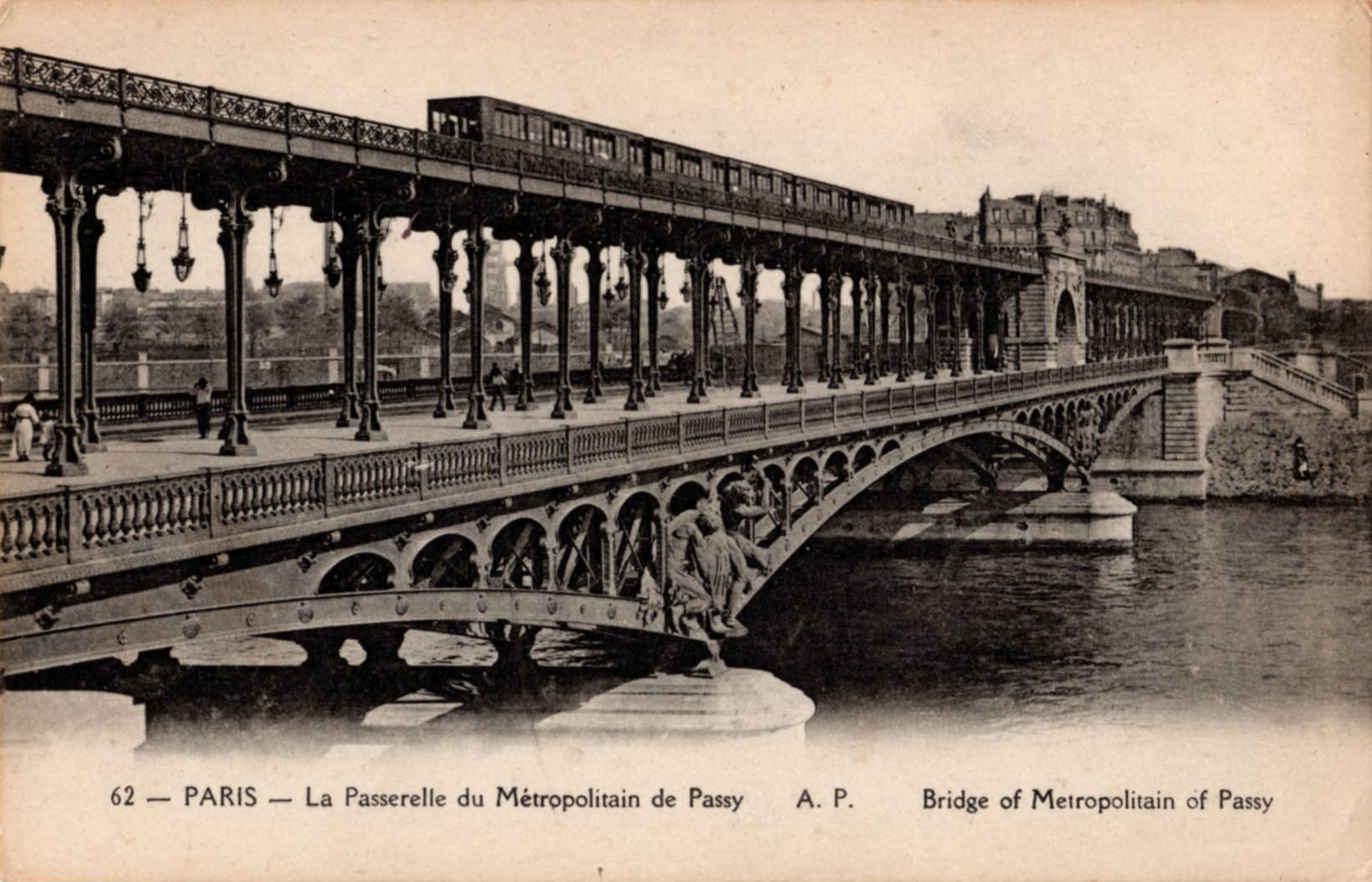
Bridges of Paris: 2 Pont de Bir-Hakeim

Pont de Bir-Hakeim links the Parisian districts of Passy (16th.) and Grenelle (15th.) and carries Métro line 6 over the Seine on one of two such crossings on its circuitous arc from Charles De Gaulle - Étoile in the west to Nation in the east. Approaching the Passy Métro station on rue de l’Alboni ends in a deep visual dive over the river Seine as if poised at the top of a ski slope.  From the railings at the end of the street the view takes in the platforms and canopies of Passy station and the ribbons of steel rail leading to the next station and beyond, deep into the 15th. arrondissement. Less obvious are the bridge abutments that mark the passage over the Seine which is the reason for this spectacular view opening up. 

The bridge itself is a two tier viaduct for road and rail (Métro) - in the centre of the roadway a pedestrian walkway and cycle route runs underneath the rail bridge.  The railway runs on a concrete deck supported by tall slender steel columns, each formed from four plate sections that taper and flare to make them easier on the eye. There’s more beautification in the form of Classical reliefs representing Electricity and Commerce on the stone built central arch. Additional sculptures grace the steel substructure where it rests on the stone pier of the Île aux Cygnes.  The bridge designer was Jean-Camille Formigé whose work can be seen all over the city on Métro infrastructure and the Viaduc d’Austerlitz. When the bridge was completed in 1905 it was known as the Viaduc de Passy – in 1948 it was renamed in honour of the Free French military victory at Bir-Hakeim in 1942.

The colonnade is a popular location for fashion photo-shoots and the bridge has made many appearances on screen, most notably in Zazie dans le Métro and Last Tango in Paris. The photos conclude with images of the elevated platforms at Métro Bir-Hakeim (formerly Quai de Grenelle).


Thursday, 17 September 2020

Parisian Sightlines - Boulevard de Bonne-Nouvelle

This tall and slender Parisian corner building is wedged into the space between rue de Cléry and rue de la Lune at the junction with Boulevard de Bonne-Nouvelle.  The photo was taken from the corner of rue du Faubourg Saint-Denis on the opposite side of the boulevard.  The lower floors of the corner building are visible in the vintage postcard view below - based on a photo taken from the same location at a slightly different angle.  The streetscape is little altered in over a hundred years although the proliferation of advertising (LU Biscuits being the most prominent) and signage has been much reduced.  The second photo was taken from rue de Cléry and offers a sidelong glimpse of the triumphal Porte de Saint-Denis hemmed in by surrounding building - it’s a great example of the visual pleasures to be found when exploring side streets of modest distinction but possessed of wonderful sightlines. The last two postcards reproduce the scene from the corner of rue de la Lune where the view of Porte Saint-Denis is uninterrupted.  Two decades separates the postcards, the monochrome example being the earlier.  Brioche de la Lune continued to be available from the Patisserie du Soleil but these formerly elegant premises today stand boarded up and empty.


Tuesday, 6 November 2018

Postcard of the Day No. 93 – Panorama du Carrefour du Châtelet


Gridlock by the banks of the Seine, conflicting traffic flows observed from above. Horse drawn vehicles and open-top limousines compete for road space while Parisians circulate at will, oblivious to the confusion. Seen from on high, interlocked vehicles form a pleasing abstract composition but there’s little of the extreme visual drama that Soviet photographer, Rodchenko obtained from his vertiginous photos of Moscow trams. Meanwhile in Chicago, below, we have another spectacular vision of traffic mayhem – overloaded trucks and columns of streetcars jostle for position. Mounted police officers observe but don’t intervene – pedestrians cluster on the street corners, few are brave enough to take their chances in the traffic.


Thursday, 20 July 2017

Paris with Chocolat-Menier


A postcard trip around Paris with Chocolat-Menier, France’s best known chocolate brand. There’s a Menier-related feature smuggled into every example of these promotional items. It might be a poster, a delivery vehicle, an illuminated sign or a Morris column. The views are usually conventional tourist hotspots with an occasional diversion to lesser attractions such as the cattle market at La Villette or Place Daumesnil. They are hand-painted in a casual brushy style with a taste for dramatic weather effects and night skies. Over a hundred were issued in the series which expanded to include les Environs de Paris. For a description of a visit to the Usine Menier at Noisiel, please follow this link.


Tuesday, 11 August 2015

Postcard of the Day No. 76 – Métro Station Sèvres-Lecourbe


A return to the Paris Métro for today’s postcard. A Métro employee stands at the platform end observing an approaching train sweeping round the curve of the viaduct. The caption tells us that the train is on Ligne 2 Sud which enables us to date the card between April 1906 and October 1907 (after which it was designated Ligne 5). Later still it became Line 6. The sharp-eyed viewer may recall this card made an earlier appearance in a previous post about Line 6. The excuse for showing it again is this brief video clip that I recorded last year and has remained undisturbed and unseen on a mislaid HD card until its recent reappearance. Now available for the first time it turns out to have been filmed at the same station – Sèvres-Lecourbe. Fractionally over 1 minute in length, every second is time well spent. One of the highlights is that most evocative of Parisian sounds – the warning note of a Métro door closure. 

Tuesday, 31 March 2015

Paris Métro Line 6


Métro Line 6 starts and finishes north of the Seine but for most of its length loops through the outer southern arrondissements flying high above the boulevards with intermittent subterranean descents. From east to west it begins underground at L’Etoile, emerging into the daylight at Passy before launching itself across the river on the Pont Bir-Hakeim. It follows a green corridor on a viaduct through the 15th. and 14th. until descending to tunnel beneath the Montparnasse district after which a second elevated section extends to Place d’Italie where it dips below ground again. Another rooftop glide leads via Quai de la Gare, recrossing the river at Pont de Bercy whence the line runs underground to Nation with only a brief burst of daylight at Bel-Air. 

Westbound train entering Bir Hakeim station

Line 6 as seen from the top of Tour Montparnasse


Aerial view of Sèvres Lecourbe station


Platforms at Quai de la Gare

Bel-Air where the train briefly surfaces