Showing posts with label métro parisien. Show all posts

Thursday, 29 April 2021

Bridges of Paris: 2 Pont de Bir-Hakeim

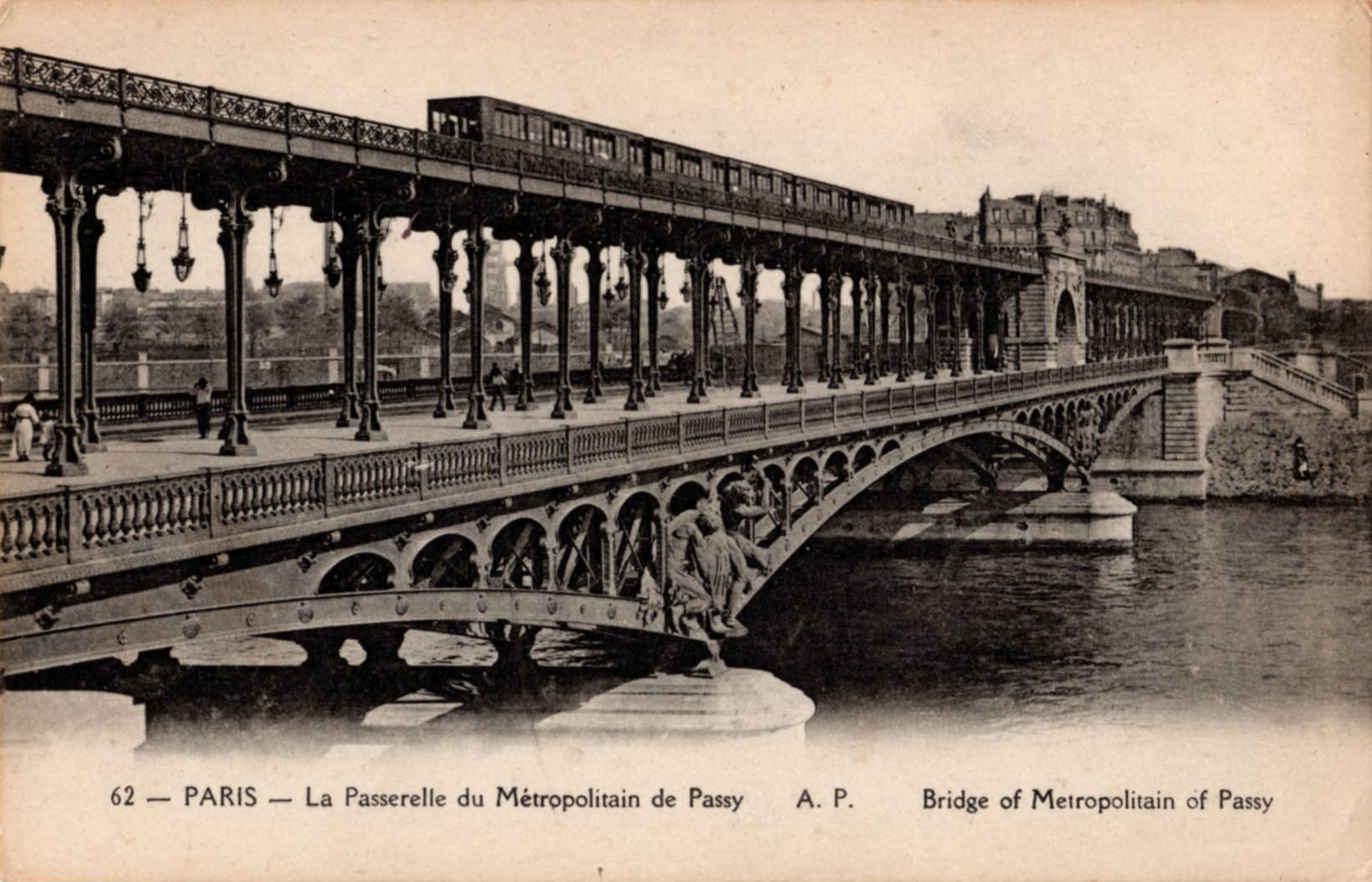
Pont de Bir-Hakeim links the Parisian districts of Passy (16th.) and Grenelle (15th.) and carries Métro line 6 over the Seine on one of two such crossings on its circuitous arc from Charles De Gaulle - Étoile in the west to Nation in the east. Approaching the Passy Métro station on rue de l’Alboni ends in a deep visual dive over the river Seine as if poised at the top of a ski slope.  From the railings at the end of the street the view takes in the platforms and canopies of Passy station and the ribbons of steel rail leading to the next station and beyond, deep into the 15th. arrondissement. Less obvious are the bridge abutments that mark the passage over the Seine which is the reason for this spectacular view opening up. 

The bridge itself is a two tier viaduct for road and rail (Métro) - in the centre of the roadway a pedestrian walkway and cycle route runs underneath the rail bridge.  The railway runs on a concrete deck supported by tall slender steel columns, each formed from four plate sections that taper and flare to make them easier on the eye. There’s more beautification in the form of Classical reliefs representing Electricity and Commerce on the stone built central arch. Additional sculptures grace the steel substructure where it rests on the stone pier of the Île aux Cygnes.  The bridge designer was Jean-Camille Formigé whose work can be seen all over the city on Métro infrastructure and the Viaduc d’Austerlitz. When the bridge was completed in 1905 it was known as the Viaduc de Passy – in 1948 it was renamed in honour of the Free French military victory at Bir-Hakeim in 1942.

The colonnade is a popular location for fashion photo-shoots and the bridge has made many appearances on screen, most notably in Zazie dans le Métro and Last Tango in Paris. The photos conclude with images of the elevated platforms at Métro Bir-Hakeim (formerly Quai de Grenelle).




Tuesday, 23 February 2021

Paris Métro 1931

Every decade in the first half of the 20th. century one or other of Europe’s colonial powers would mount an exhibition to celebrate and legitimise their imperial dominions and plunder.  The principle audience was a domestic one but it also offered an opportunity to remind rival powers of France’s global reach.  Years of planning and a purpose built exhibition building was essential to do justice to the scale of the colonial project and L’Exposition Coloniale opened in May 1931. A subsidiary aim of the exhibition was to portray the French colonial presence as enlightened and benign as if colonial subjects were almost equal partners in a global French nation.  We may look back and see a shaming exercise in imperial condescension and national self-aggrandisement but that’s not how the French public would have seen it.  For them it was a powerful reminder of France’s high standing as an international player.  Reinforcing patriotic values at a time when a gathering economic crisis was threatening the stability of a nation rapidly fracturing into political extremes of Right and Left.  Outdoor exhibits were displayed in the Bois de Vincennes and a more scholarly presentation of indigenous arts and crafts was housed in the newly constructed Palais de la Porte Dorée, about which we posted in February 2015.


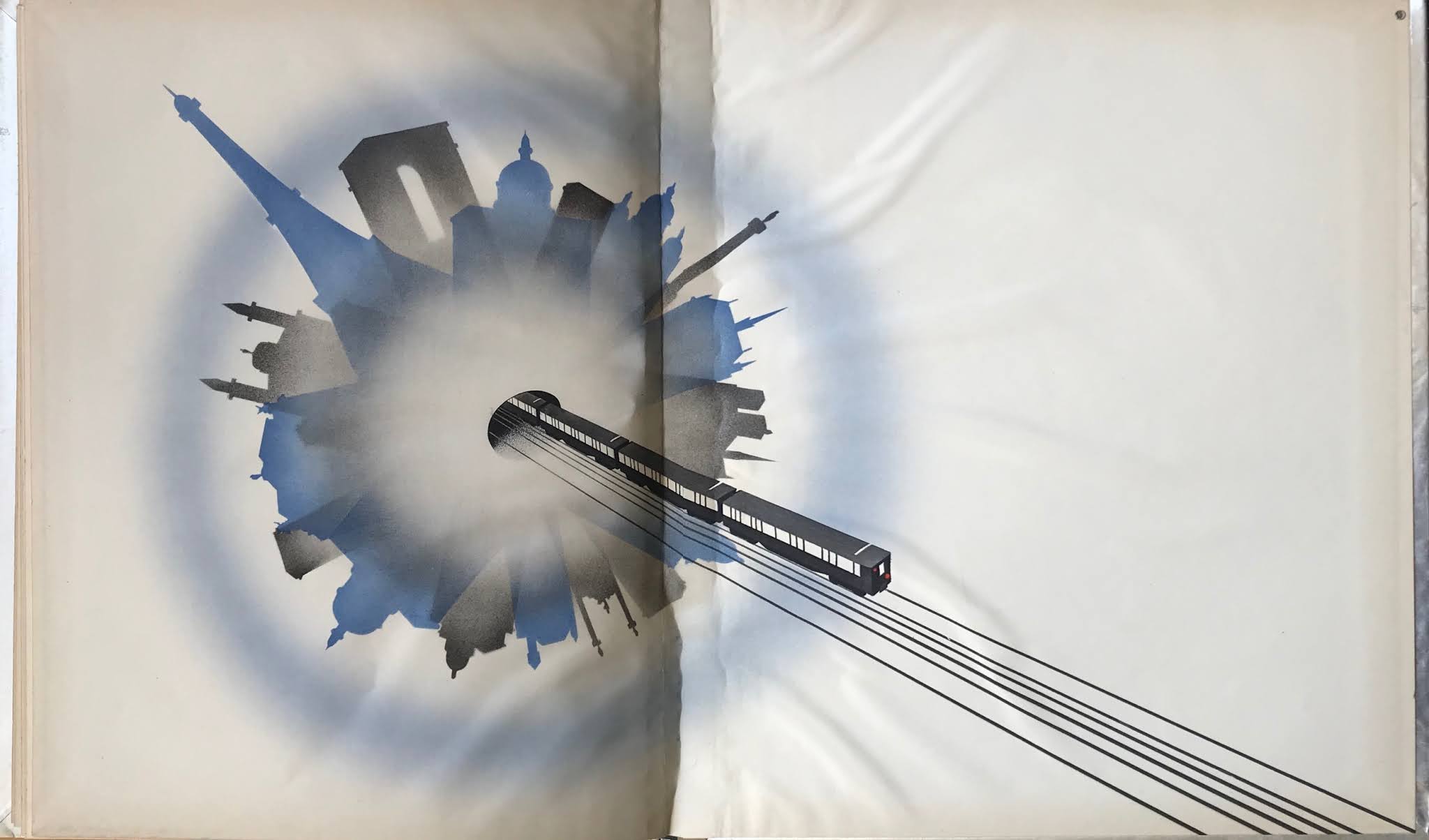
The public relations staff at the Paris Métro got swept along in the general fervour and marked the occasion with a lavish presentation book proclaiming the wonders and achievements of Parisian public transport, expensively packaged within a metallic finish board cover.  Inside were tipped-in reproductions of specially commissioned paintings of Métro-related subjects and tables of statistics demonstrating the superiority of the Métro over its international rivals. The endpapers were graced with air-brushed Art Deco-styled imagery of the Métro in action that added to the air of luxury the publishers were striving for.  It was not something to be casually handed out to the general public but almost certainly reserved for honoured guests, foreign diplomats and senior officials as a corporate souvenir gift.


Tuesday, 19 January 2021

Bridges of Paris: 1 Viaduc d’Austerlitz

While most Paris Métro lines (with the notable exception of line 6) burrow underneath the Seine, line 5 crosses over the Seine between Quai de la Rapée and Quai d’Austerlitz by courtesy of the graceful Viaduc d’Austerlitz, a single arch steel bridge built in 1904, slender in appearance but rich in decorative ironwork.  On the north bank the bridge approach is via a curving steel ramp that lifts the tracks to the required height. At the other end the bridge extends over the Quai d’Austerlitz and the roadway before plunging into the roof space of the Gare d’Austerlitz - the only terminal station in Paris where the Métro platforms are situated above the station rather than safely interred beneath.  The view from downstream includes glimpses of the clock tower at the Gare de Lyon and the offices of RATP, the nerve centre of Parisian public transport.  There are houseboats tied up alongside the Quai d’Austerlitz - in an early series of The Spiral, the stocky figure of the eternally compromised Gilou (aka Escoffier) could be seen there, going aboard for a critical meeting with an organised crime boss to whom he would offer his services as an informer from inside the police.

Jean-Camille Formigé (1845-1926) designed the bridge with the engineer, Louis Biette. Formigé is no household name but he left a distinctive mark on the city around the turn of century.  He designed the Pont de Passy (1905) and the extended viaducts that supported Métro line 2 on its aerial sections through northern Paris. His taste for decorative moulded reliefs can be seen on all these structures. The nautical themed coat-of-arms for the City of Paris with its anchor and trident, is stretched and extended and draped with fronds of seaweed and undulating fish, then repeated at intervals across the Viaduc from the main arch to the balustrades.  Robustly carved bulls’ heads surmount the stonework of the massive abutments to amplify the sense of structural strength.