It was in Detroit that Aretha Franklin mastered the art of gospel singing in her father’s New Bethel Baptist Church. In 1930 Charles Sheeler painted Ford’s River Rouge Complex transforming it into an Industrial Acropolis for the Twentieth Century. Frida Kahlo and Diego Rivera were welcomed to Detroit by Edsel Ford in 1932 where Rivera would paint the Detroit Industry Murals. In 1943, John Lee Hooker began working in a Ford Factory in Detroit, part of a massive migration of African Americans from the Jim Crow South drawn by the prospect of working for Alfred Sloan, Walter Chrysler or Henry Ford. Vast fortunes were made in the auto industry in the decades when Detroit was America’s fastest growing city. Smokey Robinson met Berry Gordon Jr in 1957 - two years later Motown Records was founded by Gordy. Left wing activism in the late 1960s saw the formation of the White Panther Party, one of whose founders, John Sinclair, poet and Marxist provocateur, became manager of the MC5 - a notoriously raucous band of musicians whose repertoire was aggressively anti-capitalist. Today they would be written off as Cultural Marxists - their demise in 1972 was every bit as rapid as their brief but explosive ascent to fame. An attentive reader may have noted how the roll call of cultural references stalls almost two generations ago - a sad consequence of the creeping disconnect from popular culture that afflicts all but a few as the decades pile up. Only Eminem and The White Stripes have penetrated my general ignorance and their achievements have no place in my personal Pantheon where the gates slammed shut many years ago.

History caught up with the city with a succession of blows - the decline of heavy industry, the Twelfth Street Riot of 1967, rising unemployment with the contraction of the auto industry leading to depopulation of an already racially segregated city as departing white homeowners deserted the city for the outer suburbs. All of which contributed to an unenviable reputation for urban decay which was crowned in the 1990s when the abandoned relics of lost industry became a kind of rust-belt theme park for urban explorers whose glamourised photographs of dereliction would go on to fill a library of coffee table books.

Detroit was home to a pioneering producer of early colour postcards. Formed in the 1890s, the Detroit Photographic Co. (later renamed Detroit Publishing Co.) developed an enormous photographic archive of North America based on photographs taken by William Henry Jackson. A large proportion of them were landscape subjects that stylistically mostly conformed to the prevailing Pictorialist code which prioritised compositional balance and atmospheric values. But Jackson’s natural curiosity drew him toward more vernacular subject matter, including the urban environment, street photography, industrial and workplace subjects and portrait studies of Native Americans, Asian Americans as well as the local inhabitants encountered on his journeys, all photographed in high definition. Postcard versions were printed in often vivid colour via the Photochrom process and marketed across the nation from the base in Detroit. In the years preceding World War 1 the company enjoyed much success selling a product that was markedly superior to that of its competitors. But a wartime slump in sales combined with the development of new and cheaper printing technology left the company struggling to compete and it went out of business in 1924. The Detroit archives remain mostly intact and have been extensively reprinted in recent years, notably by Taschen whose oversize volume, An American Odyssey, inflates the images across 600 pages to breathtaking effect. There are just two examples of the work of the Detroit Publishing Co. in this selection.

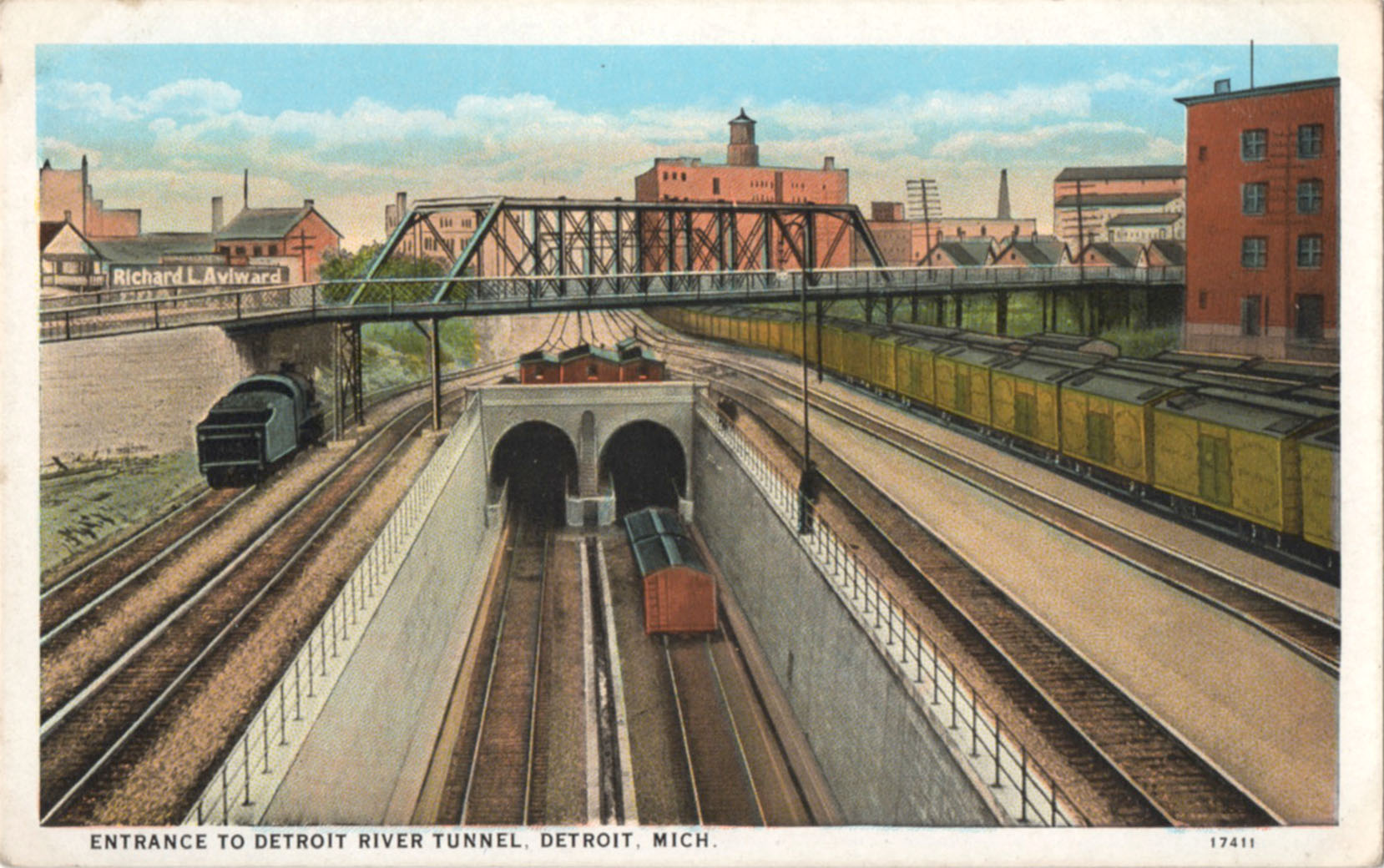
The rise and fall of Detroit lay in the future when these postcards were published. They’ve been selected to evoke a largely pre-industrial city where respectably dressed young girls could launch their model sailboats on to a tranquil lake in the park - a place where thousands would flock to the park for an evening concert. A world of gentility where the good citizens could take the air as they stroll along the canal bank in a city park with distant views of factory chimneys - a premonition of the industrial giant in the making. Women in unfeasibly large hats were welcome to dine in the basement Selfserv in the Daniel Burnham designed Majestic Building while outside in Woodward Avenue streetcars still passed every 60 seconds. Visitors to Palmer Park could admire the hollowed-out Spruce Log with its bear cage and adjacent office space. A fleet of pleasure steamers offered cruises on Lake Michigan to a variety of destinations while Canada could be reached via a passenger ferry. Any spare dollars could be deposited at the Wayne County Savings Bank.


The nostalgic country song “Detroit City” was a hit for singer Bobby Bare in 1963 - it expressed the longing of a disenchanted Southern exile in Detroit dreaming of a return to the land of the cotton fields. A sentiment that resonated just as deeply with African American performers - Ray Charles, Solomon Burke, Arthur Alexander and Joe Tex would all record their own versions.