Eric Fraser designed and illustrated this ad for Guinness for publication in the summer of 1951 - the year of the Festival of Britain on London’s South Bank. A gallery of Victorian seaside characters has been assembled in a nostalgic exercise, celebrating the past. A curiosity of the Festival iconography is the prevalence of Victorian associations and imagery in an exercise designed to embrace the excitement of the future. Most of these stereotypes have long receded into history but the Masher is still with us, though he has swapped the promenade for the manosphere and the dating app. The Punch and Judy Man and the Pierrot were key players in the world of seaside entertainment - a major activity in the first half of the last century, rapidly moving towards extinction by 1951. The concealed charms of the Bathing Belle had given way to a new era of exposure and the prudish Bathing Machine (beach hut on wheels, usually horse-drawn) had long since performed its final trundle along the English foreshore. Producers of vintage postcards captured all these characters at the height of their powers - some examples are posted below. Often they are incidental captures, minor parts of a much broader picture but occasionally a more imaginative photographer will focus on the documentary detail. The Masher was a figure of fun and more likely to turn up on hand drawn illustration postcards. This selection starts at Hastings with a Punch and Judy show of modest dimensions, then moves on to Scarborough, Millport, Clacton and other resorts where Pierrots and Minstrels take to the stage, to be followed by some more generic examples. In another post, the Masher and the Bathing Belle will be considered.
Tuesday, 30 June 2026
Sunday, 27 October 2024
Seaside Photographer at Work
Between the wars every seaside town and resort would have at least one photographic business that specialised in selling visitors their photographic likenesses. With large plate cameras they would record the departure of every charabanc tour and have prints of the participants ready for them to purchase on their return. Others would haunt the esplanades and deck chairs taking photos on spec in the hope of selling prints later. Often they would hand a docket to their subjects with a reference number and an address where the finished prints could be purchased. Another strategy was to gather the largest possible crowd of trippers at a point where a camera could record the scene from an elevated position. They were then directed to a nearby shop where prints were on sale in less than hour. The legal right to a week’s paid holiday was only established by the Holidays with Pay Act of 1938 but since the 1870s major employers had been closing factories and mills annually for a week enabling the workforce the luxury of an unpaid summer holiday commensurate with whatever they had saved during the winter. So there was no shortage of customers for the photographer’s services and photos like this must survive in hundreds of thousands if not millions.
What’s especially fascinating is the high definition that the plate camera supplied, leaving us with images that reward close scrutiny with remarkable clarity of detail. A rich variety of physical types and expressions turn up alongside a wealth of information about contemporary fashion trends. I counted only 16 hatless adults in this image. This camera confronts a mostly happy multitude of holidaymakers, it’s undated (the time is inscribed as 6.45pm) but on the reverse is the address of a Bournemouth photographic studio by the name of Bailey. Bournemouth with its origin as a Spa resort cultivated an image of respectability reflected in its Invalid’s Walk and the Russell-Cotes Art Gallery while they made the most of endorsements from the likes of Thomas Hardy and JRR Tolkien. Many proud fathers, often in collar and tie, hold their offspring high for the camera and there’s an air of prosperity apparent in many other faces suggesting that the middle class is well represented here. These aren’t the sort of people you might see on a Jarrow Hunger March.
A few details are selected here - faces that jump out of the crowd, some that are almost instantly recognisable, others that look like nobody we’ve ever seen before. There’s no lack of traditional British grumpiness to be seen but there’s also an impressive level of equanimity and good cheer - testament to the healing powers of a day at the seaside. These were the last decades of White British domination - pre-diversity Britain. After the war this would begin to change and a new and very different pattern of ethnicity arrived on the scene. People who came to Britain because Britain had come to them.
Sunday, 30 August 2020
Postcard of the Day No. 101 - Aquatic Frolics in the Wannsee
The normal relationships of scale we would expect to see in a spatially coherent composition are not to be found here in this postcard image of the Wannsee in Berlin. It’s more of a collage than an integrated image in which incongruities of size and disposition undermine our ability to fully conceptualise the visual (mis)information. It’s a paradox that German postcard producers famous for exacting high standards of printing should produce clumsy, slapdash assemblages of clip art in such numbers. That apart, it must be conceded they are not without a certain naive charm.
The Wannsee is a recreational and bathing centre located in the south western suburbs of the Berlin, popular with city residents. The distinguished artist Max Liebermann built himself a lakeside country home in 1909. In 1930 the influential silent film People on Sunday was filmed there. Later, in 1942 the Wannsee Villa hosted a gruesome gathering of Nazi bureaucrats, presided over by Heydrich and Eichmann with the aim of finalising arrangements for the Final Solution.
In Malo-les-Bains the photographer has captured a remarkable instant of documentary realism. The eye is drawn to the right where a Burt Lancaster lookalike embraces a pair of athletic bathing belles. In the centre a group of mostly moustachioed males try with varying degrees of success to join in the celebratory mood. On the left is a living caricature of rotundity, his ample contours amplified by the unflattering horizontal stripes that protect his modesty. A few more examples of immersion or part-immersion follow. None are from the UK - Brits were reluctant swimmers in this era, preferring to congregate, bare foot but fully dressed, on the tideline, with sullen and disconsolate stares directed at the cold grey sea that surrounds their sceptred isle.
Tuesday, 9 January 2018
Postcard of the Day No. 90 – Houlgate, La Plage
Wednesday, 7 October 2015
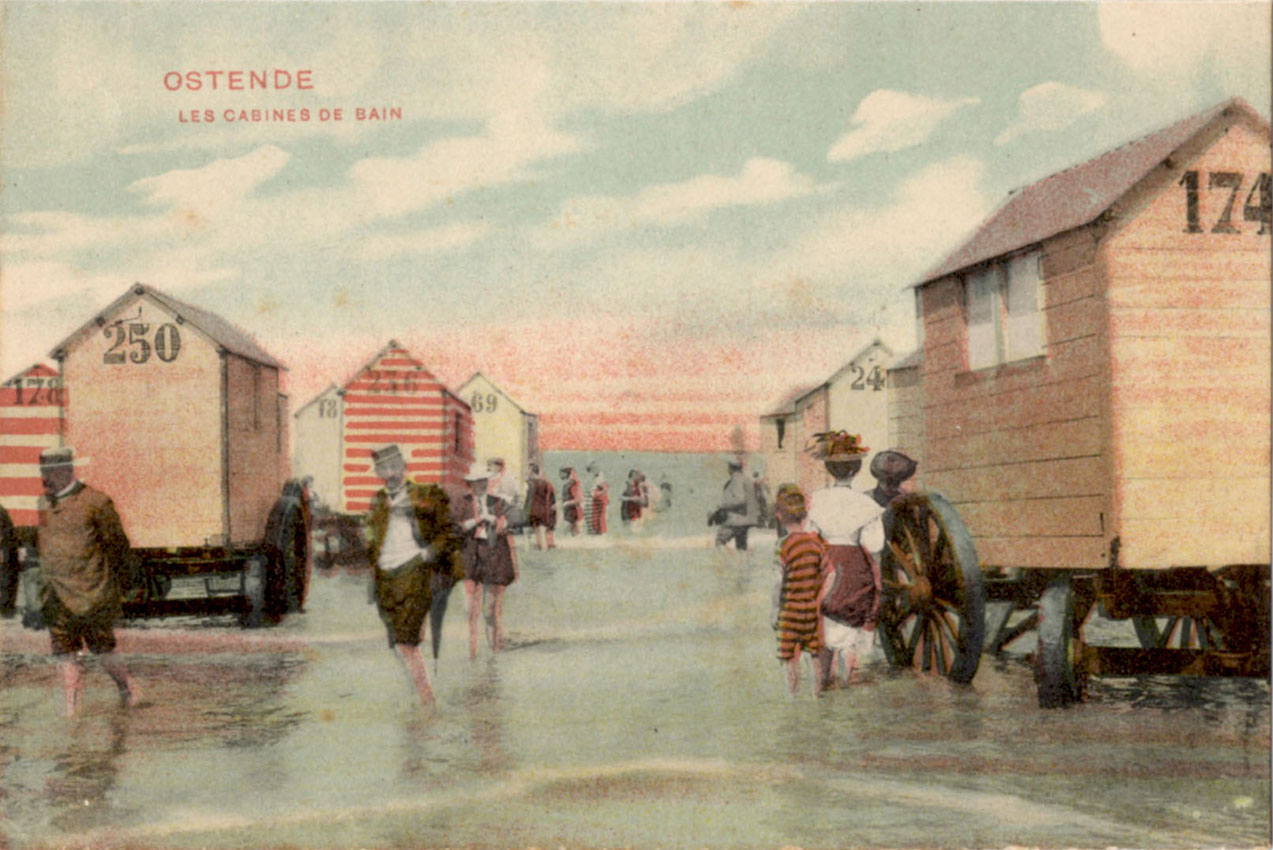
The Visual Delights of Belgian Beach Huts
Wednesday, 12 May 2010
Postcard of the Day No. 36, Cliff House

This postcard is a backward glance to a vanished landmark – its destruction being announced in the caption. It may also reflect a certain adaptability on the part of the publisher, anxious to dispose of a large volume of otherwise redundant postcards. The Cliff House has a complicated history that can be seen in a handy slideshow version by following this link. The hotel that burned down in 1907 was the most spectacular incarnation – a towering Victorian extravaganza that appeared to project forward into the mighty swell of the Pacific. Completed in 1896 to replace a predecessor that was incinerated in 1894, it was to last for little more than a decade. Despite its brief existence, the quality of confidence and conceit in the original conception has ensured it remains an object of lasting fascination. For the last hundred years it has survived in truncated form with a succession of makeovers, some of which can be seen in the cards below.


Sunday, 25 January 2009
Les Baigneuses de Boulogne

An unseasonal trip to the sea in the company of this fine group of females, enjoying the hard-won freedom to immerse themselves in seawater. Unintimidated by the climate of prudery represented by the bathing machines encroaching from behind, they confidently make the most of their day in the sun, presenting their best faces to the camera. The bathing machines could be the advancing army of the guardians of public decency, outraged by this display of immodesty. Travelling westwards to le Touquet, we encounter a group of young, smartly dressed, adolescent males taking the air with a certain swagger at the water’s edge. Another group have taken control of a small boat, grounded on the sand, and stare wistfully in the direction of the breaking waves and the open sea with a hunger for adventure. In the postcard universe, the crashing of the waves is silenced and the sea breezes are stilled, but the colour and light, the surface textures, and the sheer sensation of time and place remain marvellously preserved.