Showing posts with label metroland. Show all posts

Friday, 12 March 2021

My Travel Book

Middle class children growing up in the first half of the last century could be assured that at least one of their Christmas or birthday gifts would be a children’s annual. Many of these formulaic publications offered gender specific entertainment in the form of short stories of little merit but much moral instruction. Others aspired to be educational, dealing with subjects commonly thought to be healthy pastimes or appropriate studious topics. A diet of lawn tennis, nursing and dog grooming was provided for girls while boys could indulge their fantasies about imperial adventure among primitive tribes, every kind of excellence on the sports field or testing their skills at the wheel of a sports car. In turn the concerned parent or relative could depend upon the absolute avoidance of vulgarity on every page. Their characteristics are succinctly described by Chris Mullen at Visual Telling of Stories - his conclusion that the reading experience was a long downhill journey from the gaudy attractions of the brightly coloured boards, via the frontispiece and some dull explanatory text all the way to a series of increasingly nugatory illustrations in pen printed on the coarsest of paper stock, holds good for almost every example. Fractious and ungrateful children would actively resist these attempts to nurture their intellects and avenge themselves by drawing and scribbling across the pages in colour pencils, pens and wax crayons. Their sense of satisfaction with their efforts would only have been intensified if they had been around decades later to witness the fury their vandalism would arouse in the hearts of bookdealers as they saw their margins evaporate at the sight of a single overwritten page.
Today’s example, My Travel Book is no exception to the general rule. The cover illustration is a triumphant success in grabbing attention - precision in drawing, thoughtful graphic simplification and vibrant colour, all making for a dynamic composition. The repetitive rhythm of the ship’s funnels pushes its way up into the text block while the diagonal energy of the onrushing train is a thrilling visual counterpoint. Hand-drawn lettering gives the design a distinct flavour of Thirties art deco - especially in the second line where the up-stroke of the uppercase A rests on the baseline of the L and E. The journey into the book is a slow decline - the frontispiece (a Metropolitan Railway electric train) is a fresh and breezy evocation of the sunlit hedgerows and hills of Metroland. Next is a cutaway drawing of the inner workings of a similar locomotive, lacking the annotation that might have led to greater understanding. There’s a further dip when we come to the anecdotal illustrations of a country station platform bearing the signature of Savile Lumley (1876-1960), a stalwart of the children’s annual. The colour is insipid, the trains are generic but the accessorising of the upper middle class children is well observed and it’s pleasing to see their confidence in addressing the lower orders. There are two further shipping-related colour plates, sloppily drawn and coloured by the same casual hand and the book peters out with a few desultory pages about airships and bi-planes.
The pictorial excursion into Metroland is another excuse to write about this book - I’m old enough to have travelled behind these electric locomotives in the early 1960s from Rickmansworth, where home was on the Cedar’s Estate, into Baker Street and beyond. The locomotives were built by Metropolitan-Vickers in 1922-23 and soldiered on until 1961 when electrification reached Amersham and new build trains replaced them. Such visual charm as they possessed lay in their anachronistic appearance, reminiscent of bulky pieces of Edwardian furniture from Waring and Gillow. Their duty had been to convey a pin-striped army of bankers, lawyers, company directors and bureaucrats from the pastures of Metroland to their dusty offices in the City and West End. Observing these creatures on their daily migration could be rewarding, especially the lengths to which they would go to avoid acknowledging the existence of their fellow travellers. Many had been born in the reign of Queen Victoria and survived two world wars. Fraternisation with strangers would have compromised their natural reserve - anyway there were pipes to be smoked and crosswords to be completed. Seating was arranged in separate compartments with no internal corridor, something that commended itself to Metrolanders of a predatory disposition whose victims could only escape unwelcome attention by hurling themselves on to the tracks at high speed.

Wednesday, 5 February 2014

Destination Southgate


The centre of cultural life at the grammar school I was privileged to attend was located somewhere between the rugby scrum and the parade ground where members of the school Cadet Corps were prepared for the task of inheriting the earth. Cruelly, nature had ill-endowed me for chasing the oval ball and lacking the temperament for square-bashing, I gave my time to more effete pursuits including the study of architecture via the pages of Bannister-Fletcher and J M Richards. A book that I spent many hours browsing was Richards’s Pelican paperback Introduction to Modern Architecture where I learned about such wonders as the Gardner Warehouse in Glasgow and the Cité Radieuse in Marseille. I’ve written before about the strange power of this modest book to shape my preferences and another example was the inclusion of Charles Holden’s Arnos Grove tube station (above). The photograph of Arnos Grove was one I kept returning to, comparing its pristine Modernist lines with the ramshackle (Moor Park, which then still had wooden platforms) and drearily suburban cottage specimens (Chorleywood and Rickmansworth) to be seen in my corner of Metroland. But although it was only 20 miles from home there was never any compelling reason to visit that part of North London. 


From a contemporary perspective the partnership of architect and administrator that existed between Charles Holden and Frank Pick at London Transport in the 1930s seems both miraculous and anachronistic and I finally went to see for myself the legacy of this creative collaboration. Miraculous in the excellence of design and the consistency of vision at every level. Anachronistic in the way that it was a product of a high-minded sense of public duty, simplistically caricatured as the patronising art of knowing what’s best for people and imposing it upon them without regard for their views. The difference was that Holden and Pick were designing to meet the needs of all Londoners – not just a minority of the wealthiest and most influential. 


Charles Holden designed a spectacular low-rise cylindrical station building for Southgate, like a spacecraft touched down on a roundabout – an affinity enhanced after dark by the concealed lighting round the cornice and the concentric rings of a lighting beacon on the station roof that glows with the promise of the power of future technologies. Even after 80 years the conceptual clarity of design retains its excitement. The clean flowing lines have been protected by a Grade II* listing at English Heritage (that includes all surface buildings, platforms and escalators) and careful stewardship on the part of Transport for London. The street level interior is illuminated by a glazed clerestory and a central steel column supports the roof. Passengers ascend via escalators into an airy and elegantly curved interior enhanced by vertical and horizontal tiled surfaces. 


Arnos Grove is another Holden design, listed by English Heritage in 2011 at Grade II* and featuring a tall brick built drum with vertical glazing surmounting the station. Like Southgate and others, it was designed to function as a prominent landmark and succeeds triumphantly whilst maintaining a strong sense of dignity and restraint. The lofty ticket hall interior complete with fluted central column offers a generous sense of space for public circulation. Holden drew inspiration from Scandinavian architecture, adapting the style of large public buildings to the more modest proportions of local stations while resisting any compromise on quality or detail. 


The story of Frank Pick’s all-embracing commitment to design excellence has been told elsewhere but Southgate and Arnos Grove offer a great opportunity to experience the full impact of how this worked. The northern extension to the Piccadilly Line in 1930-33 was enabled by a government loan guarantee scheme for construction projects to relieve unemployment while planners and developers built large new housing estates to expand the market for the new service. This level of co-ordination seems impossible to achieve in the age of PFI and outsourcing. While Crossrail is a stunning engineering project, there is no associated planned approach to any industrial or residential development that may follow. 


Sunday, 24 June 2012

Watford in Three Lines


Félix Fénéon (1861-1944) was an intriguing character who at one point in his career had a day job as a senior civil servant in the Ministry of War that he somehow combined with an active involvement in anarchist causes. Under another hat he wrote as an art critic noted for his enthusiastic support of Neo-Impressionism and the work of Seurat, Signac, Luce and Pissaro. In 1906 Fénéon was employed by Le Matin newspaper in Paris to entertain readers with a selection of stories from the day’s news rewritten in condensed form. An anthology drawn from the total of 1200 was published in translation in 2007 under the title, Novels in Three Lines

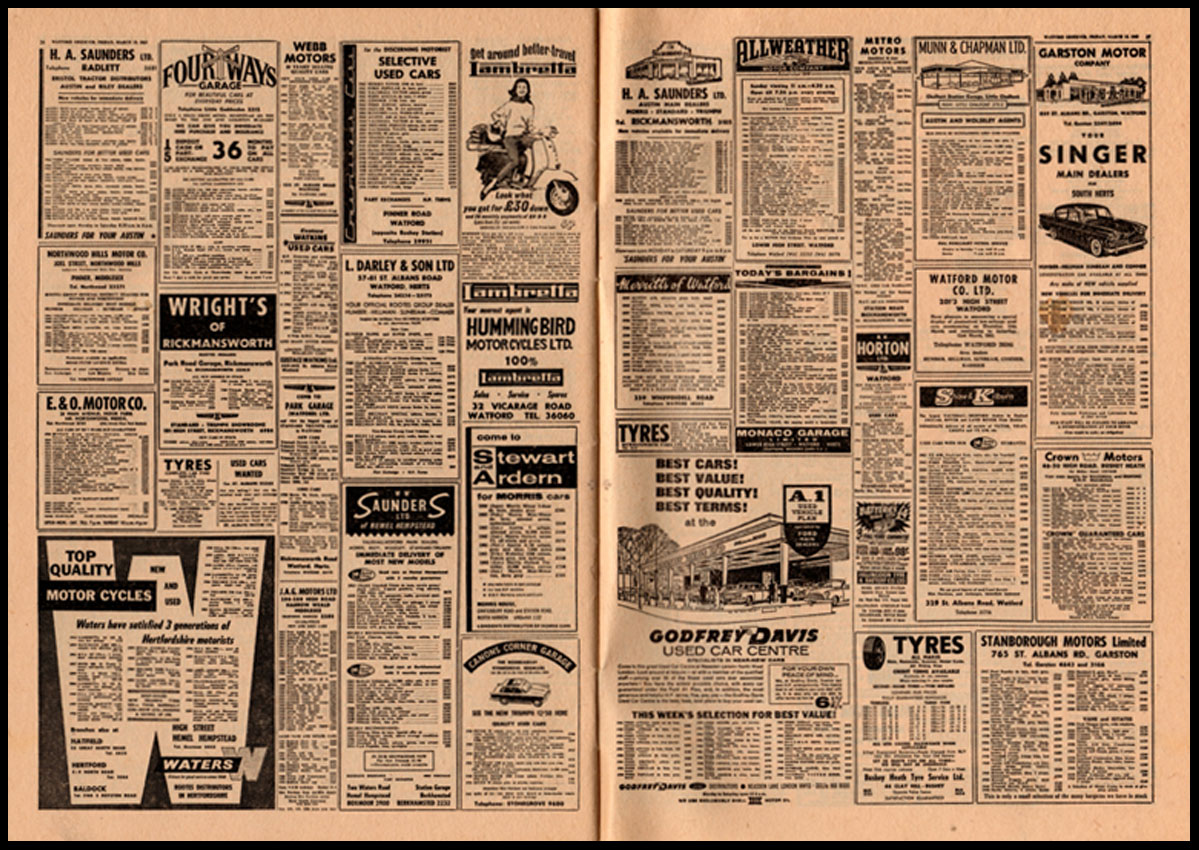
A recent discovery deep in the archive of this miniature newspaper (West Herts and Watford Observer) from March 15th. 1963 is a voice from a time when JFK was in the White House and Macmillan was in Downing Street. The back pages are full of employment advertisements for genuine full-time jobs in manufacturing. And Cliff Richard and the Shadows are performing at the local Gaumont. The news pages produced a rich harvest of dispatches from the foothills of Metro-land that seem to lend themselves to the Fénéon treatment and ten examples are presented below. 

Speaking of their 16 year old daughter, parents told a court that they had done everything for her but she had been a continual nuisance up to and including leaving the family home to live with a 20 year old man with whom she had been intimate. 

After a number of false starts, identical twin ginger haired brothers in late adolescence separately travelled by air to overseas destinations at the expense of the Royal Air Force. 

An aversion to abusive language induced a publican to arrange for a customer to be forcibly ejected from his premises. The said customer’s head impacted upon the pavement with such force that his earthly existence was terminated. 

A conscientious intruder successfully forced entry into six homes at consecutive addresses in the same street for the purpose of relieving the occupants of their most valuable possessions. 

Approaching the end of a lifetime of sorting letters and hand painting a collection of 1,000 model soldiers Mr. Harold Marsh was presented with an Imperial Service Medal by the Assistant Head Postmaster. 

Informed that he would be charged with dangerous driving and excessive speed, a van driver expressed his disappointment and requested the police officer to charge him with any offence but that. 

Noted for his ability to recall seeing swans wandering daily in search of food, Mr. Oscar Rees Gibbon died at the age of 93. For 53 years his home had been in Bushey Heath during which it had lost its rural character. 

The sum of £2 was extracted from Martin Card by way of punishment for his impudence in trespassing in search of game on land held in the possession of the Earl of Dudley who did not take kindly to this sort of behaviour. 

A performer who spoke not a word on stage during his act gripped the imagination of his club audience to such an extent that members were in turn reduced to a most untypical condition of prolonged silence. 

His second wife was a sister of his first but even the amputation of a leg in Cape Town was insufficient to extend his life beyond the age of 79, although he had in the past impressed many of his acquaintances with his intellectual stature. 


Tuesday, 22 September 2009

Liberty, Peace and Plenty


Most of the traffic that exits the M25 at Junction 17 passes by the ancient country lane that leads to Heronsgate. Those who venture on to Long Lane will find that in less than a quarter of a mile they will pass the site of the first Chartist settlement, planned and developed by Feargus O’Connor in 1846-47. There’s no better place to observe the dreams and aspirations of the Victorian working class smothered by suburban affluence. The dream was that working men and their families could exchange the tyranny of factory labour in the great industrial cities for a life of self-sufficiency on the green and fertile acres of rural Hertfordshire.


O’Connor bought the land (named it O’Connorville) and divided it into 35 plots of between 2 and 4 acres. A single cottage was to be constructed on each plot and the tenancies were allocated by ballot. The intention was that the conscientious application of spade husbandry would win sufficient produce from the soil to enable the honest workingman to support himself and his family. Fifteen single storey cottages and ten pairs of semi-detached two storey dwellings were built and ready for occupation in 1847. Lanes of 9 feet in width were laid out on a grid and for the avoidance of homesickness, named after the great industrial centres the settlers had left behind – Bradford, Stockport, Halifax and Nottingham.


The great agricultural adventure got off to an uncertain start. The weather was unkind and the settlers, more used to the factory floor, struggled with a lack of experience. In an impressive demonstration of the universal truth that governments will always find it easier to fund the regulation of benefits than to fund the benefits themselves, an inspector was appointed by the Poor Law Commissioners to ascertain whether the settlement was likely to become a burden on the local parish rates. After a good nose around he happily named and shamed the fledgling community as a failure. As O’Connor became entangled in a web of legal complications followed by bankruptcy and mental illness, matters began to unravel at Heronsgate. There was a rapid turnover in tenancies and the settlers began to pursue other lines of work to make ends meet. O’Connor’s National Land Company was compulsorily wound up and in 1860 the plots were auctioned off. Only a tiny minority of the original settlers remained.


Gentrification began in the 1880s when the addition of extensions to many of the cottages combined with demolition of others and their replacement by larger dwellings more suited to the generous plots, attracted the professional classes to the area. The arrival of the Metropolitan Railway at nearby Chorleywood accelerated the process as a daily commute to Baker Street and the City became possible. Croquet lawns, stables and servant accommodation soon covered the Chartist acres to be followed later by the tennis courts and swimming pools that can still be seen today. Remarkably, in amongst this a dwindling band continued to cultivate the land, the last such enterprise, a chicken farm, closing in the late 1950s.


The verdant residential character of the area was fully established during the 1980s and recent decades of material prosperity have enhanced the sense of exclusivity that prevails. The surrounding woodland seems to absorb most of the noise pollution from the M25 although it’s a surprise that Iain Sinclair did not include it in the itinerary for his London Orbital exploration. Distinguished former residents include Clement Attlee, who lived here during the last war and Kim Philby, who was resident in the early 1950s, prior to the accusation that he was the infamous third man. Almost all this information comes from Ian Foster’s excellent book (Heronsgate, 1999), acquired on a visit to the highly recommended Land of Liberty, Peace and Plenty that stands on the opposite side of Long Lane in outright denial of the Chartist ideal of temperance.

Saturday, 13 June 2009

Further Adventures in Metroland


My sister got married in the late 1960s and her new father-in-law was the eminent poet, critic and Professor of English, William Empson. The union between Suburbia and Bohemia was celebrated with a reception in the lovingly manicured garden at my parents’ house on the Cedars Estate, built by the Metropolitan Railway alongside the tracks between Rickmansworth and Chorleywood. William and his wife, Hetta, had guided their elderly Alvis (Hetta at the wheel) all the way from Hampstead via the badlands of Harrow and Pinner to arrive in a place that could hardly be further from their comfort zone. I was quite impressed that the author of Seven Types of Ambiguity (a book that formed part of the English syllabus at school) and a close acquaintance of George Orwell was taking a turn, drink in hand, around our garden. It must be conceded that the flow of conversation between the two tribes was far from unstoppable and in an unusual move for him, William filled an awkward silence by observing, in a clipped but genial tone, “Well, here we are in Metroland!”


Again, I was impressed. I hadn’t been aware that the untidy and tediously familiar ribbon of ancient small towns and overgrown villages tied together and developed by the Metropolitan Railway was in any way deserving of a collective noun. At the same time I realised that the journey of William and Hetta from the sophistication of NW3 to the social conformity of Outer Suburbia may have been short in miles but in cultural terms it was positively inter-galactic. There are two directions in which this could proceed. One would take us deeper into the adventures of William and Hetta in Suburbia, the second would take us further into an exploration of Metroland.


On balance, I favour the second option. The concept of Metroland was an inspired invention of the Metropolitan Railway Company, a marketing device to persuade the nation’s captains of industry to settle in the Metropolitan corridor and patronise the commuter trains that would transport them to the City of London with the minimum of fuss. The picture painted in the publicity was intensely pastoral in tone, replete with purple prose descriptions of the rustic delights in store for the newly arrived citizen of Metroland. If the thought of living alongside village smithies, dairymaids and shepherds had lured our captain of industry, he would have a strong case for being the victim of a false prospectus. The winding country lanes, lined with rampant hawthorn hedgerows and the patchwork of pastures smothered beneath carpets of wild flowers existed more in the imagination of the advertising copywriter than in reality.


Nevertheless the neat lines of semi-detached dwellings on tree lined roads, the half timbered parades of shops and the larger detached homes, hidden in their own grounds carried more than an echo of the Arts & Crafts tradition of domestic architecture. Incomes increased with the distance travelled from Baker Street and a migratory pattern emerged as Metrolanders relocated from Wembley to Pinner and all points north-west as they climbed the corporate ladder. The lucky few would make it as far as Wendover or Great Missenden before retirement. This version of Metroland is the one that John Betjeman mythologized in his 1973 television documentary. With distance lending enchantment, Betjeman’s Arcadian vision of an agreeable mixture of innocent English eccentricity and anachronistic architecture became fixed in the public consciousness. This was the high point in the reputation of Metroland, in another 10 years the M25 would be complete and create a new vector that would bisect Arcadia and open up new opportunities for travel along its north-south axis.


The last few decades have seen a massive increase in population and vehicle traffic. Planners have had to consent to a wave of destruction of substantial homes to free up space for multi-dwelling developments. Owners of green-field sites have fought tooth and nail for residential approval. Agricultural land has given way to stables, kennels and catteries, garden centres and hobby farms. All the lethally contaminated water retrieved from the site of the Buncefield oil terminal explosion and fire at Hemel Hempstead is in storage in Rickmansworth waiting for science to come up with a viable detoxification process. Despite all this, the outlines of the original Metroland dream are still there to be seen, a fading memorial to an ingenious marketing experiment. And there remains a small band of enthusiasts who keep the dream alive.

Wednesday, 9 July 2008

Metroland on the Water


The Grand Union Canal follows the Colne Valley and passes through Rickmansworth, pearl in the oyster of Metroland, on its journey to Birmingham. The area around Rickmansworth is unusually watery, a legacy of 19th. century gravel extraction that gives the town one of its few notes of distinction. The arrival of railways rapidly diminished the revenue potential of the canal and its survival is almost exclusively as a leisure facility.


The canal banks are home to a linear community of a marginal character completely unlike the rest of the town which is commuter belt par excellence. The residents of the converted narrow boats and floating homes belong to a very different world from their near neighbours occupying sprawling residential estates of 4-5 bedroom detached homes. They have no space to park 4 by 4’s or executive cars and no large gardens to mow and weed and strim into submission. What they do instead is to colonise small pockets of land adjacent to the towpath and create modest flower gardens with outdoor seating areas. They use bicycles for overland travel and to the casual observer their environmental footprints are a fraction of that of their neighbours.


This is a territory where improvisation and eccentricity prevails. Some boat owners succeed in maintaining an uncluttered appearance and a high standard of decoration and trim. At the other extreme, some vessels are an agglomeration of miscellaneous shapes and forms haphazardly attached to something close in spirit to a floating contractor’s shed with patio doors. All this variety provides the visual pleasure to be enjoyed by the towpath flâneur.


The M25 is only 2 miles away and crosses the canal a few miles to the north at King’s Langley. In terms of environmental impact, it’s difficult to conceive of a greater contrast. The motorway is a raucous, convulsive, snarling corridor of road rage and particulates. The canal is an unfrequented, insulated ribbon of serenity and its continuing existence is certainly something to celebrate.