Showing posts with label belgium. Show all posts

Wednesday, 27 October 2021

Brussels Midwinter

Scenes from the wintry streets of the Belgian capital just after the war, part of a batch of found photographs taken by a British serviceman on duty in Northern Europe.  They make an interesting record of the city in painful transition from war into peace.  Powdery snow gathers between the cobblestones and freezes in the gutters while pedestrians hunch up against the cold. The swastikas have been burned and the streets are free of the emblems of occupation. Commercial life is returning and the trams are running.  There are posters on display in the Place de Brouckère for Un Bal Surréaliste at the Academie du Beaux Arts (Salle de la Madeleine) on February 8th. - a frivolity that could never have happened under occupation. With privately owned vehicles in short supply, traffic is light and there are long queues at the tram stop. Some landmark buildings can be identified including the Monumental Palais de Justice and the Hotel Metropole (which closed in 2020). The photographer has composed with care and discovered unexpected poetry in the near deserted cobbled streets dusted with snow.


Friday, 9 July 2021

John Hassall - Poster King

John Hassall is having a moment.  There’s a comprehensive exhibition of his work at the Heath Robinson Museum in Pinner (ending on August 29) accompanied by a new book, The Life and Art of the Poster King by Lucinda Gosling (Unicorn, 2021).  This recognition is long overdue - there has been a persistent reluctance on the part of museums to exhibit the work of graphic artists whose output fell, for the most part into the category of what used to be called commercial art.  The sense that the association of art and advertising is unworthy of close study never quite goes away, along with the gulf in status between Fine Art (engages the higher faculties) and Advertising Art (vaguely disreputable, appeals to the coarser instincts). Curiously as state patronage of the arts declines the art world has been forced into an ever closer funding relationship with the world of business and finance whose tolerance for sponsoring work that questions their activities often wears thin resulting in hidden pressures to focus on work that more closely aligns with corporate interests.  In this context the straightforwardly transactional nature of the work of artists like Hassall can seem less compromised.

The book is superb - the author has unearthed some rarely seen items and chosen to display in depth rather than showcase prime (and often over-familiar) examples. The selection of thumbnail images is generous and judicious and gives a much better impression of the range of Hassall’s output than I’ve ever seen before. Two column text blocks and visual material are well balanced and make for clarity of design. Pictorial boards, illustrated endpapers and a stitched-in bookmark make an excellent package and the absence of a dust-wrapper is something to celebrate.  Hassall’s productivity was a match for Tom Purvis and some of his drawing has the toughness and muscularity of that of Purvis.

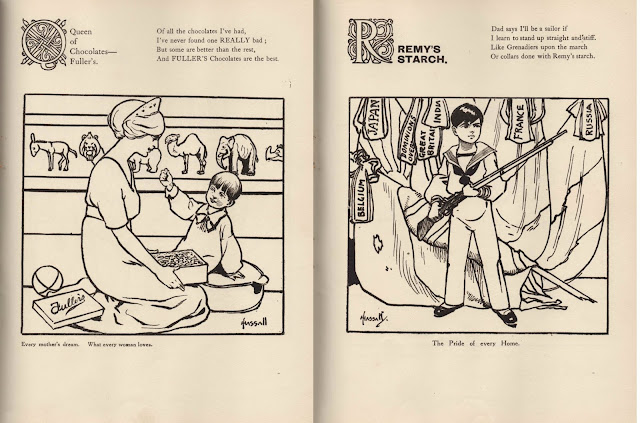
Hassall produced all the artwork for this colouring book for children in support of the Belgian Relief Fund in 1914.  The Belgian nation has never been so popular with the British public as it was in the first year of the Great War.  An intensive propaganda campaign in the popular press, demonising the German invaders for the ruthless cruelty inflicted on the civilian population created a great wave of public sympathy, of which this publication was one manifestation.  It is striking to see the extent to which it combined philanthropy with commercial interests - every page had a business sponsor whose consumer products were publicised in Hassall’s drawings in the hope that their virtues would be embedded in young minds as their clumsy brushwork stuttered across the page.  It was presented as an alphabetic sequence with accompanying versification.  Allusions to military campaigns can be found but for the most part the patriotic note is one of restraint.  Given the audience, images of children predominate and the war is very much off stage. None are especially memorable with the possible exception of the sturdy British youth who poses defiantly in his Pesco underwear with hairbrush at the ready, fully prepared to die for King and Country.




Wednesday, 1 March 2017

Crossing the Border – Herbesthal


There was a time when border disputes were a frequent trigger for international conflict. But things move on and we now live in a time where borderline enforcement is the highest priority. To mark the new era of immigration control and wall-building we present a series of vintage postcard views of frontiers beginning with the highly contested border between Belgium and Germany. In 1843 Herbesthal, then in Prussia, became the world’s first international border crossing station when the railway connecting Aachen and Liège opened to traffic. Queen Victoria and Prince Albert passed through in 1845 on a visit to their relatives. For over a century the business of examining documentation, collecting customs duties, changing locomotives and crews kept the station active and local people in employment. Station facilities expanded rapidly to cope with the growth of passenger and freight traffic and in 1890 one of Europe’s major mail sorting centres was opened in a new 5 storey building alongside the station. Herbesthal had become what we now call a communication hub. 

On the eve of the First World War, Stefan Zweig was travelling from Oostende, after one of his many holidays there, on the last train from Belgium to Germany. It was standing room only and German officials came on board at Verviers, the last Belgian station. The next station would be Herbesthal but Zweig’s train was held up while an almost continuous wave of freight trains passed in the opposite direction. Even in the darkness it was easy to see beneath the tarpaulins, the sinister forms of artillery and military vehicles. On arrival at Herbesthal, Zweig wandered the platform in search of news and discovered it to be completely occupied by German troops. By this time he was in no doubt that he was an eye-witness to a German invasion of Belgium “in defiance of the statutes of international law.” On his return to Vienna, Zweig succumbed to a brief efflorescence of pan-Germanic patriotism, attempting to enlist without success and writing in praise of the Belgian invasion he had observed for himself. By 1917 he was in temporary exile in Zurich, energetically campaigning for the pacifist road to peace.


In the post-war settlement in 1920, Herbesthal became a Belgian town until it was forcibly reabsorbed into the Reich in 1939. In 1945 it reverted to Belgium where its former importance as a border crossing was soon to disappear with the railway being re-routed some 200m. south via Welkenraedt when the line was electrified in 1966. Despite their proximity, Welkenraedt is a Francophone town while Herbesthal remains a German speaking community. This is a link to an image of all that remains of the station at Herbesthal. Previous posts on this subject can be seen by following this link.

Wednesday, 15 June 2016

Postcard of the Day No. 83 – Hôtel Normandie


The Thirties fashion for maritime themed architecture reached a kind of end point with this example from the Belgian coast at Oostduinkerke near De Panne, built in 1933 as a restaurant. Rather than borrow the sweeping curves and raking profiles associated with marine architecture this developer settled for a coarse and ill-proportioned parody of an ocean liner complete with replica funnels. There’s a long and honourable tradition of this attention seeking, novelty design in the United States where B 52s or diplodocus masquerade as gas stations and drive-ins take the form of donuts and frankfurters – sometimes known as Roadside Vernacular. Without the great American wide open spaces, European planners are wary of architecture that functions as self-promotion making this a rare exception. Ever the opportunist, the restaurateur adopted the name of the French liner Normandie when it entered service in 1937. It can still be seen through the windows of the passing Kusttram between De Panne and Oostende where we photographed it on a wet day last September.


Friday, 30 October 2015

Rembrandtlaan – an Arts and Craft suburb in De Haan


De Haan is a small select resort on the Belgian coast developed in the late 19th. and early 20th. century and laid out in conscious imitation of English town planning. Unlike the grid patterns that prevail in neighbouring resorts De Haan has a network of informal winding streets with a large circular open space in the centre. Outsize villas and hotels, mostly in the Style Normand, occupy the town centre with residential suburbs to the north-east and south-west where the street names honour great artists and writers. Rembrandtlaan is a short street that follows the route of the Kusttram (coastal tramway connecting De Panne and Knokke) in which all the homes were designed by the Ghent based architect, Valentin Vaerwyck (1882–1959) and built in 1924-27. In style these modest, unassuming houses seem to be Flemish rural vernacular meets post-war suburbanised Arts and Crafts. Hips, gables, dormers, ridge tiles, arrowslits and painted shutters set the tone. Privacy and cosiness are the priorities. The Sundial House (Zonnewijzer) was Vaerwyck’s own personal holiday home. An extensive list of buildings designed by Vaerwyck can be seen by following this link – he had a hand in designing the imposing railway station at Oostende, a full-blown exercise in French Classicism.


Thursday, 15 October 2015

Paul Delvaux – Surrealist in Suburbia


One of the attractions of the Kusttram (Belgian coastal tramway) is the Paul Delvaux Museum at Sint-Idesbald. Appropriately located in the depths of respectable suburbia the museum occupies a former hotel in which almost all the gallery space is to be found below ground level. A generous selection of paintings and drawings is on display together with a full size re-creation of the artist’s studio. Bric-a-brac from the Delvaux personal collection – skulls and skeletons, scale model trams and trains, plaster casts and props – supply context for the artworks in which they frequently appear. Although Delvaux is routinely described as a Surrealist painter, his association with the Belgian Surrealist group centred on Magritte, Mesens and Scutenaire was brief. The frequent boisterous jeux d’esprit that occupied the Belgian Surrealists held little appeal for the introverted and unsociable Delvaux for whom painting was very definitely a solitary pursuit. Constant repetition of a limited range of subject matter (nudes, classical ruins, skeletons, trains and trams) made him an easy target for their scorn.


The Delvaux imagination seems largely formed in adolescence - ancient steam locomotives and vintage electric trams journey without end through the artist’s imagination while in another cranial region wide-eyed young women disrobe to reveal slender limbs and pallid flesh. Elsewhere characters from childhood immersion in the science-fiction of Jules Verne haunt the adult imagination. Delvaux orchestrates these disparate elements into a single compositional fantasy often under cover of darkness. What Delvaux took from Surrealism was the freedom to develop a repertoire of dream-like imagery that integrated a lifetime obsession with trams and trains (a legacy of an introverted childhood) with a taste for unclothed or semi-naked female forms (an expression of erotic anxieties) set against the Palm Court architecture of the Belle Époque or the ruins of Classical civilisation (imprinted on the artist’s consciousness as an architectural student). In finished paintings Delvaux’s universe of dreams was a frozen and lifeless place where the spatial organisation of forms was slightly off-key while the forms themselves were rigid and highly stylised. His drawings and water-colour sketches show a fluency and confident mastery of proportion and spatial relationships that is excluded from the paintings.


Having made his breakthrough he seemed content to continue recycling familiar themes. Genuine menace is rare in his work – gently disturbing or puzzling is more often the case. But there are instances where he achieves something more profoundly unsettling as with “La Gare Forestière” where the bustle of a busy railway station is silently and incomprehensibly transposed into the depths of a woodland glade. The enigmatic figures of two girls observe the scene. Their faces are turned away from us but we can imagine their perplexity and sense of wonder. At his best he finds some genuine poetry and disquiet in the twilight scenes where all seems suspended indefinitely between life and death.