Showing posts with label exhibition. Show all posts

Wednesday, 14 August 2024

Harold Harvey, painting everyday life


This summer’s exhibition at Penlee House, Penzance was devoted to the paintings of Harold Harvey, the only Cornish born artist associated with the Newlyn circle of painters led by Stanhope Forbes and Laura and Harold Knight.  Harvey was an accomplished constructor of convincing figure compositions, ever alert to the awkwardness, discomfort or tension in the individuals portrayed.  Small social gatherings and domestic scenes were minutely observed and described in detail with particular attention to choices of clothing and facial expressions.  Furnishings and decorative accessories in the home came under similar scrutiny. The work of the intensively observed fishing fleet held little interest and he saw the world of the countryside through the lens of manual labour.  Most Newlyn painters ignored the industrial aspect of Cornish life, unwilling to confront the violence done to the local landscape by the activities of extractive industry, notably the excavation of China Clay and the mining of tin and copper.  Distractions of the modern world of popular entertainment and the transport revolution were studiously avoided by almost all local artists but Harvey kept returning to these subjects throughout his career.  Several of his finest paintings - featuring sunbathers and swimmers, girls outside the cinema, travellers on the top deck of a bus - were a product of this fascination.


His figure drawing was uneven in quality, lacking the bravura of Laura Knight or the conviction of Stanhope Forbes, flabbiness kept creeping in. In the 1930s, under the influence of contemporary trends (Stanley Spencer?), he cautiously experimented with figure distortion and elongation to especially good effect in the bathers painting (August 1939).  Two conflicting tendencies can be seen in his use of colour where a preference for clear, vibrant hues applied with firm, controlled brushwork existed alongside a drift into more pastel hues and softer, Renoir-influenced application of paint.  The latter technique being more apparent in portraiture, especially of child subjects.  The key element in his subject choices is his local origin - incomers and outsiders fell heavily for the most picturesque features of Cornish life (fishing, farming and a ravishing coastline in dazzling sunshine).  For Harvey these aspects were taken for granted and he rarely turned to them.  His eyes were focused on a localised experience of everyday life - the domestic middle class interior, the world of work and manual labour, the arrival of mass tourism. Inside the home he was an acute observer of the enigmatic gesture, the unusual body posture and the ambivalent glance, sometimes hinting at an underlying disquiet or noting the vagaries of fashion and the faintly absurd.  Friends and acquaintances described him as affable and good natured, though somewhat taciturn.  In later life he converted to Catholicism but nothing of his spiritual life made its way into his work which remained resolutely materialist.


Wednesday, 28 February 2024

The Fabric of Democracy: Propaganda Textiles

An intriguing exhibition at the Fashion and Textile Museum in Bermondsey provides a snapshot of the role of the visual arts in time of conflict.  When national survival is at stake everything must make a contribution to the war effort. Collective values come into play as even the most socially exclusive artists and designers strive to make a difference - nobody wants to be accused of lacking in patriotism.  There’s a change of tone from hauteur to something more demotic - extravagance is no longer acceptable while raising public morale is a new priority.  Working under this new set of constraints the fashion industry falls back upon formal simplicity, classic elegance and a colour palette that’s light, bright and uplifting. Textile designers responded with fabric prints devised around patriotic messages and texts displayed in jaunty settings.  Other nations were involved including a strong collection of kimono prints from Japan - more bellicose in their imagery but more refined in their visual language.


Monday, 9 October 2023

Art of Society 1900-1945, Neue Nationalgalerie Berlin

Z VIII, Lászlo Moholy-Nagy (1924)


Of all the paintings in this exhibition, this was the one that held my attention the longest.  Its connection with the exhibition theme was not immediately obvious but it was a singular point of calm in a line-up of loud and assertive paintings demanding serious scrutiny.  Looking at an abstract arrangement of related geometric forms in muted colours  makes it own demands - principally that the viewer is prepared to accept its legitimacy as a work of art and not worry about the absence of figuration.  While there’s not much of a case to be made for overlapping and intersecting semi-transparent shapes as windows into the human condition they can be a rich source of visual pleasure when choreographed with sensitivity and precision. All his career Moholy-Nagy was a restless experimenter and this is one of a series of related compositions painted in his second year of teaching at the Bauhaus where he replaced Johannes Itten who together with Paul Klee represented the spiritual tendency of the early years Bauhaus.  Moholy-Nagy had no such tendencies and took full advantage of the opportunity to button himself into his boiler suit and get to work in his studio.  This painting comes at the high point of his interest in Constructivism-inspired composition - he would continue to explore his favoured themes (transparency, asymmetry, dynamism, spatial ambiguity, transformation) in photography, collage, assemblage, typography and graphic design.  Constructivists sought to integrate their practice into state-led programmes to advance social progress and eliminate inequality which finally connects us back to the exhibition theme.


Stadt, Otto Moller (1921)


Elsewhere in the exhibition, which was drawn from the collection of the Neue Nationalgalerie, artists could be seen engaging with major themes - Weimar-era decadence, Prussian militarism, socialist utopianism, horrors of modern warfare, dehumanising labour. This is a personal selection of paintings that caught my eye - Expressionist paintings are given short shrift, ships, trams and trains keep turning up and there’s a bias towards unfamiliar (on my part) material.  It was interesting to see so many disturbing visions of the not so distant past, a period whose first hand witnesses are almost all deceased.  And a comfort in the sense that the visions of the artists who shared in the collective experience of the chain of catastrophes that stains the period under review, still have a part to play in the avoidance of a reprise.


Walter Spies, The Carousel, 1937


Natalia Goncharova, The Clock


Upper is Leger, lower is Edmund Kesting, Rote Sichel, 1927


Otto Dix


Heinrich Vogeler


Heinrich Vogeler


Heinrich Vogeler


Paul Fuhrmann, Am Bahnhof (1930)


Oskar Nerlinger, The Early Train (1928)


Franz Radziwill, Der Hafen II (1930) 


Christian Schad


Franz Radziwill,  Flandern (Wohin in dieser Welt?), 1940-50


Alice Lex-Nerlinger, Field Grey Creates Dividends (1931/1961)


Lyonel Feininger


 Carlo Mense, Double Portrait (Rabbi with Young Woman) 1926

Friday, 7 October 2022

Kugelhaus Dresden

On the north side of Dresden Hauptbahnhof on Wiener Platz there’s an unexceptional low rise modern office block in which is embedded a tribute to one the city’s great lost landmark buildings - the Kugelhaus.  Designed as a spherical building by Munich architect, Peter Birkenholz for the 1930 International Health Exhibition in Dresden’s Grossen Garten park.  Inspired by the unbuilt visions of Claude-Nicolas Ledoux it was quickly adopted as an emblem of the city and hosted a series of exhibitions of technology and engineering.  By the mid-1930s as the novelty faded, it fell out of favour.  Maintenance was expensive and the recently ascendant Nazis took exception to it.  When an operator could not be found it was demolished in 1938. It was Dresden’s misfortune that it fell under the control of an especially brutal Gauleiter, Martin Mutschmann.  The preservation of traditional Saxon arts and crafts was Mutschmann’s obsession when he wasn’t occupied with matters of torture and execution, suggesting he was even less receptive to Modernism than the average Nazi.  It remains the case that spherical buildings always come with problems and often have a short life. Had it been spared by the Nazi culture warriors, it would have been very unlikely to have survived the Allied firestorms of February 1945.  There’s an additional tribute to the Kugelhaus in the form of a spherical cinema in the lobby of the Volkswagen Transparent Factory which now stands on the same spot.


Tuesday, 23 February 2021

Paris Métro 1931

Every decade in the first half of the 20th. century one or other of Europe’s colonial powers would mount an exhibition to celebrate and legitimise their imperial dominions and plunder.  The principle audience was a domestic one but it also offered an opportunity to remind rival powers of France’s global reach.  Years of planning and a purpose built exhibition building was essential to do justice to the scale of the colonial project and L’Exposition Coloniale opened in May 1931. A subsidiary aim of the exhibition was to portray the French colonial presence as enlightened and benign as if colonial subjects were almost equal partners in a global French nation.  We may look back and see a shaming exercise in imperial condescension and national self-aggrandisement but that’s not how the French public would have seen it.  For them it was a powerful reminder of France’s high standing as an international player.  Reinforcing patriotic values at a time when a gathering economic crisis was threatening the stability of a nation rapidly fracturing into political extremes of Right and Left.  Outdoor exhibits were displayed in the Bois de Vincennes and a more scholarly presentation of indigenous arts and crafts was housed in the newly constructed Palais de la Porte Dorée, about which we posted in February 2015.


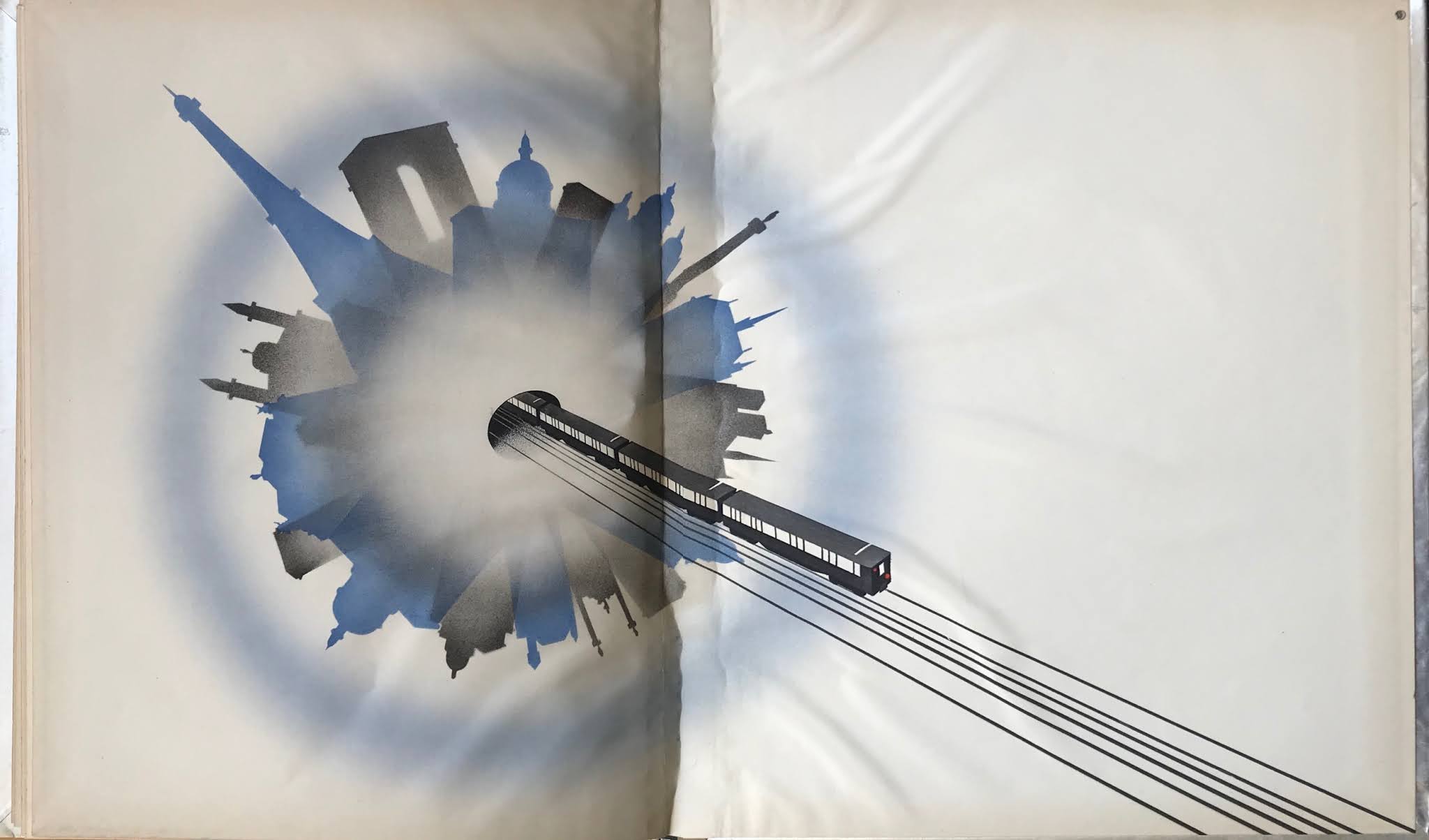
The public relations staff at the Paris Métro got swept along in the general fervour and marked the occasion with a lavish presentation book proclaiming the wonders and achievements of Parisian public transport, expensively packaged within a metallic finish board cover.  Inside were tipped-in reproductions of specially commissioned paintings of Métro-related subjects and tables of statistics demonstrating the superiority of the Métro over its international rivals. The endpapers were graced with air-brushed Art Deco-styled imagery of the Métro in action that added to the air of luxury the publishers were striving for.  It was not something to be casually handed out to the general public but almost certainly reserved for honoured guests, foreign diplomats and senior officials as a corporate souvenir gift.